
NEW
Font size
 Worksheets
Unit 3.3: Evolution and Origins of Life 23/24
Total questions: 44
Worksheet time: 22mins
According to the primordial soup model, how were biological molecules synthesized from simple molecules in Earth's early atmosphere?
Through exposure to sunlight
By reacting with volcanic gases
Through the cooling of the Earth's crust
By reacting with electricity
Why were only anaerobic organisms able to survive on Earth 3 billion years ago?
Because the Earth was too hot for aerobic organisms
Because there was an abundance of oxygen
Because there was no oxygen in the atmosphere
Because the Earth was covered entirely in water
What is the Chemical Evolution Theory based on?
The idea that life was brought to Earth from outer space
The assumption that on primitive Earth, a mixture of chemicals synthesized simple organic molecules into more complex molecules
The belief that life has always existed on Earth in some form
The theory that life started in the deep sea vents
What was the first type of cell to appear on Earth according to the text?
Eukaryotic cells
Protists
Marine Cyanobacteria
Mitochondria
What is the significance of marine Cyanobacteria in the evolution of life on Earth?
They disproved spontaneous generation.
They were the first eukaryotic kingdom.
They released oxygen into the atmosphere.
They were the first cells to contain mitochondria.
According to the endosymbiotic theory, what is the relationship between mitochondria, chloroplasts, and primitive bacterial cells?
Mitochondria and chloroplasts were once independent multicellular organisms.
Mitochondria and chloroplasts were once primitive bacterial cells.
Mitochondria and chloroplasts were the first eukaryotic cells.
Mitochondria and chloroplasts were the first cells to perform photosynthesis.
What did Francisco Redi's experiment demonstrate?
Microorganisms come from the air.
Life can come from non-living material.
Spontaneous generation of life from non-life is not possible.
Oxygen is necessary for the generation of life.
What did Louis Pasteur's experiment show?
Microorganisms can grow without oxygen.
Microorganisms are spontaneously generated from meat.
Microorganisms come from the air.
Life can spontaneously generate under the right conditions.
What was the environment like on Earth before the appearance of photosynthetic cyanobacteria?
Oxygen-rich
Radioactive
Anaerobic
Full of eukaryotic cells
What is evolution?
The process by which species lose genetic adaptations to the environment
The chronological collection of life's remains in rock layers
The process by which species come to possess genetic adaptations to the environment
A species that no longer exists
What are fossils?
A species that no longer exists
Structures that have similar functions, but different structures
Preserved remains or markings left by organisms that lived in the past
Similar structures in species sharing a common ancestor
What are fossil records?
The process by which species adapt to the environment
Structures that have similar functions, but different structures
A species that no longer exists
Chronological collection of life's remains in the rock layers
What does it mean if a species is extinct?
It has evolved into a new species
It has left a large number of fossils
It is a species that no longer exists
It has similar structures to other species
What are homologous structures?
Structures that have similar functions, but different structures
Preserved remains of organisms from the past
Similar structures in species sharing a common ancestor but now have different functions
Chronological collection of life's remains in the rock layers
What are analogous structures?
Structures in species sharing a common ancestor but now have different functions
Structures that have similar functions, but different structures, not a sign of close common ancestors!
Preserved remains of organisms from the past
Chronological collection of life's remains in the rock layers
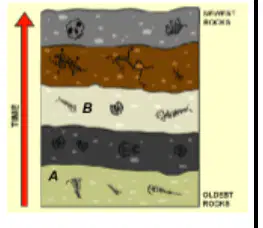
Which fossil would be older, the fossil found in layer A or the fossil found in layer B?
The fossil in layer A
The fossil in layer B
Both fossils are the same age
It is impossible to determine which fossil is older without more information
What is the term used to describe the evolutionary process where species share a common ancestor but have different functions in their structures?
Extinction
Analogous evolution
Descent with Modification
Fossil record adaptation
What are vestigial structures?
Structures that are fully functional in modern descendants
Remnants of structures that may have had important functions in ancestral species, but have no clear function in some of the modern descendants
New structures that have evolved recently
Structures found only in embryonic stages
What does embryology study?
The study of vestigial structures
The molecular history of evolution in DNA sequences
The development of gametes, fertilization, and development of embryos and fetuses
The universal genetic code
What is the significance of molecular comparison in evolutionary biology?
It helps to identify vestigial structures
It is used to study the embryonic stages of vertebrates
It is used to read molecular history of evolution in the DNA sequences of organisms
It is used to prove that the genetic code is not universal
Why is the genetic code considered nearly universal?
Because protein synthesis is different in each living organism
Because each organism has a unique set of DNA coding for proteins
Because protein synthesis is a similar process in all living things, with a segment of DNA coding for the same protein in all living organisms
Because vestigial structures are found in all living organisms
Why do we use the same codon chart to translate messenger RNA to amino acids for ALL living organisms?
Because the genetic code varies greatly among different organisms
Because each organism has its own unique codon chart
Because the genetic code is nearly universal
Because only vestigial structures are coded by the same codons in all organisms
What is the Biological species concept based on?
The ability of organisms to survive in different habitats
The ability of organisms to produce excessive numbers of offspring
The ability of a population or group of populations to breed with one another and produce fertile offspring
The separation of populations due to geographic changes
What is a gene pool?
A group of organisms that live in the same place at the same time
The range of different inherited traits within a species
All of the alleles in all the individuals that make up a population
A reproductive barrier that keeps two different species from interbreeding
Why is genetic diversity critical for a population?
It ensures that all species produce excessive numbers of offspring
It allows a population to adapt to changing environments
It keeps different species from interbreeding
It helps individuals survive and reproduce
What is reproductive isolation?
The process by which descendants of ancestral organisms spread into various habitats
The ability of individuals to survive in their environment
A reproductive barrier that keeps two different species from interbreeding
The separation of populations due to behaviors
What does geographic isolation result from?
Different breeding seasons
Geographic change or dispersal leading to geographically isolated places
The range of different inherited traits within a species
The ability to produce fertile offspring
What did Charles Darwin refer to as "fitness"?
The ability to produce excessive numbers of offspring
The separation of populations due to geographic changes
The organism's ability to survive and reproduce
The process by which descendants of ancestral organisms adapt to diverse ways of life
What is "Descent with Modification" according to Darwin?
A reproductive barrier that keeps two different species from interbreeding
The process by which descendants of ancestral organisms spread into various habitats and accumulate adaptations
The ability of individuals to survive in their environment
The separation of populations due to geographic changes
A pride of lions is at its strongest when its family members are fast, strong and larger than other lions. These characteristics are generally found in every strong group (pride) of lions. What process most likely led to the increased strength and speed of lions today?
Genetic drift
Bottleneck effect
Natural selection
Founder effect
What is the process called that favors characteristics in a varying population that fit the specific current, local environment?
Genetic Drift
Natural Screening
Adaptive Evolution
Natural Selection
What is the term used to describe the differences in traits among members of the same species, such as hair color, eye color, or beak shape?
Genetic Variation
Genetic Drift
Trait Diversity
Variation
What is the smallest level at which evolution can occur?
Organism
Ecosystem
Population
Species
What is gene flow?
The process where mutations occur in DNA
The exchange of genes with another population
The decrease of genetic diversity due to random changes
The mating dances of birds of paradise
What usually influences non-random mating?
Genetic drift
Migration of fertile individuals
Physical appearance or behavior
Random changes in genetic material
How does gene flow affect genetic diversity?
It decreases genetic diversity
It has no effect on genetic diversity
It increases genetic diversity
It only affects the genetic diversity of peacocks
What are mutations?
Changes in DNA that decrease genetic diversity
The exchange of genes between populations
Random changes in genetic material that lead to genetic variation
Non-random mating behaviors
How can mutations affect the genetic diversity of a population?
They decrease genetic diversity by causing genetic drift
They increase genetic diversity by changing available genes in a gene pool
They have no effect on genetic diversity
They prevent new traits from appearing within the population
What are hominids?
Animals that walk upright on four legs
Primates that walk upright on two legs
Reptiles that walk upright on two legs
Mammals that walk on all fours
What is a significant evolutionary development that distinguishes modern humans from their common ancestors with modern gorillas?
Bipedalism
Quadrupedalism
Larger cranial capacity
Smaller jaw size
What is the effect of bipedalism on the evolution of modern humans?
It led to a divergence in the evolution of humans and gorillas.
It caused humans to develop a larger jaw size.
It decreased the cranial capacity in modern humans.
It resulted in humans and gorillas sharing more common features.
What was the first modern human trait to evolve according to the general trend in hominid evolution?
Tool use
Bipedalism
Increased brain size
Decreased jaw size
As a result of bipedalism, what were hominid hands now free to do?
Swing from trees
Create and use tools
Walk on all fours
Support larger brain size
What is a significant effect of the change from quadrupedalism to bipedalism in hominids?
Longer toes (big toe splayed)
Chest more barrel-shaped
S-curved spine
Protruding jaw

