
 Worksheets
Unit 114 'electron theory'
Total questions: 45
Worksheet time: 23mins
What is electricity simply the movement of?
Protons carrying energy
Atoms transferring charge
Electrons carrying energy
Molecules creating light
What can electrons transfer as they move along a conductor?
Only electrical charge
Only heat
Some of their energy into other forms such as heat, light or movement
Only light
What do all electrical devices like light bulbs, televisions, and phones have in common regarding their operation?
They use different power sources
They operate without using electrons
They all harness the movement of electrons to do work
They create energy independently
What does conventional current assume in terms of the direction of current flow?
Current flows from the negative terminal to the positive terminal through the circuit.
Current flows out of the positive terminal, through the circuit, and into the negative terminal of the source.
Current does not flow through the circuit; it only flows within the source.
Current flows in a random direction, independent of the terminals.
What actually happens in electron flow?
Electrons flow from the positive terminal to the negative terminal through the circuit.
Electrons flow out of the negative terminal, through the circuit, and into the positive terminal of the source.
Electrons do not flow through the circuit; they only move within the source.
Electrons flow in a random direction, independent of the terminals.
What type of current always flows in the same direction?
Alternating current (AC)
Direct current (DC)
Static current
Variable current
What is the type of current you get from the power company?
Direct current (DC)
Alternating current (AC)
Static current
Battery current
In an AC circuit, how does the current behave?
It flows in one direction only
It diminishes over time
It reverses direction periodically
It increases in strength
What is the simplest atom?
Oxygen
Carbon
Hydrogen
Nitrogen
What is the charge of an electron?
Positive
Neutral
Negative
Variable
What charge does the proton in a hydrogen atom carry?
Negative
Neutral
Positive
Variable
How many protons and electrons does the simplest atom of hydrogen have, as per the learning material?
1 proton and 2 electrons
2 protons and 1 electron
1 proton and 1 electron
2 protons and 2 electrons
How many protons does a copper atom have?
28
29
30
31
What is the relationship between the number of protons and electrons in an electrically neutral atom?
The number of protons is more than electrons
The number of electrons is more than protons
The number of protons is equal to the number of electrons
There is no specific relationship
How is the single electron in the outer orbit of the copper atom described?
Strongly attached to the atom
Not attached to the atom
Loosely attached to the atom
Completely detached from the atom
What happens when a material is connected across a battery?
The positive plate repels electrons, and the negative plate attracts them.
Both plates repel electrons.
Both plates attract electrons.
The positive plate attracts electrons, while the negative plate repels them.
What does the battery provide in an electric circuit?
A source of resistance
A source of electromotive force (EMF)
A source of electric charge
A source of photons
What is the resultant electron flow around the circuit called?
Electric charge
Electric field
Electric current
Electric potential
According to the electron theory, how is the direction of conventional current related to electron flow?
It flows in the same direction as electron flow.
It flows in the opposite direction to electron flow.
It is perpendicular to electron flow.
It is unrelated to electron flow.
What does current refer to in electrical terms?
Resistance to flow
Potential difference
Flow of electricity
Energy consumption
What is the unit of measurement for voltage?
Amps
Volts
Ohms
Watts
Resistance in an electrical circuit is measured in which of the following units?
Amps
Volts
Ohms
Joules
Current is measured in what unit?
Volts
Ohms
Amps
Watts
How many electrons flow through a conductor per second in 1 amp of electrical current?
625,000,000,000,000,000
6,250,000,000,000,000
62,500,000,000,000,000
625,000,000,000,000
What is voltage in electrical terms?
Voltage is the resistance to current flow
Voltage is electrical pressure and creates current flow
Voltage is the rate of flow of charge
Voltage is a type of electrical insulation
What creates a flow in the direction of lower pressure in electrical terms?
A similarity in pressure between two points
A difference in pressure between two points
A constant pressure at one point
The absence of pressure
What does resistance do to current flow in an electrical circuit?
Increases current flow
Does not affect current flow
Reduces current flow
Reverses current flow
In which unit is electrical resistance measured?
Ampere (A)
Volt (V)
Ohm (Ω)
Watt (W)
What is the relationship between resistance and current flow according to the image?
The higher the resistance, the more current that will flow
The higher the resistance, the less current that will flow
The lower the resistance, the more current that will flow
The resistance has no impact on the current flow
What is the formula to calculate voltage according to Ohm's Law?
V = I/R
V = IR
V = R/I
V = I + R
If the resistance is 240 ohms and the current is 0.5 Amps, what is the voltage?
120 Volts
480 Volts
0.48 Volts
240 Volts
Using Ohm's Law, if you have a resistance of 240 ohms and a voltage of 229.92 Volts, what is the current in Amps?
0.958 Amps
1.958 Amps
0.5 Amps
2.958 Amps
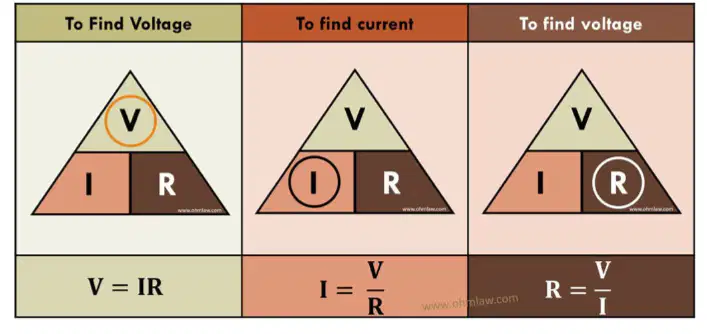
Refer to the diagram above, which triangle correctly represents the formula to find current (I)?
To find voltage: V at the top, I and R at the bottom
To find current: I at the top, V and R at the bottom
To find voltage: I at the top, V and R at the bottom
To find current: R at the top, V and I at the bottom
What is the voltage always assumed to be when calculating fuse size?
120V
220V
230V
240V
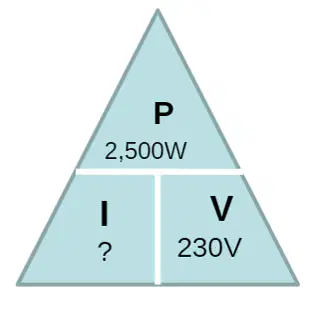
Using the Power Triangle provided in the learning material, if the power (P) is 2,500 watts and the voltage (V) is 230 volts, what is the current (I)?
10.87 amps
11.96 amps
12.50 amps
13.04 amps
What is the correct size fuse to use with an appliance that has a current of 10.86 Amps?
5 Amp Fuse
10 Amp Fuse
13 Amp Fuse
15 Amp Fuse
What is an electrical circuit?
A device that stores electrical energy
A path or line through which an electrical current flows
A tool used to measure electrical current
A type of electrical switch
What does a closed circuit allow?
It allows electrical current to flow
It prevents electrical current from flowing
It stores electrical current
It measures electrical current
What is the consequence of an open circuit?
It allows electrical current to flow more efficiently
It allows electrical current to flow without interruption
It does not allow electrical current to flow
It stores electrical current for later use
What are the main components of an electric circuit as mentioned in the learning material?
Conductors, load, power source, protective device, and a switch
Conductors, resistors, capacitors, inductors, and a power source
Wires, batteries, resistors, capacitors, and LEDs
Transistors, diodes, wires, a switch, and a battery
What is the function of conductors in an electric circuit?
To store electrical energy
To regulate the flow of electricity
To make the path through which electricity flows
To convert electrical energy into light
What is the role of one piece of the wire in an electric circuit?
It connects the load back to the power source
It acts as a protective device
It serves as a switch to turn the circuit on and off
It converts the electrical energy into mechanical energy
What material are the conductors usually made of?
Aluminum
Copper
Steel
Gold
What is the function of a switch in an electrical circuit?
To increase the flow of electricity
To interrupt the flow of electricity
To measure the flow of electricity
To store electrical energy
What happens when the switch in the circuit is closed?
The circuit is interrupted and electricity does not flow.
The circuit remains unchanged and electricity does not flow.
The circuit is completed and electricity flows.
The circuit overheats and electricity flow stops.

