wayground logo

Free Printable Worksheets

Font size

S
M
L
XL
Worksheets

Unit 3&4 Practice Q EMS, P Trends 2024 (3&4 of 6)

Total questions: 186

Worksheet time: 4hrs 49mins

Name
Class
Date
1.

Which type photon carries the most energy?

a)

Yellow Light

b)

Red Light

c)

Blue Light

d)

Green Light

2.

The speed of electromagnetic radiation:

a)

depends on the form of radiation

b)

is always 3 x 10⁸ m/s, regardless of the type

c)

decreases as distance increases

d)

is 6.626 x 10⁻³⁴ J x s

3.

We perceive various wavelengths within the visible light spectrum as:

a)

sound

b)

color

c)

time

d)

smell

4.

Which of the following is a unit for frequency?

a)

Joules

b)

Hertz

c)

meters per second

d)

seconds

5.

Light is:

a)

a star and a galaxy

b)

a wave and a particle

c)

sound and energy

d)

unable to be measured

6.

A light particle is called a(n):

a)

electromagnetic wave

b)

photon

c)

electron

d)

atom

7.

We see a "rainbow of colors" that when perceived together produce:

a)

black light

b)

white light

c)

gamma rays

d)

x-ray images

8.

which of the following emits visible light?

a)

glass

b)

a light bulb

c)

a black shirt

d)

a mirror

9.

Which has a longer wavelength?

a)

infrared

b)

ultraviolet

10.

A gamma ray photon and a microwave photon are traveling in a vacuum. Compared to the wavelength and energy of the gamma ray photon, the microwave photon has a -----?

a)

shorter wavelength and less energy

b)

shorter wavelength and more energy

c)

longer wavelength and less energy

d)

longer wavelength and more energy

11.

When wavelength increases...

a)

energy decreases

b)

energy increases

12.

A light particle is called a(n):

a)

electromagnetic wave

b)

photon

c)

electron

d)

atom

13.

Light that appears "red" to our eyes has a wavelength of...

a)

700 nm

b)

400 nm

c)

500 nm

d)

100 nm

14.

Calculate the frequency of a wave that has
a wavelength of 0.10 m.

a)

3 x 10⁹ Hz

b)

3 x 10⁸ Hz

c)

3 x 10⁷ Hz

d)

Cannot be solved

15.
An argon ion laser emits light at 488 nm. What is the frequency of this radiation?
a)
4.07 x 10⁻¹⁹ Hz
b)
6.15 x 10¹⁴ Hz
c)
1.46 x 10² Hz
d)
2.05 x 10⁶ Hz
16.
Which wave has a greater frequency?
a)
A
b)
B
17.
_____________________light is the only type of EM wave detected by the human eye.
a)
Red
b)
Gamma
c)
Microwave
d)
Visible
18.
A microwave oven emits radiation at a wavelength of 0.005 m. What is the frequency of this radiation?
a)
6.67 x 10⁻⁷ Hz
b)
2.00 Hz
c)
1.50 x 10⁶ Hz
d)
6.00 x 10¹⁰ Hz
19.
A common infrared laser operates at 1.06 x 10³ nm. What if the energy of a photon with this wavelength?
a)
7.02 x 10^-40 J
b)
6.25 x 10^-28 J
c)
3.54 x 10^-15 J
d)
1.87 x 10^-19 J
20.

What is the frequency of infrared light with a wavelength of 1.05 x 10⁻⁶ m?

a)

6.96 x 10-40 Hz

b)

2.86 x 10¹⁴ Hz

c)

9.62 x 10⁻¹³ Hz

d)

2.55 x 10⁻¹⁹ Hz

21.

What is the frequency of ultraviolet light with a wavelength of 1.24 x 10⁻⁷ m?

a)

2.42 x 10¹⁵ Hz

b)

8.22 x 10⁻³⁴ Hz

c)

3.00 x 10⁸ Hz

d)

1.04 x 10¹³ Hz

22.

A violet spectral line of an element has a wavelength of 4.2 x 10⁻⁷ m. What is the frequency of the violet light?

a)

3.00 x 10⁸ Hz

b)

6.63 x 10⁻³⁴ Hz

c)

7.14 x 10¹⁴ Hz

d)

1.04 x 10⁻¹³ Hz

23.

The distance between successive crests of a wave

a)

Wavelength

b)

Frequency

c)

Trough

d)

Distance

24.

Which of the following has the largest or highest frequency?

a)

Radio Waves

b)

Gamma Ray Waves

c)

Visible Waves

d)

X-Rays

25.

the number or amount of complete wavelengths that pass a point in a given amount time:

a)

Wavelength

b)

Frequency

c)

Waves

d)

Crests

26.

A class made a solar cooker out of a large can. What color should they paint the can in order to collect the most heat?

a)

dark green

b)

black

c)

pink

d)

white

27.

Which color of visible light has the shortest wavelength?

a)

red

b)

green

c)

violet

d)

yellow

28.

This diagram shows waves that are

a)

seismic

b)

mechanical

c)

longitudinal

d)

electromagnetic

29.

This is a wave pattern diagram for two transverse waves. How do the waves compare?

a)

both waves have the same frequency

b)

both waves have the same wavelength

c)

the top wave has a longer wavelength and the bottom wave has more energy

d)

the top wave has a higher frequency than the bottom wave

30.

Which statement best describes the relationship between visible light and the electromagnetic spectrum?

a)

visible light and the electromagnetic spectrum are different names for the same thing

b)

visible light occupies about half of the electromagnetic spectrum

c)

visible light is a narrow band in the electromagnetic spectrum

d)

visible light and the electromagnetic spectrum have a small area overlap

31.
In a vacuum, all electromagnetic waves have the same
a)
wavelength
b)
frequency
c)
speed
d)
amplitude
32.
which of the following does NOT belong in the electromagnetic spectrum:
a)
X-ray
b)
sound wave
c)
ultra violet rays
d)
microwaves
33.
Why do you see lightning from a distant storm before you hear thunder?
a)
The thunder is produced after the lightning.
b)
Your eyes react faster than your ears.
c)
Light travels faster than sound.
d)
Sound travels faster than light.
34.

Solve this problems using the equation: C = λ x ν

If an AM radio station broadcasts at 9.95 x 10² kHz, what is the wavelength of this radiation? (Convert to Hz first).

a)

6.59 x 10⁻²⁸ m

b)

1.01 x 10⁻⁶ m

c)

3.32 x 10⁻³ m

d)

301 m

35.

Solve this problems using the equation: C = λ x ν

A microwave oven emits radiation at a wavelength of 5.00 x 10⁻¹cm. What is the frequency of this radiation?

(Convert to m first).

a)

6.67 x 10⁻⁷ Hz

b)

2.00 Hz

c)

1.50 x 10⁶ Hz

d)

6.00 x 10¹⁰ Hz

36.

Violet light has a wavelength of 4.10 x 10⁻¹² m. What is the frequency?

a)

1.23 x 10 -3 Hz

b)

7.31 x 10¹⁹ Hz

c)

1.37 x 10¹² Hz

d)

3.0 x 10⁸ Hz

37.

If the brightness of a beam of light increases without changing its color, the ______ will increase.

a)

number of photons

b)

frequency of the light

c)

energy of the photons

d)

wavelength of the photons

38.

Energy can't be .....

a)

transformed.

b)

made or destroyed.

c)

converted.

d)

harnessed or produced.

39.
Light is a form of __________ energy. 
a)
Sound 
b)
Electromagnetic
c)
Fun
d)
Thermal 
40.

A beam of light has a wavelength of 600 nm in air. What is the frequency of the light (c = 3x10⁸ m/s)?

a)

5 x 10¹⁴ Hz

b)

2 x 10¹⁴ Hz

c)

3 x 10¹⁴ Hz

d)

6 x 10¹⁴ Hz

41.

Find the frequency of an electromagnetic wave with a wavelength 2.75 × 10⁻⁸ m.

a)

1.10 Hz

b)

1.09 × 10¹⁶ Hz

c)

9.17 × 10¹⁵ Hz

d)

9.17 × 10¹⁶ Hz

42.

Which of the following electromagnetic waves travels the fastest?

a)

gamma rays

b)

radio waves

c)

ultraviolet waves

d)

they all travel the same speed

43.

Mr. H catches the news on 780 AM, which broadcasts at 780. kHz. Determine the wavelength of these radio waves.

a)

3.85 x 10⁵ m

b)

385 m

c)

3.85 x 10⁴ m

d)

3.85 x 10⁶ m

44.
The relationship between wavelength and frequency is λ=c/f.  Calculate the wavelength of light that has a frequency of 5.2 x 10¹² 1/s. The speed of of light is 3.0x 10⁸ m/s.
a)
5.8 x 10 -5 m
b)
5.8 x 10 -7 m
c)
5.19 x 10 14 m
d)
1.56 x 10 23 m
45.
Solve this problems using the equation: 
C = λν
If an AM radio station broadcasts at
9.95 x 10⁵ Hz, what is the wavelength of this radiation?
a)
6.59 x 10⁻²⁸ m
b)
1.01 x 10⁻⁶ m
c)
3.32 x 10⁻³ m
d)
302 m
46.

Calculate the wavelength of light that has a frequency of 5.2 x 10¹² Hz.

a)

5.8 x 10 -5 m

b)

5.8 x 10 -7 m

c)

5.19 x 10 14 m

d)

1.56 x 10 23 m

47.

IRAS, the Infrared Astronomy Satellite launched by NASA in 1983, had a detector that measured infrared or heat radiation from different regions of space. What is the frequency of infrared light that has a wavelength of

1.10 X 10⁻⁶ m?

a)

3.67 x 10⁻¹⁵ Hz

b)

3.67 x 10⁻³ Hz

c)

2.73 x 10² Hz

d)

2.73 x 10¹⁴ Hz

48.
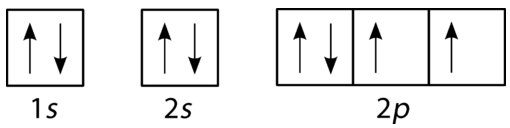
This orbital diagram represents:  
a)
C
b)
B
c)
N
d)
O
49.
This orbital diagram represents:  
a)
C
b)
B
c)
N
d)
O
50.
What is incorrect about this orbital diagram?
a)
Both arrows in the 2p box should be pointing up
b)
There is nothing incorrect with this diagram
c)
In the there should only be 1 orbital in the first 2p box and one in the 2nd 2p box
d)
All the arrows should be pointing up.
51.
 The diagram above represents two electrons with 
a)
a. opposite spins.
b)
 b. the same spin.
c)
c. different energies.
d)
d. different energy levels.
52.

Which example shows a violation of Hund's Rule?

a)

A

b)

B

c)

C

d)

D

53.
All orbitals of equal energy are occupied by one electron before any single orbital is occupied by a second electron.
a)
Aufbau principle
b)
Pauli exclusion principle
c)
Hund’s rule
d)
Core Notation
54.
An electron occupies the lowest energy orbital that can receive it.
a)
Hund’s rule
b)
Pauli exclusion principle
c)
Bohr model of the atom
d)
Aufbau principle
55.

Which of the following is written correctly?

a)

A

b)

B

c)

C

d)

D

56.

Which shows the correct orbital diagram for Cobalt?

a)
b)
c)
d)
57.

What element's orbital notation is pictured here?

a)

Ar

b)

Br

c)

Cu

d)

Cl

58.
What atom matches this electron configuration?
1s22s22p63s23p64s23d10
a)
Zinc
b)
Copper
c)
Nickel
d)
Germanium
59.
What electron configuration matches an oxygen atom?
a)
1s22s22p63s2, 3p64s23d104p5
b)
1s22s22p4
c)
1s22s22p6
d)
1s22s22p63s23p64s23d1
60.
How many electrons can the first energy level hold?
a)
1
b)
2
c)
8
d)
0
61.
The electron configuration of an atom is 1s22s22p6.  The number of electrons in the atom is 
a)
3
b)
6
c)
8
d)
10
62.
Which electron configuration belongs to Chlorine (Cl)?
a)
1s2s2p3s3p5
b)
1s2s2p3s3p6
c)
1s2s2p3s3p7
63.
This orbital diagram represents:  
a)
C
b)
B
c)
N
d)
O
64.
What is incorrect about this orbital diagram?
a)
Both arrows in the 2p box should be pointing up
b)
There is nothing incorrect with this diagram
c)
In the there should only be 1 orbital in the first 2p box and one in the 2nd 2p box
d)
All the arrows should be pointing up.
65.
Which element is pictured?
a)
neon
b)
fluorine
c)
magnesium
d)
argon
66.
Which is associated with more energy? 
a)
2p
b)
2s
c)
3p
d)
1s
67.
How many electrons can the d sublevel hold?
a)
14
b)
10
c)
2
d)
6
68.
How many electrons can the s sublevel hold?
a)
14
b)
10
c)
2
d)
6
69.
How many electrons can the p sublevel hold?
a)
14
b)
10
c)
2
d)
6
70.
Which element is pictured?
a)
neon
b)
fluorine
c)
magnesium
d)
argon
71.
Which is not true of alkali metals?
a)
Largest atomic radius in a period
b)
Smaller ionic radius than atomic radius
c)
Lowest ionization energy in a period
d)
Lowest electronegativity in a period
72.

When atom gains an electron, the size will

a)

increase

b)

decrease

c)

have no change

d)

smaller

73.

How many electrons should Boron have around its Lewis dot model?

a)

1

b)

2

c)

3

d)

4

74.
Which of the following would be higher for alkali metals than for halogens?
a)
atomic radius
b)
ionic radius
c)
electronegativity
d)
ionization energy
75.

When atom loses an electron, the size will

a)

be greater

b)

increase

c)

have no change

d)

be smaller

76.

Which of the following would have a larger ionic radius than atomic radius?

a)

Sodium

b)

Calcium

c)

Zinc

d)

Chlorine

77.
Put these in order of increasing electronegativity:
Se, S, and O
a)
Se < S < O
b)
Se < O < S
c)
O < S < Se
d)
S < Se < O
78.
Why does fluorine have a higher ionization energy than iodine?
a)
The outer electrons are farther away from the nucleus in an iodine atom, so the attraction is lower.
b)
There are more electrons in the inner shells of a fluorine atom, so the outer electrons are shielded from the nuclear charge.
c)
Actually, iodine has a higher ionization energy than fluorine because it has a higher atomic number.
d)
Iodine has more valence electrons than fluorine.
79.

Which of these is correct?

a)
b)
80.

The octet rule states that an atom will gain or lose electrons in order to have a full valence shell (usually 8).

a)

True

b)

False

81.
Which of the following will have a higher ionization energy than arsenic (As)?
a)
Gallium (Ga)
b)
Neon (Ne)
c)
Antimony (Sb)
d)
Germanium (Ge)
82.
Which of the following will have a lower ionization energy than Scandium (Sc)?
a)
Helium (He)
b)
Titanium (Ti)
c)
Calcium (Ca)
d)
Magnesium (Mg)
83.

Question

a)

2

b)

1

c)

3

d)

4

84.
Which of these has the highest electronegativity?
a)
Sulfur
b)
Germanium
c)
Scandium
d)
Cesium
85.
Ionization energy is...
a)
the energy required to add an electron to a specific atom
b)
how much energy it takes to remove an electron from an atom
c)
the energy required to shield the outer electrons from the nucleus
d)
a measure of the ability of an atom to attract electrons
86.

An unknown element (X) has a larger atomic radius than iron. Which of the following is most likely to be true?

a)

X has a higher ionization energy than iron.

b)

X has a higher electronegativity than iron.

c)

X is a halogen in the same period as iron.

d)

X is an aklaline earth metal in the same period as iron.

87.
The transition metal with the lowest electronegativity is...
a)
Francium (Fr)
b)
Zinc (Zn)
c)
Lawrencium (Lr)
d)
Mercury (Hg)
88.

This element is very reactive, but it is the least reactive element in its group. It is diatomic in its gaseous form, but it is a solid at room temperature. It is usually purple. It is a poor conductor and usually sublimates rather than melting.

a)

Iodine

b)

Fluorine

c)

Lithium

d)

Silicon

89.
Ionization energy is the amount of energy required to remove the electron that is closest to the nucleus.
a)
True
b)
False
90.
Which of the following elements are in order from lowest electronegativity to highest?
a)
F, N, B, Li
b)
Ga, Si, O, He
c)
K, Al, C, F
d)
Mg, V, Mo, Os
91.
The atom with the largest atomic radius in Group 18 is - 
a)
Ar
b)
He
c)
Kr
d)
Rn
92.

The transition metal with the highest ionization energy is...

a)

Mercury (Hg)

b)

Zinc (Zn)

c)

Scandium (Sc)

d)

Cadmium (Cd)

93.
Which of the following trends would be higher for noble gases than for alkali metals?
a)
atomic radius
b)
electronegativity
c)
ionization energy
d)
ionic radius
94.
As you move down the periodic table atoms get bigger.  This is because ____________.
a)
The atoms have more mass.
b)
The atoms have more protons.
c)
The atoms have more energy levels
d)
The atoms have more nuetrons
95.
Which of these has the largest atomic radius?
a)
Fluorine
b)
Arsenic
c)
Calcium
d)
Rubidium
96.
Which atom has the largest atomic radius?
a)
potassium
b)
rubidium 
c)
francium
d)
cesium
97.

Which of the following elements would be smaller as an ion than as a neutral atom?

a)

Fluorine

b)

Phosphorus

c)

Iodine

d)

Lithium

98.
The atom with the largest atomic radius in Period 4 (row 4) is - 
a)
K
b)
Kr
c)
Fe
d)
Fe
99.
Electronegativity is...
a)
how good an atom is at attracting electrons
b)
the ability of an atom to lose electrons
c)
the energy required to remove an electron from a specific atom
d)
how easy it is to make friends. 
100.

Elements which are shiny, conduct electricity and heat are called:

a)

metal

b)

nonmetal

c)

metalloid

d)

radioactive

101.

Which element is not a metal?

a)

Hg

b)

Rh

c)

Al

d)

B

102.

What are the elements along the dark line on the periodic table called?

a)

metals

b)

nonmetals

c)

metalloids

d)

noble gases

103.

What is on the left side of the dark line on the periodic table?

a)

Non-Metals

b)

Metals

c)

Metalloids

d)

Anions

104.

Which is a halogen?

a)

Helium

b)

Chlorine

c)

Oxygen

d)

Niobium

105.

Which is an alkali metal?

a)

Magnesium

b)

Iron

c)

Sodium

d)

Europium

106.

A horizontal row of elements in the periodic table is called:

a)

column

b)

group

c)

period

d)

family

107.

A vertical column in the periodic table is called:

a)

row

b)

group

c)

period

d)

table

108.

How many valance electrons does iodine have?

a)

6

b)

16

c)

7

d)

17

109.

What period and group is arsenic?

a)

Period 3, Group 4A

b)

Period 3, Group 5A

c)

Period 4, Group 5A

d)

Period 4, Group 4A

110.

An electron that resides in the outermost shell of an atom is called:

a)

periodic trend

b)

electron shell

c)

ionic radius

d)

valence electron

111.

Which atom has the largest atomic radius?

a)

magnesium

b)

chlorine

c)

barium

d)

selenium

112.

Order the following from smallest to largest atomic radii:

Ra, Be, Ca, Rb, H

a)

Ra, Be, Rb, H, Ca

b)

Rb, H, Ca, Be, Ra

c)

Ra, Rb, Ca, Be, H

d)

H, Be, Ca, Rb, Ra

113.

The element with the largest electron affinity is:

a)

At

b)

F

c)

Cl

d)

Br

114.

As we go from the left side to the right side on the periodic table, electronegativity:

a)

Increases

b)

Decreases

c)

Remains constant

115.

Which of the following elements has the highest electronegativity?

a)

Cl

b)

Si

c)

Mg

d)

Ca

116.

Which of the following has the lowest reactivity?

a)

P

b)

Au

c)

Ba

d)

Rb

117.

The energy required to remove the most loosely bound electron is the definition of:

a)

Electronegativity

b)

Electron Affinity

c)

Atomic Radius

d)

Ionization Energy

118.

The energy released when an electron is added to an atom is called:

a)

Valence shell

b)

Electronegativity

c)

Electron affinity

d)

Ionization energy

119.

Which of the following will have a lower ionization energy than Scandium (Sc)?

a)

Helium (He)

b)

Titanium (Ti)

c)

Calcium (Ca)

d)

Magnesium (Mg)

120.
What atom matches this electron configuration?
1s2s2p3s2
a)
Neon
b)
Magnesium
c)
Aluminum
d)
Potassium
121.
Which is the electron configuration for an oxygen atom?
a)
1s22s22p63s23p64s2
b)
1s22s22p4
c)
1s22s22p6
d)
1s22s22p63s23p6
122.
What is the maximum number of electrons that an orbital can have?
a)
1 electron
b)
2 electrons
c)
3 electrons
d)
4 electrons
123.
How many valence electrons are represented here?
a)
7
b)
5
c)
2
d)
8
124.
How many d orbitals are there in a given sublevel?
a)
1
b)
3
c)
5
d)
7
125.
How many p orbitals are there in a sublevel?
a)
2
b)
1
c)
4
d)
3
126.
How many electrons can the d sublevel hold?
a)
8
b)
10
c)
2
d)
4
127.
What is this element? 
1s22s22p63s23p6
4s23d104p6
a)
Argon
b)
Krypton
c)
Selenium
d)
Bromide
128.
What atom matches this electron configuration?
[Xe] 6s2 4f14 5d9
a)
Mercury
b)
Gold
c)
Platinum
d)
Thallium
129.
What is the shorthand electron configuration for Sulfur atom?
a)
[Ar] 3p4
b)
[He] 3s23p4
c)
[Ne] 3s23p4
d)
[Na] 3s23p3
130.
How many electrons can the first energy level hold?
a)
1
b)
2
c)
8
d)
0
131.
How many valence electrons does Chlorine have?
a)
5
b)
2
c)
7
d)
5
132.
How many valence electrons does phosphorus have?
a)
5
b)
2
c)
8
d)
15
133.
What element has the valence shell configuration
3s2 3p2
a)
Al
b)
B
c)
Si
d)
Ga
134.
Which element is pictured?
a)
neon
b)
fluorine
c)
magnesium
d)
argon
135.
What noble gas should be used to write the shorthand configuration for Te?
a)
Ar
b)
Kr
c)
Xe
d)
Sb
136.
Identify the element in Period 5 that has 1 valence electron?
a)
Rb
b)
Nb
c)
Ag
d)
Sb
137.
What element in Period 4 has 5 valence electrons?
a)
Zr
b)
As
c)
V
d)
Sb
138.
Which of the following is a p block element?
a)
Ca
b)
Ar
c)
Re
d)
Au
139.
Electron arrangement that uses arrows
a)
Electron configuration
b)
Shorthand configuration
c)
Lewis dot structure
d)
Orbital diagram
140.
This orbital diagram represents:  
a)
C
b)
B
c)
N
d)
O
141.
How many electrons can the d sublevel hold?
a)
14
b)
10
c)
2
d)
6
142.

the Orbital Notation in the image belongs to which element?

a)

C

b)

Si

c)

Ge

d)

Sn

143.
Which electron configuration belongs to Chlorine (Cl)?
a)
1s2s2p3s3p5
b)
1s2s2p3s3p6
c)
1s2s2p3s3p7
144.

How many electrons can the p sublevel hold?

a)

14

b)

10

c)

2

d)

6

145.
What atom matches this electron configuration?
1s22s22p63s23p64s23d10
a)
Zinc
b)
Copper
c)
Nickel
d)
Germanium
146.

What the electron configuration for the sulfide anion? (S2-)

NOTE: When typing use this format 4s2 3d10 4p6

(a)  

147.

The s sublevel resembles this type of shape

a)

dumbell

b)

clover

c)

sphere

d)

double clover

148.
How many electrons can the first energy level hold?
a)
1
b)
2
c)
8
d)
0
149.

What energy level is next to be filled after the 4s?

a)

5s

b)

3d

c)

4p

d)

4d

150.
 The diagram above represents two electrons with 
a)
a. opposite spins.
b)
 b. the same spin.
c)
c. different energies.
d)
d. different energy levels.
151.

What is the electron configuration for Sulfur

Long Hand configuration only 1s2 2s2

(a)  

152.

This shape is that of a/n:

a)

s orbital

b)

p orbital

c)

d orbital

d)

f orbital

153.

How many electrons does an atom with 8 protons have (assuming the atom is neutral)?

a)

8

b)

16

c)

15.99

d)

24

154.

The electron with the electron configuration 1s22s22p63s23p2 has how many valence electrons

a)

2

b)

4

c)

6

d)

14

155.
How many electrons does Si contain? (click to see image)
a)
14
b)
28
c)
2
d)
4
156.
Which element is pictured?
a)
neon
b)
fluorine
c)
magnesium
d)
argon
157.

Electrons lowest in energy are held ___ to the nucleus.

a)

Closer

b)

Further Away

c)

Relative

158.

How many electrons are in the 3p orbital of Phosphorous?

a)

1

b)

2

c)

3

d)

4

159.
What is incorrect about this orbital diagram?
a)
Both arrows in the 2p box should be pointing up
b)
There is nothing incorrect with this diagram
c)
In the there should only be 1 orbital in the first 2p box and one in the 2nd 2p box
d)
All the arrows should be pointing up.
160.

Magnesium (Mg) has _______ completely filled s-orbitals.

a)

1

b)

2

c)

3

d)

4

161.
How many electrons can the s sublevel hold?
a)
14
b)
10
c)
2
d)
6
162.

The rule that says each orbital much receive one electron before an orbital in that sublevel can have two

a)

Hunds Rule

b)

Aufbau Principal

c)

Pauli Principal

d)

Law of Conservation of Energy

163.

For an electron in an atom to change from the ground state to an excited state,

a)

energy must be emitted

b)

energy must be absorbed

c)

radiation must be emitted

d)

the electron must make a transition from a higher to a lower energy level

164.
What electron configuration matches an oxygen atom?
a)
1s22s22p63s2, 3p64s23d104p5
b)
1s22s22p4
c)
1s22s22p6
d)
1s22s22p63s23p64s23d1
165.
This orbital diagram represents:  
a)
C
b)
B
c)
N
d)
O
166.

Which of the following represent an atom of Chlorine (Cl)?

a)

[Ar]4s24p5

b)

[Ne]3s23p5

c)

[Ne]3s24p5

d)

[Ar]4s23p5

167.

The rule that says electrons enter sublevels with the lowest energy first

a)

Pauli Principal

b)

Hund's Rule

c)

Aufbau Principal

d)

Law of Conservation of Energy

168.

What is the identity of the element that has an electron configuration of 1s22s22p63s23p64s23d104p65s24d105p5?

a)

Antimony

b)

Iodine

c)

Flerovium

d)

Strontium

169.

How many different shapes are there for an s orbital?

a)

1

b)

3

c)

5

d)

7

170.

Identify the Electron Configuration for Aluminum (Al)

a)

1s2 2s2 2p6 3s2 3p1

b)

1s2 2s2 2p6 3s2 3p3

c)

1s2 2s2 2p6 3s2 4p1

171.

What atom matches this electron configuration?

1s22s22p63s23p64s23d10

a)

Zinc

b)

Copper

c)

Nickel

d)

Germanium

172.

What atom matches this electron configuration?

1s22s22p63s2

a)

Neon

b)

Magnesium

c)

Aluminum

d)

Potassium

173.

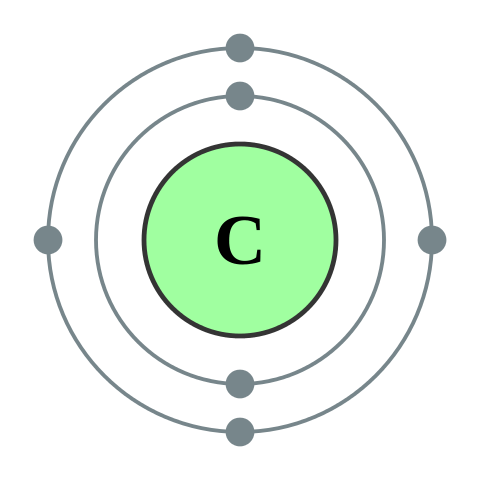
How many valence electrons does carbon have?

a)

4

b)

5

c)

6

d)

7

174.

USE THE PERIODIC TABLE

How many valence electrons does Phosphorus have?

a)

31

b)

5

c)

15

d)

4

175.

How many valence electrons are found in atoms of group 1 (aka the alkali metals)?

a)

7

b)

6

c)

4

d)

1

176.
How many valence electrons are found in atoms of group 14?
a)
4
b)
3
c)
14
d)
16
177.
This could be the dot diagram of 
a)
Ne
b)
Si
c)
Al
d)
Be
178.

This could be the dot diagram of

a)

Mg

b)

Cl

c)

C

d)

O

179.

How many valence electrons does Germanium (Ge) have?

a)

32

b)

4

c)

14

d)

2

180.

Which of the following is a correct electron dot structure?

a)
b)
c)
d)
181.

Which of the following is the correct electron dot structure for nitrogen?

a)
b)
c)
d)
182.

This could be the dot diagram for...

a)

He

b)

Al

c)

Be

d)

Si

183.

What is the "magic number" of valence electrons for atoms to be stable?

a)

1

b)

2

c)

8

d)

18

184.

_______ is the rule of thumb in which elements will bond to have eight electrons in their outer valence orbital, giving it the same electron configuration as a ___________.

a)

Octet Rule; Noble Gas

b)

Boarding House Rule; Noble Gas

c)

Electron Configuration; Alkali Metal

d)

Net Neutral Rule; Noble Gas

185.

How many core electrons does potassium have?

a)

1

b)

2

c)

18

d)

19

186.

Chemical reactions involve ________

a)

electrons

b)

protons

c)

neutrons

d)

beta particles

e)

heat