wayground logo

Free Printable Worksheets

Font size

S
M
L
XL
Worksheets

AP Bio Final Review!

Total questions: 191

Worksheet time: 1hrs 4mins

Name
Class
Date
1.

Based on the data given in the table, which two are most closely related?

a)

Human & Gorilla

b)

Gorilla & Orangutan

c)

Human & Chimpanzee

d)

Chimpanzee & Orangutan

2.

Based on the figure, which organism is most closely related to the polar bear?

a)

Black Bear

b)

European Brown Bear

c)

Western North American Brown Bear

d)

Asian Brown Bear

3.

Which evidence would be the most accurate when developing a cladogram?

a)

Morphological

b)

Molecular

c)

Ecological

d)

Fossil

4.

Natural selection acts on

a)

phenotypes

b)

genotypes

5.

A strong wind, blowing pollen further than normal is an example of

a)

bottleneck effect

b)

mutations

c)

founder effect

d)

gene flow

6.

Occurs when one extreme phenotype is selected.

Example: Individuals may be tall, med, or short

Only the short ones survive

a)

Directional selection

b)

Stabilizing selection

c)

Disruptive selection

7.

Selection against BOTH extreme phenotypes

Example: Individuals can be tall, med, or short

Only the medium ones survive

a)

Directional selection

b)

Disruptive selection

c)

Stabilizing selection

8.

A natural event that separates a population, usually decreasing its diversity represents the

a)

bottleneck effect

b)

founder effect

c)

natural selection

d)

gene flow

9.

A mechanism for evolution -

gradual change over time seen in the fossil record

a)

descent with modification

b)

natural selection

c)

gene flow

d)

bottleneck effect

10.

In order for a population to reach Hardy-Weinberg equilibrium, it must have:

a)

No mutations or gene flow

b)

No natural selection

c)

Random mating

d)

Extremely large population size

e)

all of these

11.

Two clades that emerge from the same node such as B and C, or E and F

a)

sister taxa

b)

basal taxa

c)

clade

12.

Structures that we have evolved out of using (like whale leg bones) are called

a)

vestigial structures

b)

homologous structures

c)

analogous structures

13.

Characteristics that are similar between 2 species that share a common ancestor

a)

Homologous structures

b)

Analogous Structures

c)

Vestigial structures

14.

What factors would increase the frequency of a genotype in a population over time?

a)

Increased reproduction rates in a population

b)

Selective pressures that make the trait favorable

c)

Genetic drift

d)

Mutations in the population

15.

What are selection pressures?

a)

Conditions that prevent a population from evolving

b)

Organisms that shape and influence the ecosystem

c)

Random changes in allele frequencies in a population

d)

Any changes in biotic or abiotic factors that influence survivability

16.

In mice brown fur (B) is dominant over white fur (b). Scientists observed a population of 2000 mice, and found the frequency of the B allele to be 0.7. 10 years later the scientists revisited the population and found the frequency of the B allele to be 0.4.


In the original study, what percentage of the mice would have white fur?

a)

70%

b)

49%

c)

9%

d)

30%

17.

Darwin’s finches on the Galapagos Islands were separated by what kind of reproductive barrier?

a)

Temporal isolation

b)

Behavioral isolation

c)

Geographic isolation

d)

Gamete isolation

18.

Which of the following is the equation that you would use for Hardy-Weinberg?

a)

p + 2q = 1

b)

2p + 2q = 1

c)

2p + q = 1

d)

p + q = 1

19.
 A hurricane wipes out half the population of blue jays in Cape Hatteras, North Carolina.
a)
Natural Selection
b)
Mutation
c)
Genetic Drift
d)
Gene Flow
20.

Five new species of bacteria were discovered in Antarctic ice core samples. The nucleotide (base) sequences of rRNA subunits were determined for the new species. The table below shows the number of nucleotide differences between the species.

a)

b)

c)

d)

21.

This process involves homologous chromatids exchanging genetic material to increase genetic diversity.

a)

crossing over

b)

random fertilization

c)

independent assortment

d)

gene flow

22.

Which of the following best describes the inheritance pattern of the shown pedigree?

a)

Autosomal Dominant

b)

Sex-Linked Dominant

c)

Autosomal Recessive

d)

Sex-Linked Recessive

23.

In animals, traits determine by the mitochondrial DNA are inherited from the _______________.

a)

mother

b)

brother

c)

father

d)

sister

24.

How many gamete different combinations could a person with a genotype of AaBB create?

a)

4

b)

3

c)

2

d)

1

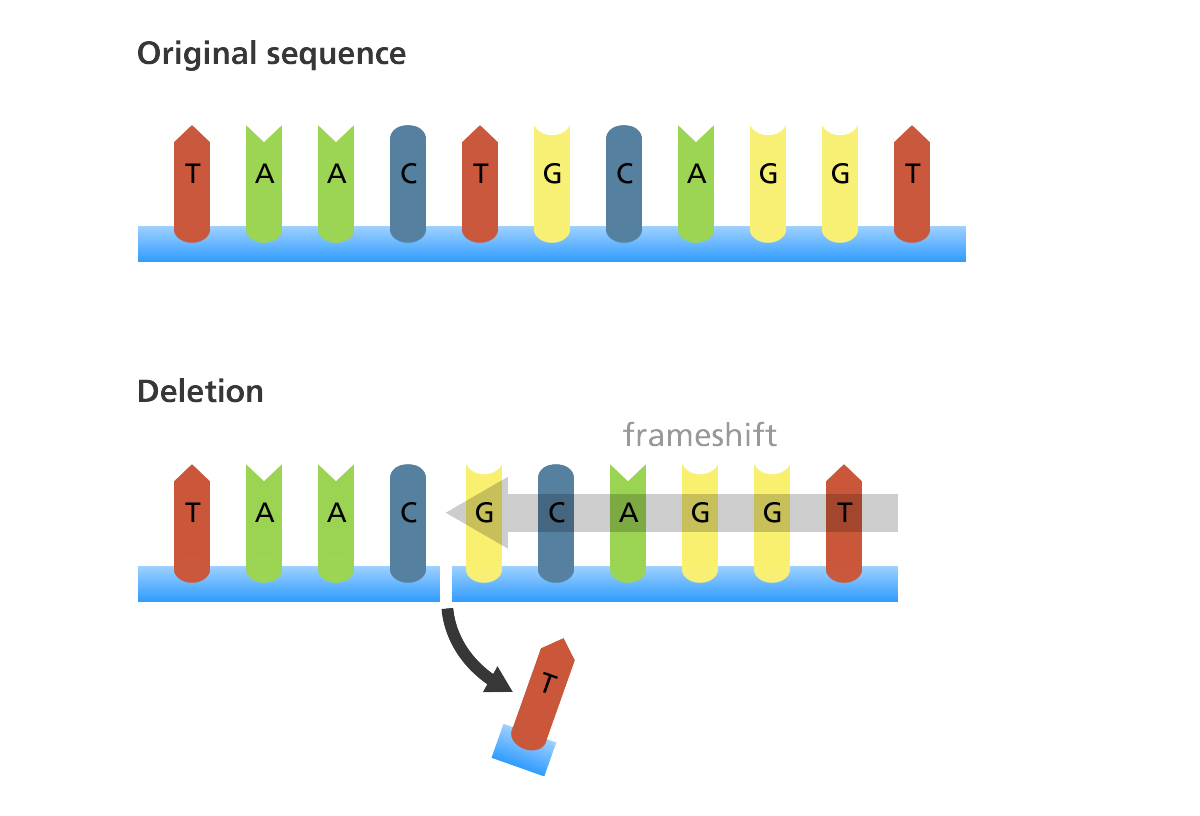
25.

The diagram above illustrates which of the following processes?

a)

Crossing-over

b)

Base pair subsitution

c)

Duplication

d)

Deletion

26.

If blue and red true-breeding flowers are mated and result is all purple offspring, what inheritance pattern would this be indicative of?

a)

Codominance

b)

Dominance

c)

Incomplete dominance

d)

Multiple Alleles

27.

Can a human male be a carrier of red-green color blindness if it's located on the X-chromosome?

a)

Yes, males can be carriers of red-green color blindness, as color blindness is autosomal dominant

b)

No, males cannot be the carriers of red-green color blindness, as color blindness is X-linked

c)

No, males cannot be the carriers of red-green color blindness, as color blindness is Y-linked

d)

Yes, males can be carriers of red-green color blindness, as color blindness is autosomal recessive

28.

Susy has blonde hair (hh). Her mother has blonde hair, and her father has brown hair (dominant trait). What are the genotypes of Molly's parents?

a)

Mom: hh; Dad: HH

b)

Mom: hh, Dad: Hh

c)

Mom: hh, Dad; hh

d)

Mom: HH, Dad: HH

29.

Who is the Father of Genetics?

a)

Charles Darwin

b)

Einstein

c)

Newton

d)

Gregor Mendel

30.

In snapdragons come in three colors yellow (YY), blue (BB), and green (YB). What would be the chances of having green flowers if you crossed a blue snapdragon with a green snapdragon?

a)

25 %

b)

50%

c)

75%

d)

0%

31.

Two chromosomes in the nucleus that carry genes for the same traits are known as

a)

complementary chromosomes

b)

heterologous chromosomes

c)

homologous chromosomes

d)

BFF4L

32.

What is an allele?

a)

Segment of DNA

b)

One of the alternate forms of a gene

c)

A phenotype

d)

One of the alternative forms of DNA

33.

According to Mendel's Law of Segregation,

a)

there is a 50% probability that a gamete will get a dominant allele

b)

allele pairs segregate of independent other pairs of alleles in gamete form

c)

allele pairs separate in gamete formation.

d)

there is a 3:1 ratio in the f2f^2 generation

34.

In a dihybrid cross where both parents are heterozygous at both loci, expected phenotypic ratio

a)

the ratio is 4:3:1

b)

the ratio is 1:1

c)

the ratio is 9:3:3:1

d)

the ratio is 1:2

35.

This karyotype is that of a...

a)

Male

b)

Female

36.

Name this phase of Meiosis

a)

Anaphase II

b)

Anaphase I

c)

Metaphase I

d)

Metaphase II

37.

Name this phase of Meiosis:

a)

Telophase I

b)

Prophase II

c)

Telophase II

d)

Anaphase II

38.

In humans, the haploid number of chromosomes is ____.

a)

23

b)

46

c)

69

d)

92

39.

The phase of Meiosis in which chromatids separate:

a)

Prophase II

b)

Metaphase II

c)

Telophase II

d)

Anaphase II

40.

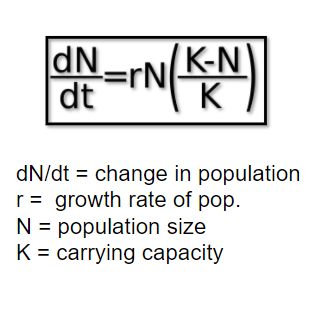
If a population has a carrying capacity (K) of 1000, and the growth rate (r) is 1.1, what is the population growth when the population (N) is 500?

a)

147

b)

227

c)

337

d)

1124

41.

Which of the following is most likely to cause the greatest decrease in the species B population?

a)

A decrease in species A

b)

A decrease in species D

c)

An increase in species E

d)

A decrease in species C

42.

A new mountain range has formed by bare rock being pushed up from under the earth. Which type of organisms would you expect to be the pioneer species and what type of succession is this an example of?

a)

Lichen, Primary Succession

b)

Lichen, Secondary Succession

c)

Grasses, Primary Succession

d)

Grasses, Secondary Succession

43.
A herd of zebras would be considered a
a)
community
b)
species
c)
ecosystem
d)
population
44.
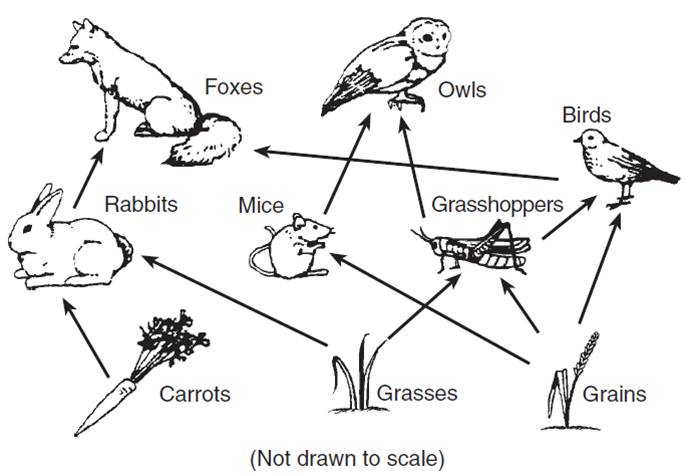
Which of the following is a primary consumer in this food web?
a)
Foxes
b)
Carrots
c)
Mice
d)
Owls
45.
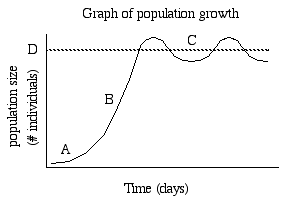
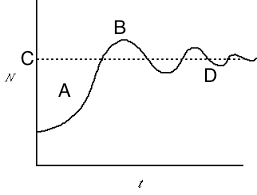
Which point on the graph represents carrying capacity?
a)
A
b)
B
c)
C
d)
D
46.
Why is only 10% of the energy passed along to the next trophic level?
a)
90% is lost through heat, reproduction, and movement
b)
90% is gained
c)
90% is lost in light energy
d)
because only 10% is lost
47.
Refer to the diagram of the survivorship curve.
Which curve best describes an organism that invests a lot of energy in parenting?
a)
A
b)
B
c)
C
d)
this is not a survivorship curve
48.
Which letter shows the the exponential growth of a population?
a)
A
b)
B
c)
C
d)
D
49.
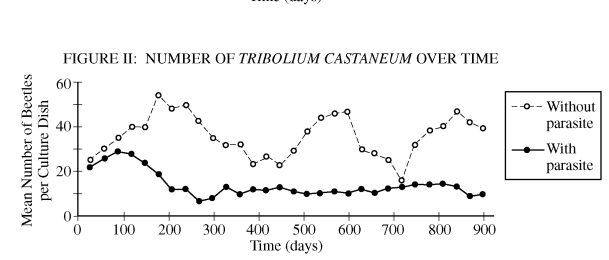
Which of the following correctly describes the interactions between T. castaneum and the parasite.
a)
The parasite decreases the population density of beetles in each culture dish.
b)
The parasite increases the population density of beetles in each culture dish.
c)
The parasite has no effect on the population density of the beetles.
50.
How do matter and energy flow differently?
a)
Energy flows in one direction, matter is recycled
b)
Matter flows in one direction, Energy is recycled
c)
Energy and Matter are both recycled
d)
Energy and Matter both flow in one direction
51.
Primary consumer's energy is 54,000 joules. How much energy was provided to secondary consumers?
a)
53,460 J
b)
540 J
c)
5,400 J
d)
54 J
52.
A team of ecologists observed feeding patterns of several populations in the desert. The energy pyramid shown below depicts the feeding patterns the ecologists observed. Which of the following best explains the difference in the amount of available energy in the trophic levels of the desert ecosystem?
a)
There is less energy available in the producers because their tissues are less dense than those at higher trophic levels. 
b)
There is more energy available in the second trophic level because less energy is needed for hunting compared to the higher trophic levels. 
c)
There is less available energy in the fourth trophic level because of the loss of energy through metabolism in each of the lower trophic levels. 
d)
There is more available energy in the birds of prey because they have greater muscle mass for storing energy than organisms in lower trophic levels have. 
53.
________ grow slowly over time, cares for its young over a long period of time and is usually near the carrying capacity of its ecosystem.
a)
K-strategists
b)
R-strategists
c)
Uniform strategists
d)
environmentalists
54.
A species that exerts a large, positive impaction on its ecosystem is known as a:
a)
Keystone species
b)
Invasive species
c)
Indicator species
d)
Poached species
55.
After a forest fire, an ecosystem would start regrowth through -
a)
primary succession
b)
secondary succession
c)
climax community
d)
limiting factors
56.
Which of these populations is experiencing the fastest growth?
a)
A
b)
B
c)
C
d)
D
57.
In the lac operon model the genes within the operon will be expressed if:
a)
lactose is absent in the cell
b)
glucose is present in the cell
c)
lactose is present in the cell
58.
Why are insertion and deletion mutations so harmful?
a)
They change all of the codons from the mutation on down the line, which changes the amino acid sequence
b)
They insert things that an organism doesn't need.
c)
They often delete things that organisms need.
d)
Insertion and deletions are not any more harmful than substitution mutations.
59.
Identify the SUBSTITUTION mutation from the following DNA sequence: 
ATG CCA AAT
a)
ATG TCA AAT
b)
ATG CCT AAA T
c)
ATC CA  AT
d)
ATG CCA AAT
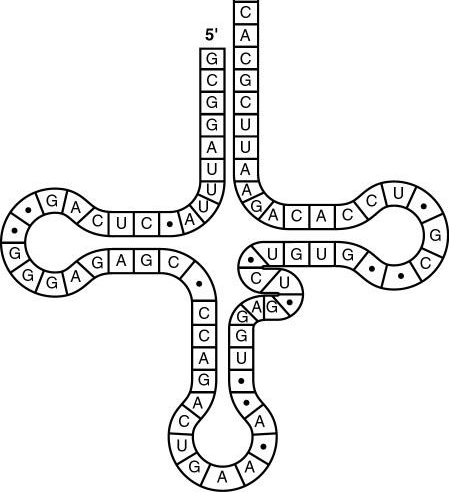
60.
What structure of this molecule binds with the mRNA molecule?
a)
Amino Acid
b)
tRNA
c)
Anticodon
d)
Codon
61.

What type of molecule helps turn on specific genes?

a)

Inducers

b)

Repressors

c)

Methalation

d)

Morphogenesis

62.
What strand is copied faster?
a)
Leading
b)
Lagging
63.

Which enzyme proofreads and removes RNA Primase

a)

Ligase

b)

Polymerase 1

c)

Polymerase 3

d)

Helicase

64.
Which RNA bases would pair with TACGAA in transcription
a)
AUGCUU
b)
ATGCTT
c)
GCATCC
d)
GCAUCC
65.

Which of the following describes the conversion factor between nucleic acids and proteins?

a)

3 amino acids = 1 nucleotide

b)

3 amino acids = 3 nucleotides

c)

3 nucleotides = 1 amino acid

d)

3 nucleotides = 3 amino acids

66.
What type of operon is the lac (lactose) operon?
a)
inducible
b)
repressible
c)
positive control
d)
promoible
67.
Which of the following is responsible for the creation of Okazaki fragments during replication?
a)
The two sides of the DNA ladder are not symmetrical
b)
Single strand binding proteins only attach to one side of the strand
c)
DNA helicase can only influence one side of DNA
d)
DNA polymerase can only travel in the 3’ to 5’ direction
68.
Consider the base pair rule when answering this question. If a sample of DNA is 30% adenine, what % of the sample would you expect to be cytosine. (There is math involved here!)
a)
10
b)
20
c)
50
d)
70
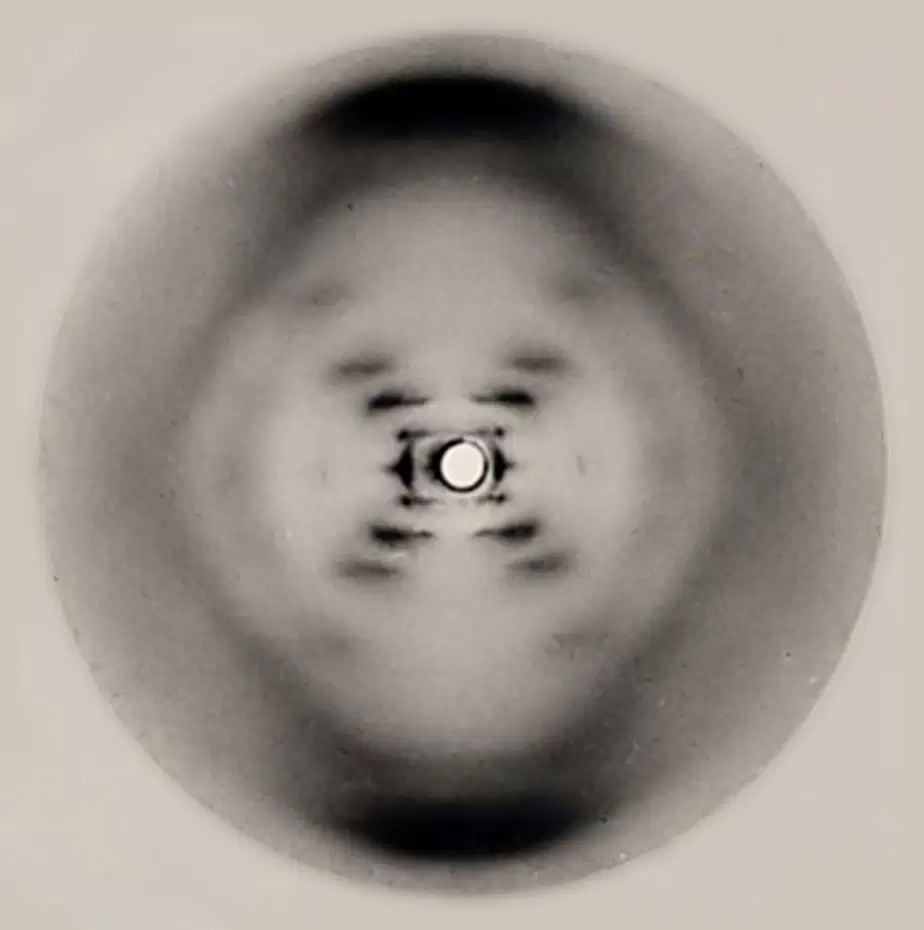
69.
The photo taken by Rosalind Franklin provided what clue for Watson and Crick?
a)
the way bases paired
b)
the helix shape of the molecule
c)
the hydrogen bond locations
d)
the anti-parallel arrangement
70.
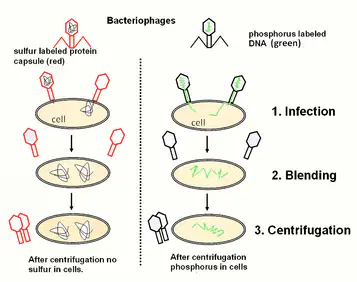
In the Hershey-Chase experiment, radioactive phosphorous was found in newly created phages. This supported which hypothesis?
a)
DNA was in the form of a double helix.
b)
DNA could be transformed into harmful variants.
c)
DNA was the molecule of heredity.
d)
DNA contained equal amount of thymine and adenine.
71.
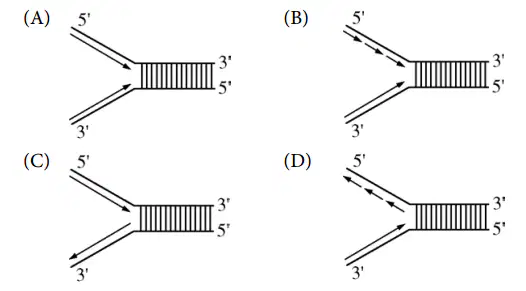
Which of the following images most accurately illustrates DNA replication?
a)
A
b)
B
c)
C
d)
D
72.
Each time a cell divides, the telomeres:
a)
decrease in number
b)
decrease in size
c)
increase in number
d)
increase in size
73.
What amino acid sequence will be produced based on the mRNA codon sequence
5'-AUG-UCU-UCG-UUA-UCC-UUG-3'
a)
met-ser-leu-ser-leu-ser
b)
met-ser-ser-leu-ser-leu
c)
met-leu-phe-arg-glu-glu
d)
met-glu-arg-arg-glu-leu
74.
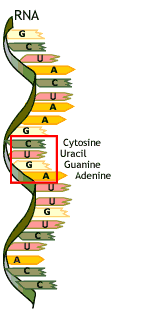
In RNA, Uracil pairs with ______. 
a)
cytosine
b)
adenine
c)
guanine
d)
thymine
75.
What is a peptide bond?
a)
Bond that holds two amino acids together.
b)
A bond that holds hydrogen and oxygen molecules together.
c)
A bond that holds the phosphate group of one nucleotide and a sugar of a neighboring nucleotide.
d)
A bond that is formed by the sharing of electrons.
76.

The image shows part of a polypeptide. What determines the order in which the amino acids are connected to each other in the polypeptide?

a)

the chemical structure of each R-group in the amino acid

b)

the order of the the nitrogenous bases in a gene

c)

the random nature of ribosome function

d)

the sequence of amino acids that make up the gene

77.
The "on/off" switch for an operon is called the
a)
promoter
b)
repressor
c)
operator
d)
gene
78.
A chemical modification of DNA that does not affect the nucleotide sequence of a gene but makes that gene less likely to be expressed.
a)
methylation
b)
acetylation
c)
transcription
d)
translation
79.
Which protein is responsible for allowing the bacteria to grow in the presence of ampicillin?
a)
GFP
b)
araC
c)
Beta Lactamase
d)
Restriction Enzyme
80.
What did we use to create temperature differential to sweep plasmid inside
a)
heat shock
b)
ice
c)
arabinose
d)
CaCl2
81.
Which gene is responsible for the bacteria glowing?
a)
bla
b)
araC
c)
GFP
d)
pGLO
82.

Which of the plates would show no growth?

a)

-pGlo, -AMP

b)

-pGlo, +AMP

c)

+pGlo, +AMP

d)

all would show growth

83.

This laboratory procedure is known as

a)

CLONING

b)

gel electrophoresis

c)

chromatography

d)

use of a dichotomous key

84.

A student performed a gel electrophoresis experiment. The results are represented in the diagram

below. Compared to the fragments at the top of the gel, the fragments at the lower end are

a)

larger, and move slower

b)

larger, and move faster

c)

smaller, and move faster

d)

smaller, and move slower

85.
Based on these results whose blood was found in the blood stain at the crime scene?
a)
Bob
b)
Sue
c)
John
d)
Lisa
86.
DNA fingerprinting works because
a)
Most genes are dominant
b)
All organisms contain RNA
c)
The most important genes are different among most people
d)
No two people, except identical twins, have exactly the same DNA 
87.
Protein molecules around which DNA is tightly coiled in chromatin
a)
Histones
b)
Whey
c)
Casein
d)
Hemoglobin
88.

What is the correct organization of DNA?

a)

chromatin -> nucleosome -> DNA -> chromosome

b)

DNA -> nucleosome -> chromatin -> chromosome

c)

DNA -> nucleosome -> chromosome -> chromatin

d)

chromosome -> DNA -> nucleosome -> chromatin

89.

Which phase is not considered a mitotic phase?

a)

Interphase

b)

Metaphase

c)

Anaphase

d)

Telophase

90.

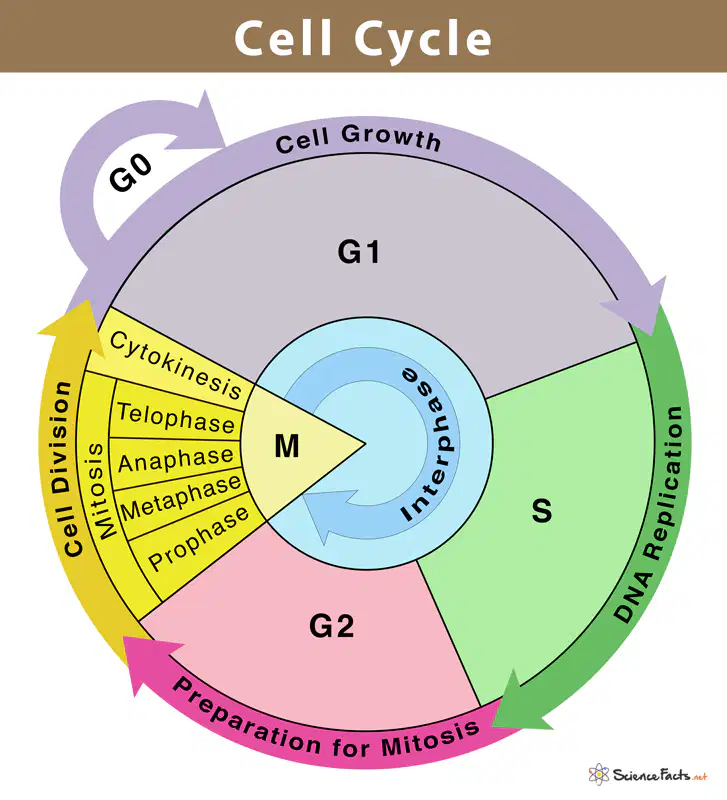
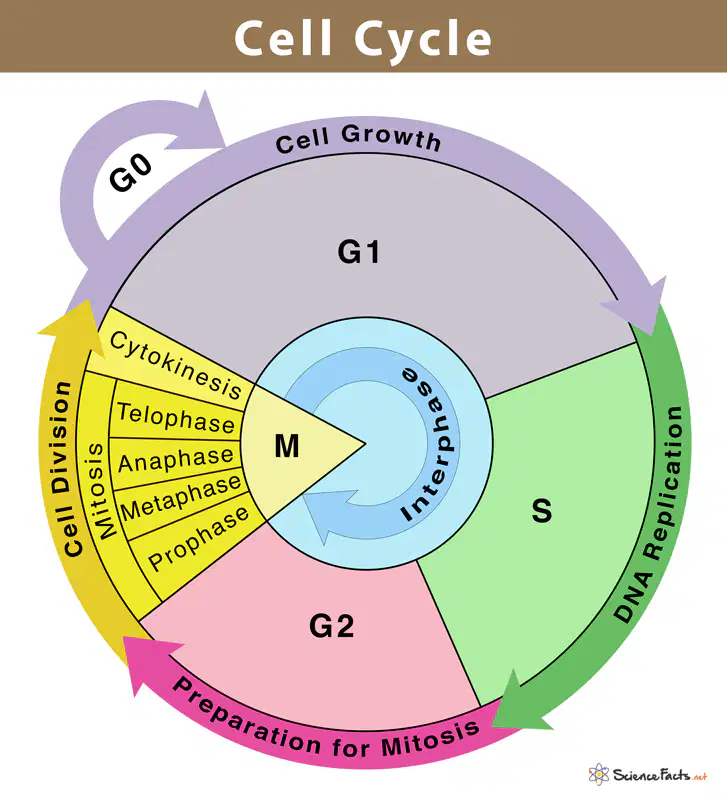
What checkpoint involves checking for cell size, growth factors, and DNA damage before replication? Cells with errors will be sent to the G0 phase.

a)

G1

b)

G2

c)

M

91.

What checkpoint checks for completion of DNA replication and any DNA damage?

a)

G1 checkpoint

b)

G2 checkpoint

c)

M Checkpoint

92.
How does the concentration of cyclin change as a cell goes through the cell cycle?
a)

Cyclin concentration remains constant.

b)

Cyclin concentration increases during interphase and decreases during mitosis.

c)

Cyclin concentration decreases during interphase and increases during mitosis.

d)

Cyclin concentration is inversely related to CDK concentrations.

93.
Gametes have haploid or diploid number of chromosomes?
a)
Haploid
b)
Diploid
94.
A human has 46 chromosomes in their body cells.  What is the haploid number?
a)
46
b)
92
c)
23
d)
12
95.

What are the "strings" called that are attached to the chromosomes?

a)

Centrioles

b)

Chromatin

c)

Spindle Fibers

96.

Cells from cancerous tumors usually have an unusual number of chromosomes, and unusual looking chromosomes. What could explain this?

a)

cancer cells are in G0

b)

cancer cells are arrested in the S phase

c)

cell cycle check points are not in place

d)

transformation introduces new chromosomes to cells

97.
Identify the Cell Cycle Stage.
a)
Interphase
b)
Anaphase
c)
Telophase
d)
Prophase
98.

Describe the interaction between cyclin and CdK.

a)

cyclin interacts with CdK to initiate the mitotic phase

b)

cyclin is the precursor to CdK, when synthesized allow for mitosis proceed

c)

cyclin acts as an inhibitor to CdK to wait for all DNA to be synthesized

d)

cyclin binds to CdK to initiate DNA replication

99.

What is the end result of mitosis?

a)

An undifferentiated stem cell

b)

4 genetically unique haploid cells

c)

2 genetically identical diploid cells

d)

2 genetically unique daughter cells

100.
What is the process called when the cytoplasm divides?
a)
Cytoskeleton
b)
Interphase
c)
Anaphase
d)
Cytokinesis
101.
Cells are anchorage dependent.
a)
Regular cells
b)
Cancer cells
102.

In which stage of the cell cycle does the cell grow in size?

a)

G1

b)

S

c)

G2

d)

Mitosis

103.
In mitosis, the two resulting cells are
a)
different from the starting cell and identical to each other.
b)
different from the starting cell and different from each other.
c)
identical to the starting cell and different from each other.
d)
identical to the starting cell and identical to each other.
104.
DNA is replicated during ______ of the cell cycle.
a)
G1
b)
S
c)
G2
d)
G0
105.
Cells spend the majority of their lives in
a)
Interphase
b)
Mitosis
c)
Synthesis 
d)
Gap 2
106.

The body part that senses the change inside the organism ...

a)

receptor

b)

control center

c)

effector

d)

response

107.

Which part of the feedback loop is a body part that makes a change to bring the system back to homeostasis?

a)

Effector

b)

control center

c)

response

d)

receptor

108.

Which of these shows the cell cycle phases in their correct order AND correctly paired with their functions?

a)

G1-growth, M-division, G2-DNA checkpoints, S-DNA replication

b)

G1-growth, S-DNA replication, G2-prepare to divide, M-division

c)

M-division, G1-growth, S-DNA replication, G2-prepare to divide

d)

S-Interphase, G2-growth, M-division, G1-DNA replication
109.
When glucose levels in the blood rise, your brain sends a signal to your pancreas. The pancreas releases insulin, which opens channels in cell membranes to allow glucose to enter the cell, lowering blood sugar levels. 
a)
Positive Feedback Response
b)
Negative Feedback Loop 
110.

The outcome of each protein is influenced by their

a)

amino acid sequence

b)

type of ribosome used

c)

hydrogen bonding

d)

location the protein is build within the cell
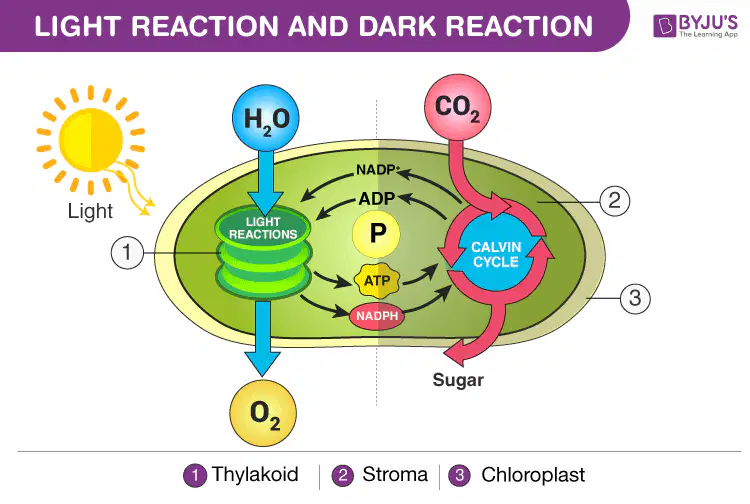
111.

Plants use the following reactants for the light reaction

a)

Water and CO2

b)

Water and NADPH

c)

Water and NADP+

d)

NADPH and ATP

112.

Photosynthesis goal is to

a)

convert light energy into glucose energy

b)

use light energy to make oxygen gas

c)

convert sugar energy into ATP

d)

convert sugar energy into oxygen gas

113.

If the proton (H+) pump in the thylakoid was not working which molecule could not be made during the light reaction?

a)

NADPH

b)

ATP

c)

Water

d)

Oxygen gas

114.

Plants obtain CO2 into the chloroplast by

a)

active transport

b)

diffusion

c)

facilitated diffusion

d)

endocytosis

115.

Photosystems are made of

a)

chloroplasts

b)

chromosomes

c)

chlorophyll

d)

cytoplasm

116.

During noncyclic photophosphorylation all of the following occur EXCEPT

a)

ATP is made using electron energy that will leave on NADPH

b)

results in oxygen gas being produced

c)

water is split (photolysis)

d)

electrons from photosystem 1 return back to photosystem 1

117.

What does a C4 plant do?

a)

stores CO2 in a separate cell from its photosynthetic cell during the day

b)

stores CO2 in a vacuole during the night.

c)

can't store CO2 so it sufferes photorespiration

d)

can't store CO2 so it speeds up cellular respiration in order to make more CO2

118.

Which plant LACKS CO2 storage method

a)

C3

b)

C4

c)

CAM

119.

The calvin cycle requires what substances from the light reaction?

a)

CO2 and Water

b)

light and CO2

c)

ATP and NADPH

d)

glucose and O2

120.
Which structures shown in the Figure make up the ADP molecule?
a)
A and B
b)
A, B and C
c)
A, B, C, and D
d)
C and D
121.
Which structures shown in the Figure make up the ATP molecule?
a)
A and B
b)
A, B and C
c)
A, B, C, and D
d)
C and D
122.
Which of the following results in the storage of energy in terms of the ATP/ADP cycle?
a)
The breaking of the bond between the 5-carbon sugar and the 1st phosphate group
b)
The addition of a phosphate group
c)
The removal of a phosphate group
d)
The addition of glucose 
123.

What substance helps in removing a phosphate?

a)

Adenosine

b)

Water

c)

Hydrogen

d)

Phosphates

124.
Water is used to break bonds between polymers
a)
dehydration synthesis
b)
Hydrolysis
125.
A catalyst works by
a)
changing the order of the reaction
b)
increasing the temperature
c)
lowering the activation energy
d)
making the activated complex
126.
Succinate dehydrogenase catalyzes the conversion of succinate to fumarate. The reaction is inhibited by malonic acid, which resembles succinate but cannot be acted upon by succinate dehydrogenase. Increasing the ratio of succinate to malonic acid reduces the inhibitory effect of malonic acid. What is malonic acid's role with respect to succinate dehydrogenase?
a)
It is a competitive inhibitor.
b)
It is an allosteric regulator.
c)
It is able to bind to succinate.
d)
It blocks the binding of fumarate.
127.
The place, other than the active site, where activators and inhibitors bind to an enzyme is called the ________ site.
a)
competitive
b)
allosteric
c)
alterior
d)
rate
128.
What type of reaction is occurring in this graph?
a)
endergonic
b)
exergonic
c)
unable to determine
129.

What is being represented by the letter B in the image?

a)

Substrate

b)

Enzyme

c)

reactants

d)

Product

130.

Which of the following do not affect enzymes ability to function?

a)

pH

b)

substrate concentration

c)

temperature

d)

water

131.

The active site of an enzyme can:

a)

bind allosteric regulators.

b)

bind competitive inhibitors.

c)

bind non-competitive inhibitors.

d)

change the Gibbs Free Energy of the reaction.

132.

Which enzyme functions best in acidic environments?

a)

neither enzyme

b)

Enzyme A

c)

Enzyme B

d)

Both enzymes

133.
reduced electron carrier molecule formed in glycolysis
a)
NAD+
b)
NADH
c)
acetyl CoA
d)
FAD
134.
The first step in getting energy in the cell by breaking down glucose is known as
a)
the Krebs cycle
b)
electron transport
c)
fermentation
d)
glycolysis
135.
Glycolysis results in the net gain of:
a)
2 ATP
b)
4 ATP
c)
4 NADH
d)
2 Acetyl CoA
136.

What is the correct order for aerobic cellular respiration?

a)

glycolysis --> ETC --> Citric Acid Cycle

b)

ETC --> glycolysis --> Citric Acid Cycle

c)

glycolysis --> Citric Acid Cycle --> ETC

d)

Citric Acid Cycle --> glycolysis --> ETC

137.

How many ATP are produced in cellular respiration?

a)

2 ATP

b)

4 ATP

c)

12 ATP

d)

36 ATP

138.
How many FADH2 molecules are produced by 1 molecule of glucose?
a)
1
b)
2
c)
3
d)
4
139.
Where does the electron transport chain happen?
a)
Matrix
b)

Cristae/Intermembrane

c)
Outer membrane
d)
Cytoplasm
140.

Which of the following is produced during the Electron Transport Chain?

a)
CO2
b)
O2
c)
C6H1206
d)
H2O
141.

What is the purpose of Chemiosmosis?

a)

To use the movement of H+ to help phosphorylate ADP --> ATP using ATP Synthase

b)

To create a chemical gradient

c)

To use the movement of electrons down the transport chain to create a H+ gradient.

d)

To break down Acetyl CoA into C02 to produce ATP and NADH

142.
Which way would the purple molecules move through the semi-permeable membrane?
a)
From the  A side  to the B-side
b)
From the B side to the A side
c)
none of the purple molecules would move
d)
they would move equally back and forth in a state of dynamic equilibrium
143.
Which of the following is responsible for getting large or charged (polar) molecules across the cell membrane?
a)
E
b)
B
c)
C
d)
D
144.
When cells are placed in a __________ solution they begin to swell.
a)
Hypertonic
b)
Isotonic
c)
Hypotonic
d)
Equalized
145.
Which form of active transport is being shown? (Inside of  the cell is tan colored) 
a)
Facilitated Diffusion
b)
Exocytosis
c)
Endocytosis
d)
Receptor-mediated endocytosis
146.
The sodium-potassium pumps requires energy to move ions across the cell membrane against their concentration gradient so it is a type of
a)
active transport
b)
osmosis
c)
diffusion
d)
facilitated diffusion
147.
 Engulfing of bacteria by white blood cells is called as
a)
Phagocytosis
b)
Pinocytosis
c)
Exocytosis
d)
Endocytosis
148.
The difference in the concentration of a substance from one location to another is called 
a)
diffusion
b)
osmosis
c)
concentration gradient
d)
passive transport
149.
The picture  is an example of _________________.
a)
isotonic
b)
diffusion
c)
osmosis
d)
active transport
150.
Water will move?
a)
Into the cell
b)
Out of the cell
c)
Neither into or out of the cell
151.
The hydrophilic regions of a membrane protein are most likely
a)
present only in muscle cells
b)
associated with the fatty acid region of the lipids
c)
either on the surface or inserted into the interior of the membrane
d)
exposed on the surface of the membrane
152.
Which of the following functions as a recognition site for interactions between cells?
a)
Phospholipids
b)
Cholesterol 
c)
Fatty acids
d)
Glycolipids
153.

What is the process called when the cell controls what goes into or out of the cell with the help of energy?

a)

passive transport

b)

osmosis

c)

diffusion

d)

active transport

154.
Which of the following statements regarding the mitochondria is correct?
a)
Mitochondria contain their own ribosomes and thus produce some of their own proteins.
b)
Mitochondria are involved in the transport that occurs as a part of the endomembrane system.
c)
Mitochondria rely on the DNA of the eukaryote cell in order to function correctly.
d)
Mitochondria produce ATP only used by themselves.
155.
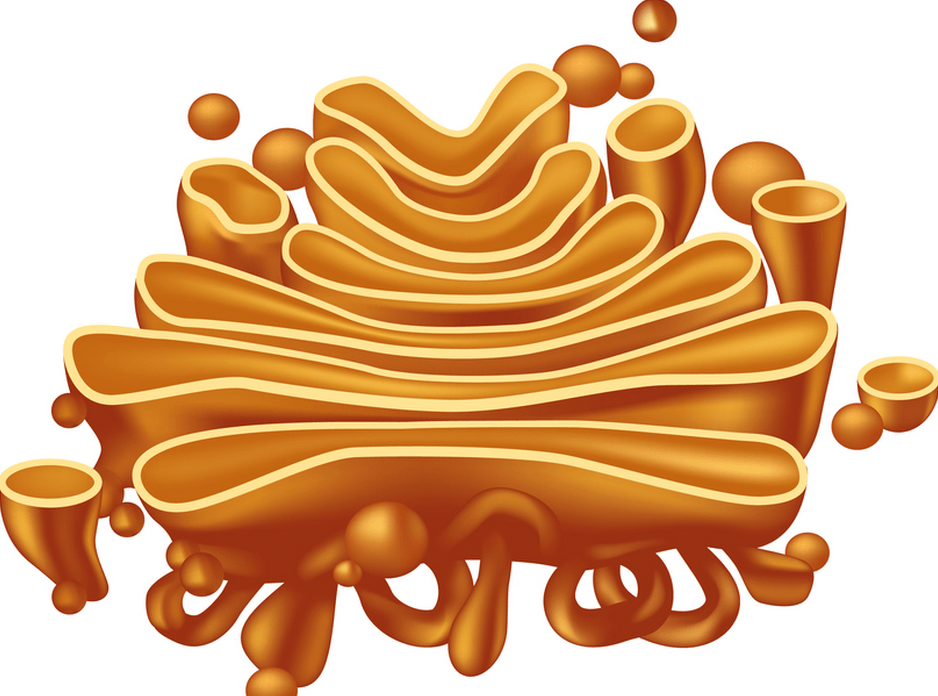
I am a protein packaging and shipping machine! Who am I?
a)
vacuole
b)
ribosome
c)
mitochondrion
d)
golgi apparatus
156.
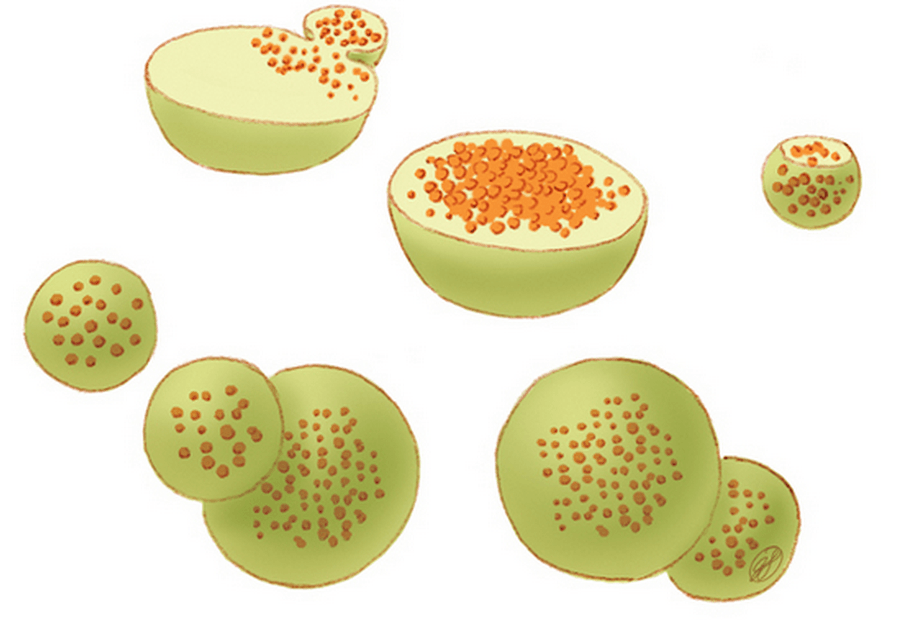
You might think of me as the trash collector, but recycler is maybe more accurate. What am I?
a)
mitochondria
b)
lysosome
c)
vacuole
d)
ribosome
157.
No nucleus
a)
Eukaryote
b)
Prokaryote
c)
Both
158.

Which organelle provides structure and protection to plant cells?

a)

cell membrane

b)

ribosome

c)

golgi apparatus

d)

cell wall

159.

Where are the ribosomes attached in a cell?

a)

Smooth ER

b)

Cell Membrane

c)

Mitochondria

d)

Rough ER

160.

_____ and _____ are organelles that arose from endosymbiosis

a)

nucleus and cell membrane

b)

mitochondria and chloroplasts

c)

cell wall and chloroplasts

d)

mitochondria and nucleus

161.
The absorption of nutrients is determined by...
a)
The cell's volume
b)
The cell's surface area
c)
The cell's ribosomes
d)
The cell's DNA
162.
As a cell becomes larger, its
a)
surface area increases faster than its volume.
b)
volume increases faster than its surface area
163.
Define Surface area
a)
The total area on the surface of an object
b)
Length X Width 
c)
6 X (length X width)
d)
Add up the sides and divide by 4
164.

Which of the following is least efficient?

a)

A

b)

B

c)

C

d)

D

165.

The three types of endocytosis

a)

Phagocytosis

Pinocytosis

Receptor-mediated

b)

Phagocytosis

Exocytosis

Active Transport

c)

Passive

Pinocytosis

Receptor-Mediated

d)

Receptor-Mediated

Active

Passive

166.

The cell membrane is composed of _________ head and _________ tail.

a)

Hydrophobic

Hydrophilic

b)

Hydrophilic

Hydrophobic

167.

The following data was collected by observing subcellular structures of three different types of eukaryotic cells. Identify a function of Cell X.

a)

Detoxification

b)

Secretion of Proteins

c)

Motility

d)

Storage

168.

Cells in the pancreas will incorporate radioactively labeled amino acids into proteins. This "tagging" of newly synthesized proteins enables a researcher to track their location. Predict the most likely pathway of an enzyme secreted by pancreatic cells.

a)

Rough ER -> lysosomes -> vesicles that fuse with the plasma membrane

b)

Smooth ER -> Golgi apparatus -> vesicles that fuse with the plasma membrane

c)

Nucleus -> Smooth ER -> Golgi apparatus

d)

Rough ER -> Golgi apparatus -> vesicles that fuse with the plasma membrane

169.

Match the following organelles to their descriptions:

a)

Mitochondria

1.

Present in large numbers in cells that have high energy demands, such as muscles

b)

Golgi apparatus

2.

Has a receiving (cis) and shipping (trans) face: packaging and secretion center

c)

Lysosomes

3.

Membrane-bound structure containing hydrolytic enzymes

d)

Smooth ER

4.

An organelle with extensive, folded membranes: abundant in cells that detoxify poisons

170.

Match the following cells in solutions to their outcomes:

a)

Animal cell placed in hypertonic solution

1.

Shrivel

b)

Animal cell placed in hypotonic solution

2.

Lyse

c)

Plant cell placed in hypertonic solution

3.

Plasmolysis

d)

Plant cell placed in hypotonic solution

4.

Turgid

e)

Plant cell placed in isotonic solution

5.

Flaccid

171.

Mutations in which gene causes cystic fibrosis?

a)

HTT

b)

PINK1

c)

CFTR

d)

HBB

172.

Which ion is unable to move across the membrane in CF?

a)

Chloride

b)

Hydrogen

c)

Fluoride

d)

Sodium

173.

CFTR is an example of what protein channel?

a)

Ion Gated

b)

Ligand Gated

c)

Receptor Mediated-Endocytosis

d)

Active Transport Channel

174.
The monomer, building block, of proteins
a)
Amino Acid
b)
Fatty Acid
c)
Nucleotide
d)
monosaccharide
175.
Combines with 3 fatty acid chains to make up a triglyceride; part of the monomer of lipids
a)
Amino Acid
b)
Fatty Acid
c)
Glycerol
d)
Nucleotide
176.
The monomer, building block, of DNA and RNA; made up of a sugar, phosphate, and nitrogenous base
a)
Amino Acid
b)
Fatty Acid
c)
Nucleotide
d)
Monosaccharide
177.
What 3 letters do enzymes typically end in?
a)
-ose
b)
-ase
c)
-ese
d)
-tic
178.
Which of the following elements make up nucleic acids?
a)
C, H, O
b)
C, H, O, N
c)
C, H, O, N, P
d)
C, H, O, Ca, S
179.
The diagram shows a bond forming between two amino acids. What is the name of this reciprocation?
a)
Dehydration Synthesis
b)
Hydrolysis
c)
Pepysis
d)
Oxidation
180.
Is this hydrocarbon saturated or unsaturated? 
a)
saturated
b)
unsaturated
181.
The bond that joins amino acids are called:
a)
Peptide Bonds
b)
Ester Bonds
c)
Glycosidic Linkages
d)
Phosphodiester Bonds
182.
Amino acids all have the same general morphology except for the:
a)
Amino Group
b)
Carboxyl Group
c)
'R' Group
d)
Carbonyl Group
183.

The picture above is considered what kind of carbohydrate?

a)

Disaccharide

b)

Polysaccharide

c)

Monosaccharide

184.

How many amino acids are there for the body to combine together to form certain proteins?

a)

12

b)

10

c)

20

185.

This is a type of simple carbohydrate that consists of two sugars.

a)

Polysaccharide

b)

Disaccharide

c)

Monosaccharide

186.

An example of a disaccharide would be

a)

Glucose

b)

Glycogen

c)

Lactose

187.

Attraction of molecules between the same substance

a)

Adhesion

b)

Cohesion

c)

Polarity

188.

The hydrogen and oxygen atoms are held together by what kind of bond?

a)

Hydrogen

b)

Covalent

c)

Polysaccharide

189.

It takes a lot of energy to break apart water molecules, there for meaning water has a

a)

high chance of evaporation

b)

high specific heat

c)

never freezes

190.

When water molecules attach to each other this is through a

a)

Covalent bond

b)

Polypeptide

c)

Hydrogen Bond

191.

An example of an unsaturated fat would be?

a)

Butter

b)

Olive Oil

c)

Crisco