wayground logo

Free Printable Worksheets

Font size

S
M
L
XL
Worksheets

AP Bio Review part 2

Total questions: 191

Worksheet time: 3hrs 32mins
Name
Class
Date
1.
Large bodies of water do not quickly fluctuate in temperature. Why?
a)
Water is a solvent.
b)
Water has a high heat capacity.
c)
Water acts as a buffer.
d)
Water is non-polar.
2.
The fact that ice floats on liquid water is due to the fact that water's solid is ___________ than it's liquid form
a)
less polar
b)
more polar
c)
less dense
d)
more dense
3.
What makes a molecule polar?
a)
Equal sharing of valence electrons
b)
Unequal sharing of valence electrons
c)
Stealing of electrons
d)
Temporary charges that come and go
4.

Water is an excellent solvent. Select the property that justifies this statement.

a)

as a polar molecule, it can surround and dissolve ionic and polar molecules

b)

it forms ionic bonds with ions, hydrogen bonds with polar molecules, and hydrophobic interactions with non polar molecules

c)

it forms hydrogen bonds with itself so cohesion is possible

d)

it is liquid and will adhere to many substances

5.

The partial negative charge at one end of a water molecule is attracted to a partial positive charge of another water molecule. What is this type of attraction called?

a)

a polar covalent bond

b)

an ionic bond

c)

a hydration shell

d)

a hydrogen bond

6.
 Small insects can walk across the surface of calm water. Their feet push the surface of the water down slightly, somewhat like a person walking across a trampoline, but they do not break the surface. What is the best explanation for why this happens?
a)
The insects are light enough so that they do not break the hydrogen bonds holding the water molecules together
b)
The insects actually use their wings to hover slightly above the water's surface and they only skim it with their feet
c)
The insects' feet are non-polar, so they are repelled by the polar water molecules and are pushed away from the water's surface
d)
The insects are small enough to see the individual water molecules, so they are able to step carefully from one molecule to the next
7.
A florist places a bouquet of white carnations in water containing blue dye. After a time, the flowers turn blue. What process helped the carnations to change color?
a)
Specific heat 
b)
Surface tension
c)
Cohesion and adhesion of water molecules 
d)
Formation of covalent bonds between hydrogen and oxygen molecules
8.
Water makes up approximately 60% of the human body and plays a vital role in regulating body temperature. Which property of water makes it good at regulating temperature?
a)
Water is a good solvent.
b)
Water exhibits strong cohesion.
c)
. Water has an unusual crystalline structure.
d)
Water has a high capacity for heat.
9.
Water has a much higher specific heat than most other covalent compounds. What do you predict might happen if water had a low specific heat instead?
a)
Flooding would occur and animals would be forced to migrate
b)
 Harmful organisms living in water would reproduce at a rapid rate
c)
Organisms that are sensitive to changes in temperature would die
d)
Plants would not have enough water to effectively carry out photosynthesis
10.
 Many fish and aquatic plants can survive a cold winter because the layer of ice that forms at the top of the lake insulates the water below and prevents the lake from freezing solid. What unique property of water contributes to this effect? 
a)
Water absorbs heat when it evaporates and forms a gas 
b)
 Water expands and becomes less dense when it freezes.
c)
Water molecules completely separate into ions in solutions.
d)
 Water forms hydrogen bonds with ions and other polar substances. 
11.
 Which of the following characteristics of water is not a result of hydrogen bonding?
a)
adhesive strength
b)
capillarity
c)
cohesive strength
d)
All of the above are a result of hydrogen bonding.
12.

A substance that cannot be decomposed into simpler substances by chemical means - made up of the same atoms

a)

atom

b)

element

c)

molecule

d)

organism

13.

An atom that has a different number of neutrons than the standard for that element.

a)

element

b)

isotope

c)

molecule

d)

organism

14.

A group of two or more atoms that are bonded together

a)

elements

b)

isotopes

c)

molecules

d)

essential elements of life

15.

a major component of genes and proteins

a)

nitrogen

b)

sulfur

c)

iron

d)

oxygen

16.

major part of photosynthesis and respiration

a)

carbon

b)

hydrogen

c)

sulfur

d)

calcium

17.

is an important part of dna molecules

a)

phosphorus

b)

hydrogen

c)

sulfur

d)

iron

18.
Because water has a positively charged end and a negatively charged end, it can be described as
a)
amphipathic
b)
hydrophobic
c)
polar
d)
nonpolar
19.
The property of water that allows water molecules to stick to each other is
a)
adhesion
b)
cohesion
c)
density
d)
specific heat
20.
The property of water that allows water molecules to stick to another substance is
a)
adhesion
b)
cohesion
c)
density
d)
specific heat
21.

Salt dissolves in water because

a)

The water molecules wiggle between the Na and Cl atoms

b)

Water gets warm and moves around too much

c)

The polar areas of water molecules surround the Na and Cl ions

22.
The image below shows a polymer of glucose molecules. What type of macromolecule is this?
a)
carbohydrate
b)
protein
c)
lipid
d)
nucleic acid
23.
What type of macromolecule is shown in the image below?
a)
Carbohydrate
b)
Nucleic Acid
c)
Fatty Acid
d)
Protein
24.
An unknown molecule contains a sugar and a phosphate group. It is likely what?
a)
carbohydrate
b)
protein
c)
lipid
d)
nucleic acid
25.
Larger polymers are formed when monomers are joined together by a _______ reaction.
a)
dehydration synthesis
b)
digestion
c)
hydrolysis
d)
redox
26.
What is the ratio carbon:hydrogen:oxygen in carbohydrates?
a)
1:1:1
b)
1:2:1
c)
2:1:1
d)
2:1:2
27.

Identify the macromolecule that would form from the monomer pictured in the image below.

a)

carbohydrate

b)

nucleic acid

c)

protein

d)

lipid

28.
How are the subunits of proteins linked together?
a)
ionic bonds
b)
amino acids
c)
monomers
d)
peptide bonds
29.
The image depicts which level of structure in proteins?
a)
primary
b)
secondary
c)
tertiary
d)
quaternary
30.
Which 4 elements make up most of all living matter?
a)
Carbon, Hydrogen, Nitrogen, Oxygen
b)
Carbon, Oxygen, Sodium, Potassium
c)
Carbon, Hydrogen, Calcium, Nitrogen
d)
Carbon, Oxygen, Nitrogen, Sulfur
31.
Which type of lipid forms the primary structure of the cell membrane?
a)
triglycerides
b)
wax
c)
cholesterol
d)
phospholipid
32.

Macromolecule that steroids are made of

a)

protein

b)

nucleic acids

c)

carbohydrates

d)

lipids

33.

Amylase, pepsin, lipase, DNA polymerase are all enzymes made out of what macromolecule?

a)

proteins

b)

nucleic acids

c)

carbohydrates

d)

lipids

34.

Which of the following is NOT a monomer subunit

a)

glucose

b)

nucleotide

c)

amino acid

d)

triglyceride

35.

The cell membrane is made out of these TWO macromolecules

a)

proteins

b)

nucleic acids

c)

carbohydrates

d)

lipids

36.

Which statement applies to hydrolysis

a)

breaks down polymers

b)

produces water

c)

creates glycogen from glucose

d)

creates proteins from amino acids

37.

Protein folding: What happens during tertiary folding?

a)

the peptide bonds are made

b)

carboxyl groups connect to amine groups through Hydrogen bonds

c)

Hydrophobic side chains interact and "find" each other

d)

multiple polypeptide chains connect together

38.

What macromolecule group does this belong to?

a)

proteins

b)

carbohydrates

c)

lipids

d)

nucleic acids

39.

What is this?

a)

monosaccharide

b)

protein

c)

amino acid

d)

nucleotide

40.

ATP belongs to which macromolecule

a)

protein

b)

nucleic acids

c)

carbohydrates

d)

lipids

41.
What 4 structures are common between plant, animal, and bacterial cells?
a)
Golgi Apparatus, Chloroplasts, Ribosomes, Nucleus
b)
Cell Wall, Mitochondria, Cell Membrane, Cytoplasm
c)
Rough ER, Smooth ER, Nucleus, Ribosomes
d)
DNA, Cytoplasm, Ribosomes, Cell membrane
42.
A protein that forms an ion channel through a membrane is most likely 
a)
a peripheral membrane protein
b)
a phospholipid
c)
an enzyme.
d)
a transmembrane protein
43.
The difference between osmosis and diffusion is that
a)
diffusion is passive transport, whereas osmosis is active transport
b)
only in diffusion do molecules move from areas of high concentration to areas of low concentration
c)
osmosis is the opposite of diffusion and only involves the movement of water
d)
osmosis refers specifically to the movement of water, whereas diffusion refers to the movement of any type of molecules
44.
If aquaporins are injected into the membranes of epithelial cells that line blood vessels,
a)
the flow of Na+ through aquaporins will increase
b)
the intracellular concentration of K+ will increase
c)
the membranes will become more permeable to water
d)
the electrical properties of the cells will be altered
45.
A saltwater snail is placed in freshwater. What happens to its cells?
a)
They shrink
b)
They swell
c)
Nothing happens
46.
When cells are placed in a __________ solution they begin to swell.
a)
Hypertonic
b)
Isotonic
c)
Hypotonic
d)
Equalized
47.
Hydrophobic region of the cell membrane?
a)
E
b)
B
c)
C
d)
48.
A HYPERTONIC solution has a _____ concentration of solute than the interior of the cell and a cell will ______ when placed into this solution.
a)
lower; shrink
b)
lower; swell
c)
higher; shrink
d)
higher; swell
49.
Which of the following is NOT a type of passive transport?
a)
diffusion
b)
facilitated diffusion
c)
osmosis
d)
endocytosis
50.
What is the approximate sucrose concentration in the potato core?
a)
.43 M
b)
.30 M
c)
0.0 M
d)
1.0 M
51.

What kind of cells usually have a cell wall?

a)

Plants and Animals

b)

Animals

c)

Plants

d)

Plants and Bacteria

52.
Special proteins help move particles, but NO energy is needed. This is..
a)
facilitated diffusion
b)
exocytosis
c)
active transport
d)
equilibrium
53.

Keratin is a protein found in hair. Where in a cell is keratin made?

a)

nucleus

b)

vacuole

c)

ribosomes

d)

mitochondria

54.

Maintains shape, acts as tracks for organelles to move, and makes up cilia/flagella.

a)

plasmodesmata

b)

cytoskeleton

c)

cytosol

d)

Endoplasmic reticulum

55.

When a neuron responds to a particular neurotransmitter by opening gated ion channels, the neurotransmitter is serving as which part of the cell communication pathway?

a)

relay molecule

b)

endocrine molecule

c)

signal molecule

d)

receptor

56.
At puberty, an adolescent female body changes in both structure and function of several organ systems, primarily under the influence of changing concentrations of estrogens and other steroid hormones. How can one hormone, such as estrogen, mediate so many effects?
a)
Estrogen is produced in very large concentration and therefore diffuses widely.
b)
Estrogen binds to specific receptors inside many kinds of cells, each of which have different responses to its binding.
c)
The subcomponents of estrogen, when metabolized, can influence cell response.
d)
Estrogen is kept away from the surface of any cells not able to bind it at the surface.
57.
Phosphorylation cascades involving a series of protein kinases are useful for cellular signal transduction because
a)
they amplify the original signal manyfold.
b)
they always lead to the same cellular response.
c)
they are species specific.
d)
the number of molecules used is small and fixed.
58.
Lipid–soluble signaling molecules, such as testosterone, cross the membranes of all cells but affect only target cells because
a)
intracellular receptors are present only in target cells.
b)
only target cells retain the appropriate DNA segments.
c)
only target cells possess the cytosolic enzymes that transduce the testosterone.
d)
most cells lack the Y chromosome required.
59.
What is a substance called if it speeds up a chemical reaction?
a)
reusable
b)
catalyst
c)
specific
d)
fragile
60.
With what 3 letters do enzymes typically end?
a)
-ose
b)
-ase
c)
-ese
d)
-tic
61.

Enzymes are an example of

a)

Lipids

b)

Carbohydrate

c)

Protein

d)

Nucleic Acid

62.

Most chemical reactions in the body rely on enzymes. Why are enzymes are necessary for many cellular reactions?

a)

The reactions are too slow to meet the needs of the cell if enzymes are missing

b)

The reactions take up too much space in the cell if enzymes are missing

c)

Enzymes change reactants from solid to liquid during the reactions.

d)

Enzymes supply the oxygen necessary for the reactions.

63.

The human body maintains a temperature of around 98.6 degrees at all times. Enzymes are involved in almost every chemical reaction in the body. Which of the following describes the connection between these two statements?

a)

The body is kept relatively warm to prevent too much enzyme action.

b)

The body needs to be warm to prevent hypothermia.

c)

Enzymes function best at a specific temperature.

d)

There is no connection between the two statements.

64.
Any substance that is acted upon by an enzyme is called a(n)?
a)
Coenzyme
b)
Substrate
c)
Vitamin
d)
Polypeptide
65.
What happens when enzymes are heated to a high temperature?
a)
The enzymes die.
b)
The shapes of the enzyme are altered denature
c)
The enzymes' amino acid sequence changes.
d)
The enzymes remain the same
66.
Where do substrates bind on an enzyme?
a)
voltage-gated channels
b)
surface receptor
c)
calcium channels
d)
active site
67.
Which of the following conclusions can be drawn from this graph?
a)
The optimum pH of the enzyme is 6.6.
b)
The optimum pH of the enzyme is 5.8
c)
The enzyme’s activity increases as pH increases 5.0 to 9.0
d)
The enzyme’s activity is greater around pH of 8.0 .
68.
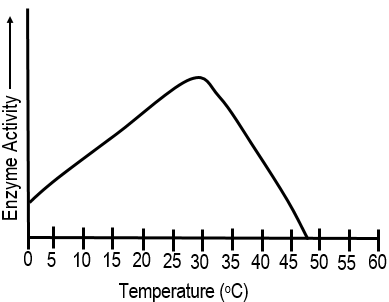
Based on the graph, what is the optimal temperature for this enzyme? 
a)
15oC
b)
40oC
c)
30oC
d)
35oC
69.

The amount of energy needed for a reaction to occur is called the (a)   ?

70.

What does an enzyme do?

a)

Decreases the activation energy of a reaction

b)

Increases the activation energy of a reaction

c)

Does not change the activation energy of a reaction

d)

Makes the reaction last longer

71.

How does an enzymes shape relate to its function?

a)

the shape of the enzyme has no relation to its function

b)

the enzyme is shaped specially for certain substrates to perform a specific reaction

c)

the enzyme shape acts as a receptor to certain products

d)

the enzyme shape can fit into specific substrates to cease a reaction

72.

What's going on in this picture?

a)

The enzyme is taking the red substrate and turning it blue

b)

The enzyme's active site is blocked by a competitive inhibitor

c)

The enzyme can't function if too many substrates are trying to bind

d)

This is an example of an anabolic enzyme reaction

73.

An activor or inhibitor binding place that is not the active site, causing the enzyme to change conformation (shape) is an example of ...

a)

competative inhibition

b)

allosteric control

c)

optimum conditions

d)

induced fit

74.

Glucose is ____________________ during cell respiration

a)

reduced

b)

oxidized

75.

ATP is a more stable molecule than ADP

a)

True

b)

False

76.

During cell respiration, the first step is to USE to ATP

a)

True

b)

False

77.

Glycolysis occurs in the cytoplasm and produces all of the following EXCEPT

a)

ATP

b)

Carbon Dioxide

c)

3 carbon chain (pyruvate)

d)

NADH (electron carrier)

78.

The purpose of the Krebs cycle is to

a)

completely oxidize the remaining glucose chain

b)

produce carbon dioxide

c)

produce water

d)

regenerate NAD+ so glycolysis can continue

79.

Chemiosmosis is the use of energy to _______________________

a)

set up a hydrogen ion gradient

b)

to produce water

c)

oxidize glucose

d)

remove electrons from the ETC using oxygen gas

80.

What is FALSE about ATP synthase

a)

it can be found in the mitochodrion and chloroplast

b)

it is an enzyme with two substrates, ADP and a phosphate

c)

it is a transport protein

d)

it actively transports H+ across membranes

81.

Oxidative phosphorylation uses _______________ to make ATP

a)

electrons energy from glucose

b)

electron energy from oxygen gas

c)

electron energy from water

82.

What makes more ATP

a)

oxidative phosphorylation during ETC and ATP synthase

b)

substrate level phosphorylation during glycolysis and krebs

83.

Oxygen gas is a _____________ of cell respiration because it _______

a)

reactant, replaces lost electrons from glucose

b)

reactant, removes low energy electrons from the ETC chain

c)

product, it the left over after the carbon chain releases its electrons

d)

product, when water splits to give electrons, oxygen gas is the waste product

84.

Purpose of fermentation is to

a)

make NAD+

b)

make carbon dioxide

c)

oxidize glucose

d)

create a proton gradient

85.

All of the follow occur anaerobically EXCEPT

a)

glycolysis

b)

fermentation

c)

Krebs cycle

86.

If the ETC was blocked by cyanide what would happen?

a)

the mitochondrion would over heat

b)

excessive NAD+ would build up in the cells and blood

c)

oxygen levels would decrease

d)

NADH and FADH2 would be in high levels

87.

A mouse at 10 C would use oxygen _______________ than a snake at 10 C (assume same size)

a)

faster

b)

slower

88.

If the environment temperature is 40 C a snake's body will be 40 C.

a)

True

b)

False

89.

Phosphofructokinase is an enzyme used in glycolysis. Which of the following will make is work more efficiently?

a)

increased levels of ATP

b)

increased levels of AMP

c)

increases levels of oxygen gas

d)

increased levels of pyruvate

90.

ATP synthase directly uses _____________ to spin in order to connect phosphate onto ADP

a)

diffusion from a proton gradient

b)

diffusion from an electron gradient

c)

active transport of a proton gradient

d)

active transport of an electron gradient

91.

What is NOT produced during glycolysis

a)

ATP

b)

NADH

c)

Pyruvate

d)

CO2

92.

Which of the following can still happen without oxygen gas present in the cell

a)

production of NAD+ at the electron transport chain

b)

production of NADH during krebs cycle

c)

production of NADH during glycolysis

d)

oxidative phosphorylation at the ATP synthase

93.

What is this process showing?

a)

substrate level phosphorylation

b)

chemiosmosis

c)

Krebs cycle

d)

glycolysis

94.

Which of the following is FALSE about this process?

a)

the pH of the intermembrane space is more acidic than the matrix

b)

the H+ is using facilitated diffusion as it passes through the ATP synthase

c)

ATP is used to move the H+ against its gradient along the ETC

d)

O2 gas is needed to remove the low energy electrons from the ETC

95.

If this is a yeast solution, what type of gas will be collecting in the inverted graduated cylinder

a)

hydrogen

b)

carbon dioxide

c)

oxygen gas

96.

What is this process showing?

a)

glycolysis

b)

Krebs cycle

c)

alcoholic fermentation

d)

aerobic respiration

97.
Time period between cell divisions.
a)
Anaphase
b)
Mitosis
c)
Cytokinesis
d)
Interphase
98.
3 stages of interphase
a)
G1, M, G2
b)
M, C, S
c)
G1, S, G2
d)
P, M, G1
99.
During which stage of interphase does the DNA duplicate.
a)
M Phase
b)
G1 Phase
c)
S Phase
d)
G2 Phase
100.
During which stage of interphase does cell growth occur and the production of more organelles occur.
a)
G1 Phase
b)
S Phase
c)
C Phase
d)
G2 Phase
101.

Apoptosis is

a)

programmed cell death

b)

mysterious cell death

c)

programmed cellular mutation

d)

mysterious cellular mutation

102.
p53 activates which of the following?
a)
Tumor suppressor genes
b)
cell cycle
c)
DNA repair proteins
d)
uncontrolled cell division
103.
The phase of mitosis in which the sister chromatids separate from each other
a)
prophase
b)
metaphase
c)
anaphase
d)
telophase
104.
How does mitosis in plant cells differ from mitosis in animal cells?
a)
animal cells form a cell plate
b)
plant cells form a cell plate
c)
plant cells go through the process in reverse
d)
plant cells go through two rounds of mitosis while animal cells just do one
105.
In which phase of mitosis do the sister chromatids line up on the equator of the cell?
a)
Prophase
b)
Metaphase
c)
Anaphase
d)
Telophase
106.
Which phase is shown in the diagram
a)
prophase
b)
metaphase
c)
anaphase
d)
telophase
107.
What is one half or one rod of the condensed chromatin called?
a)
DNA
b)
chromatin
c)
chromatid
d)
chromosome
108.

What is the correct order of nuclear division?

a)

prophase, prometaphase, metaphase, anaphase, telophase

b)

prometaphase, metaphase, prophase, anaphase, telophase

c)

telophase, anaphase, metaphase, prophase

d)

prophase, anaphase, prometaphase, metaphase, telophase

109.
Cell division is represented by what letter?
a)
A
b)
B
c)
C
d)
D
110.

A kinetochore is a special protein located at the ___________ of a chromosome.

a)

membrane

b)

centrioles

c)

centrosome

d)

cell wall

111.

Instead of mitosis, prokaryotes use a process known as ______ to replicate.

a)

meiosis

b)

fusion

c)

diploid budding

d)

fission

112.
Which is true about embryonic stem cells?
a)
They no longer divide, their cell type is set and cannot change.
b)
They can develop into only one type of cell.
c)
They can become any cell type in the body.
d)
They are found in adults.
113.
Stem cells are
a)
cells that grow uncontrollably
b)
undifferentiated and can be any type of cell
c)
never go through cell division
d)
only found in embryos
114.
An abnormal mass of cancer cells is called a 
a)
tumor
b)
cyst
c)
lesion
d)
polyp
115.
Metastasis is
a)
the spread of cancer from one part of the body to another.
b)
the growth of tumors in the lungs
c)
cancer of the blood cells
d)
cancer that is found in connective tissues
116.

Which of the following is characteristic of a malignant rather than a benign tumour?

a)

Develops a blood supply.

b)

Undergoes metastasis.

c)

Cells divide an unlimited number of times.

d)

Grows without needing a growth signal.

117.

Fully grown parent cells split into two halves resulting in two daughter cells with the exact DNA as the parent.

a)

Binary Fission

b)

Budding

c)

Fragmentation

d)

Vegetative Reproductions

118.
In binary fission how does the DNA of the daughter cells compare to the DNA of the parent cell? 
a)
It is only half of the amount of DNA found in the parent.
b)
It is identical.
c)
It is a mix of the parent's DNA.
d)
It has some similarities and some differences.
119.
How many parent(s)are needed for asexual?
a)
4
b)
1
c)
9
d)
100
120.
All Offspring of Asexual reproduction are identical
a)
True
b)
False
121.
Suppose that in sheep, a dominant allele (B) produce black hair and a recessive allele (b) produce white hair. If you saw a black sheep, you would be able to identify
a)
its phenotype for hair color
b)
its genotype for hair color
c)
the genotype of only one of its parents
d)
the phenotype of both of its parents
122.
One of the main reasons genes assort independent of one another  is that 
a)
they produce unrelated traits
b)
they produce related traits
c)
they are on the same chromosome
d)
they are on different chromosomes.
123.
In mice, the homozygous mice are black and white. The heterozygous mice are gray. What pattern of inheritance is expressed in fur color in mice?
a)
complete dominance and recessiveness
b)
co-dominance
c)
incomplete dominance
d)
pleiotropy
124.
Chromosomes that do NOT play a role in determining the sex of an individual are called
a)
sex chromosoems
b)
X and Y
c)
autosomes
d)
A and B are correct
125.
A heterozygous white pig(Wwmate with blue pig (ww).  
Probability of getting heterozygous offspring?
a)
50%
b)
25%
c)
100%
126.
The genetic make up of this flower is ________.
a)
homozygous recessive
b)
heterozygous
c)
homozygous dominant
d)
white
127.
A child has type O blood, if mother has type A blood, what would the fathers blood type be
a)
A,B, or O
b)
AB or A
c)
AB or B
d)
O only
128.
Heterozygous is when...
a)
the alleles are the same
b)
the alleles are different
c)
the alleles are absent
d)
the alleles are present
129.
In plants, tall (T) is dominant to short (t). Perform the following cross: Tt x Tt. What is the probability of producing a short plant?
a)
0%
b)
25%
c)
50%
d)
75%
130.
What gamete possibilities could come from this parent's genotype?
a)
AB, AB, aB, aB
b)
Ab, AB, Ab, ab
c)
Ab, Ab, Ab, Ab
d)
AB, aB, ab, aB
131.
What goes in box 1
a)
AABb
b)
AABB
c)
aabb
d)
AaBb
132.
Cross Two Homozygous plants
(
RRYY x rryy)
R = round seeds, r  = wrinkled seeds Y = yellow seeds, y = green seeds
What percent will have Round and Yellow seeds? 
a)
0%
b)
25%
c)
50%
d)
100%
133.
A single gene has 3 or more alternative forms. These are called
a)
heterozygotes
b)
multiple alleles
c)
epistatic
d)
polygenic
134.
If the parents of a cross are AaBcCc x aaBBcc. What is the probability of an offspring that is homozygous recessive for all 3 traits?
a)
1/64
b)
1/32
c)
1/8
d)
O
135.
If a female was a carrier for sex-linked color blindness, what percentage of her male children would also be color blind?
a)
0%
b)
25%
c)
50%
d)
100%
136.
In a sex-linked inheritance pedigree you would expect to see
a)
more affected females
b)
all carrier males
c)
more affected males
d)
an equal number of affected males and females
137.
A man who has a sex-linked allele will pass it on to
a)
all his daughters
b)
all his sons
c)
1/2 of his daughters
d)
1/2 of his sons
138.
Which of the following statements best describes what a Barr body is and its significance?
a)
it is an inactivated Y chromosome and results in a man being sterile
b)
It is an inactivated Y chromosome, and the person who has it appears female
c)
It is an inactivated X chromosome and results in females with half their cells have one X inactivated and in the other half of their cells have the other X inactivated
d)
it is an inactivated X chromosome and results in females who are sterile
139.
In humans, hemophilia is an X-linked recessive trait. If a man and a woman have a son who is affected with hemophilia, which of the following is definitely true?
a)
The mother carries an allele for hemophilia
b)
The father carries an allele for hemophilia
c)
The father is afflicted with hemophilia
d)
both parents carry an allele for hemophilia
140.
In peas, the trait for tall plants is dominant (T) and the trait for short plants is recessive (t).  The trait for yellow seeds is dominant (Y) and the trait for green seeds is recessive (y).
A cross between two plants results in 292 tall, yellow plants and 103 short, green plants.  What are the most likely genotypes of the parents?
a)
TtYY x Ttyy
b)
TTYy x TTYy
c)
TTyy x TTYy
d)
TtYy x TtYy
141.
Hemophilia is a recessive x-linked disorder.
Which genotype represents a male with hemophilia?
a)
XHXh
b)
XhXh
c)
XHY
d)
XhY
142.
What is the genotype of the father?
a)
AA
b)
aa
c)
Aa
d)
AA or aa
143.
What are alleles
a)
different forms of the same gene
b)
an alternate step of the cell cycle
c)
body cells
d)
another name for gametes
144.
Which of the following DOES NOT increase variation in the next generation?
a)
Independent Assortment
b)
Random Fertilization
c)
Crossing Over
d)
Asexual reproduction
145.

When crossing a homozygous recessive with a heterozygote, what is the chance of getting an offspring with the homozygous recessive phenotype?

a)

0%

b)

25%

c)

50%

d)

75%

e)

100%

146.

This pedigree chart is for a family, some of whose members exhibit the recessive trait, woolly hair. Affected individuals are indicated by an open square or circle. What is the likelihood that the progeny of D-3 and D-4 will have wooly hair?

a)

0%

b)

25%

c)

50%

d)

75%

e)

100%

147.

Which of the following is an example of polygenic inheritance?

a)

pink flowers in snapdragons

b)

The ABO Blood group in humans

c)

Skin color in humans

d)

Huntington's disease in humans

148.

A new species of tulip was recently discovered. A population of pure red tulips was crossed with a population of pure blue tulips. The resulting F1 generation was all purple. This result is an example of which of the following?

a)

Complete dominance

b)

Incomplete dominance

c)

Co-dominance

d)

Linkage

149.
The three stages of cell signalling are
a)
paracrine, local, and synaptic
b)
reception, transduction, and response
c)
transcription, translation, and folding
d)
alpha, beta, and gamma
150.
1.  Each of the following numbered processes are involved in signal transduction pathways:  
 I.  Response
 
II.  Amplification
 
 III.  Reception
 
IV.  Transduction
Which of the following represents the sequence of events in a typical signal transduction pathway?
a)
I, II, III, IV
b)
III, I, IV, II
c)
II, IV, I, III
d)
III, IV, II, I
151.
A signal molecule that binds to a plasma-membrane protein is a
a)
ligand
b)
second messenger
c)
protein kinase
d)
receptor protein
152.
Protein kinases activate other relay proteins by adding a(n) ____ to them.
a)
phosphate
b)
ATP molecule
c)
cAMP
d)
GTP
153.
What type of transmembrane receptor is being shown?
a)
gated ion channel
b)
G-protein receptor
c)
tyrosine kinase receptor
154.
What do second messengers do?
a)
transport a signal through the lipid bilayer
b)
relay a signal from the outside to the inside of the cell
c)
relay message from the inside of the mebrane throughout the cytoplasm
d)
dampen the message
155.
What determines whether a cell is a target cell for a particular signal molecule?
a)
phosphorylation cascade
b)
cAMP
c)
signal receptors
d)
phosphatase
156.
G proteins are a family of proteins involved in transmitting chemical signals originating from outside a cell into the inside of the cell. G proteins function as molecular switches.
Which of the following best describes the role in which the G protein is most intimately involved in the process shown above?
a)
Production of the ligand molecule.
b)
Reception of the signal.
c)
Transduction of the signal.
d)
Production of response to signal.
157.

Type of cell signaling where the ligand is released and will affect cells in its "neighborhood"

a)

autocrine signaling

b)

juxtracrine signaling

c)

paracrine signaling

d)

endocrine signaling

158.

Type of cell signaling where the ligand is produced at a location distant from its target cell(s)

a)

autocrine signaling

b)

juxtracrine signaling

c)

paracrine signaling

d)

endocrine signaling

159.

What is being depicted in the image?

a)

Amplification of the signal molecule

b)

Enzymatic proteins inhibiting process of the signal transduction pathway

c)

Kinase groups adding dimer groups to other enzymes

d)

Diffusion of molecules within the cell due to the signaling molecule

160.

Testosterone does not affect all cells of the body because __________.

a)

testosterone cannot cross the plasma membrane

b)

not all cells have cytoplasmic receptors for testosterone

c)

not all cells in the body have membrane receptors for testosterone

d)

it is a local regulator

e)

it affects only cells that have ion-channel receptors

161.

The general name for an enzyme that transfers phosphate groups from ATP to a protein is __________.

a)

protein dehydrogenase

b)

protein kinase

c)

protein phosphatase

d)

peptidase

e)

protein cyclase

162.

The source of phosphate for a phosphorylation cascade is __________.

a)

cAMP

b)

protein kinase

c)

GTP

d)

ATP

e)

protein phosphatase

163.
Which of the following statement is correct?
a)
Cell communicate with one another in multicellular organisms using extracellular signaling molecules or hormones
b)
Cell communicate with one another in unicellular organisms using extracellular signaling antigen and antibody
c)
Cell communicate with one another in multicellular organisms using intracellular signaling molecules only
d)
Cell communicate with one another in unicellular organisms using intracellular signaling antigen and antibody
164.
A cell is known to respond to a particular signaling molecule. Which of the following must be true of this cell?
a)
It is in the heart muscle
b)
it is also the site of production for the signaling molecule
c)
It contains the receptor for the signaling molecule
d)
It is incapable of signal transduction
165.

What is Apoptosis?

a)

Programmed cell death

b)

Inflammation of cell

c)

Phagocytosis

d)

Plasmolysis

166.

Why is apoptosis required?

a)

Glycolysis

b)

Cell division: Meiosis and mitosis

c)

Elimination of threats such as viruses and DNA damage

167.
Which of the following are products of the light reactions of photosynthesis that are utilized in the Calvin Cycle?
a)
CO2 and glucose
b)
ATP and NADPH
c)
ADP, P and NADP+
d)
H2Oand O2
168.
Where does the Calvin cycle take place?
a)
Stroma
b)
thylakoid
c)
thylakoid space
d)
matrix
169.
When oxygen is released as a result of photosynthesis, it is a direct by-product of____
a)
reducing NADP+
b)
splitting water molecules
c)
chemiosmosis
d)
electron transfer in photosystem 1
170.
T or F: Autotrophs, but not heterotrophs, can nourish themselves beginning with carbon dioxide and other nutrients that are entirely organic
a)
True
b)
False
171.
The splitting of carbon dioxide to form oxygen gas and carbon compounds occurs during ______
a)
photosynthesis
b)
respiration
c)
neither photosynthesis or respiration
d)
both photosynthesis and respiration
172.
T or F: Photosynthesis is anabolic and Cellular respiration is catabolic
a)
True
b)
False
173.
The color of light least effective in driving photosynthesis is _________
a)
blue
b)
red
c)
orange
d)
green
174.
T or F: The light reactions of Photosynthesis requires ATP.
a)
True
b)
False
175.
In a plant cell, where are ATP synthase complexes located?
a)
thylakoid membranes only
b)
inner mitochondrial membranes only
c)
thylakoid membrane and inner mitochondrial membranes
d)
thylakoid membrane and plasma membranes
176.
What is the primary function of the Calvin cycle?
a)
regenerate ATP for use in the light reactions of photosynthesis
b)
produce carbon dioxide for use in the light reactions of photosynthesis
c)
produce oxygen by oxidizing water
d)
produce simple sugars from carbon dioxide
177.
The splitting of carbon dioxide to form oxygen gas and carbon compounds occurs during ______
a)
photosynthesis
b)
respiration
c)
neither photosynthesis or respiration
d)
both photosynthesis and respiration
178.
Which of the following events occurs in the light reactions of photosynthesis?
a)
NADP+ is produced
b)
ATP is consumed to yield ADP
c)
light is absorbed and funneled to  chlorophyll a
d)
carbon dioxide is fixed in organic molecules
179.
What supplies the electrons that are lost in PS I?
a)
the electrons from PS II
b)
water
c)
glucose
d)
oxygen
180.

The light reactions occur in the ________ and the calvin cycle takes place in the ________.

a)

Chloroplast / thylakoid membrane

b)

stroma / thylakoid

c)

mesophyl / stomata

d)

thylakoid membrane / stroma

181.

Plants obtain CO2 into the chloroplast by

a)

active transport

b)

diffusion

c)

facilitated diffusion

d)

endocytosis

182.

Which of the following would have the least affect on photosynthetic rate?

a)

increase the temp from 20°C to 30°C

b)

increasing the CO2 from 400 ppm to 600ppm

c)

increasing the light intesity from 40 Watts to 60 Watts

d)

increasing the amount of O2 from 20% to 30% in the air

183.

Where does the oxygen produced in the light dependent reactions of photosynthesis come from?

a)

chlorophyll

b)

carbon dioxide

c)

the atmosphere

d)

water

184.

ATP is made during the light reaction using all of the following EXCEPT

a)

proton pump

b)

hydrogen ion gradient

c)

electron energy from photosystem II

d)

NADPH donating electrons

185.

If the proton (H+) pump in the thylakoid was not working which molecule could not be made during the light reaction?

a)

NADPH

b)

ATP

c)

Water

d)

Oxygen gas

186.
Where does the carbon come from that is used to form glucose?
a)
The soil
b)
CO2 in the air
c)
From other carbohydrates
d)
Calvin Cycle
187.
What is one function of the other pigments  besides chlorophyll, in the chloroplast?
a)
to block damaging wavelengths of light
b)
to absorb different wavelengths than the chloroplasts
c)
to provide different colors to the leaves
d)
to transfer energy to a separate photosystem beside the one using chlorophyll a and b.
188.
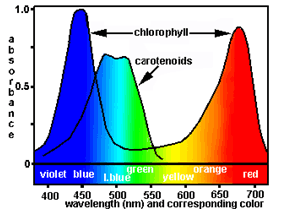
Plants with the largest amount of which pigment will be best suited for growing conditions where light has a green hue.
a)
Chlorophyll A
b)
Chlorophyll B
c)
Carotenoids
d)
A combination of all 3
189.
Which product is produced by the splitting of water during the light-dependent reactions of photosynthesis?
a)
NADPH
b)
oxygen
c)
glucose
d)
carbon dioxide
190.
An _____  can make its own food, while a _____ cannot make its own food.
a)
Autotroph, Heterotroph 
b)
Heterotroph, Autotroph
c)
Chlorophyll, Chloroplast 
191.
Which of the following conclusions can be drawn from this graph?
a)
The optimum pH of the enzyme is 6.6.
b)
The optimum pH of the enzyme is 5.8
c)
The enzyme’s activity increases as pH increases 5.0 to 9.0
d)
The enzyme’s activity is greater around pH of 8.0 .