
 Worksheets
Evolution Unit Review
Total questions: 43
Worksheet time: 31mins
Which of the following is an example of a vestigial structure?
Dog's tail
Bird's beak
Human appendix
Fish gills
Convergent evolution leads to the development of similar structures in unrelated organisms.
True
False
Why do scientists study embryos as they search for evidence of evolution?
Embryonic development can provide insights into the evolutionary relationships between two different species
Scientists can identify similarities and differences in their development that can show shared ancestry
Studying embryos allows scientists to trace changes that have occurred within a species
All the above
What does the term "analogous structures" refer to?
Structures that are essential for survival
Structures that are exactly the same in every organism
Structures that are remnants of ancient organisms
Structures that serve the same function but have different evolutionary origins
In natural selection, how does the environment contribute to the survival and reproduction of organisms?
By selecting for traits that are well-suited to the environment
By promoting traits randomly
By causing equal pressure on all traits in a population
By favoring individuals with any genetic mutations
Which of the following best describes how natural selection contributes to the process of evolution?
Natural selection directly causes genetic mutations in organisms
Natural selection acts as a random force, leading to unpredictable changes in species
Natural selection favors traits that enhance survival and reproduction
Natural selection accelerates the rate of reproduction in a population
What is speciation?
The process when new species arise from existing ones
Natural selection
Makes a species more vulnerable
Causes equal pressure on all traits in a population
In the concept of "survival of the fittest," what does "fittest" mean?
The species works out everyday
the ability of an organism to adapt and thrive within its environment
when a new species arise from existing ones
a species that goes to the gym twice a week
What role does genetic diversity play in a species' resilience to diseases and parasites?
It has no impact on a species' susceptibility to diseases
It reduces the ability of a species to resist disease
It allows for variations in immune responses, contributing to resistance
It makes a species more vulnerable to parasitic attacks
What is a fossil?
A type of rock formation
A term used for ancient artifacts made by humans
A rare mineral found in caves
The preserved remains of living organisms from the past
Fossils can only be found in sedimentary rock that are only found in remote, uninhabited areas, away from human activity.
True
False
Where can fossils be found?
Fossils can be found in all types of rocks
Fossils can be found in diverse environments worldwide
Fossils can be found during human activity, such as, excavation, mining or construction projects
All the above
How do fossils provide for evolution? (two correct answers)
By showing the gradual changes in organisms over time
By demonstrating that all organisms have remained unchanged since their creation
By revealing the existence of now-extinct species
By providing direct observations of evolutionary processes
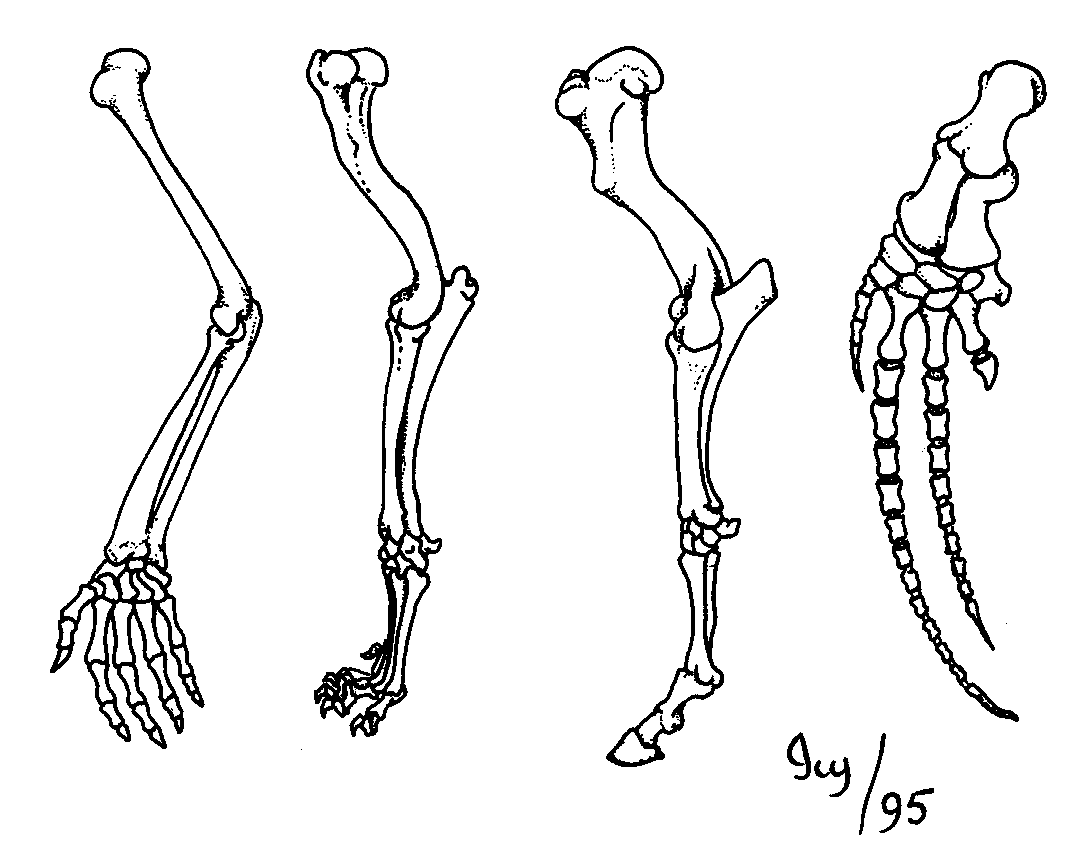


Differences in traits are called:
natural selection
genetic variations
artificial selection
adaptations
Vocab check:
The theory that organisms have slowly changed over time...
fossil record
relative dating
evolution
adaptation

Organisms D and C clearly lived in an aquatic (water) environment. Organism A does not look like it lived in the water. What is the most likely explanation for this?
The fossil in layer A died on land and was carried to the water
The fossils in layer C and D did not live in the same location as the fossil in layer A
The environment changed over a long period of time. It used to be under water, but is not anymore
In which kind of rock do we usually find a fossil?
sedimentary rock
metamorphic rock
igneous rock
If you know the age of a fossil, you know the relative age of the ________________ it was found inside.
sticky tar
rock
amber
ice
If you know the age of a rock, you know the relative age of the _________________ that was found inside.
sticky tar
fossil
amber
ice
Which of the following would be an example of absolute age?
Fossil A is older than Fossil B
Fossil A and Fossil B are the same age
Fossil A is 10 million years old


What are the oldest fossils and why?
B, C- because they are closest to the top
A, B- because they are closest to the bottom
They are all the same age- because they are all found on layer 2
A, B- because they are found closest to the top

Which of the following can be learned by using the fossil record?
When organisms changed or evolved
when organisms appeared on Earth
when organisms became extinct
All the above
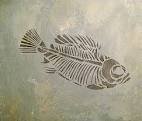
If scientists found this fossil in a desert, what could they infer?
what fish are like today
that this fish lacked oxygen
that water once covered the area where this fossil was found

When did fossil A become extinct?
Layer 1
Layer 2
Layer 3
Layer 4


What is the best reason that fossil #4 is NOT a good index fossil?
It is not widespread
it is not short-lived (in numerous layers)
It is in half of the outcrops


