wayground logo

Free Printable Worksheets

Font size

S
M
L
XL
Worksheets

Sliding Filament Theory - plus extras

Total questions: 32

Worksheet time: 17mins

Name
Class
Date
1.

We can tell when a muscle is contracted as the Z lines will be..?

a)

closer together

b)

further apart

c)

moved up

d)

moved down

2.

___are thin filaments.

a)

troponin

b)

tropomyosin

c)

actin

d)

myosin

3.

___are thick filaments.

a)

actin

b)

myosin

c)

troponin

d)

tropomyosin

4.

___are regulatory proteins that cover the myosin binding site on the actin.

a)

troponin-tropomyosin

b)

sarcomere

c)

sarcolemma

d)

sarcoplasmic reticulum

5.

Calcium binds to ___of the troponin-tropomyosin complex.

a)

troponin

b)

tropomyosin

c)

actin

d)

myosin

6.

Calcium is stored in the ___.

a)

sarcoplasm

b)

sarcolemma

c)

sarcoplasmic reticulum

d)

transverse tubules

7.

___forms a crossbridge with actin.

a)

actin

b)

myosin

c)

calcium

d)

ATP

8.

___provides energy for muscle contraction and relaxation.

a)

cAMP

b)

ADP

c)

ATP

d)

M line

9.
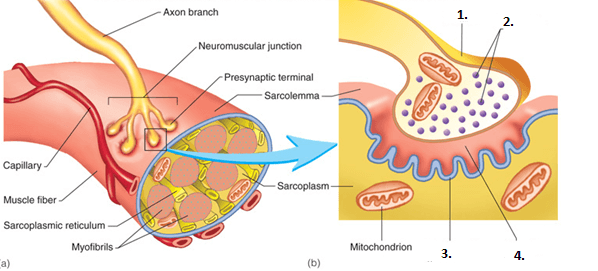
Region where a motor neuron comes in close contact with a muscle cell.
a)
neurotransmitter
b)
muscular dystrophy
c)
muscle tension
d)
neuromuscular junction
10.
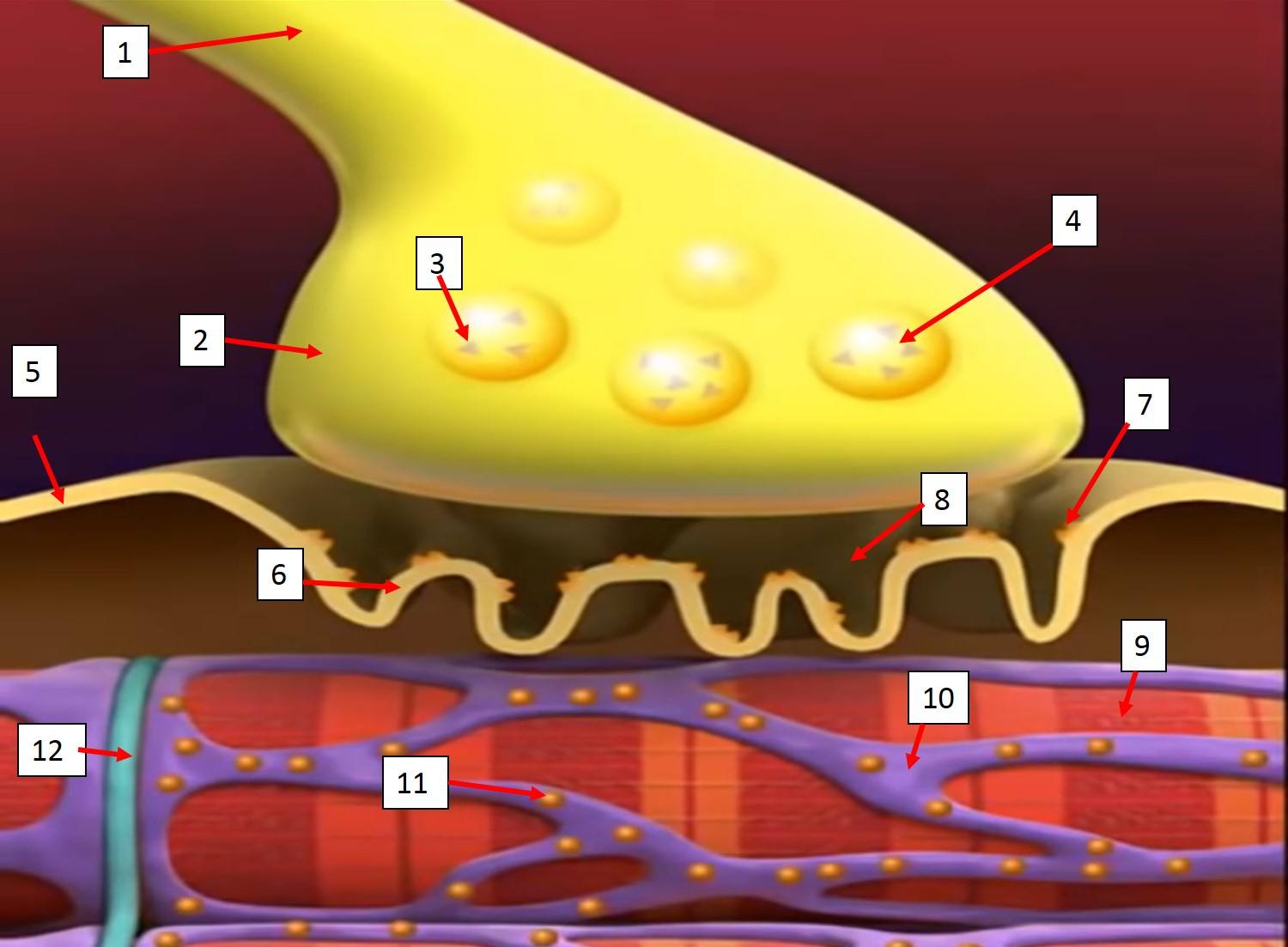
The gap between a neuron and a muscle cell: (#4 in the diagram)
a)
synaptic cleft
b)
sarcolemma
c)
vesicle
d)
Ca2+ ion
11.
The neurotransmitter stored in the axon terminal identified as #3
a)
Acetylcholine
b)
Protein Channel
c)
Calcium Ion (Ca2+)
d)
Syanptic Cleft
12.
The organelle containing actin and myosin identified as #9
a)
ACh
b)
Sarcolemma
c)
Vesicle
d)
Myofibril
13.

Contractile unit of a muscle which is also the functional unit of a muscle is ...

a)

sarcomere

b)

motor unit

c)

fascicle

d)

myofibril

14.
What two chemicals are necessary for muscle contraction to occur?
a)
Niacin and Potassium
b)
Calcium and ATP
c)
Sodium and Potassium
d)
Ach and Potassium
15.
What is a crossbridge?
a)
Where myosin binds to actin
b)
Where the calcium crosses into the cytoplasm
c)
Where calcium binds with troponin
d)
None of the answers are correct.
16.

The Z Line provides attachment for the ...

a)

Troponin

b)

Myosin

c)

Actin

d)

ATP

17.

What starts a muscle contraction?

a)

Release of Calcium Ions

b)

Attachment of Myosin-Heads

c)

An Action Potential

d)

Release of ADP

18.

What binds to the Myosin Head to cause it to detach from the Actin?

a)

ATP

b)

ADP

c)

CNS

d)

ETC

19.

The 'prime mover' is also known as...

a)

...the agonist

b)

...the antagonist

c)

...the main muscle

d)

...the concentric muscle

20.
Long distance runners have large proportion of ___________ fibers.
a)
slow oxidative
b)
fast oxidative
c)
fast glycolytic
21.
Which muscle fibre produces the lowest force when in contracts?
a)
Type 1
b)
Type 2a
c)
Type 2b
d)
Type 3
22.

The A band contains

a)

actin filaments only

b)

myosin filaments only

c)

both myosin and actin filaments

d)

neither myosin nor actin filaments

23.

Select all that apply to slow twitch fibres

a)

contract slowly

b)

high level of force

c)

high level of resistance to fatigue

d)

low level of force

24.

What would be the most predominant muscle fibre for this athlete?

a)

Slow

b)

Type 1

c)

Type 11a

d)

Type 11x

25.

"Muscle action where the muscle remains the same length" refers to which type of muscle contraction?

a)

Flexion

b)

Concentric

c)

Isometric

d)

Eccentric

e)

Abduction

26.

What are the 2 types of isotonic contractions?

a)

Eccentric

b)

Synovial

c)

Type 1 and 2

d)

Concentric

e)

Isometric

27.

In the downwards phase of a press-up, the triceps contract....?

a)

Concentrically

b)

Eccentrically

c)

Isometrically

28.
a)
Latissimius Dorsi
b)
Trapezius
c)
Triceps
d)
Erectors
29.

Where are deltoids located?

a)

lower arm

b)

shoulder

c)

temples

d)

bottom

30.
a)
Hamstrin
b)
Quadricep
c)
Tibialis Anterior
d)
Gastrocenmius
31.
Which one of the following is a key characteristic of slow twitch muscle fibers? 
a)
They contain large amounts of Mitochondria
b)
They are fast to fatigue
c)
They are recruited last
d)
They contain low numbers of Mitochondria
32.
Which muscle fibres have the fewest capillaries?
a)
Type 1
b)
Type 2a
c)
Type 2b
d)
Type 8