
 Worksheets
8202L3CHPPT2
Total questions: 65
Worksheet time: 33mins
Modern domestic central heating systems are categorized based on what two factors?
The type of fuel used and the cost
The way the system is filled with water and the pressure it operates at
The size of the house and the number of radiators
The brand of the system and the installation date
What is a characteristic of low pressure, open-vented systems?
They are not connected to the mains water supply
They require a constant supply of electricity to operate
They are fed from a feed and expansion cistern located at high level
They are the most modern type of system available
Sealed, pressurised systems are different from low pressure, open-vented systems because they:
Use gravity to operate
Are fed directly from the mains cold water
Do not use a feed and expansion cistern
Both B and C are correct
What is a modern example of a sealed, pressurised system?
A gravity system
A fully pumped system
A combination boiler system
An open-vented system
What does a combination (Combi) boiler system only require for its operation?
A time switch and a room thermostat
A pilot light and a chimney
A fuel tank and a water pump
A heat exchanger and a blower
What do modern combination boilers contain for safety control?
A thermostat and a timer
An expansion vessel or a pressure relief valve
A fuel gauge and a carbon monoxide detector
A pilot light and a smoke detector
What additional feature do most 'combis' have?
A backup heating element
An integral filling loop
A solar panel connection
A programmable timer
What is the function of the expansion vessel in a combination boiler system?
To regulate the room temperature
To provide the main cold water supply
To accommodate water expansion as it heats
To discharge excess water from the system
What is the purpose of the filling loop in the combination boiler system?
To provide a pathway for heating flow
To allow for manual addition of water to the system
To control the temperature of the hot water supply
To connect the room thermostat to the boiler
What is the purpose of an automatic bypass valve in a boiler system?
To increase water pressure across the boiler
To control water flow and maintain a minimum flow rate through the boiler
To completely stop the water flow through the boiler
To allow for maximum circulation pressure when alternative water paths are open
When must a bypass circuit be installed in a boiler system?
When the boiler is turned off
When the boiler manufacturer does not require one
When the boiler manufacturer requires one or specifies a minimum flow rate during firing
Only in combination boilers
Which boilers typically have an automatic bypass already installed?
Electric boilers
Most combination boilers and sealed system boilers
Solid fuel boilers
Open vent boilers
What do sealed heating systems use instead of a feed and expansion cistern to accommodate the expansion of water?
A) A temporary filling loop
B) An expansion vessel and a pressure relief valve
C) A pressure gauge
D) A combination boiler
Which of the following is NOT a type of sealed heating system mentioned in the text?
A) Sealed systems with an external pressure vessel
B) System boilers that contain all necessary safety controls
C) Combination boilers
D) Open vent boilers
What is the purpose of an expansion vessel in a sealed system?
To pump water throughout the system
To replace the feed and expansion cistern on the vented system and allow safe expansion of water
To heat the water in the system
To measure the pressure within the system
What is the expansion vessel divided by?
A steel plate
A plastic partition
A neoprene rubber diaphragm
A glass barrier
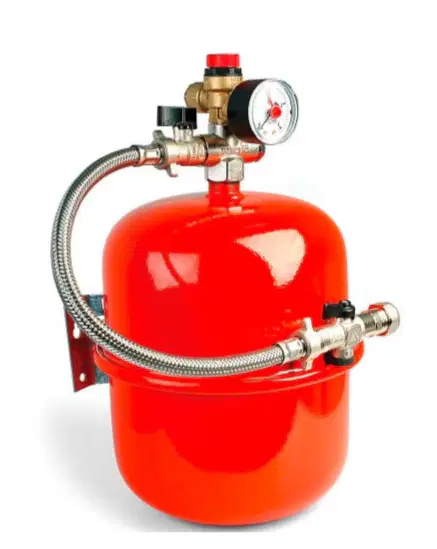
What components are visible on the expansion vessel in the image?
Temperature control valve and pressure gauge
Filling loop, pressure relief valve and pressure gauge
Air vent and safety valve
Thermostat and expansion tank
What is the purpose of the expansion vessel in a sealed system?
To measure the pressure within the system
To provide a cold water supply to the system
To absorb the expanded water when the system is heated
To release pressure from the system as a safety measure
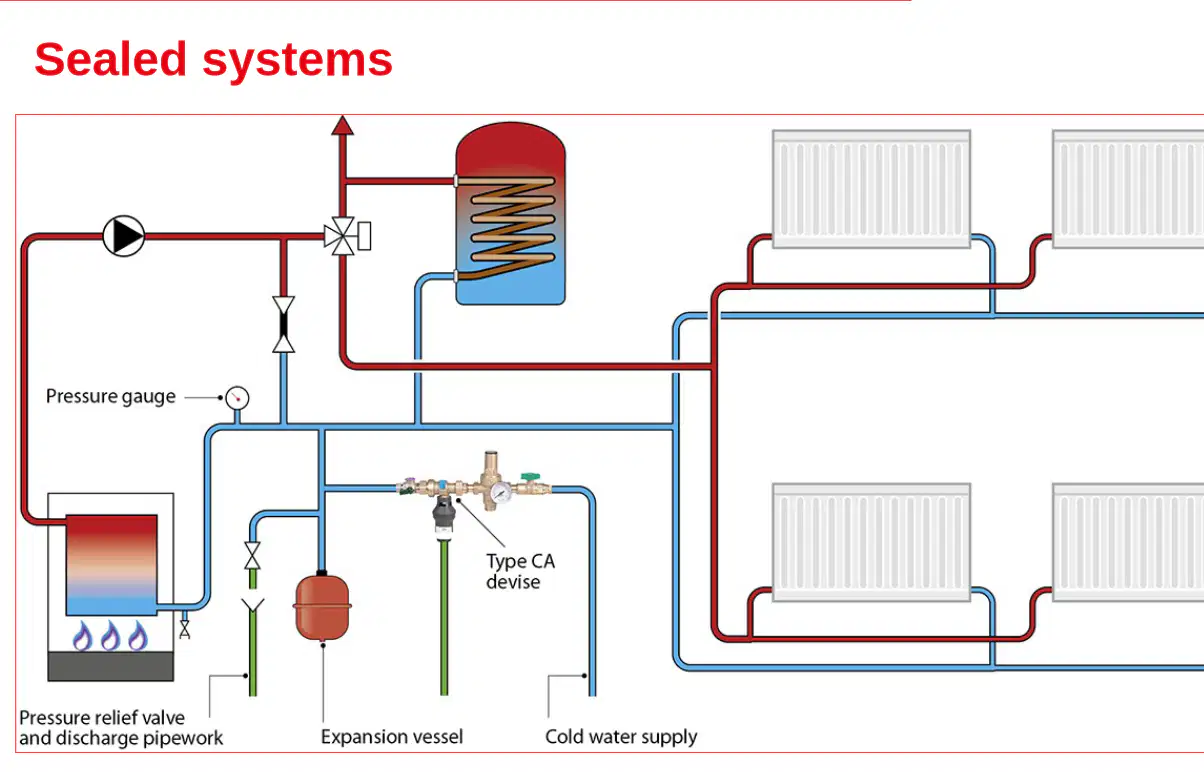
Where is the pressure gauge located in the sealed system diagram?
Next to the cold water supply
Attached to the expansion vessel
On the primary return pipework
On the main supply line before the radiators
What is the function of the pressure relief valve and discharge pipework in the sealed system?
To control the flow of hot water to the radiators
To prevent backflow of water in the system
To absorb excess water from the system
To release excess pressure from the system as a safety measure
What does the Type CA devise in the diagram represent?
A type of pressure gauge
A type of expansion vessel
A backflow prevention device
A type of pressure relief valve
What type of circulation does the two-pipe semi-gravity system have for the hot water circuit?
Pumped circulation
Gravity circulation
Forced air circulation
No circulation
What component controls the heating in the two-pipe semi-gravity system?
Boiler
Room thermostat
Feed and expansion cistern
Programmer
Are two-pipe semi-gravity systems compliant with Building Regulation part L?
Yes, they are fully compliant
No, they are not compliant
Only with modifications
Compliance varies by region
How are boilers connected to two-pipe semi-gravity systems generally described in terms of efficiency?
High efficiency
Moderate efficiency
Low efficiency
Variable efficiency
What does the three-port mid-position valve control in a fully pumped mid-position valve - Y plan system?
The flow of gas to the heating system
The flow of water to the hot water cylinder and heating circuit
The electrical supply to the room thermostat
The temperature of the water in the hot water cylinder
What is the purpose of the automatic bypass valve in the Y plan system?
To regulate the gas pressure in the heating system
To connect the electrical circuits of the system
To connect the flow and return pipe and open when system pressure increases
To control the temperature of the room thermostats
What is the result of the bypass opening when the system pressure increases in the Y plan system?
It causes the water to flow through the boiler, preventing 'lock-out'
It shuts down the boiler immediately
It disconnects the heating circuit from the hot water cylinder
It stops the flow of water to the radiators
How does the Y plan system prolong the circulator life?
By allowing water to flow through the boiler when the system pressure increases
By shutting down the boiler when the room reaches the desired temperature
By preventing water from flowing to the hot water cylinder
By locking out the system when the temperature is too high
What is the purpose of the zone valve in the fully pumped two two-port valves - S plan system?
To increase the water pressure in the system
To control the hot water and CH and act as an isolator by closing the flow of water off
To regulate the temperature of the water in the system
To provide a direct water supply to the radiators
What activates the zone valve that controls the hot water in the S plan system?
The room thermostat
The cylinder thermostat
The programmer
The system bypass
When should an additional heating zone valve be fitted in a property using the S plan system?
When the property is over 100m²
When the property is over 150m²
When the property has more than two bathrooms
When the property has a single floor
What is fitted to the S plan system similarly to the Y plan system?
A two-port zone valve
A cylinder thermostat
An automatic bypass
A programmer
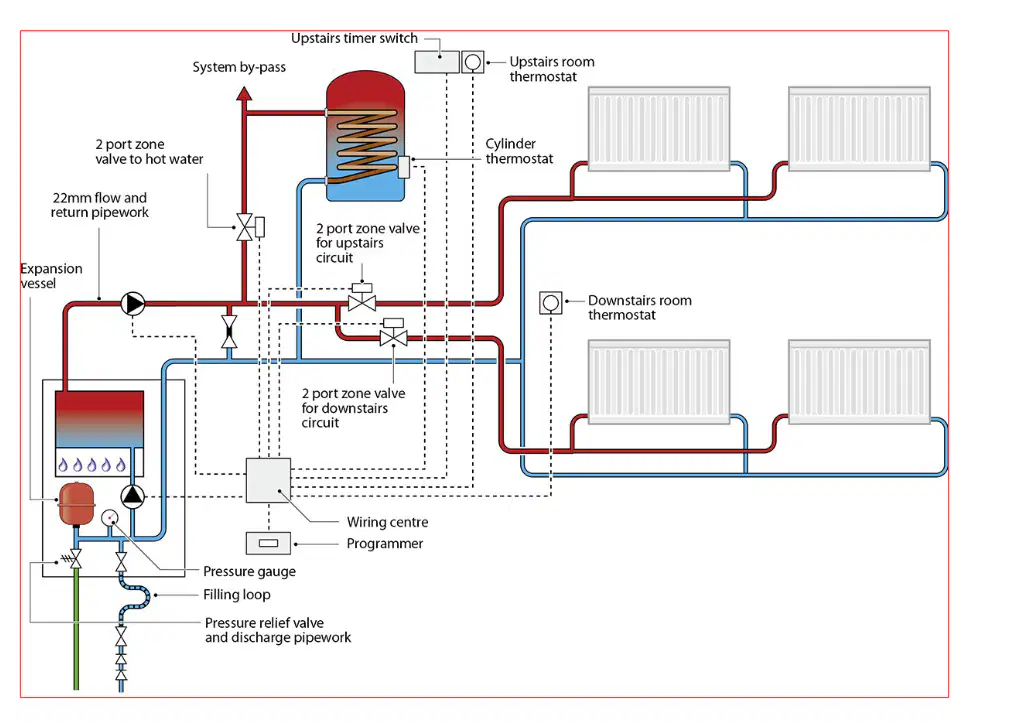
What is the purpose of the 2 port zone valve to hot water in the S plan plus system?
To control the flow of water to the upstairs room
To bypass the system
To control the flow of hot water to the cylinder
To release pressure from the system
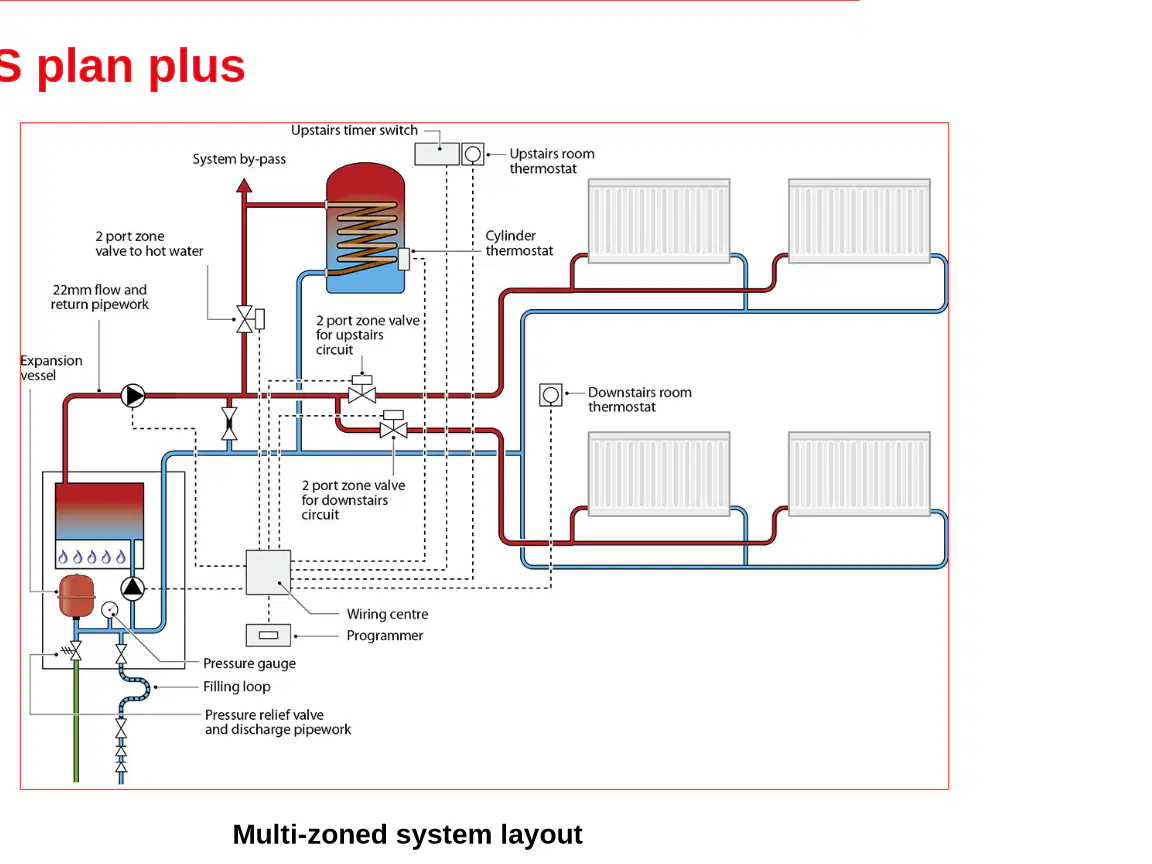
Where is the expansion vessel located in the S plan plus system?
Next to the upstairs timer switch
Near the wiring centre and programmer
Close to the pressure gauge and filling loop
Attached to the return pipework in the boiler
What component in the S plan plus system is responsible for controlling the temperature in the downstairs room?
Upstairs timer switch
Downstairs room thermostat
Cylinder thermostat
Pressure relief valve
What is the function of the filling loop in the S plan plus system?
To control the temperature in the upstairs room
To maintain the pressure within the system
To discharge excess water from the system
To provide hot water to the radiators
Which type of system is recommended for larger properties according to the learning material?
Y Plan
S Plan
S plan +
Neither Y Plan nor S Plan
Which feature is common to both Y Plan and S Plan systems?
Can be used with sealed systems
Boiler interlock
Full thermostatic control
All of the above
Which system can be zoned according to the information provided?
Only Y Plan
Only S Plan
Both Y Plan and S Plan
Neither Y Plan nor S Plan
Is the Boiler interlock feature available in both Y Plan and S Plan systems?
Yes, in both systems
No, in neither system
Yes, but only in Y Plan
Yes, but only in S Plan
What is commonly known as a zone valve?
A three-port diverter valve
A two-port motorised valve
A manual control valve
A pressure relief valve
What activates a zone valve?
A water level sensor
A room or cylinder thermostat
A timer switch
A pressure gauge
What does a zone valve allow to be controlled separately?
Cold water and gas circuits
Hot water and electrical circuits
Hot water and the heating circuits
Waste water and the cooling circuits
What happens to the zone valve when there is a call for heat?
The zone valve closes
The zone valve opens
The zone valve remains unchanged
The zone valve regulates the water pressure
What occurs when the thermostat is up to temperature?
The zone valve opens further
The zone valve starts to regulate flow
The zone valve closes (isolates)
The zone valve triggers an alarm
What does a three-port mid-position valve control in a plumbing system?
The flow of gas to the heating system
The flow of water to both the heating and hot water circuits
The electrical supply to the boiler
The air circulation in central heating systems
What do the labels on the three ports of a mid-position valve represent?
AB = hot water, A = central heating, B = the flow for the boiler
AB = central heating, A = the flow for the boiler, B = hot water
AB = the flow for the boiler, A = hot water, B = central heating
AB = the flow for the boiler, A = central heating, B = hot water
Can a three-port diverter valve provide hot water and heating simultaneously?
Yes, always
No, it provides either hot water or heating, but never both simultaneously
Yes, but only in combi systems
No, it only provides heating
Where is a cylinder thermostat typically situated on a hot water cylinder?
At the bottom
In the middle
A third of the way up
At the top
What is the common maximum temperature setting for a cylinder thermostat?
30°C
45°C
60°C
75°C
Where should a room thermostat ideally be located?
On an outside wall
Near a heat source
1.5m up a wall and away from heat sources
On the ceiling
Which of the following is NOT a type of room thermostat mentioned in the text?
Bi-metallic type
Wi-Fi enabled
App-activated
Solar-powered
What type of room thermostat is more commonly being fitted according to the text?
Basic bi-metallic type
Programmable
Compensating
Manual
What does the boiler thermostat govern?
The temperature of the room
The flow rate of the water
The temperature of the primary water
The pressure of the water in the heating system
What is the purpose of incorporating frost thermostat and pipe thermostat into a system?
To increase the efficiency of the heating system
To stop vulnerable parts of the system from freezing
To reduce the overall cost of the plumbing system
To monitor the water usage in the system
What do the frost thermostat and pipe thermostat override in a plumbing system?
The circulator and boiler
The water supply valves
The programmer and other thermostats
The electrical supply to the system
What should the frost thermostat and pipe thermostat be set to in order to function properly?
3-5°C
10–20°C
20–40°C
30–50°C
Where is the frost thermostat usually positioned?
In the main living areas of a house
In vulnerable areas such as garage installations
Inside the boiler unit
Near the water supply inlet
What is the function of the pipe thermostat when it activates the circulator and boiler?
To cool down the system water
To warm up the system water
To maintain the current temperature of the system water
To shut off the water supply
What is the purpose of programmers in central heating systems?
To provide electrical supply to the heating system
To allow independent timed control of both the hot water and the central heating
To monitor the temperature of the water in the heating system
To physically turn on and off the heating system
What feature do programmers often have for operating the system outside the programmed timings?
A 'lock' feature
A 'reset' button
A 'boost' or 'override' button
A 'shutdown' mechanism
What is the function of a programmer in plumbing systems?
It controls the water pressure in the pipes.
It switches two circuits separately, usually for heating and hot water.
It regulates the electrical supply to the plumbing system.
It cleans the water before it enters the heating system.
What additional functionality does a full programmer provide compared to a standard programmer?
It allows for temperature control only.
It allows for water pressure adjustments.
It allows fully independent time setting for space and hot water heating.
It provides electrical circuit management.
What do programmable room thermostats combine into one unit?
Temperature and pressure control
Temperature and time control
Zone control and water filtration
Pressure control and electrical supply regulation

