wayground logo

Free Printable Worksheets

NEW

Font size

S
M
L
XL
Worksheets

Heat and Temperature - Unit Review

Total questions: 40

Worksheet time: 33mins

Name
Class
Date
1.
what is the meaning of convection?
a)
cold rises heat falls
b)
heat
c)
cold
d)
hot rises cold falls
2.
what is the meaning of conduction
a)
when heat transfers from objects that are not touching
b)
heat rise 
c)
cold fall
d)
when heat transfers from objects that are touching
3.
what kind of heat is happening when the sun heats your body
a)
conduction
b)
convection
c)
density
d)
radiation
4.
heat rises
a)
true
b)
false
5.
A group of friends gather around a fire to stay warm.
a)
conduction
b)
convection
c)
radiation
6.
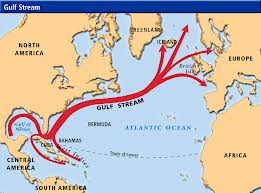
The Gulf Stream is a current that brings warm ocean water from the south to the north.
a)
conduction
b)
convection
c)
radiation
7.
Walking on the warm sand sand with your bare feet.
a)
conduction
b)
convection
c)
radiation
8.
Which of the following is not a conductor 
a)
Wood
b)
Copper
c)
Iron
d)
Silver 
9.
Temperature is the measurement of the average ________ energy of the molecules in an object
a)
Kinetic 
b)
Heat
c)
Motion
d)
None of the above
10.
Objects that allow energy to pass through them easily are _______
a)
Insulators
b)
Conduction
c)
Conductors
d)
None of the above
11.
Boiling water is an example of what two types of heat transfer
a)
Conduction and Radiation
b)
Conduction and Convection
c)
Radiation and Convection
12.
When you touch a cold window, how is energy being transferred?
a)
The window transfers heat to you 
b)
You transfer heat to the window
c)
The sun transfers heat to you
d)
None of the above
13.
Ice melting in a cup is caused by....
a)
The ice is heated up by the drink
b)
Ice is cooling down the liquid
14.
When heat transfers from warmer to cooler, the molecules
a)
move closer and slow down
b)
move closer and speed up
c)
spread out and slow down
d)
spread out and speed up
15.
Average of kinetic energy
a)
Thermal Energy
b)
Temperature
c)
Heat
16.

Temperature is the __________ _________ energy of moving particles

a)

average potential

b)

average kinetic

c)

total potential

d)

total kinetic

17.

Cold things often have a _________ kinetic energy because_______

a)

lower; particles are moving around less

b)

lower; particles are moving around more

c)

higher; particles are moving around the same

d)

higher; particles do not move

18.

Which will have the HIGHEST thermal energy?

a)

Hot cup of tea

b)

Cold bathtub water

c)

Huge lake

d)

Warm bowl of soup

19.

Which will have the LOWEST thermal energy?

a)

Large mug of hot coffee

b)

Baby bottle with warm milk

c)

Gatorade jug of cold Gatorade

d)

Large frozen puddle

20.

As temperature increases, molecules _____________

a)

move slower

b)

move the same

c)

move faster

d)

stop moving

21.
How do materials change from one state of matter to another?
a)
They gain or lose energy
b)
They break appart
c)
The particles get stickyer
d)
They are magnetised to themselves
22.
Which states allow easy flow of particles
a)
Gas and Solid
b)
Gas and Liquid
c)
Solid and Liquid
d)
Gas only
23.
What happens to particles as they heat up?
a)
They slow down
b)
Nothing
c)
They don't move
d)
They speed up
24.

Which state of matter has particles that move the least/slowest?

a)

solid

b)

water

c)

gas

25.
Adding HEAT to matter causes its particles to:
a)
move faster and farther apart
b)
Move slower and farther apart
c)
Move faster and closer together
d)
Move slower and closer together
26.
Which of the following occurs when a liquid becomes a gas?
a)
the particles slow down
b)
the particles beak away from one another
c)
the particles move closer together
27.
How do the particles of matter move as the matter changes state in the diagram?
a)
The particles released energy and move as matter changed state?
b)
The particles released energy and moved more quickly.
c)
The particles gained energy and moved more slowly.
d)
The particles gained energy and moved more quickly.
28.
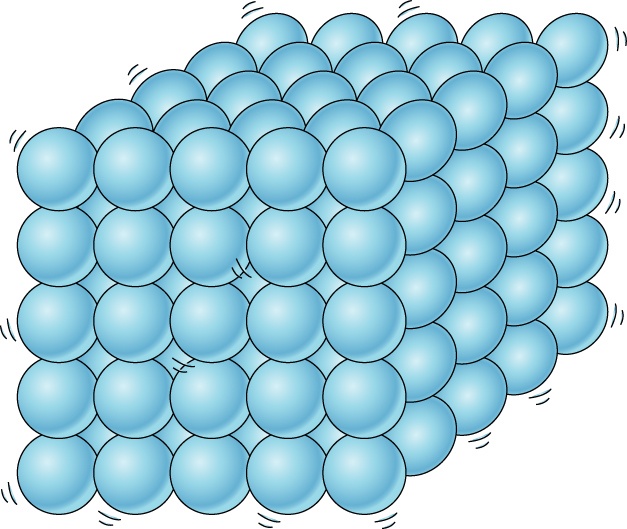
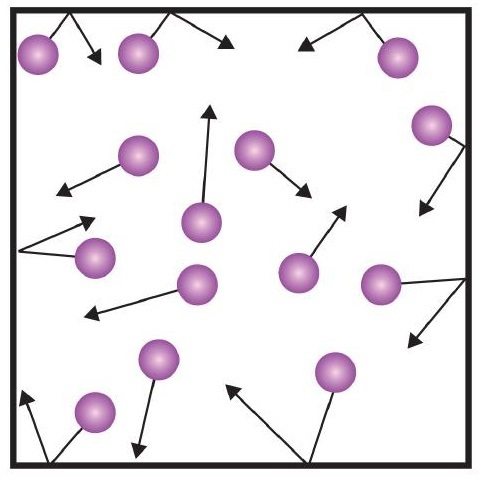
Which description best matches this particle model?
a)
Particles are closely packed, vibrate fixed position, strong intermolecular forces.
b)
Particles are closely packed, no movement, strong intermolecular forces
c)
Particles are closely packed, move around each other, medium intermolecular forces
29.
Which description best matches this particle model?
a)
Particles move fast in specific directions, weak intermolecular force
b)
Particles have a lot of space between them and move fast in random directions.
c)
Particles have lots of energy and have a medium intermolecular forces between them. 
30.

Which state of matter has tightly packed particle in fixed positions?

a)

solid

b)

liquid

c)

gas

31.
If a balloon is cooled what will happen to the volume?
a)
Volume will increase
b)
Volume will decrease
c)
Volume will not change
32.

Heating a substance ____________ molecular motion.

a)

increases

b)

decreases

33.
When an object expands, its _________ increases.
a)
mass
b)
volume
c)
shape
d)
size 
34.
The liquid in the thermometer rises when it is placed in the hot water because ___________. 
a)
it gains heat from the hot water and expands.
b)
loses heat from the hot water and contracts. 
c)
the surrounding air is too warm. 
d)
the liquid is boiling. 
35.
When energy from the sun is used to heat something directly (with no moving parts), it is called... 
a)
active solar heating
b)
passive solar heating
c)
photovoltaic cells
36.
Which of these is a disadvantage of windmills?
a)
amount of land required
b)
time to construct one
c)
the availability of wind
d)
the location of reliable wind
37.
Which renewable energy source uses the superheated water below earth's surface to spin a turbine and generator?
a)
hydroelectric dam
b)
geothermal power
c)
wind farm
d)
hydrogen fuel
38.
__________ is an energy resource that WILL NOT run out in the next several hundred years.
a)
Renewable Energy Resource
b)
Nonrenewable Energy Resource
39.
__________ is an energy resource that WILL run out in the next several hundred years.
a)
Renewable Energy Resource
b)
Nonrenewable Energy Resource
40.
Natural Gas is a __________ energy resource.
a)
Renewable
b)
Nonrenewable