wayground logo

Free Printable Worksheets

Font size

S
M
L
XL
Worksheets

11.1 and 11.2 Quiz (Fossils and Relative Dating)

Total questions: 40

Worksheet time: 24mins

Name
Class
Date
1.

the process by which remains or traces of living things become fossils

a)

fossilization

b)

index fossil

c)

trace fossil

d)

hard remains

2.

fossils used to determine the age of rock layers

a)

index fossil

b)

fossilization

c)

trace fossil

d)

hard remains

3.

Molds are the solid part left over when a rock fills a fossil gap.

a)

True

b)

False

4.

Methods of fossilization can include (check all that apply)

a)

amber

b)

tar

c)

ice

d)

molds

e)

wildfire

5.

Fossilization is extremely common.

a)

True

b)

False

6.

Animals with hard parts are much more likely to become fossilized.

a)

True

b)

False

7.

(a)   are our best clues about the history of life on Earth.

8.

An index fossil allows a scientist to determine the (a)   of the rock it is in.

9.

thin rock layer that is unique and widespread so it can be used to match rock layers by age in different areas (two words)

(a)  

10.

Scientific law that states in horizontal sedimentary rock, the oldest layers are at the bottom

a)

intrusion

b)

fault

c)

index fossil

d)

superposition

11.
The diagram shows a cross section of rocks beside a highway. 
Which rock type is the oldest?
a)
rock type 1
b)
rock type 2
c)
rock type 3
d)
rock type 4
12.
In the diagram which rock lasyer is probably the oldest?
a)
layer 1
b)
layer 2
c)
layer 5
d)
layer 6
13.
Which rock layer most likely contains fossils of the most recently evolved organisms
a)
1
b)
2
c)
3
d)
4
14.
The diagram shows some of the layers of rocks found in the Grand Canyon. Scientists find these layers of rock useful for studying fossils
What type of rock is shown labeled in these layers?
a)
extrusive
b)
igneous
c)
metamorphic
d)
sedimentary
15.
Which can most likely be concluded about the top layer of rock seen in an undisturbed cliff wall?
a)
The top layer is older than layers located farther down the cliff.
b)
The top  layer is younger than layers located farther down the cliff.
c)
The top layer contains more fossils than layers located farther down the cliff.
d)
The top layer contains fewer fossils than layers located farther down the cliff.
16.
The age of a rock compared to the ages of other rocks is the rock's
a)
absolute age
b)
geologic age
c)
sedimentary age
d)
relative age
17.
A gap in the geologic record is known as a(n)_______________.
a)
unconformity
b)
intrusion
18.

The preserved remains of an organism from long ago is called a ___________

a)

stratum

b)

clast

c)

fossil

d)

relative age

19.

Fossil #1 is found 700ft under ground and fossil #2 is found 300ft under ground, which is newer?

a)

Fossil #1

b)

Fossil #2

c)

Neither fossil is newer

d)

Both Fossils are the same age

20.

Which of the following IS NOT a phanerozoic period?

a)

quatenary

b)

triassic

c)

devonian

d)

permian

e)

bipedian

21.

Which is not a mesozoic period

a)

triassic

b)

jurassic

c)

cretaceous

d)

mississippian

22.

The Archean eon is from 2500 mya to 4000 mya

a)

True

b)

False

23.

The Cenozoic Era breaks down into what two periods?

a)

quaternary and tertiary

b)

jurassic and triassic

c)

permian and pennsylvanian

d)

silurian and cambrian

24.

What is the largest span of geological time?

a)

Era

b)

Period

c)

Epoch

d)

Eon

25.

What era are we currently living in?

a)

Paleozoic Era

b)

Mesozoic Era

c)

Cenozoic Eon

d)

Cenozoic Era

26.
Which rock layer in the diagram seems to be the oldest?
a)
F
b)
E
c)
B
d)
A
27.

Which fossil is the youngest?

a)

fossil A

b)

fossil B

c)

fossil C

d)

fossils A and B are the same age

28.

What is the geological time scale ?

a)

A clock

b)

A calendar

c)

Something that divides Earths history into groups

29.
Relative dating of rock layers tells us that the deeper we dig, _______.
a)
the younger the rocks get
b)
the smellier the rocks get
c)
the harder the rocks get
d)
the older the rocks get
30.
How old do Paleontologists believe the Earth is?
a)
2015 years old
b)
3.6 billion years old
c)
4.6 billion years old
d)
4.6 million years old
31.
The Paleozoic, Mesozoic, and Cenozoic are divisions in the geologic time scale called ____
a)
centuries
b)
layers
c)
periods
d)
eras
32.

What helps geologists match rock layers, and determine the relative ages of the rocks.

a)

Index fossils

b)

fossil fuels

c)

Index rocks

33.
Which of the following correctly lists the layers in order from oldest to youngest?
a)
A, B, C, D, E
b)
E, B, C, D, A
c)
E, D, C, B, A
d)
C, B, A, D, E
34.

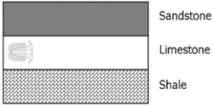
The diagram shows a section of land that has been undisturbed and includes a fossil.What can be concluded about the fossil?

a)

The fossil is younger than the limestone.

b)

The fossil is older than the shale.

c)

The fossil is approximately the same age as the limestone.

d)

It is approximately the same age as the sandstone.
35.
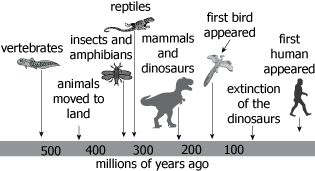
The time line shows the evolution of life forms during the geologic time scale.Which statement is supported by the time line?
a)
Dinosaurs became extinct 150 million years ago.
b)
Birds evolved approximately 275 million years ago.
c)
Animals started inhabiting land approximately 300 million years ago.
d)
Insects and amphibians appeared approximately 325 million years ago.
36.

A paleontologist just discovered a Flower fossil. In which layer do you think the fossil was found in?

a)

Cenozoic Layer

b)

Mesozoic Layer

c)

Paleozoic Layer

d)

Late Proterozoic Layer

37.
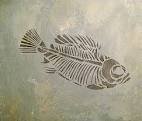
If scientists found this fossil, what could they infer?
a)
what fish are like today
b)
that this fish lacked oxygen
c)
what kind of animal ate this fish
d)
that water once covered the area
38.

Which Era was dominated by dinosaurs?

a)

Paleozoic

b)

Mesozoic

c)

Cenozoic

d)

Cambrian

39.

What division of time was the longest ?

a)

Paleozoic

b)

Mesozoic

c)

Cenozoic

d)

Precambrian

40.

what are eras mark all that apply

a)

Proterozoic

b)

Mesozoic

c)

Precambrian

d)

Hadean

e)

Paleozoic