
 Worksheets
Waves Exam Review
Total questions: 59
Worksheet time: 51mins

High frequency waves make
high pitch sounds
low pitch sounds
loud sounds
soft sounds

Low frequency waves make
high pitch sounds
low pitch sounds
loud sounds
soft sounds

Waves with tall amplitudes make
high pitch sounds
low pitch sounds
loud sounds
soft sounds

Which letter represents the trough of a wave?
A
B
C
D
E
Which letter represents the crest of a wave?
A
B
C
D
E
What is the equation for frequency?
# waves * time
#waves / time
time / # waves
time / # waves2
What is the unit for frequency?
cm
m
units2
Hz

How many waves are represented here?
2
3
0
1

How much of a wave is the red portion?
1/2
1.5
1/4
3/4
If five waves pass you in 37 seconds, what is the frequency of the wave?
0.185 Hz
32 Hz
0.135 Hz
7.4 Hz

The amplitude of this wave is
1 m
2 m
3 m
4 m

The wavelength of this wave is
25 cm
85 cm
65 cm
40 cm

This wave represents 10 seconds. What is the frequency of the wave?
0.2 Hz
2 Hz
-2 Hz
20 Hz
Identify the x-location of the first trough.
25 cm
85 cm
65 cm
40 cm
List the Primary colors of light:
Red, Purple, Blue
Cyan, Magenta, Yellow, and Black
Red, Yellow, Blue
Red, Green, Blue
List the Primary colors of ink:
Red, Green, Blue
Cyan, Magenta, yellow, and black
Red, Yellow, Blue
Red, Purple, Blue


What part of the electromagnetic spectrum can be seen by humans?
Visible Light
Microwaves
Ultraviolet Waves
Infrared Waves


What part is #7?
Semicircular Canals
Eustachian Tube
Cochlea
Oval Window
The cochlea is found in which section of the ear?
outer
inner
middle
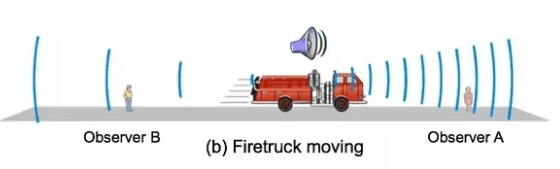
Look at the picture. Who is experiencing a higher pitched sound?
Observer A
Observer B
There's no difference
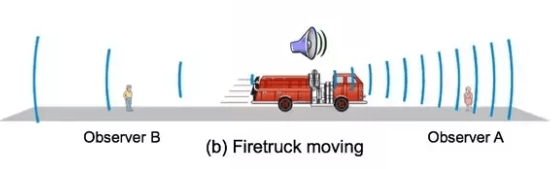
Look at the picture. Who is experiencing a lower pitched sound?
Observer A
Observer B
There is no difference


What variable changes the pendulum's period the most?
pendulum mass
pendulum length
time

Which location represents the amplitude?
f
g
h
j

4 sec = ______ Hz.

Compared to a 10 degree amplitude, a pendulum has an amplitude of 30 degrees. It has a
Compared to a 30 degree amplitude, a pendulum has an amplitude of 10 degrees. It has a

The colors of the visible light spectrum in order from largest wavelength to smallest wavelength are:
Violet, Indigo, Blue, Green, Yellow, Orange, and Red
Green, Blue, Indigo, Violet, Red, Orange, and Yellow
Red, Orange, Yellow, Green, Blue, Indigo, and Violet
Yellow, Orange, Red, Violet, Indigo, Blue, and Green

Light waves bending through a prism is an example of:
Reflection
Refraction
Absorption

Light waves bouncing off of this mirror is an example of:
Reflection
Refraction
Absorption

Light waves bouncing off of this lake is an example of:
Reflection
Refraction
Absorption

A carbon nanotube capturing light is an example of:
Reflection
Refraction
Absorption

A fish bowl bending light waves and distorting an image of a cat's face is an example of:
Reflection
Refraction
Absorption

A black shirt capturing light waves and making a person feel hot in the summer is an example of:
Reflection
Refraction
Absorption

Light waves bending through a magnifying glass and becoming so concentrated that they start a fire is an example of:
Reflection
Refraction
Absorption

A light wave bouncing off of a windshield visor is an example of:
Reflection
Refraction
Absorption

Which graph has the higher amplitude?
Graph A
Graph B
What would happen to the wavelength if the frequency was doubled?
the wavelength would be halved
the wavelength would be doubled
the wavelength would stay the same
frequency does not affect wavelength
What happens to the frequency of a wave when the amplitude is tripled?
the frequency is tripled
the frequency is a third of what it was
amplitude does not affect frequency
What would happen to the frequency is the wavelength was tripled?
the frequency would be a third of what it was
the frequency would be 3 times larger
the frequency would stay the same
the wavelength does not affect the frequency of a wave

On this EM spectrum, which way should you move to INCREASE the wavelength?
to the left
to the right
On this EM spectrum, which way should you move to INCREASE the wave energy?
to the left
to the right
On this EM spectrum, which way should you move to INCREASE the frequency?
to the left
to the right
The peed of light is 3.0x10⁸ m/s, what is it in standard notation?
0.00000003 m/s
300,000,000 m/s
300,000 m/s
0.003000000 m/s

