
 Worksheets
3.2 Genetics Review
Total questions: 41
Worksheet time: 29mins
Name
Class
Date
1.
genotypes made of the same alleles
a)
alleles
b)
heterozygous
c)
homozygous
d)
recessive
2.
genotypes made of two different alleles
a)
heterozygous
b)
homozygous
c)
dominant
d)
alleles
3.
gene that is always expressed
a)
heterozygous
b)
homozygous
c)
dominant
d)
recessive
4.
different forms of genes for a single trait
a)
heterozygous
b)
homozygous
c)
recessive
d)
alleles
5.
gene that is expressed only in the homozygous state
a)
recessive
b)
dominant
c)
alleles
d)
homozygous
6.
Choose the dominant allele.
a)
d
b)
E
c)
q
d)
n
7.
Choose the recessive allele.
a)
M
b)
D
c)
r
d)
P
8.
Choose the homozygous dominant.
a)
AA
b)
GR
c)
bB
d)
mm
9.
Choose the homozygous recessive.
a)
ee
b)
Ff
c)
HH
d)
oa
10.
Choose the purebred.
a)
Bb
b)
bb
c)
cC
d)
Rr
11.
Choose the hybrid
a)
ZZ
b)
kk
c)
Jk
d)
Ff
12.

Which Punnet squares are correct?
a)
a) and b)
b)
b) and c)
c)
c) and d)
d)
a) and d)
13.
What do the letters on the outside of the Punnett square stand for?
a)
possible offspring genotypes
b)
parent alleles
c)
dihybrid traits
d)
parent phenotypes
14.
What do the letters on the inside of the Punnett square stand for?
a)
possible offspring genotypes
b)
parent alleles
c)
dihybrid traits
d)
parent phenotypes
15.

In corn plants, normal height, N, is dominant to short height, n. If the Punnett square showing the cross NN x nn was complete what would it indicate for possible offspring?
a)
all normal height
b)
1/2 normal and 1/2 short
c)
all short height
d)
I don't know how to do a Punnett square.
16.

In corn plants, normal height, N, is dominant to short height, n. If the Punnett square showing the cross Nn x Nn was complete what would it indicate for possible offspring?
a)
1/2 normal and 1/2 short
b)
3/4 normal and 1/4 short
c)
all normal height
d)
I don't know how to do a Punnett square.
17.

In corn plants, normal height, N, is dominant to short height, n. If the Punnett square showing the cross Nn x nn was complete what would it indicate for possible offspring?
a)
1/2 normal and 1/2 short
b)
3/4 normal and 1/4 short
c)
all short height
d)
I don't know how to do a Punnett square.
18.
In guinea pigs, short hair, S, is dominant to long hair, s. Which allele combination would have a phenotype with long hair?
a)
SS
b)
Ss
c)
ss
d)
s
19.

In guinea pigs, short hair, S, is dominant to long hair, s. If you cross a "Ss" pig with a "ss" pig (Ss x ss) what is the probability of having offspring with long hair?
a)
100% = 4/4
b)
50% = 2/4
c)
25% = 1/4
d)
0% = 0/4
20.
In tomatoes, red fruit (R) is dominant over yellow fruit (r). A plant that is homozygous recessive would have what genotype and phenotype?
a)
RR = yellow
b)
rr = red
c)
rr = yellow
d)
Rr = red
21.
In guinea pigs, short hair, S, is dominant to long hair, s. If you cross two pigs that are both heterozygous (with short hair) what are the odds that you will have a short haired offspring?
a)
100%
b)
75%
c)
50%
d)
25%
22.
Hornless (H) in cattle is dominant over horned (h). A homozygous hornless bull is mated with a homozygous horned cow. What will be the genotype and phenotype of the first generation?
a)
HH = hornless
b)
Hh = hornless
c)
Hh = horned
d)
H = hornless
23.
In humans, being a tongue roller (R) is dominant over non-roller (r). A man who is a non-roller would have what genotype?
a)
roller
b)
non-roller
c)
Rr
d)
rr
24.
In humans, being a tongue roller (R) is dominant over non-roller (r). A woman who is heterozygous for tongue rolling has what genotype?
a)
roller
b)
non-roller
c)
Rr
d)
RR
25.
If the man and women from the previous question have children (rr x Rr), what is the probability of the child being a tongue roller? R) is dominant over non-roller (r).
a)
100%
b)
75%
c)
50%
d)
0%
26.
Brown eyes in humans are dominant to blue eyes. A brown-eyed man, whose mother was blue-eyed, marries a brown-eyed woman whose father had blue eyes.
What is the probability that this couple will have a blue-eyed child?
What is the probability that this couple will have a blue-eyed child?
a)
100%
b)
50%
c)
25%
d)
0%
27.

What does a filled in square represent?
a)
Not affected Female
b)
Not affected Male
c)
Affected Male
d)
Affected Female
28.

How many generations are shown in this pedigree?
a)
1
b)
2
c)
3
d)
4
29.

How many kids did the mother and father from the first generation have?
a)
2
b)
4
c)
5
d)
6
30.
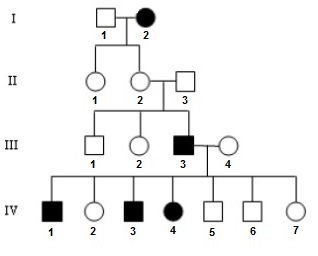
This pedigree represents the inheritance of hemophilia in this family. How many of the females have the hemophilia trait?
a)
8
b)
5
c)
2
d)
3
31.

What do half colored symbols represent?
a)
The individual is a carrier (heterozygous).
b)
The individual expresses the trait.
c)
The individual has both recessive alleles.
d)
The individual has both dominant alleles.
32.

What does an open circle represent?
a)
Not Affected Male
b)
Not Affected Female
c)
Affected Male
d)
Affected Female
33.

Is this trait (the shaded individuals) dominant or recessive?
a)
dominant
b)
recessive
34.

In the second generation-how many people are carriers of the trait?
a)
2
b)
3
c)
5
d)
6
35.

How many people in this whole pedigree have the trait/disease?
a)
2
b)
3
c)
4
d)
6
36.

How many females are in this pedigree?
a)
3
b)
4
c)
6
d)
7
37.

What is this?
a)
Pedigree
b)
Karyotype
c)
Venn diagram
d)
Punnett Square
38.

Which individual in the first generation is a carrier?
a)
The male
b)
The female
c)
individual 1
d)
None of the above
39.

How many individuals are there in the 3rd generation?
a)
2
b)
3
c)
4
d)
6
40.

Which gender can be carriers of colorblindness and not have it?
a)
Just males
b)
Just females
c)
Both genders
41.

How many people in the pedigree are carriers for the disorder?
a)
6
b)
8
c)
2
d)
9
100 %

