Wayground logo

Free Printable Worksheets

Font size

S
M
L
XL
Worksheets

Weather notebook quiz

Total questions: 40

Worksheet time: 1hrs 6mins

Name
Class
Date
1.

What typically happens to cloud formation in a high pressure system?

a)

Clouds tend to dissipate due to downward moving air

b)

Humidity increases, leading to more clouds

c)

Clouds form more readily as air moves upward

d)

Increased upward air movement results in storm formation

2.

If I was trying to determine the pressure of an air mass I would use a...

a)

thermometer

b)

barometer

c)

rain gauge

d)

anemometer

3.

What is the primary characteristic of a cold front?

a)

It is where cold air moves under warm air, forcing the warm air to rise

b)

It is defined by warm air moving over cold air, creating clouds

c)

A boundary where no significant temperature change occurs

d)

The area where precipitation is least likely to occur

4.

If I wanted to determine the amount of rainfall after a storm I would check a...

a)

rain gauge

b)

barometer

c)

anemometer

d)

weather balloon

5.

When occluded front is approaching, what happens?

a)
warm air is pushing under cold air causing humid weather and lower temperatures
b)

warm air is pushing under cold air causing humid weather and higher temperatures, however this front is very unpredictable

c)

warm air is pushed under several cold air masses causing lots of rain however this front is very unpredictable

d)
cold air is pushed over warm air causing rain and thunderstorms
6.
If an air mass is rising, it must be
a)

low pressure

b)

high pressure

c)

a witch

d)

a front

7.
If an air mass is sinking, it must be
a)

low pressure

b)

high pressure

c)

a ghost

d)

cheese

8.
Air masses are different in many ways. Which of these is NOT different?
a)
moisture contents 
b)
ratio of oxygen/nitrogen  
c)
 atmospheric pressure
d)
 temperature  
9.
When a cold front or a warm front stays in place for several days without invading another front, it is called a ______. 
a)
stationary front 
b)
 cold front 
c)
occluded front
d)
warm front 
10.
This is the symbol for which type of front?
a)
cold front
b)
warm front
c)
stationary front
d)
occluded front
11.
This is the symbol for which type of front?
a)
cold front
b)
warm front
c)
occluded front
d)
stationary front
12.
What does this symbol on a weather map indicate? 
a)
High pressure system
b)
Low pressure system
c)
Cold front
d)
Warm front
13.
What does this symbol on a weather map indicate? 
a)
High pressure system
b)
Low pressure system
c)
Cold Front
d)
Warm Front
14.
Winds are caused by differences in 
a)
precipitation
b)
humidity
c)
air pressure
d)
turbulance
15.
This type of front can bring thunderstorms.
a)
cold
b)
warm
c)
stationary
d)
occluded
16.
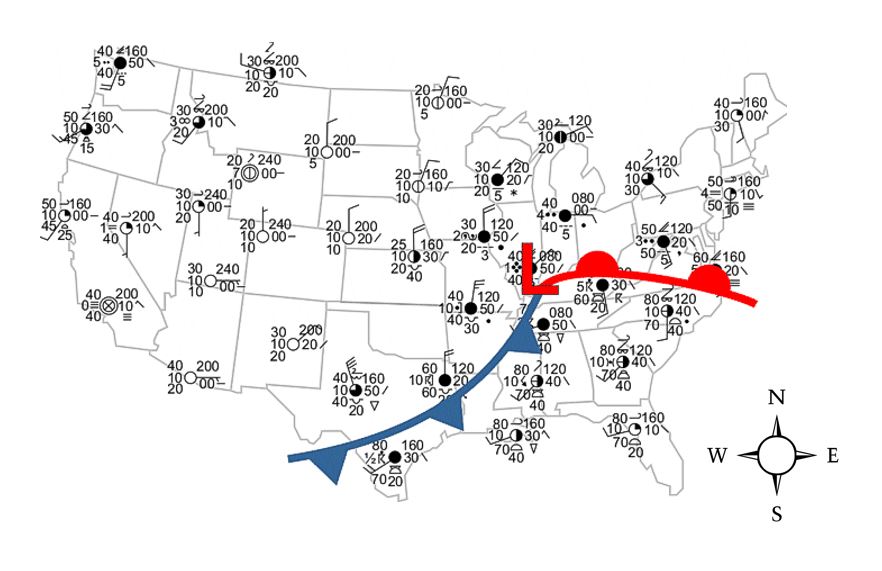
What direction is the warm front moving on the map? 
a)
North
b)
South
c)
East
d)
West
17.
What direction is the cold front moving on the map? 
a)
Southwest
b)
Northwest
c)
Southeast
d)
Northeast
18.
Which type of front typically produces stratus clouds, drizzle and warmer temperatures?
a)
   cold
b)
 warm
c)
stationary
d)
occluded
19.
Which type of front often produces thunderstorms?
a)
cold
b)
stationary
c)
 warm
d)
occluded
20.
Which system results in rainy or stormy weather?
a)
high pressure
b)
low pressure
c)
hurricane
d)
weather system
21.
Which system results in drier, fairer weather?
a)
high pressure
b)
low pressure
c)
hurricane
d)
weather system
22.

Choose the locations likely to have a tropical air mass (2 correct answers)

a)

Colorado

b)

Texas

c)

Bahamas

d)

Montana

23.

Which of the following is NOT a maritime air mass?

a)

New York

b)

North Carolina

c)

Montana

d)

Virginia

24.

Continental air masses have characteristically (a)   air.

25.

If a Polar air mass and a Tropical air mass meet, which will rise to the top?

a)

Polar

b)

Tropical

26.

An air mass gets its ____________ and __________ from the water or land it came from.

a)

humidity, temperature

b)

size, shape

c)

color, weight

d)

weather, animals

27.

The word that means land is -

a)

polar

b)

tropical

c)

continental

d)

maritime

28.

Maritime air is very -

a)

humid (moist)

b)

dry

29.

The temperature of air that comes from the tropics is very -

a)

cold

b)

warm

30.

The temperature that comes from the poles is very -

a)

cold

b)

warm

31.

The first part of the name of an air mass tells us-

a)

polar or continental

b)

tropical or polar

c)

continental or maritime

d)

maritime or tropical

32.
What are the ingredients necessary for a cloud to be created?
a)
wind, heat, water
b)
dust, water vapor, low pressure
c)
cool temperatures, water, vapor
d)
high pressure, water, wind
33.
What happens to cloud formation when air pressure rises (high pressure)?
a)
amount of clouds decreases
b)
amount of clouds increases
c)
clouds scatter
d)
clouds come together
34.

How is temperature and cloud formation related?

a)

Temperature has no affect on cloud formation

b)

When air temperature increases,  cloud formation increases

c)

When air temperature decreases, cloud formation increases

d)

Low humidity and low temperature increases cloud formation

35.
When the weather gets cloudy, that's a good sign that _____________________
a)
Higher air pressure is coming in
b)
Temperatures are going up
c)
Temperatures are moving down
d)
Lower air pressure is coming in
36.

What is the effect of a high pressure system on weather conditions?

a)

It leads to stormy weather

b)

It brings about warmer temperatures

c)

It results in clearer skies and cooler weather

d)

It causes increased precipitation

37.

What instrument is primarily used to measure wind speed?

a)

Barometer

b)

Hygrometer

c)

Anemometer

d)

Thermometer

38.

Which type of air mass is characterized by dry and hot conditions?

a)

Maritime Tropical

b)

Continental Tropical

c)

Maritime Polar

d)

Continental Polar

39.
This weather instrument is an...
a)
wind vane
b)
anemometer
c)
barometer
d)
thermometer
40.
The weather forecast tomorrow says there will be a 15 mph northeast wind and a high temperature of 52 degrees. What three instruments will a meteorologist use to make this prediction?
a)

anemometer, weather vane, thermometer

b)

barometer, hygrometer, weather vane

c)
thermometer, satellite image, hygrometer
d)

weather vane, satellite image, barometer