
 Worksheets
Anatomy Nervous System Review Part 2
Total questions: 97
Worksheet time: 1hrs 8mins
The two major parts of the nervous system are the
brain and spinal cord
central and somatic nervous systems
sympathetic and parasympathetic systems.
peripheral and central nervous systems
Which of the following is regulated by the autonomic nervous system?
Breathing
Kicking a soccer ball
Balancing on one foot
Raising your hand
Dopamine and Serotonin are examples of _______________
Axon
Neurotransmitters
Somatic Nerves
Autonomic Nerves
The branch-like figures that receive impulses and conduct them to the cell body
Dendrite
Axon
Cell Body
Myelin Sheath
The two parts of the Peripheral Nervous System
Brain and Spinal Cord
Somatic and Autonomic
Systematic and Brain
Spinal cord and Autonomic

What is number 3 pointing at on the neuron?
Dendrite
Axon
Myelin Sheath
Soma

What part of the neuron is number 4 pointing at?
Dendrite
Axon Terminal
Axon
Myelin Sheath

Which part of the Neuron is number 1 pointing at?
Dendrite
Cell body
Axon
Nucleus
The cerebrum deals with planning, recalling information, and decision making.
True
False
An elderly woman with tremors and shuffling of her gait might be developing:
cerebral palsy.
Alzheimer's disease.
Parkinson's disease.
multiple sclerosis.
These neuron processes transmit information from the sensory organs to the central nervous system.
efferent
afferent
These neuron processes transmit information from the central nervous system to the muscles and glands.
efferent
afferent
This part of the nervous system regulates involuntary actions such as heart function, blood pressure, breathing, digestion.
Autonomic Nervous System
Sensory Nervous System
Motor Nervous System
Peripheral Nervous System
The tiny gap between neurons where nerve impulses are sent from one neuron to another. It is where communication occurs between an axon and dendrite.
synapse
axon terminal
impulse
myelin
What part of the brain deals with the thalamus and hypothalamus?
Brain Stem
Cerebellum
Diencephalon
Cerebrum
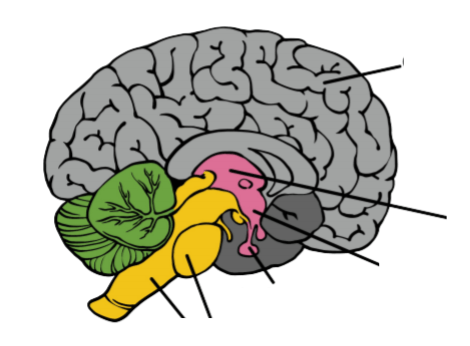
What structure is grey in this picture?
Cerebrum
Cerebellum
Brain Stem
The brain and spinal cord make up the:
Peripheral Nervous System
Somatic Nervous System
Autonomic Nervous System
Central Nervous System
Controls sensations (pain, temperature, touch), visual-spatial processing, body position. These are part of the sensory cortex.
Frontal Lobe
Occipital Lobe
Temporal Lobe
Parietal Lobe

Identify the lobe of the brain.
frontal
temporal
occipital
parietal

Identify the lobe of the brain that is highlighted.
frontal
temporal
occipital
parietal

What is the part highlighted in red?
Cerebrum
Cerebellum
Brain Stem
Diencephalon
The autonomic system controls your eyes and kidneys
True
False
Controls the "fight or flight" response.
Sympathetic
Parasympathetic
Controls the "rest and digest" response.
Sympathetic
Parasympathetic
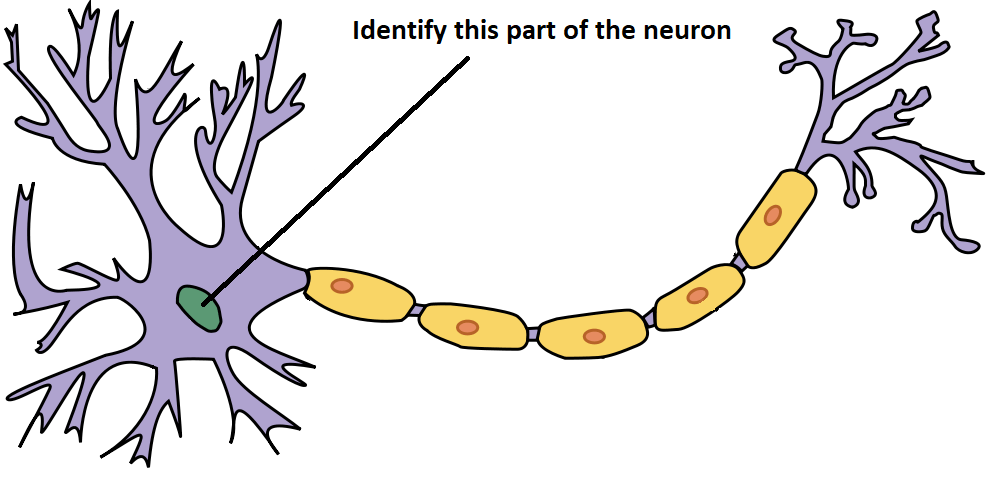
Nucleus
Cell Body
Axon
Node of Ranvier
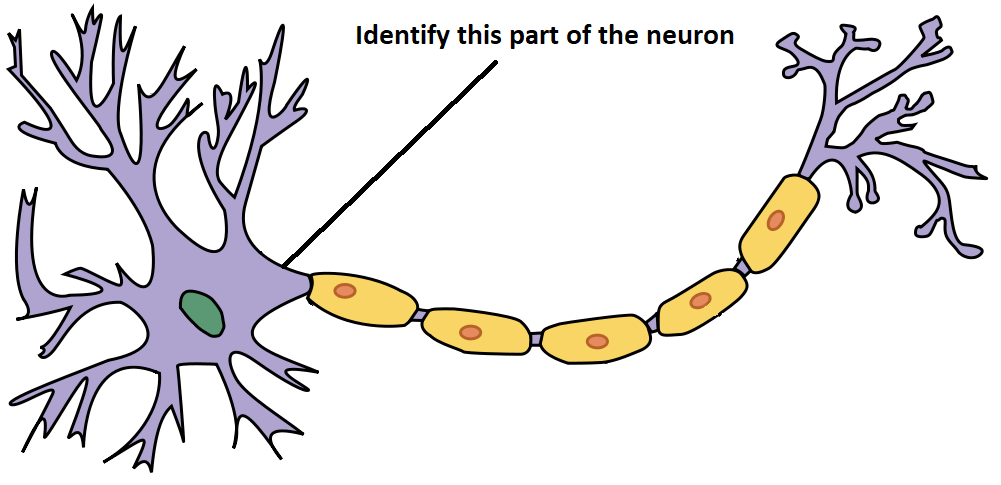
Nucleus
Cell Body
Axon
Node of Ranvier
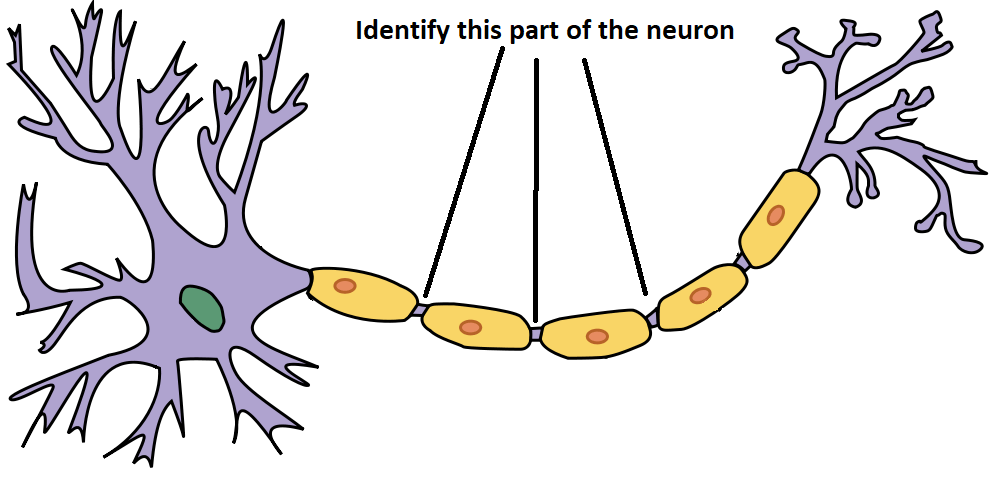
Nucleus
Cell Body
Axon
Node of Ranvier
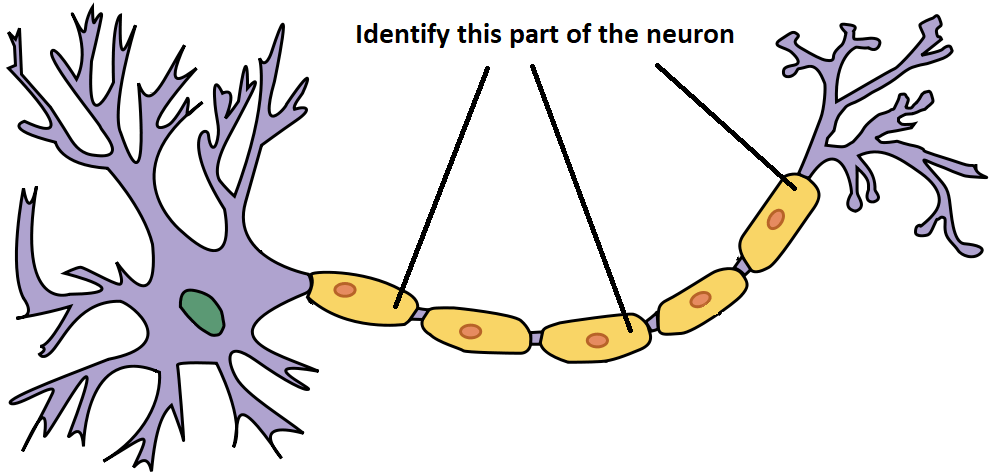
Dendrites
Axon Terminals
Myelin Sheath
Schwann Cells
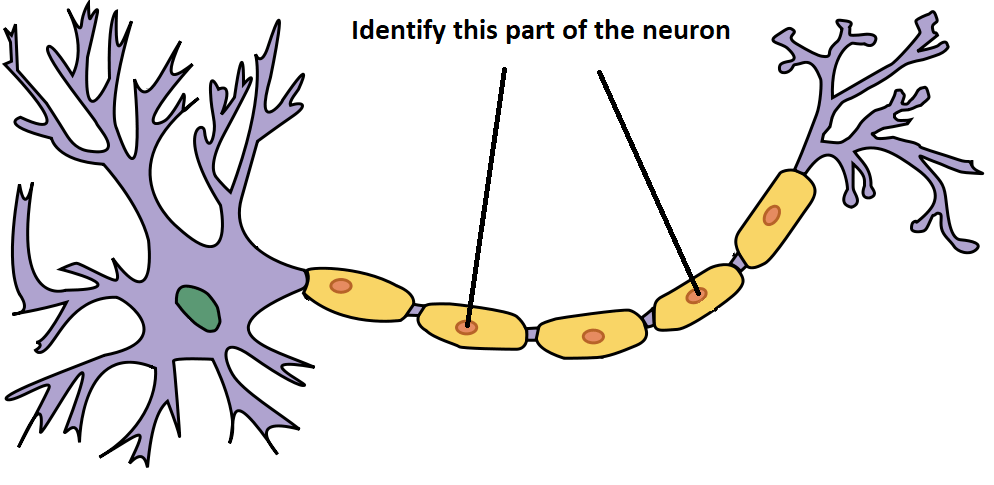
Dendrites
Axon Terminals
Myelin Sheath
Schwann Cells
Myelin, an insulating material, is found in
cell bodies
dendrites
axon terminals
Schwann cells
Carry impulses from from receptors to CNS
afferent/sensory neurons
efferent/motor neurons
dendrites
axon terminals
Transmit impulses toward from the cell body
afferent/sensory neurons
axons
dendrites
astrocytes

Cells that form myelin sheaths on CNS
astrocytes
oligodendrocytes
microglia
neurotransmitters

Cells that form myelin sheaths on PNS
astrocytes
oligodendrocytes
microglia
Schwann cells

Scavenge and degrade dead cells & protect the brain from invaders
ependymal cells
oligodendrocytes
microglia
astrocytes

Produce cerebrospinal fluid in the brain & spinal cord
ependymal cells
oligodendrocytes
microglia
astrocytes
Which cell type provides structure to nervous tissue?
Ependymal Cells
Oligodendrocytes
Astrocytes
Microglia
What type of neuroglial cell attaches neurons to capillaries?
Astrocyte
Oligodendrocytes
Microglial
Ependymal
Small cells that engulf and destroy microbes and cellular debris in the CNS
microglia
horns
neuroglia
astrocytes
If you picked up a hot coal, the signal from the sensory neurons in your fingertips would travel to ____________ in your spinal cord.
Sensory Neurons
Motor Neurons
Interneurons
Type of neuron that sends nerve impulses to muscles and gland, by the command of other neurons.
Motor Neurons
Interneurons
Sensory Neurons
Unipolar neurons are always ....
Sensory
Reflex
Visual
Only in the CNS
The Central Nervous System is almost all ....
Unpolar
Bipolar
Multipolar
Unipolar
When a neuron is depolarized, what are the first channels to open?
Sodium
Potassium
Calcium
ACTH
When a neuron is resting, the inside of the axon has a ____________ charge.
-55 mV
-70 mV
40 mV
-75 mV
When a neuron is not engaged in an impulse.
Resting potential
Action potential
Neural potential
Synaptic potential
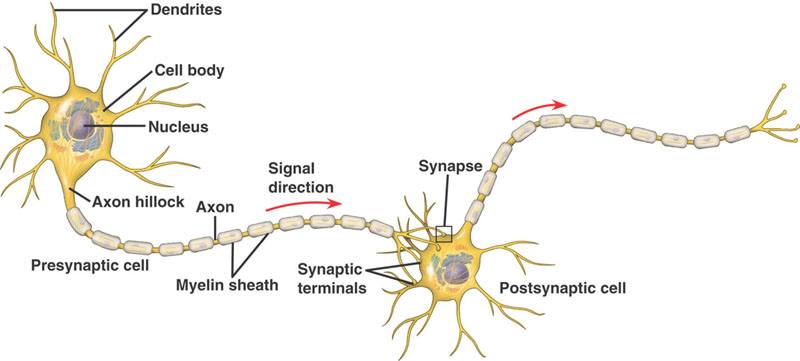
Which ions are involved in the electrical nerve impulse?
Iodine and Sodium
Potassium and Sodium
Iron and Sodium
Calcium and Iodine

What number on the graph represents the Hyperpolarization phase?
1
2
3
4
Why is -55 mV a significant number?
This is the largest charge achieved during an action potential
This is the threshold required to complete an action potential
This is the resting charge of a neuron
This is the charge when all the sodium is inside the cell
At what stage are both ions present in large concentrations INSIDE the neuron?
Depolarizarion
Repolarization
Hyperpolarization
Resting Potential

If you are having trouble with your BALANCE and COORDINATION, which part of your brain should be checked?
cerebrum
cerebellum
brain stem
spinal cord
Which is the correct sequence in the transmission of a neural impulse?
axon, dendrite, cell body, synapse
dendrite, axon, cell body, synapse
synapse, axon, dendrite, cell body
dendrite, cell body, axon, synapse
White matter is ________ and Grey matter is ________
myelinated; phosphorylated
unmyelinated; myelinated
myelinated; unmyelinated
phosphorylated; myelinated

This is the main reason why people are having stroke:
bleeding brain
damaged brain
blockage in the brain
too much sleeping
Signs and symptoms of stroke can be detected using this acronym:
FACE
FAST
FACT
FADE

This symptom of stroke is called:
ugly face
face of a man
face drooping

How do you call this symptom of stroke?
face drooping
speech difficulty
arm weakness
When one is suferring from stroke, one or both arms are numb.
True
False
T in FAST stands for:
Time
Time to call an ambulance
Time to eat
Time to go home
Encephalitis is a condition in which, for some reason, the _________ is experiencing inflammation.
brain
spinal cord
meninges
ventricles
concussion
The correct medical term for someone who suffers from recurrent seizures is:

This section of the brain plays a role in regulating breathing.
Pons
Medulla oblongata
Hypothalamus
Cerebellum

This is the largest portion of the diencephalon, which communicates sensory and motor information between the body and the cerebral cortex.
Thalamus
Epithalamus
Hypothalamus
Which structure helps protects the brain against jolts?
Cranium
Meninges
Blood-brain barrier
Cerebrospinal fluid
The emotional part of the brain is mostly controlled by which structure?
Thalamus
Hypothalamus
Epithalamus
Hyperthalamus
Elevated ridges on the surface of the brain are called:
Gyrus
Fissures
Lobes
Sulcus
The brain stem consists of the:
Cerebrum, cerebellum and midbrain
Midbrain, suprabrain and low brain
Thalamus, hypothalamus and epithalamus
Midbrain, pons and medulla oblongata
Meningitis is the tern to describe inflammation of the _______.
Brain
Meninges
Both the brain and meninges
None of the above
A traumatic brain injury (TBI) results from
an open head wound
mechanical force
an infection
poisoning

The red line in the picture represents which of the following structures?
Central Sulcus
Lateral Fissure
Longitudinal Fissure
Transverse Fissure

What is #8?
Medulla Oblongata
Pons
Midbrain
Cerebellum
What is #9?
Thalamus
Pons
Midbrain
Cerebellum
What is #13?
Hypothalamus
Pons
Midbrain
Thalamus
Allows for communication between the two cerebral hemispheres.
corpus callosum
lateral fissure
pons
thalamus

A group of nervous system disorders resulting
from brain damage before or during birth, or in
early infancy
cerebral palsy
epilepsy
multiple sclerosis
dementia

An organic brain disease involving loss of
function in two or more areas of cognition
epilepsy
meningitis
dementia
traumatic brain injury

A condition involving a progressive loss of brain
function with major consequences for memory,
thinking, and behavior
epilepsy
multiple sclerosis
dementia
Alzheimer's disease

What type of neuron is B?
Sensory
Inter
Motor
What type of neuron is C?
Sensory
Inter
Motor
In a reflex arc, the sensory neuron leads to the ___________ and the motor neuron leads to the __________
Spinal cord, CNS
CNS, muscle
Spinal cord, muscle
Muscle, CNS
Reflex actions are important because
They provide a quick, involuntary response
They prevent injury
They are essential to the survival of organisms
All of the above
Which type of neuron causes a muscle to contract in a reflex arc?
Motor Neuron
Sensory Neuron
Interneuron
Effector

Light Blue Arrow
Motor Output
Sensory Input
Integration
Response
Stimulus
Purple Arrow
Motor Output
Sensory Input
Integration
Response
Stimulus

Lime Green Arrow
Motor Output
Sensory Input
Integration
Response
Stimulus
Light Blue Line (Neuron)
Sensory Neuron
Motor Neuron
Interneuron
Effector
Effector Organ
Green Line (Neuron)
Sensory Neuron
Motor Neuron
Interneuron
Effector
Effector Organ
Muscle
Sensory Neuron
Motor Neuron
Interneuron
Effector

What is the order of a nerve impulse?
Na channels open and Na ion diffuse inward
the membrane becomes depolarized
K channels open and K ions diffuse outward
the membrane becomes repolarized
Reflex arc order
receptor
sensory neuron
integration (interneuron)
motor neuron
effector
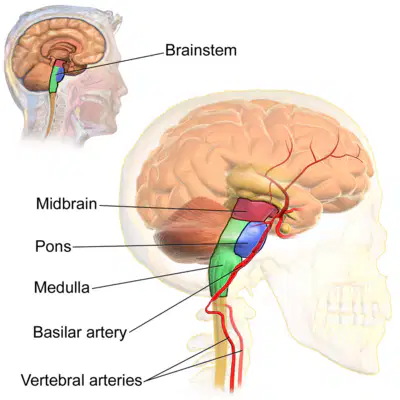
The midbrain, pons, and medulla oblongata are found in the
brain stem
diencephalon
cerebrum
cerebellum
Match the following
relays info to cerebrum- controls body movement/posture
midbrain
carries info from one side of brain to other, controls breathing
pons
transmits impulses btwn brain & spinal cord, controls blood pressure, swallowing, heart rate, coughing
medulla oblongata

