
 Worksheets
CP - U11 Practice
Total questions: 73
Worksheet time: 2hrs 2mins
Deposition is the phase change in which a gas turns straight into a ____________ without first turning into a liquid.
solid
liquid
gas
plasma

What phase change is occurring when substances like dry ice turn straight from a solid to a gas?
evaporation
deposition
sublimation
freezing

What phase change takes place when a liquid turns into a gas?
melting
condensation
sblimation
evaporation

What phase change takes place when a liquid turns into a solid?
freezing
condensation
melting
deposition

Walking outside on a hot day and having your solid popsicle turn into a liquid is an example of ______________ .
deosition
melting
evaporation
sublimation

When you see drops of liquid water on your cold soda can caused by cooling of the water vapor in the air, ______________ has occurred.
melting
sublimation
condensation
freezing

When you boil water and it turns to steam, you are seeing an example of ________________ occur.
evaporation
condensation
freezing
melting
Which of the following phase changes is a result of removing heat energy?
melting
freezing
evaporation
sublimation
When the temperature of matter increases, the particles...
speed up and move closer
slow down and move closer together
speed up and move farther apart
slow down and move farther apart
Which state of matter has NO definite shape and NO definite volume?
gas
solid
liquid
Which state of matter has a definite shape and a definite volume?
gas
solid
liquid
Which state of matter has NO definite shape, but does have a definite volume?
gas
solid
liquid
All changes in the state of matter of a substance requires...
vibration
permission
energy
water
Which substance has the weakest intermolecular forces?
Substance A, boiling point of 75 °C
Substance B, boiling point of 105 °C
Substance C, boiling point of 25 °C
Substance d, boiling point of 45 °C
The weaker the intermolecular forces of a substance the _____________ the boiling point
higher
lower
________________________ have the strongest intermolecular forces of attraction.
Dipole- Dipole
Dispersion
Hydrogen Bonds
Intramolecular forces are the forces
Covalent bonds are examples of
intermolecular forces.
intramolecular forces.
Intermolecular forces are weaker than intramolecular forces.
True.
False.

What letter on the diagram represents the triple point?
A
B
C
D
What is the melting point of this substance at 1 ATM of pressure?
40
60
100
110

What is being measured on the x axis?
Pressure
Temperature
Energy
Mass
What is being measured on the y axis?
Pressure
Temperature
Energy
Mass
What state of matter is EASIEST to compress?
Solid
Liquid
Gas
Adding heat to a substance...
can change its state of matter
speeds up the molecules
adds kinetic energy
all of these are true
Removing heat from a substance...
weakens the connection between molecules
slows down the molecules
makes molecules less organised
all of these are true
The point at which a liquid has enough energy to become a gas is called its...
boiling point
melting point

In which region(s) does temperature increase? (a)

At which letter is the substance changing its state of matter?
A only
A, C, and E
D and E
B and D
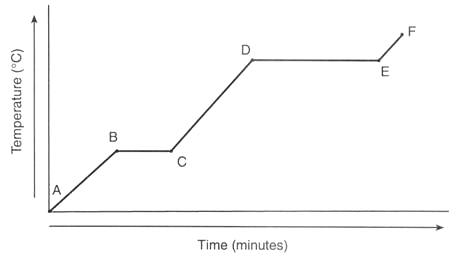
Are the particles moving faster or slower as time goes on?
Faster
Slower
What state/phase is the object likely from points A to B?
Solid
Liquid
Gas
Plasma
What is happening to the particles in the substance between points D and E?
Melting
Freezing
Vaporizing
Sublimating

Is the substance gaining or losing energy?
Gaining
Losing

Where on the graph are phase changes taking place? Click all that apply.
1
2
3
4
5

Which substance would have the weakest intermolecular forces of attraction?
CH4
NaCl
H2O
MgF2

Intermolecular forces for: NH3
Dispersion Force
Dipole dipole
Hydrogen bonding
The weaker the intermolecular forces of a substance the _____________ the boiling point
higher
lower

Intermolecular forces for: CO2
Dispersion Force
Dipole dipole
Hydrogen bonding

Intermolecular Forces are the forces that exist
Between two or more molecules
Within a single molecule
Only in molecules containing carbon
In all molecules
Examples of an intermolecular force include
london disperson
hydrogen bonding
dipole dipole
all of the above
For hydrogen bonding to occur, a molecule must have a hydrogen bonded to
carbon
another hydrogen
Fluorine, Chlorine or Oxygen
Fluorine, Nitrogen or Oxygen
Type of intermolecular force present in I2, Br2, and Cl2. (all nonpolar)
dipole dipole
H-bond
London dispersion
metallic
Does NH3 or PH3 have a higher boiling point?
(Hint: NH3 has hydrogen bonds and PH3 does not)
NH3 because it has the strongest IMF's
PH3 because it has the strongest IMF's
In general, substances with stronger intermolecular forces have ________ boiling points than those with weaker forces
Higher
Lower
The same
Which substance has the weakest intermolecular forces?
Substance A, boiling point of 75 °C
Substance B, boiling point of 105 °C
Substance C, boiling point of 25 °C
Substance d, boiling point of 45 °C
The intermolecular force present in all matter is
Hydrogen Bonding
Ionic Bonding
Dipole-Dipole
London or Dispersion
The strongest IMF is
London/Dispersion
Dipole-Dipole
Hydrogen Bonding
The weakest IMF is
Dipole-Dipole
Dispersion
Hydrogen Bonding
Which of the following has the highest boiling point? (diatomic molecules are nonpolar)
Which of the following properties is not affected by intermolecular forces?
Color
Melting point
Surface tension
Viscosity
Ionic bonds and covalent bonds are ____ than intermolecular forces
Stronger
Weaker
A liquid evaporates very quickly. What type of intermolecular force(s) would you expect to be present?
London dispersion, dipole-dipole, and hydrogen bonding
London dispersion and dipole-dipole
Only London dispersion forces
Nonpolar molecule samples all contain
(Check all that apply)
Hydrogen Bonding
Dipole Dipole
London Dispersion Forces
Ionic Bonds
List the following from strongest to weakest.
ion-dipole bonds
Hydrogen bonds
dipole-dipole interactions
London Dispersion Forces / Van Der Waals Forces
Where in this diagram are the intermolecular forces strongest?
Water is liquid at room temperature, but carbon dioxide is not. Why is that?
CO2 is straight, while H2O is bent.
H2O has weaker intermolecular forces due to dipole-dipole interactions.
H2O has stronger intermolecular forces due to hydrogen bonding.
CO2 has less mass than H2O.

Which of the following characteristics describe the following substance? Select all that apply.
London dispersion forces (aka Van Der Waals forces)
dipole-dipole interactions
Hydrogen bonds
polar
Which of the following is an intramolecular force?
hydrogen bonding
polar covalent bonding
London dispersion forces
dipole-dipole interaction
Intramolecular forces are the forces
within molecules
between molecules

What kind of force is the arrow pointing to?
Intramolecular Force
Intermolecular Force

What kind of force is the arrow pointing to?
Intramolecular force
Intermolecular force
Intermolecular Forces include : (a) (b) (c)
Intermolecular forces for: CO2
Dispersion Force
Dipole dipole
Hydrogen bonding

