
Font size
 Worksheets
P.E. & K.E. Quiz# 1
Total questions: 50
Worksheet time: 48mins
Kinetic energy is the energy of an object in motion. Objects that are moving faster have more kinetic energy than objects that are moving slower (if both objects have the same mass). If two objects have different masses, the more massive objects has more kinetic energy (if they are moving at the same speed).
I don't get it.
GOT IT!

The car and the girl are moving at the same velocity (5 m/s) Which of the following statements is correct?
The car has LESS kinetic energy (because it has more mass than the girl)
The car has MORE kinetic energy (because it has more mass than the girl)
The car and the girl have the SAME amount of kinetic energy (because they are moving at the same speed)
The girl has the MORE kinetic energy (because she has less mass than the car)
Kinetic energy is...
energy carried in ultraviolet waves
energy stored in food
energy in motion
energy from splitting an atom
What two factors affect an object's kinetic energy?
area and volume
mass and weight
weight and height
mass and speed
Increasing an object's speed will increase its kinetic energy.
false
true
Increasing an object's mass will increase its kinetic energy.
true
false
When do you have more kinetic energy?
When I am running down the hallway
When I am walking down the hallway
I always have the same kinetic energy
I need more information
If you are sledding downhill, do you have more kinetic energy at the top of the hill or at the bottom of the hill?
At the top because you are going slower
At the bottom because you are going faster
Kinetic energy does not change as you go downhill
I need more information
Jose M. runs down the hallway and remembers that he forgot his bookbag in the classroom. He runs back into the classroom and grabs his bookbag and runs out at the SAME SPEED. When does he have more kinetic energy?
His kinetic energy is the same
I need more information
His kinetic energy is greater WITHOUT his bookbag
His kinetic energy is greater WITH his bookbag

Car 1 and Car 2 have the same mass. Which of the following statements is true?
Car 1 has the most kinetic energy because it is moving at a faster rate of speed.
Car 2 has the least amount of kinetic energy because it is actually smaller than car one.
Car 2 has the most kinetic energy because it is moving at a slower rate of speed.
Car 1 has the least amount of kinetic energy because it is moving at a faster rate of speed.
KE=21mv2
This is the equation for kinetic energy. Based on the equation, we know that the relationship between kinetic energy (KE) and mass (m) is _______________.
linear
non-linear
KE=21mv2
This is the equation for kinetic energy. Based on the equation, we know that the relationship between kinetic energy (KE) and speed or velcity (v) is _______________.
linear
non-linear
KE=21mv2
This is the equation for kinetic energy. Based on the equation, which of the following graphs most closely resembles the relationship between mass (m) and kinetic energy (KE)?


KE=21mv2
This is the equation for kinetic energy. Based on the equation, which of the following graphs most closely resembles the relationship between speed or velocity (v) and kinetic energy (KE)?


Which of the following is not a factor in PEg?
Acceleration due to gravity.
The height of an object.
The speed of travel of an object.
The mass of an object.
Why do object not have PEg in space?
Because their mass is zero.
Because gravity is zero.
This is false, objects always have PEg.
A 20 kg box is lifted 6 m above the ground. How much PEg does it have?
120 J
200 J
1200 J
60 J
What happens to the PEg of a rock that sits on the edge of a cliff as it starts to fall?
The rock loses PEg and gains KE.
The rock loses KE and gains PEg.
The rock retains all its PEg and gains KE
The rock retains both PEg and KE
Which statement is most true of the term "g" in PEg?
It is the letter used to denote gravity.
It is the letter used to denote the speed of an object.
It is the letter used to denote the acceleration of an object that is caused by gravity.
It does not form part of the equation for PEg.
A leaf has fallen off a tree and hit the floor of the woods. Why is PEg = 0 J ?
The leaf is no longer being acted upon by gravity.
The leaf no longer has any height off the ground.
The leaf no longer has any mass.
The leaf does not have 0 J of PEg.
A 50 kg jogger jumps 1.6 m off the ground. How much energy did they use to do this?
80 J
500 J
160 J
800 J
Moving a book to a lower shelf decreases its potential energy
True
False
Depends on how fast you move it
It depends on the genre of the book
A rock at the edge of a cliff has kinetic energy because of its position.
True
False
A compressed spring is an example of ____
Gravitational Potential Energy
Chemical Potential Energy
Elastic Potential Energy
Electrical Potential Energy
A kite stuck in a tree has ______ energy due to its position.
Potential
Kinetic
Chemical
Thermal
Differences in gravitational potential energy depend on an object's _________.
mass and speed
mass and height
height and speed
mass only
Which is the best synonym for potential energy?
Stored energy
Energy of motion
Energy due to gravity
Mechanical energy


Which passenger has the most potential energy?
A
B
C
D

The formula for calculating the gravitational potential energy in an object is shown above. Which object will have the largest value for its GPE
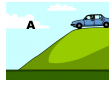
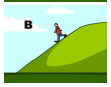
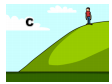
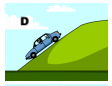
The formula for calculating the gravitational potential energy in an object is shown above. Which object will have the largest value for its GPE
What are Equations for Gravitational Potential Energy?
Gravitational Potential Energy = Mass x Gravitational Field Strength x Height
Gravitational Potential Energy = Weight x Height
Gravitational Potential Energy = Mass x Gravitational Field Strength / Height
Gravitational Potential Energy = Weight / Height
Gravitational Potential Energy (Ep) is...
the energy stored in a stretched object
the energy stored in an electrically charged object
the energy stored in a frozen object
the energy stored in a raised object
An object's gravitational potential energy store can be increased by...
by lifting the object higher
increasing the velocity (speed) of the object
decreasing the size of the object
decreasing the mass of the object
In the equation for gravitational potential energy, 'Ep' stands for
electrical energy
elastic potential energy
kinetic energy
gravitational potential energy
The formula for calculating gravitational potential energy is...
1/2 x mass2 x gravitational field strength x height
mass x gravitational field strength x height
1/2 x mass x gravitational field strength x height
mass x gravitational field strength x height2
To convert grams into kilograms...
multiply the grams by 100
divide the grams by 100
multiply the grams by 1000
divide the grams by 1000
The units for gravitational potential energy is...
Newtons per kilogram, N/kg
Joules, J
degrees celsius, oC
kilograms, kg

What is the gravitational potential energy of an 85 kg mountain climber at the summit of a 6267 m volcano?
Let g = 9.8N/kg
5,220,411 J
532,695 J
73.7 J
54,356.6 J

What is the gravitational potential energy of a 26 kg eagle, flying at an altitude of 65 m at a speed of 19 m/s?
Let g = 9.8N/kg
32,110 J
1690 J
172.4 J
16,562 J

An Olympic high jumper, with a mass of 82 kg, has a maximum gravitational potential energy of 1970 J. How high was the jump?
Let g = 9.8N/kg
24 m
161,540 m
2.5 m
201 m

The world record for pole vaulting is 6.15 m. I the pole vaulter’s gravitational potential energy is 4942 J, what is his mass?
Let g = 9.8N/kg
803.6 kg
504.3 kg
30,393.3 kg
82 kg
One of the tallest radio towers is in Fargo, North Dakota. The tower is 629 m tall. If a bird lands on top of the tower, so that the gravitational potential energy associated with the bird is 2033 J, what is its mass?
Let g = 9.8N/kg
1,278,757 kg
12,531,819 kg
3.25 kg
0.330 kg
0.309 kg

