
Font size
 Worksheets
ES Meteorology Quiz #1 Review
Total questions: 55
Worksheet time: 5hrs 35mins
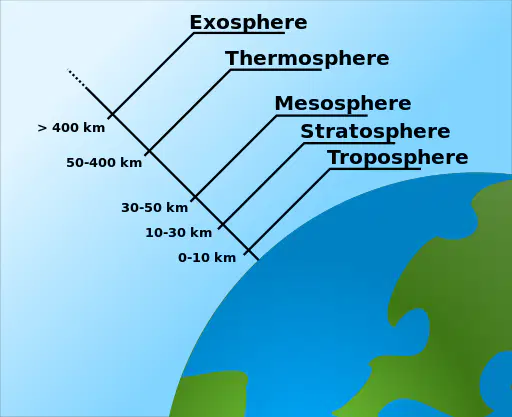
The layers of Earth's atmosphere are differentiated (separated from one another) by...
temperature trends
color trends
composition
gases
Which of the following shows the correct order of Earth's atmospheric layers from Earth's surface to space?
mesosphere, stratosphere, troposphere, thermosphere, exosphere
troposphere,stratosphere, mesosphere, thermosphere, exosphere
stratosphere, thermosphere, mesosphere, troposphere, exosphere
thermosphere, stratosphere, mesosphere, troposphere, exosphere
Which of the following are greenhouse gasses found in the atmosphere?
Carbon Dioxide (CO2)
Water Vapor (H2O)
Oxygen (O2)
Nitrogen (N2)
Methane (CH4)

Use the graph to answer the following question:
In which layer does most of Earth's weather occur?
Troposphere
Stratosphere
Mesosphere
Thermosphere
Exosphere
Use the graph to answer the following question:
In which layer(s) does temperature decrease as altitude increases?
Troposphere
Stratosphere
Mesosphere
Thermosphere
Exosphere
Use the graph to answer the following question:
In which layer(s) does temperature increase as altitude increases?
Troposphere
Stratosphere
Mesosphere
Thermosphere
Use the graph to answer the following question:
In the troposphere, how does air pressure respond to an increase in altitude?
Air pressure in the troposphere increases as altitude increases
Air pressure in the troposphere decreases as altitude increases
Air pressure in the troposphere does not change as altitude increases
There is such a small amount of gas in the troposphere that there is no air pressure
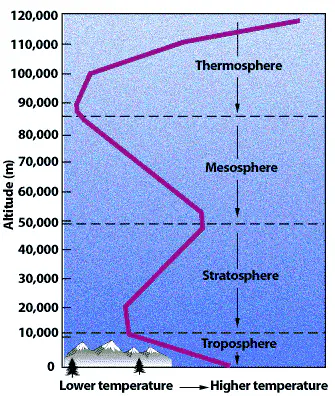
Use the graph to answer the following question:
In which atmospheric layer would you find ozone (O3)
Troposphere
Stratosphere
Mesosphere
Thermosphere
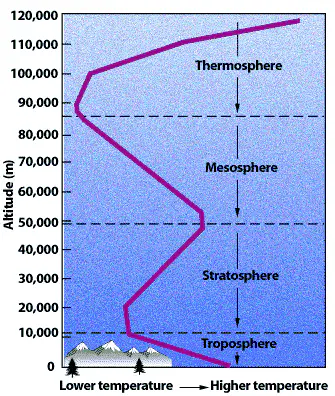
Why does the temperature increase as altitude increases in the stratosphere?
The stratosphere is closer to the sun so it is warmer
The stratosphere has more carbon dioxide which warms the layer
The stratosphere contains the ozone layer which absorbs UV radiation causing warming
The stratosphere receives more heat reradiated from Earth's surface than other atmospheric layers.


How does heat move? (check all that apply)
from an warmer object to a cooler object
from a cooler to a warmer object
toward a hot object
From an object with higher average particle motion to an an object with lower average particle motion
higher temperature to lower temperature
Energy transmitted by electromagnetic waves
conduction
convection
radiation
__________ is the transfer of heat by the movement (currents) in a fluid (liquids and gasses).
Conduction
Convection
Radiation

When you touch hot sand, heat is transferred by _________ to your skin.
conduction
convection
radiation

Two fluids, one warm and one cold, mix. The warm fluid rises and the cool fluid sinks
Conduction
Convection
Radiation


The Sun's heat reaches the Earth through the vacuum of space.
Radiation
Conduction
Convection
none of these

A toaster oven heats the air inside, creating cycles of hot air that warm food.
Radiation
Conduction
Convection
none of these

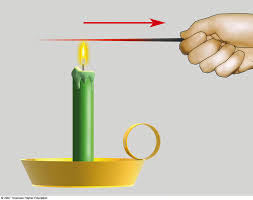
This flame is hotter than the air around it. Which of the following describes how the heat will be transferred?
The heat will flow from hot to cold
The heat will flow from cold to hot
The heat will flow equally in both directions
none of these


How is weather different from climate?
Weather can fluctuate daily. Climate is the same over a short-period of time.
Weather is current conditions of the atmosphere. Climate is the average atmospheric conditions over a long period of time.
Weather is the same over a short-period of time. Climate can fluctuate daily.
Weather is the average atmospheric conditions over a long period of time. Climate is the current conditions of the atmosphere.
As the concentration of greenhouse gases increases, the temperature increases, causing glaciers to melt. Since there is less ice and snow, albedo decreases, which leads to more glaciers melting, and further increases in global temperature.
This is an example of a negative feedback loop.
This is an example of a positive feedback loop.
This is not a feedback loop.
Negative feedback loops ______.
tend to amplify changes
tend to enhance changes
tend to make the system more unstable
tend to dampen changes
Positive feedback loops _______.
tend to buffer changes
tend to amplify changes
tend to dampen changes
tend to stop changes
If you want to keep your house cool all year, should you design the house roof to have a high or a low albedo?
High
Low
Which object below would have an albedo score closer to 1 (aka 100%).
A green forest
A deep blue ocean
Fresh clean snow
A pitch black rooftop
Which object below would have an albedo score closer to 0 (aka 0%).
A green forest
A deep blue ocean
Fresh clean snow
A pitch black rooftop
When two things are the same temperature:
They have the same number of molecules
Their molecules stop moving
Their molecules move at the same average speed
Heat transfer between the two things stops
The increase in temperature with height in the atmospheric layer, which inverts the temperature-altitude relationship and can worsen air-pollution problems.
dew point
temperature inversion
humidity
saturation

According to the image, which substance has the highest heat capacity?
Substance A
Substance B
Substance C
Substance D
What would be the most likely identity of substance B
Black beach sand
Black soil
Water
Tan beach sand
What would be the most likely identity of substance A
Black beach sand
Black soil
Water
Tan beach sand

Refer to the graph to answer the following questions:
After the ten minutes, which substance radiated the least energy?
Black sand
White sand
Water
There was no difference in radiation between the three substances
Refer to the graph to answer the following questions:
According to the data on the graph, water...
warms slower than land and cools faster than land
warms faster than land and cools faster than land
warms slower than land and cools slower than land
warms faster and cools slower than land

What would be the effect on the particles if more heat is radiated from the system to the surroundings?
Weather transfers energy into and out of the atmosphere in a _________ time frame.
Long (30 years)
Short
Oceans heat up and cool down _______ than land.
faster
more slowly

Which Substance has the HIGHEST heat capacity?
A
B
C
Cannot be determined from the information provided
A, B and C all have the SAME heat capacity

Situation: On a warm day, electromagnetic radiation from the sun is absorbed by the ground causing the molecules of the ground to vibrate faster. When gas molecules in the lower troposphere come in contact with these ground molecules, energy is transferred to them and they also move faster.
What kind of heat transfer is this?
Convection
Radiation
Conduction

The transfer of thermal energy between object by the collisions between particles in the objects
conduction
convection
temperature inversion
humidity
The layer of the atmosphere closest to Earth's surface, where most of the mass of the atmosphere is found and in which most weather takes place and air pollution collects.
exosphere
mesosphere
stratosphere
thermosphere
troposphere
In the atmosphere, thermal inversions occur when which normal form of heat transfer is interrupted?
Radiation
Convection
Conduction
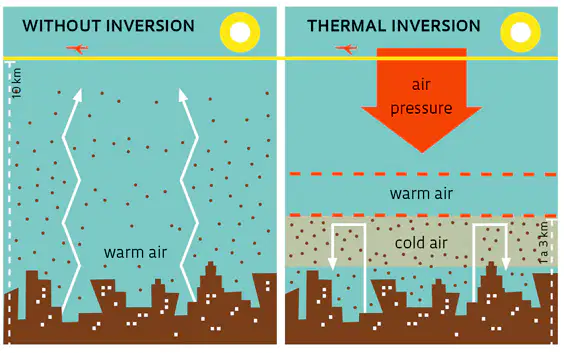
What causes smog to get "stuck" close to Earth during a thermal inversion?
Warmer air at Earth's surface which cools as altitude increases
Air pressure decreasing as altitude increases
A colder layer of air trapped near the ground by a warmer layer above it?
What affect does heating a fluid (liquid or a gas) have? (check all that apply)
Density increases
Density decreases
Density remains constant
Fluid will rise
Fluid will sink
What affect does cooling a fluid (liquid or a gas) have? (check all that apply)
Density increases
Density decreases
Density remains constant
Fluid will rise
Fluid will sink
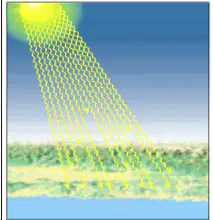
Incoming insolation (solar radiation) which is not reflected from Earth's surface is absorbed. What then happens to this energy?
It goes into the center of the Earth
It is re-radiated as UV radiation to the troposphere
It causes the ground to change state
It is re-radiated as infrared radiation (heat) to the troposphere
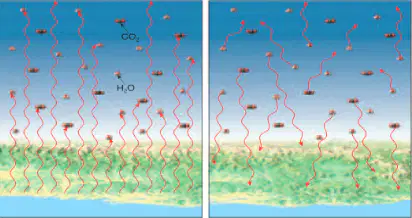
What causes the troposphere to be warmer at lower altitudes? (check all that apply)
Thermal inversions
Lower altitudes in the troposphere are closer to the re-radiation of infrared (heat) from Earth's surface
Oxygen and nitrogen gas absorb and re-radiate heat back toward Earth's surface
Carbon dioxide gas and water vapor absorb and re-radiate heat back toward Earth's surface

