wayground logo

Free Printable Worksheets

Font size

S
M
L
XL
Worksheets

Genetics Unit Review

Total questions: 150

Worksheet time: 3hrs 35mins

Name
Class
Date
1.

Wrinkle seeds are recessive over Round.


Which pair is a recessive gene?

a)

RR

b)

rr

c)

Rr

2.

Which of these are characteristics of inherited traits?

a)

being able to speak in front of a crowd

b)

having green eyes and brown hair

c)

mastering your multiplication facts

d)

becoming a teacher

3.

A person who breeds animals keeps careful records of the fur color of parents and offspring from each generation. The fur color is a trait transferred from generation to generation.


What are the structures that carry the information for these traits called?

a)

organelles

b)

genes

c)

muscles

d)

cytoplasm

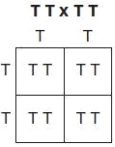
4.

What is the chemical called that is found inside our cell's nucleus and determines our inherited traits?

a)

D.N.A.

b)

genes

c)

chromosomes

d)

chloroplast

5.

A characteristic passed from parents to their offspring is called a __________________ trait.

a)

acquired

b)

inherited

c)

dominant

d)

recessive

6.

Which of the following is an example of an inherited trait?

a)

liking pizza

b)

riding a bike

c)

blowing bubbles with your gum

d)

freckles

7.

Which characteristic could be inherited from a parent?

a)

the type of shoes worn

b)

having scars

c)

the color of hair

d)

riding a bicycle

8.

Which statement is TRUE about the pedigree in the picture?

a)

every female is color blind

b)

every male is color blind

c)

only males are color blind

d)

only females are color blind

9.

In this pedigree, the shaded individuals represent family members that CAN roll their tongue. How many males in the 2nd generation can roll their tongue?

a)

1

b)

2

c)

3

d)

5

10.

In this pedigree, how many females are in the entire chart?

a)

2

b)

3

c)

5

d)

8

11.
Katie observes three birds sitting on a tree branch in her yard. All three birds are red with brown on their chests. Which best explains why the three birds have similar appearances?
a)
The birds have similar diets.
b)
The birds live in the same habitat.
c)
The birds are sitting in the same tree.
d)
The birds are members of the same population.
12.
Heterozygous is when...
a)
the alleles are the same
b)
the alleles are different
c)
the alleles are absent
d)
the alleles are present
13.
G = green, g = yellow
The genotype for a yellow plant is...
a)
GG
b)
Gg
c)
gg
d)
all of the choices result in yellow
14.
Which of the following alleles is homozygous (purebred) recessive?
a)
Tt
b)
tt
c)
TT
d)
t
15.
Aa, DD, bB, yy are all examples of
a)
genotypes
b)
phenotypes
16.
Which of the following genotypes is homozygous dominant?
a)
A
b)
Aa
c)
AA
d)
aa
17.
Which of the following genotypes is heterozygous?
a)
Bb
b)
BB
c)
bb
d)
B
18.
In a flowering plant species, red flower color (R) is dominant over white flower color (r). What is the genotype of any red-flowering plant resulting from this species?
a)
rr
b)
R
c)
RR
d)
RR or Rr
19.
What you see, or the physical appearance.
a)
Genotype
b)
Phenotype
c)
Homozygous
d)
Heterozygous
20.
How many alleles (letters) do each person carry for a trait?
a)
1
b)
2
c)
3
d)
4
21.
How many alleles (letters) does a child get from each parent for each trait?
a)
1
b)
2
c)
3
d)
4
22.
Which of the following is a phenotype?
a)
Aa
b)
red hair
c)
heterozygous
d)
DNA
23.
One form of a gene is called_______________
a)
a DNA
b)
a Phenotype
c)
a trait
d)
an allele
24.
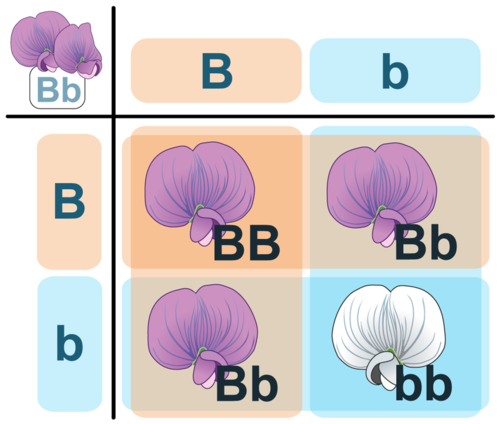
In this punnett square, which is the dominant trait?
The B stands for bud.
a)
purple flower bud
b)
white flower bud
c)
dominant
d)
recessive
25.
W=white hair
w= non-white hair
If you cross a horse with WW and a horse with ww what fraction of the offspring would be expected to have white hair?
a)
none
b)
3/4
c)
1/2
d)
all
26.
The study of heredity and the variation of inherited characteristics 
a)
gene
b)
genetics 
c)
meiosis 
d)
hybrid 
27.
A dog gives birth to 5 puppies. What percentage of the chromosomes does each puppy share with the mother?
a)
25%
b)
50%
c)
75%
d)
100%
28.
this image is an example of
a)
codominance
b)
dominance
c)
incomplete dominance
29.
this image is an example of
a)
codominance
b)
dominance
c)
incomplete dominance
30.

A mutation is harmful to an organism if it

a)

changes the phenotype of an organism

b)

changes the DNA segment

c)

reduces the organism's chance of survival

d)

makes the organism better able to avoid predators

31.

Who studied different characteristics of pea plants by cross-pollinating plants?

a)

Gregor Mendel

b)

Albert Punnett

c)

Sir Isaac Newton

d)

David Kuster

32.

What is the probability of producing a tall pea plant from a cross between two hybrid tall pea plants?

a)

25%

b)

50%

c)

75%

d)

100%

33.

What does a Punnett Square determine?

a)

all of Mendel's discoveries about genetic crosses

b)

all the outcomes of a genetic cross

c)

only the recessive allele combinations

d)

only the dominant allele combinations

34.

Genotype is

a)

stem height

b)

feather color

c)

physical appearance

d)

genetic makeup

35.

The term that relates to physical characteristics that are studied in genetics.

a)

traits

b)

offspring

c)

generations

d)

hybrids

36.

Factors that control traits are

a)

purebreds

b)

genes

c)

recessives

d)

parents

37.

A mutation is

a)

any change that is harmful

b)

any change in a gene or chromosome

c)

any change that is helpful

d)

any change in the phenotype

38.

An organisms's allele combination is known as

a)

phenotype

b)

mutation

c)

hybrid

d)

genotype

39.

If a homozygous black cat (BB) is crossed with a homozygous white cat (bb), what is the probability of having a cat with white fur?

a)

100%

b)

0%

c)

75%

d)

25%

40.

What is the primary generation for a Punnett Square called?

a)

F2 generation

b)

F1 generation

c)

P generation

d)

G generation

41.

A mother gives birth to a son, she then gives birth to a daughter. What is the likely hood that she will have another son?

a)

75%

b)

25%

c)

50%

d)

100%

42.
An allele whose trait only shows up when no dominant allele is present.
a)
hidden allele
b)
dominant allele
c)
recessive allele
d)
present allele
43.
Two heterozygous (Tt) tall pea plants are crossed. Which describes their offspring?
a)
50% tall and 50% short
b)
75%tall and 25% short
c)
100%short
44.
What ratio of the offspring from the cross shown will be homozygous recessive for the trait of tallness? 
a)
0 in 4
b)
1 in 4
c)
2 in 4
d)
4 in 4
45.

In plants, tall (T) is dominant to short (t). Perform the following cross: Tt x Tt. What is the probability of producing a short plant?

a)

0%

b)

25%

c)

50%

d)

75%

46.

Who is considered the "father" of modern genetics?

a)

Einstein

b)

Mendel

c)

Disney

d)

Washington

47.
T - tall and t = short
In the punnett square below, what belongs in the missing square
a)
tt
b)
Tt
c)
Bb
d)
TT
48.
What is the yellow seed genotype?
a)
aa
b)
Aa
c)
AA
d)
AA or Aa
49.
In a heterozygous genotype, the ___________ allele takes over in the phenotype.
a)
recessive
b)
dominant
c)
lower case letter
d)
both 
50.
Two brown eyed parents (Bb) have a baby. What is the chance the baby is blue eyed?
a)
0 %
b)
25%
c)
50%
d)
75%
51.

What is the probability that the offspring will express the dominant trait?

a)

25%

b)

50%

c)

75%

d)

100%

52.

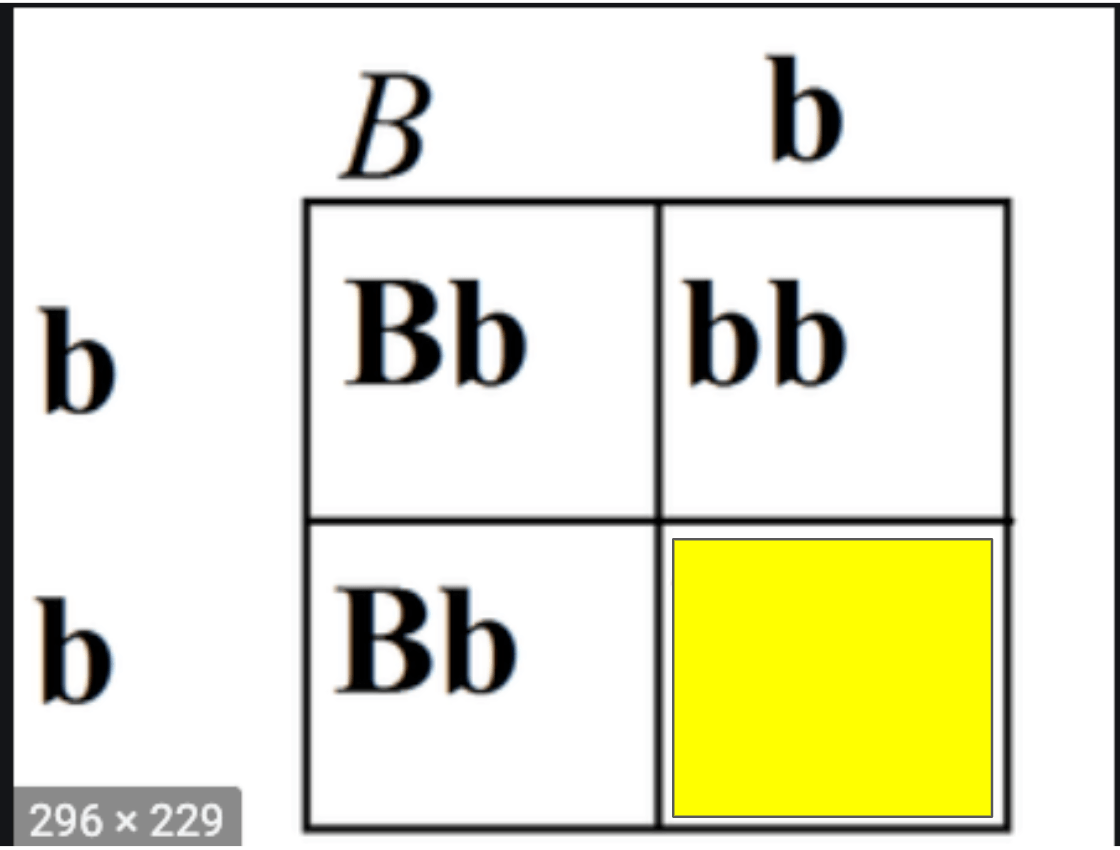
Fill in the Yellow Box

a)

Bb

b)

BB

c)

bb

53.

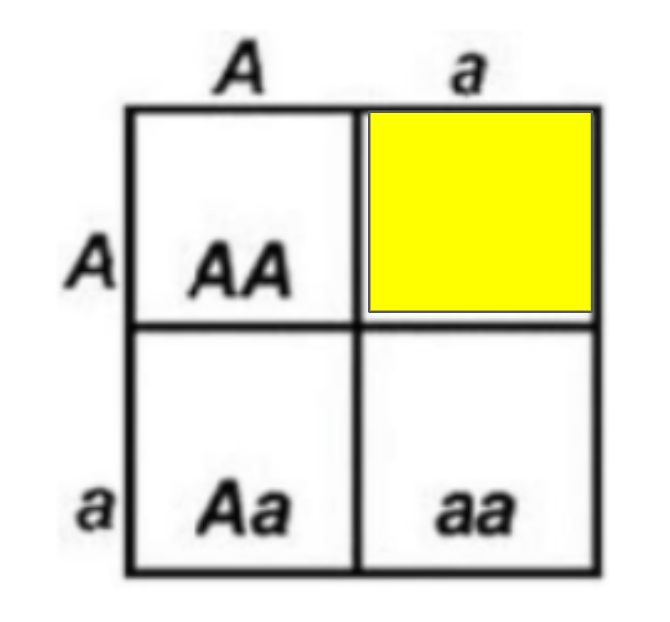
Fill in the Yellow Box

a)

AA

b)

Aa

c)

aa

54.
A heterozygous yellow pea plant's genotype would be:
a)
YY
b)
yy
c)
Yy
d)
Yg
55.
B - black, b - brownTwo black mice mate and have some black and some brown mice.  What is the genotype of the parents?
a)
BB x Bb
b)
BB x bb
c)
Bb x Bb
d)
Bb x bb
56.
What are the possible genotypes for this cross?
(Click the picture to see it without the text)
a)
TT = 25% Tt= 50% tt=25%
b)
all tall
c)
TT= 75% tt = 25%
d)
Tt = 100%
57.
What does a filled in square represent?
a)
Not affected Female
b)
Not affected Male
c)
Affected Male
d)
Affected Female
58.
How many generations are shown in this pedigree?
a)
1
b)
2
c)
3
d)
4
59.
How many kids did the mother and father from the first generation have?
a)
2
b)
4
c)
5
d)
6
60.
What do half colored symbols represent?
a)
The individual is a carrier (heterozygous).
b)
The individual expresses the trait.
c)
The individual has both recessive alleles.
d)
The individual has both dominant alleles.
61.
What does an open circle represent?
a)
Not Affected Male
b)
Not Affected Female
c)
Affected Male
d)
Affected Female
62.
In the second generation-how many people are carriers of the trait?
a)
2
b)
3
c)
5
d)
6
63.
How many people in this whole pedigree have the trait/disease?
a)
2
b)
3
c)
4
d)
6
64.
How many females are in this pedigree?
a)
3
b)
4
c)
6
d)
7
65.
What is this?
a)
Pedigree
b)
Karyotype
c)
Venn diagram
d)
Punnett Square
66.
Which individual in the first generation is a carrier?
a)
The male
b)
The female
c)
individual 1
d)
None of the above
67.
How many people in the pedigree are carriers for the disorder? 
a)
b)
8
c)
2
d)
9
68.
How many affected females are deceased? 
a)
0
b)
2
c)
4
d)
All 
69.
Which generation connects these two pedigrees? 
a)
1
b)
2
c)
3
70.
A carrier is represented by what symbol? 
a)
Clear 
b)
Shaded 
c)
Half Shaded
d)
1:4 ratio 
71.
Offsprings are represented by....
a)
Horizontal Line 
b)
Vertical Line 
72.
In the second generation-how many people have the disease or display the physical trait?
a)
2
b)
4
c)
5
d)
6
73.
What does a horizontal line between a square and a circle mean?
a)
They are siblings
b)
They are cousins
c)
They are married ("together")
d)
They are the children
74.
If a trait SKIPS a generation, it is an indication that the trait is....
a)
dominant
b)
recessive
c)
incompletely dominant
d)
co-dominant
75.

Objective #13

On a pedigree how do we know if they have the trait?

a)

Not shaded

b)

Shaded

76.

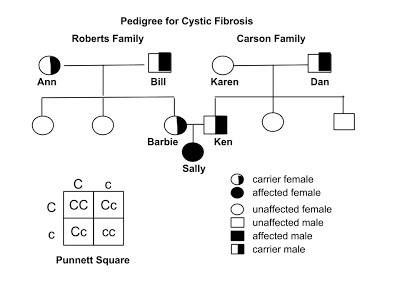
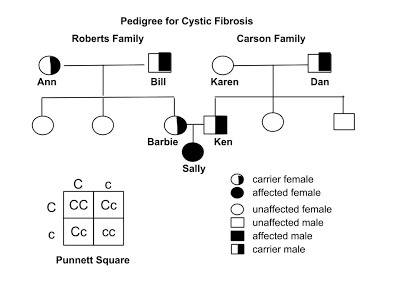
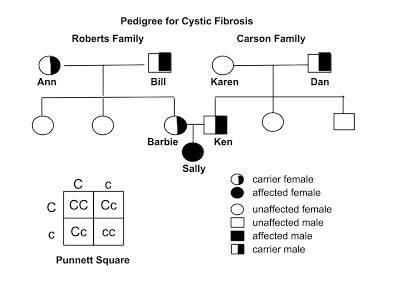
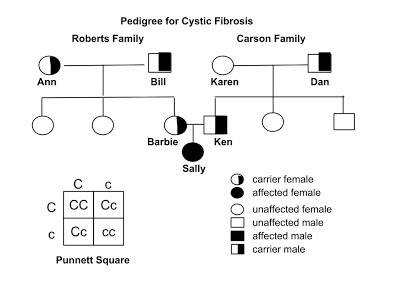
Cystic Fibrosis is a recessive trait. Which genotype(s) will not have cystic fibrosis? Pick two.

a)

CC

b)

Cc

c)

cc

77.

Cystic Fibrosis is a recessive trait. Which phenotype will show from a heterozygous genotype (Cc)?

a)

CC

b)

Cc

c)

cc

d)

Normal (unaffected or carrier)

e)

Cystic Fibrosis (affected)

78.

Cystic Fibrosis is a recessive trait. What is the genotype of Bill?

a)

CC

b)

Cc

c)

cc

79.

Cystic Fibrosis is a recessive trait. What is the genotype of Sally?

a)

CC

b)

Cc

c)

cc

d)

Cystic Fibrosis

e)

Normal

80.

Cystic fibrosis is a recessive trait. If Karen and Dan have another child, what are the chances that it will have cystic fibrosis? (Make a punnett square!)

a)

0%

b)

25%

c)

50%

d)

75%

e)

100%

81.

What is the difference between sexual and asexual reproduction?

a)

Asexual produces genetically different offspring. Sexual produces genetically identical.

b)

Sexual produces offspring with fewer chromosomes. Asexual produces more.

c)

Sexual produces genetically different offspring. Asexual produces genetically identical.

d)

Sexual reproduction is quicker than asexual.

82.

What is the purpose of meiosis?

a)

To create daughter cells.

b)

To create identical cells.

c)

To create offspring that are genetically identical.

d)

To create a faster process of reproduction.

83.

Combining of egg and sperm

a)

Asexual Reproduction

b)

Sexual Reproduction

c)

Diverse

d)

Uniform

84.

Involves only one parent

a)

Asexual Reproduction

b)

Sexual Reproduction

c)

Diverse

d)

Uniform

85.

occurs when a second organism develops from an outgrowth of the original.

a)

Vegetative propagation

b)

Budding

c)

Fragmentation

d)

Binary Fission

86.

A type of cell division where the cell divides into two copies

a)

Vegetative propagation

b)

Budding

c)

Fragmentation

d)

Binary Fission

87.
If two organisms reproduce sexually, then their offspring will exhibit a genetic makeup that is -
a)
identical to only one parent
b)
identical to all of its siblings
c)
a unique combination of traits
88.

What kind of reproduction is pictured?

a)

spore reproduction

b)

fragmentation

c)

parthenogenesis

d)

budding

e)

runner

89.

What is a gamete?

a)

sex cell

b)

human cells

c)

plant cells

d)

plant and animal cells

90.

The male gamete is a ______. The female gamete is a _____. When the two gametes come together, it's called _____.

a)

egg, sperm, offspring

b)

sperm, egg, offspring

c)

sperm, egg, gamete

d)

sperm, egg, asexual reproduction

e)

sperm, egg, fertilization

91.

Sexual reproduction provides more diversity/variation in a species.

a)

true

b)

false

92.

How many parents are required for asexual reproduction?

a)

none

b)

1

c)

2

d)

4

93.

How many parents are involved with sexual reproduction?

a)

none

b)

1

c)

2

d)

4

94.

Genes is described as...

a)

the release of energy

b)

unit of heredity

c)

waste produced by cells

d)

collection of adaptation

95.

The hereditary information in animal and plants cells is located on the chromosomes, which the cells store in the --

a)

vacuoles

b)

nucleus

c)

cytoplasm

d)

ribosomes

96.

On what structures are genes located?

a)

chromosomes

b)

lysosomes

c)

ribosomes

d)

golgi bodies

97.
Humans have ____ chromosomes.
a)
57
b)
22
c)
46
d)
100
98.
Genetic traits are passed from ________ to ________.
a)
parent; offspring
b)
chromosomes; traits
c)
DNA; genes
d)
offspring; parents
99.
Traits can be inherited or influenced by ______ factors, like the sun. 
a)
environmental
b)
mutation
c)
variation
d)
genetic
100.
Differences in traits are called _________ and explain why siblings don't look exactly alike.
a)
mutations
b)
variations
c)
traits
d)
evolution
101.
Forensic scientists study ______ to help figure out crimes.
a)
DNA
b)
plants
c)
cells
d)
fossils
102.
Which is a molecule that is present in all living cells and that contains the information that determines the traits that a living thing inherits and needs to live?
a)
DNA
b)
nucleotide
c)
base
d)
mutation
103.
This is a change in the DNA sequence of a gene.
a)
change
b)
mutation
c)
bond
d)
tomorrow
104.

"Offspring" means:

a)

Children

b)

Parents

105.

Vocab check:

The theory that organisms have slowly changed over time...

a)

fossil record

b)

relative dating

c)

evolution

d)

adaptation

106.
When an organism completely dies out, it is called.....
a)
Adaption
b)
Extinction
c)
Fossilization
d)
Mutation
107.
In the graph shown, how many species of lizards seem to have beneficial adaptations?
a)
1
b)
2
c)
3
d)
4
108.
What most likely caused the finches on the Galapagos Islands to have beaks that were differnt from the finches living on the South American mainland?
a)
They were different types of food available on the island.
b)
The finches on the islands had to drink salt water.
c)
There were different types of predators living on the island.
d)
The finches on the mainland built different types of nests.
109.
Which beneficial variation would be most helpful in a desert environment?
a)
white fur
b)
claws for burrowing
c)
grean and black camouflage
d)
flippers
110.
What is it called when an organism is best adapted to its environment, it will survive and reproduce more successfully than other organisms less adapted?
a)
cloning
b)
evolution of all species
c)
natural selection
d)
selective breeding
111.
This scientist came up with the idea of natural selection.
a)
Jean Baptiste Lamarck
b)
Gregor Mendel
c)
Charles Darwin
d)
Thomas Malthus
112.
Inherited trait that helps an organism survive is a(n) __________.
a)
Fossil
b)
Adaptation
c)
Ancestor
d)
Natural selection
113.
Survival of the fittest or when favorable adaptations reproduce faster is called what?
a)
Evolution
b)
Adaptation
c)
Natural selection
d)
Fossilization
114.
All the individuals of a species that live in a particular area are called a
a)
variation
b)
population
c)
fossil
d)
group
115.
Why are advantageous traits more likely to be passed onto offspring?
a)
Because they are more likely to survive and reproduce.
b)
Because they come from dominant alleles.
c)
Because they come from recessive alleles.
d)
Because the trait is an acquired phenotype.
116.
Natural selection is when ____________ decides who survives and who doesn't
a)
nature
b)
humans
c)
animals
d)
years
117.
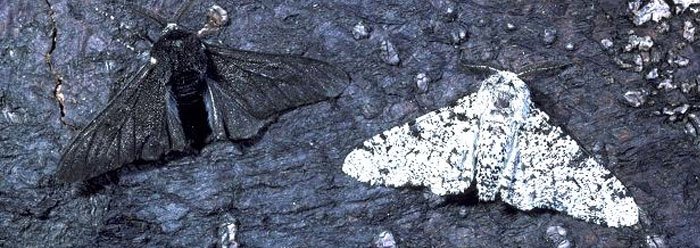
The trees these moths used to live on were white, but have been covered in soot from coal factories. Which moth will be more successful in this environment?
a)
Dark moth
b)
Light moth
c)
Both will be equally successful
d)
Neither will be successful
118.
Where humans have bred organisms together based on traits we like.
a)
Evolution
b)
Natural Selection
c)
Extinction 
d)
Artificial Selection
119.
The long and sharp beak of a woodpecker is an example of:
a)
Natural Selection
b)
Selective Breeding
120.
The surroundings and conditions in which an organism lives and operates.
a)
Evolution
b)
Population
c)
Environment
d)
Biological diversity
121.

Beak shape, camouflage, and webbed feet are all examples of which type of adaptation?

a)

Behavioral Adaptation

b)

Physical Adaptation

122.

How can a person's muscle cells have the same exact DNA sequences as their nerve cells even though the look and perform completely different?

a)

The two different cells become mutated

b)

The proteins expressed in each cell are different

c)

They actually have different DNA in the two types of cells.

d)

The genome of the different cells changes

123.
Activation or deactivation of genes by environmental experiences throughout development
a)
turn on genes
b)
gene expression
c)
environmental factors
d)
gene markers
124.

Why do identical twins begin to look different as they age?

a)

Their environment causes mutation of the MAOA gene.

b)

Mutations accumulate which deactivates histone proteins.

c)

Exposure to different environments causes the addition of epigenetic tags that result in changes in gene function.

d)

The DMNT gene is silenced.

125.
Which factor can affect the epigenome?
a)
nutrition
b)
exercise
c)
stress 
d)
all of these factors can affect the epigenome
126.

True or False: Epigenetic changes are permanent.

a)

True

b)

False

127.

True or False: Epigenetic changes can be passed on to future generations.

a)

True

b)

False

128.
At what stage in the life of identical twins is the epigenome expected to be most similar?
a)
Age 6 months
b)
Age 21
c)
Age 55
d)
Trick quesiton; the epigenome never changes
129.

The study of the inherited changes in gene expression that occur without a change in gene sequence and influence how an organism's genes express themselves. Mechanisms are influenced by food and environment. They play an important role in the fetal basis of adult disease susceptibility.

a)

bionomics

b)

genomics

c)

genetics

d)

epigenetics

130.

The end result of mitosis is

a)

4 Identical Cells are produced

b)

4 genetically different cells are produced

c)

2 identical cells are produced

d)

2 genetically different cells are produced

131.

The end result of meiosis is...

a)

4 identical cells

b)

4 genetically different cells

c)

2 identical cells

d)

2 genetically different cells

132.

If an organism reproduces asexually, its offspring will most likely be...

a)

genetically identical to the parent

b)

genetically different from each other

c)

produced from specialized cells known as gametes

d)

A mutant

133.

How many divisions are in meiosis?

a)

46

b)

23

c)

2

d)

4

134.

What process results in the division of 1 cell into 2 identical daughter cells?

a)

Mitosis

b)

Meiosis

c)

G1

d)

Cross-Over

135.
products of meiosis are genetically
a)
different
b)
identical
136.
A human usually has xx amount of chromosomes.
a)
6
b)
22
c)
4
d)
46
137.
What causes genetic variation in meiosis?
a)
chromosomes lining up
b)
crossing over of chromosomes
c)
separation of chromosomes
d)
chromosomes pulling apart
138.

if a body cell normally has 24 chromosomes how many will it have at the end of mitosis.

a)

6

b)

12

c)

24

d)

48

139.

Which of the following are in order from smallest to largest

a)

Cells -> tissue -> organ -> organ system

b)

Cells -> Organ system -> tissue -> organ

c)

Organ system -> Organ -> Tissue -> Cell

d)

Tissue -> organ system -> Cell -> Organ

140.
Before a cell can divide, what must happen?
a)
Nothing, it is always ready to divide
b)
The number of chromosomes must be cut in half
c)
The number of chromosomes must double
d)
The number of chromosomes must triple.
141.
How many chromosomes do humans have?
a)
46-- 23 from mom, 23 from dad
b)
22--11 from mom, 11 from dad
c)
10-- 5 from mom, 5 from dad
d)
23
142.
Which of the following is the correct order of organization in living things from most basic (simple) to most complex?
a)
a.  Organism, cell, tissue, organ, organ system
b)
a.  Organ system, organ, tissue, cell, organism
c)
a.  Cell, tissue, organ, organ system, organism
d)
a.  Cell, organ, tissue, organ, organism, organ system
143.

The smallest unit of a living thing

a)

Cell

b)

Tissue

c)

organ

d)

Organ system

e)

Organism

144.
What is the difference between a cell and a tissue?
a)
cell is basic unit of life; tissue is group of cells that work as one
b)
cell is group of tissues; tissue is basic unit of life
c)
cell is basic unit of life; tissue is groups of different cells
d)
cell is group of organs; tissue is group of different cells
145.
When a group of organs work together to perform a particular function they create a/an
a)
organ system
b)
organism
c)
tissue
d)
organ
146.
Which is an example of an organism?
a)
a beetle
b)
a lake
c)
a rock
d)
a shell
147.
A group of different tissues working together to do a job is called a/an _____.
a)
tissue
b)
organ
c)
stem cell
d)
organ system
148.
This is a example of........ 
a)
organ system
b)
cells
c)
organ
d)
tissue
149.
which is the correct order of the levels of organization from simple to complex?
a)
organism, population, community, ecosystem
b)
ecosystem, community, population, organism
150.

Arrange the following in order from biggest to smallest.

Nucleus

DNA

Chromosome

Gene

a)

Nucleus, Chromosome, Gene, DNA

b)

DNA, Gene, Chromosome, Nucleus

c)

Chromosome, Gene, DNA, Nucleus

d)

Gene, Nucleus, DNA, Chromosome