wayground logo

Free Printable Worksheets

NEW

Font size

S
M
L
XL
Worksheets

BIOLOGY 2

Total questions: 75

Worksheet time: 3hrs 33mins

Name
Class
Date
1.
What does DNA stand for?
a)
Deoxyribose Nucleic Acid
b)
Denatured Natural Acid
c)
Do Not Accept
d)
I Don't Know
2.
What does DNA do?
a)
a.  It carries genetic codes from parents to offspring.
b)
a.  It carries oxygen from the lungs to the body.
c)
a.  It tells you who you are.
d)
a.  It defines the organism.
3.
What is the shape of a DNA?
a)
Double Helix
b)
Base Pairing
c)
The shape of you
d)
Hydrogen Bonding
4.
Adenine, Cytosine, Guanine and Thymine are examples of
a)
DNA structure
b)
DNA bases
c)
DNA double helix
d)
Paired bases
5.
The rules of DNA pairing states that Adenine (A) always pairs up with
a)
Thymine
b)
Cytosine
c)
Adenine
d)
Guanine
6.
The rules of DNA pairing states that Cytosine (C) always pairs up with
a)
Thymine
b)
Cytosine
c)
Adenine
d)
Guanine
7.
The sequence of bases forms the
a)
Genetic Code
b)
DNA base pair
c)
Double Helix
d)
Paired bases
8.
What holds the DNA bases together?
a)
Hydrogen bonds
b)
DNA bases
c)
Double Helix
d)
Paired bases
9.
How many hydrogen bonds do C and G have between them?
a)
1
b)
2
c)
3
d)
4
10.
What is a DNA molecule made of?
a)
Base, sugar, phosphate
b)
Base, sugar, coffee
c)
Base, roof, height
d)
DNA, sugar, phosphate
11.
Which of the following best describes a DNA molecule?
a)
double helix
b)
contains ribose
c)
made of amino acids
d)
contains Uracil
12.
Which sequence of DNA bases would pair with this partial strand
ATG TGA CAG
a)
ATG TGA CAG
b)
TAC ACT GTC
c)
GTA AGT GAC
d)
CAT TCA CTG
13.
Which of the following units are repeatedly joined together to form a strand of DNA?
a)
amino acids
b)
nucleotides
c)
fatty acids
d)
polysaccharides
14.
Why is DNA important?
a)
it is very small and very complicated
b)
it's in everything
c)
it serves as the blueprint for traits of all living things
d)
because we eat it every day for energy
15.
What determines the code, or information, of a DNA molecule?
a)
the shape (structure) of the nitrogen bases
b)
the order (sequence) of the nitrogen bases
c)
the color of the nitrogen bases
d)
the frequency (number) of nitrogen bases
16.
DNA replication results in two DNA molecules,
a)
each one with two original strands
b)
each one with two new strands
c)
each one with one new strand and one original strand
d)
one with two new strands and the other with two original strands
17.
In what phase of the cell cycle does DNA replication take place?
a)
G1
b)
S
c)
G2
d)
M
18.
Nitrogenous bases are joined by which type of bond?
a)
polar bonds
b)
ionic bonds
c)
covalent bonds
d)
hydrogen bonds
19.
In a molecule of double-stranded DNA, the amount of Adenine present is always equal to the amount of
a)
cytosine
b)
guanine
c)
thymine
d)
uracil
20.
What sugar is in DNA?
a)
deoxyribose
b)
ribose
c)
oxyribose
d)
deoxyose
21.
Which 2 molecules form the sides (backbone) of the DNA ladder?
a)
deoxyribose sugar and adenine
b)
deoxyribose sugar and a hydrogen bond
c)
deoxyribose sugar and the nucleus
d)
deoxyribose sugar and phosphate
22.
Replicate the following strand of DNA: 
AATCATGGA
a)
AATCATGGA
b)
TTAGTACCT
c)
UUAGUACCU
d)
GGATAUCUA
23.
What are the three components of a nucleotide?
a)
sugar, hydrogen, nitrogen base
b)
sugar, oxygen, nitrogen base
c)
sugar, phosphate, nitrogen base
d)
sugar, phosphate, protein
24.

Which of the following is the correct definition for a genotype?

a)

The physical expression of a gene. (Characteristics)

b)

A strand of DNA made up of multiple mutations.

c)

The expression of one of your parents traits.

d)

The set of genes in our DNA which is responsible for a particular trait.

25.
Which of the following genotypes is homozygous dominant?
a)
A
b)
Aa
c)
AA
d)
aa
26.
Which of the following genotypes is heterozygous?
a)
Bb
b)
BB
c)
bb
d)
B
27.
In a heterozygous genotype, the ___________ allele takes over in the phenotype.
a)
recessive
b)
dominant
c)
lower case letter
d)
both 
28.
Look at the picture. The probability that a child will inherit the recessive trait is
a)
25%
b)
50%
c)
75%
d)
100%
29.
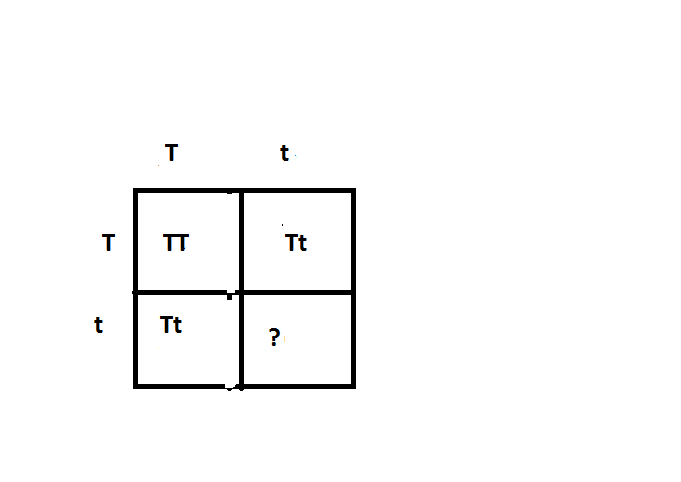
T - tall and t = short
In the punnett square below, what belongs in the missing square
a)
tt
b)
Tt
c)
Bb
d)
TT
30.

An example of a heterozygous gene is

a)

FF

b)

ff

c)

Ff

31.

An example of a homozygous recessive gene is

a)

Dd

b)

DD

c)

dd

d)

DAB

32.

An example of a homozygous dominant gene is

a)

Dd

b)

DD

c)

dd

d)

DAB

33.
Dominant alleles are represented by a:
a)
Male gene
b)
lowercase letter
c)
recessive trait
d)
capital letter
34.
Aa, DD, bB, yy are all examples of
a)
genotypes
b)
phenotypes
35.
Alternative forms of a gene are called
a)
Alleles
b)
Homozygous
c)
DNA
d)
Genetics
36.
Hair colour is an example of
a)
genotype
b)
phenotype
37.
If a trait is recessive, it needs to be inherited from ___ parents to be 'expressed'.
a)
one
b)
both
38.
Mark is heterozygous. If B is for brown hair, and b is for blonde hair, what is Mark's genotype?
a)
BB
b)
bb
c)
Bb
d)
bB
39.

Punnett Square

a)

a genetic factor that blocks another genetic factor

b)

a genetic factor that is blocked by the presence of a dominant factor

c)

physical appearance of a trait

d)

a model used to predict possible genotypes and phenotypes of offspring

40.

Physical appearance of a trait

a)

gene

b)

allele

c)

genotype

d)

phenotype

41.

Which of the following genotypes is homozygous recessive?

a)

Tt

b)

tt

c)

TT

d)

tT

42.

Which of the following is the correct definition for a genotype?

a)

The physical expression of a gene. (Characteristics)

b)

A strand of DNA made up of multiple mutations.

c)

The expression of one of your parents traits.

d)

The set of genes in our DNA which is responsible for a particular trait.
43.
Which of the following genotypes is homozygous dominant?
a)
A
b)
Aa
c)
AA
d)
aa
44.
Which of the following genotypes is heterozygous?
a)
Bb
b)
BB
c)
bb
d)
B
45.
In a heterozygous genotype, the ___________ allele takes over in the phenotype.
a)
recessive
b)
dominant
c)
lower case letter
d)
both 
46.
Look at the picture. The probability that a child will inherit the recessive trait is
a)
25%
b)
50%
c)
75%
d)
100%
47.
T - tall and t = short
In the punnett square below, what belongs in the missing square
a)
tt
b)
Tt
c)
Bb
d)
TT
48.

An example of a heterozygous gene is

a)

FF

b)

ff

c)

Ff

49.

An example of a homozygous recessive gene is

a)

Dd

b)

DD

c)

dd

d)

DAB

50.

An example of a homozygous dominant gene is

a)

Dd

b)

DD

c)

dd

d)

DAB

51.
Dominant alleles are represented by a:
a)
Male gene
b)
lowercase letter
c)
recessive trait
d)
capital letter
52.
Aa, DD, bB, yy are all examples of
a)
genotypes
b)
phenotypes
53.
Alternative forms of a gene are called
a)
Alleles
b)
Homozygous
c)
DNA
d)
Genetics
54.
Hair colour is an example of
a)
genotype
b)
phenotype
55.
If a trait is recessive, it needs to be inherited from ___ parents to be 'expressed'.
a)
one
b)
both
56.
Mark is heterozygous. If B is for brown hair, and b is for blonde hair, what is Mark's genotype?
a)
BB
b)
bb
c)
Bb
d)
bB
57.

Punnett Square

a)

a genetic factor that blocks another genetic factor

b)

a genetic factor that is blocked by the presence of a dominant factor

c)

physical appearance of a trait

d)

a model used to predict possible genotypes and phenotypes of offspring

58.

Physical appearance of a trait

a)

gene

b)

allele

c)

genotype

d)

phenotype

59.

Which of the following genotypes is homozygous recessive?

a)

Tt

b)

tt

c)

TT

d)

tT

60.
What does a filled in square represent?
a)
Not affected Female
b)
Not affected Male
c)
Affected Male
d)
Affected Female
61.
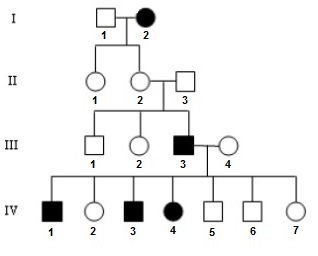
How many generations are shown in this pedigree?
a)
1
b)
2
c)
3
d)
4
62.
How many kids did the mother and father from the first generation have?
a)
2
b)
4
c)
5
d)
6
63.
This pedigree represents the inheritance of hemophilia in this family. How many of the females have the hemophilia trait?
a)
8
b)
5
c)
2
d)
3
64.
What do half colored symbols represent?
a)
The individual is a carrier (heterozygous).
b)
The individual expresses the trait.
c)
The individual has both recessive alleles.
d)
The individual has both dominant alleles.
65.
What does an open circle represent?
a)
Not Affected Male
b)
Not Affected Female
c)
Affected Male
d)
Affected Female
66.
Is this trait (the shaded individuals) dominant or recessive?
a)
dominant
b)
recessive
67.
How many females are in this pedigree?
a)
3
b)
4
c)
6
d)
7
68.
Give the genotype for person II-1, for this autosomal trait.
a)
GG
b)
Gg
c)
gg
d)
we cannot be 100% sure of the genotype
69.
If a trait SKIPS a generation, it is an indication that the trait is....
a)
dominant
b)
recessive
c)
incompletely dominant
d)
co-dominant
70.
If this pedigree shows an autosomal recessive disorder, what MUST the genotype of individual II-3 be?
a)
HH
b)
Hh
c)
hh
d)
None of the above
71.

Objective #13

This is a pedigree that follows blue eyes which is a recessive trait. What is the genotype of the father (square) in generation 1?

a)

Aa

b)

AA

c)

aa

d)

A?

72.

In this pedigree, the shading represents people in the family with dark hair while the unshaded represents blondes. Is dark hair controlled by a dominant or recessive allele?

a)

Dominant

b)

Recessive

73.

Individuals that are shaded in have premature hair whitening. Is this trait dominant or recessive? How do you know?

a)

Dominant because it skips generations

b)

Dominant because it is present in every generation

c)

Recessive because it skips generations

d)

Recessive because it is present in every generation.

74.
How are individuals III-2 and II-4 related?
a)
Cousins
b)
Dad and Daughter
c)
Uncle and Niece
d)
Grandpa and Granddaughter
75.

What is used to regulate many bodily processes?

a)

bile

b)

hormones

c)

blood vessels

d)

hydrochloric acid