
 Worksheets
Road to Revolution Test
Total questions: 45
Worksheet time: 26mins
Name
Class
Date
1.
American colonists who remained loyal to Britain and opposed the war for independence.
a)
boycott
b)
loyalists
c)
militia
2.
Cannons and large guns
a)
boycott
b)
loyalists
c)
artillery
3.
The action of an armed force that surrounds a fortified place and isolates it while continuing to attack.
a)
siege
b)
tariff
c)
artillery
4.
Civilians trained as soldiers but not part of the regular army.
a)
loyalists
b)
militia
c)
artillery
5.
Member of a militia during the American Revolution who could be ready to fight at a moment's notice.
a)
militia
b)
minutemen
c)
patriots
6.
Colonists who wanted independence from Britain.
a)
militia
b)
patriots
c)
artillery
7.
The deliberate spreading of such information, rumors, etc.
a)
patriots
b)
propaganda
c)
artillery
8.
Refusal to buy goods or services as a punishment or protest.
a)
boycott
b)
minutemen
c)
siege
9.
Tax on imported goods.
a)
boycott
b)
siege
c)
tariff
10.
What is the term used for a person who came to the new world, paid for their own way plus another passenger in return for 2 plots of 50 acres of land?
a)
Indentured Servant
b)
Headright System
c)
Virginia Cavaliers
11.
What is the term used to describe those people who came to the new world and had to pay off their passage, food, and shelter by working for the person who paid for their voyage?
a)
Indentured Servant
b)
Headright System
c)
Virginia Cavaliers
12.
Who led a group of angry colonists in an attack against the Indians on the frontier when Governor Berkeley of Jamestown would not protect them?
a)
Nathaniel Bacon
b)
George Washington
c)
Ben Frankiln
13.
After defeating the Indians, the angry colonists attacked Berkeley and his men at ...
a)
Philadelphia
b)
Boston
c)
Jamestown
14.
Who fought against each other in the French & Indian War?
a)
Great Britain and the colonist
b)
France and Spain
c)
Great Britain and France
15.
Which country was NOT fighting for control of the North American continent during the French and Indian War?
a)
France
b)
Spain
c)
Great Britain
16.
British declaration that forbids colonists from settling west of the Appalachians.
a)
Declaratory Act
b)
Proclamation of 1763
c)
Committee of Correspondence
17.
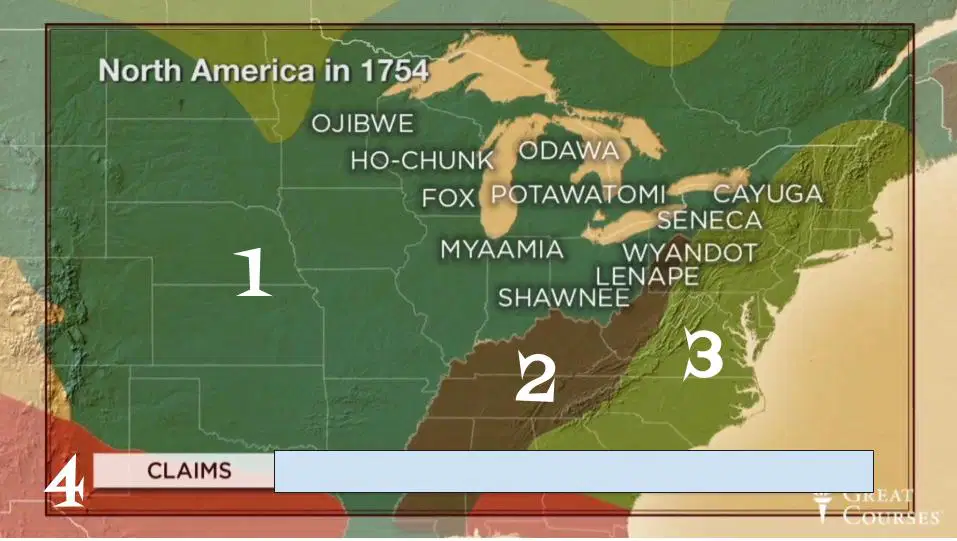
This is a map of North America in 1754. What territories belong to #1?
a)
France
b)
Spain
c)
Ohio River Valley
18.
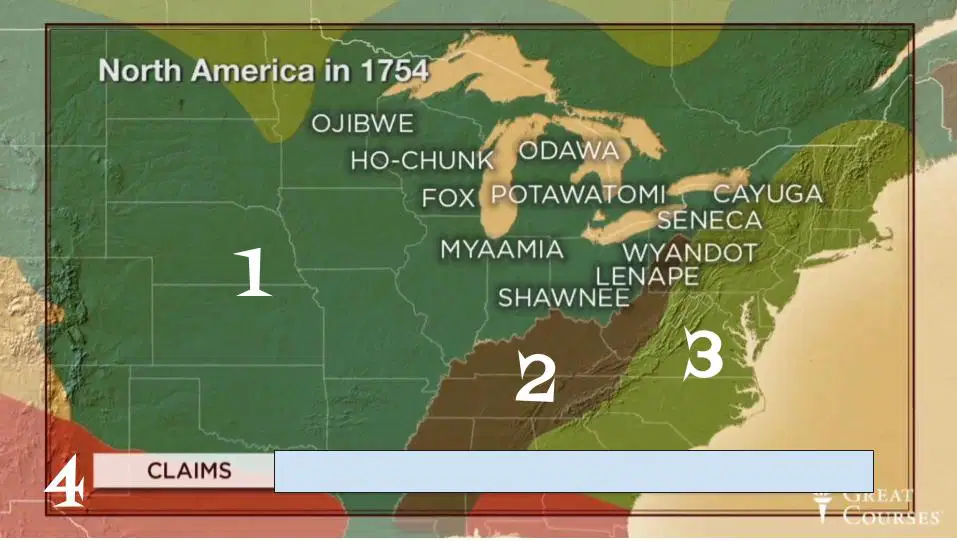
This is a map of North America in 1754. What territories belong to #2?
a)
Great Britain
b)
Spain
c)
Ohio River Valley
19.
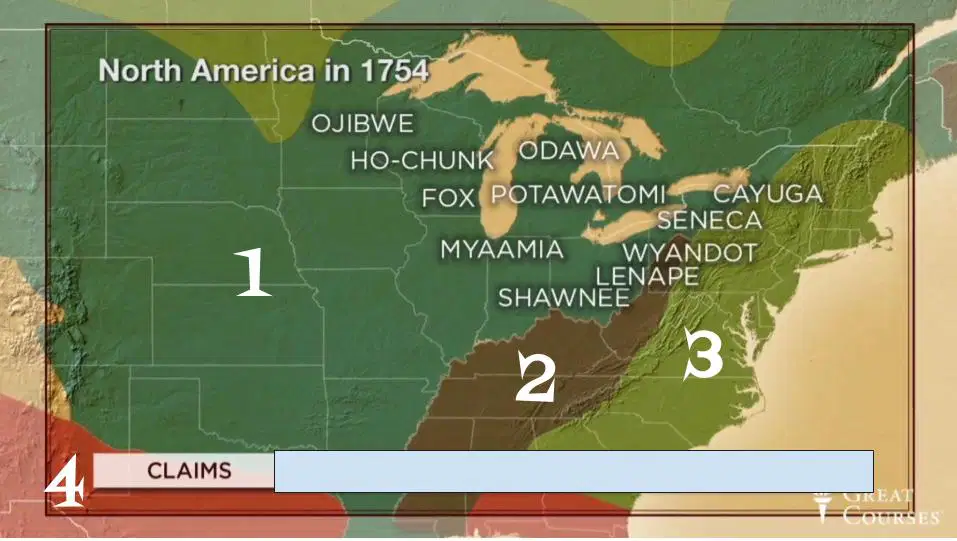
This is a map of North America in 1754. What territories belong to #3?
a)
Great Britain
b)
Spain
c)
Ohio River Valley
20.
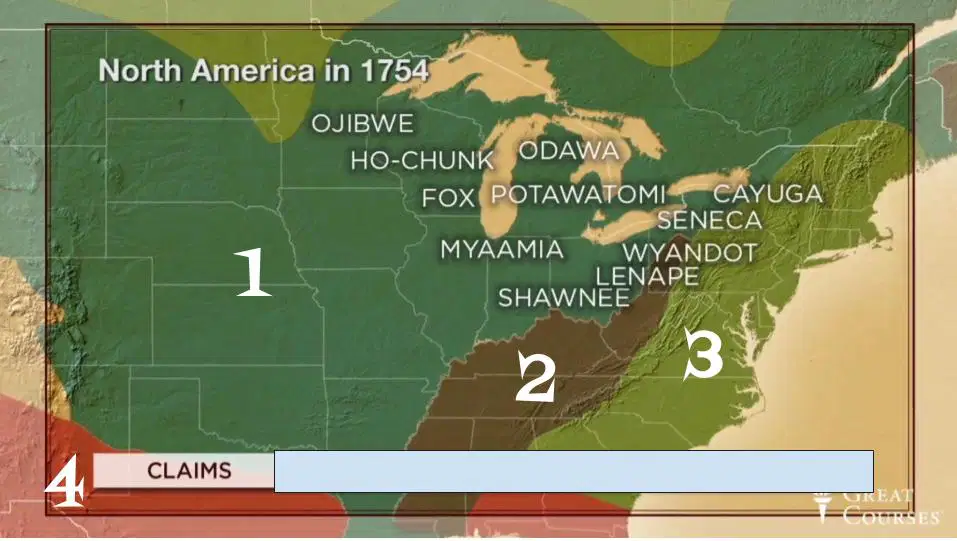
This is a map of North America in 1754. What territories belong to #4?
a)
France
b)
Great Britain
c)
Spain
21.
Laws passed in 1767 that taxed goods such as glass, paper, paint, lead, and tea.
a)
Writs of Assistance
b)
Townshend Act
c)
Intolerable Act
22.
Law passed where customs officials could inspect a ship's cargo or colonist home without giving a reason. Colonists protested that it violated their rights as British citizens.
a)
Writs of Assistance
b)
Intolerable Act
c)
Declaratory Act
23.
What famous leader led Great Britain's army during the French & Indian War but proved unsuccessful and was replaced by William Pitt?
a)
Marquis de Montcalm
b)
George Washington
c)
Ben Franklin
24.
Ended the French and Indian War between Great Britain and France. France gave up all territories in mainland North America and ended the military threat to the British Colonies.
a)
Proclamation of 1763
b)
Treaty of Paris
c)
Stamp Act Congress
25.
Launched in 1763 by a loose confederation of native American tribes primarily from the Great Lakes region, the Illinois Country, and Ohio Country who were dissatisfied with British postwar policies in the Great Lakes region after the British victory in the French and Indian war.
a)
Bacon's Rebellion
b)
Pontiac's Rebellion
c)
Boston Massacre
26.
In 1651 these were designed to tighten the government's control over trade between England, its colonies, and the rest of the world. Banned foreign ships from transporting non-English goods or its colonies.
a)
Townshend Act
b)
Navigation Act
c)
Sugar Act
27.
An Act which requires colonies to provide lodging and supplies for British troops.
a)
Intolerable Acts
b)
Quartering Act
c)
Townshend Act
28.
A law requiring all legal and commercial documents to carry an official stamp showing that a tax has been paid.
a)
Intolerable Acts
b)
Stamp Act
c)
Townshend Act
29.
Tax on sugar, molasses, and other goods shipped to colonies.
a)
Sugar Act
b)
Stamp Act
c)
Townshend Act
30.
Law passed by parliament allowing the British East India Company to sell its low-cost tea directly to the colonies - undermining colonial tea merchants; et to the Boston Tea Party.
a)
Tea Act
b)
Sugar Act
c)
Stamp Act
31.
Organization founded by Samuel Adams consisting of a system of communication between patriot leaders in New England and throughout the colonies. Rallied colonial opposition against British policy and established a political union among the 13 colonies.
a)
Albany Plan of Union
b)
Committee of Correspondence
c)
Stamp Act Congress
32.
British proclaimed the right to tax colonist for no reason without challenge.
a)
Intolerable Acts
b)
Townshend Act
c)
Declaratory Act
33.
What country won the French & Indian War?
a)
Great Britain
b)
France
c)
Spain
34.
An organization formed by women prior to the American Revolution. They got together to protest treatment of the colonies.
a)
Daughters of Liberty
b)
Women of Liberty
c)
Sons of Liberty
35.
Group of colonist who protested the Stamp Act, saying that Parliament couldn't tax without colonist consent.
a)
Stamp Act Congress
b)
Sons of Liberty
c)
2nd Continental Congress
36.
1770 British troops fired on and killed 5 American colonists. Remembered as a key event in helping shock the colonial public into the Patriot cause.
a)
Pontiac's Rebellion
b)
Boston Massacre
c)
Bacon's Rebellion
37.
Congress of America leaders which first met in 1775, declared independence in 1776, and helped lead the United States during the Revolution.
a)
1st Continental Congress
b)
2nd Continental Congress
c)
Stamp Act Congress
38.
1773 Demonstrations by citizens of Boston who (disguised as Mohawk Indians) raided three British ships in Boston harbor and 342 chests of tea into the harbor.
a)
Boston Massacre
b)
Boston Tea Party
c)
Bacon's Rebellion
39.
The Boston Tea Party of 1773 was:
a)
An isolated incident
b)
One of several similar protests to occur
c)
Carried out by the colonists' Indian allies
40.
In responce to the Boston Tea Party, 4 acts passed in 1774, Port of Boston closed, reduced power of assemblies in colonies, permitted royal officers to be tried elsewhere, provided for quartering of troop's in barns and empty houses.
a)
Townshend Act
b)
Intolerable Acts
c)
Tea Act Congress
41.
When British soldiers came across to North America to fight they had to cross the ...
a)
Atlantic Ocean
b)
Indian Ocean
c)
Pacific Ocean
42.
The British learned quickly that fighting a war in America was much different than a war with their other European enemies. What were all of the differences that they experienced? Choose all that apply
a)
Clothing that American wore was anything they had, not all of the people fighting had proper uniforms.
b)
War tactics were very different in that any rules that the English were used to did not apply in America.
c)
War did not have to take place on an open field one enemy in front of the other.
d)
In America Generals were fighting right along side their men instead of hanging the back to stay alive.
e)
In America a specific time for the war to take place was not talked about or planned out ahead of time.
43.
Reorder the following
a)
Bacon's Rebellion
b)
French and Indian War
c)
Proclamation of 1763
d)
Sugar Act 1764
e)
Stamp Act of 1765
1)
2)
3)
4)
5)
44.
Reorder the following
a)
Quartering Act
b)
Declaratory Act
c)
Townshend Act
d)
Boston Massacre
e)
Committee of Correspondence
1)
2)
3)
4)
5)
45.
Reorder the following
a)
Coercive/ Intolerable Act
b)
1st Continental Congress
c)
Lexington and Concord
d)
2nd Continental Congress
e)
Battle of Bunker Hill
1)
2)
3)
4)
5)
100 %

