
Font size
 Worksheets
Ecosystems Quiz
Total questions: 43
Worksheet time: 22mins
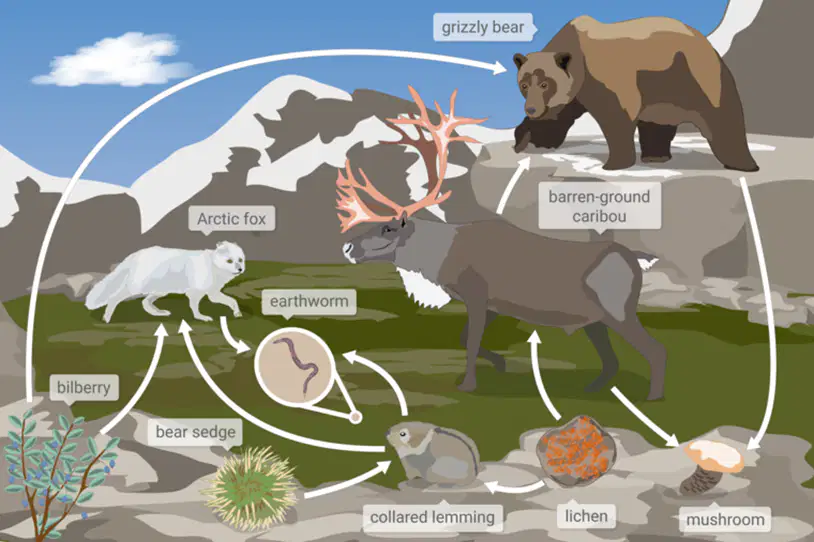
A food web models how the matter eaten by organisms moves through an ecosystem. The arrows in a food web represent how matter moves between organisms in an ecosystem.
What would be most impacted if all the earthworms died out?
Select ALL that would apply
collared lemming
arctic fox
bear sedge
mushroom
Which of the following is an example of a carnivore in a food chain?
Oak tree
Rabbit
Lion
Wheat
What role do herbivores play in a food web?
They decompose dead organisms.
They consume plants.
They eat other animals.
They produce their own food through photosynthesis.
Which of the following is considered a decomposer in ecosystems?
Wolf
Mushroom
Grass
Deer
In a predator-prey relationship, what role does the predator play in its niche?
It helps to pollinate plants.
It controls the population of the prey.
It produces oxygen through photosynthesis.
It breaks down dead organisms.
Which of the following is considered a biotic factor in an ecosystem?
Water
Sunlight
Trees
Rocks
Which of the following is an abiotic factor in an ecosystem?
Bacteria
Temperature
Insects
Birds
The specific role or job of an organism in its environment is known as its:
Habitat
Niche
Population
Community
Which of the following are consumers in an ecosystem?
Plants
Algae
Lions
Mushrooms
Which of the following are considered producers in an ecosystem?
Wolves
Trees
Fungi
Fish
What do omnivores eat?
Only plants
Only meat
Both plants and meat
Neither plants nor meat
Which of the following animals is a herbivore?
Bear
Eagle
Cow
Shark
What is the primary role of decomposers in an ecosystem?
To produce food through photosynthesis
To consume other organisms
To break down dead organisms and recycle nutrients
To serve as prey for predators
Which of the following best describes a predator-prey relationship?
A relationship where both organisms benefit
A relationship where one organism eats the other
A relationship where both organisms compete for food
A relationship where one organism provides shelter for the other
What does the term "biotic" refer to?
Non-living components of an ecosystem
The living components of an ecosystem
The physical space an organism occupies
The climate of an ecosystem
What does "abiotic" refer to?
The living organisms in an environment
The non-living factors in an environment
The decomposers in an ecosystem
The primary producers in an ecosystem
Which of the following best defines an organism's niche?
Its physical appearance
Its diet
Its role in the ecosystem
Its habitat
Who are the primary consumers in an ecosystem?
Carnivores
Herbivores
Omnivores
Decomposers
Which group of organisms are the first link in the food chain?
Primary consumers
Secondary consumers
Tertiary consumers
Producers
Omnivores can act as:
Only primary consumers
Only secondary consumers
Both primary and secondary consumers
Neither primary nor secondary consumers
Which of the following is an example of an abiotic factor affecting a niche?
Type of prey available
Amount of predators
Temperature
Plant life
In a food web, which type of organism receives energy directly from producers?
Primary consumers
Secondary consumers
Tertiary consumers
Quaternary consumers
What is the main difference between a food chain and a food web?
A food chain shows a single path of energy flow, while a food web shows multiple paths.
A food web only includes carnivores, while a food chain includes all types of organisms.
A food chain is more complex than a food web.
A food web does not include producers.
Which of the following organisms is most likely to be at the top of a food chain?
Grass
Rabbit
Hawk
Snake
How do decomposers contribute to the nutrient cycle in an ecosystem?
By consuming live plants
By preying on herbivores
By breaking down dead organisms and releasing nutrients back into the soil
By producing oxygen through photosynthesis
Which of the following best describes the role of producers in an ecosystem?
They are the primary source of food for carnivores.
They convert sunlight into chemical energy through photosynthesis.
They break down organic matter and recycle nutrients.
They consume other organisms for energy.
What is the primary difference between biotic and abiotic factors?
Biotic factors are living, while abiotic factors are non-living.
Abiotic factors can reproduce, while biotic factors cannot.
Biotic factors are always harmful to ecosystems, while abiotic factors are beneficial.
Abiotic factors include animals and plants, while biotic factors include rocks and water.
Which of the following is an example of a consumer?
A tree
A mushroom
A lion
Grass
What role do producers play in the carbon cycle?
They release carbon dioxide through respiration.
They consume carbon dioxide during photosynthesis.
They break down carbon compounds in dead organisms.
They increase carbon levels in the ocean.
Which of the following best describes an omnivore's niche?
Feeding only on plants
Feeding only on meat
Feeding on both plants and animals
Breaking down dead organic matter
How do abiotic factors like water and temperature affect the distribution of organisms in an ecosystem?
They have no significant effect on where organisms live.
They determine which organisms can survive in certain areas.
They only affect the distribution of plants, not animals.
They only affect the distribution of animals, not plants.
What is the main function of carnivores in an ecosystem?
To produce oxygen
To decompose dead matter
To control the population of herbivores
To pollinate plants
Why are decomposers important for a healthy ecosystem?
They provide food for primary consumers.
They help in pollination.
They recycle nutrients back into the soil.
They produce oxygen through photosynthesis.
Which of the following is an example of a predator-prey relationship?
Bee and flower
Lion and zebra
Mushroom and dead tree
Fish and water
What is the primary source of energy for all ecosystems?
Water
Sunlight
Decomposers
Consumers
Which of the following best describes the flow of energy in a food chain?
From producers to decomposers to consumers
From consumers to producers to decomposers
From producers to primary consumers to secondary consumers
From decomposers to producers to consumers
How do herbivores obtain energy?
By consuming other animals
By decomposing organic material
By eating plants
By photosynthesis
What is the role of abiotic factors in determining the types of plants that can grow in an ecosystem?
They have no role; only biotic factors influence plant growth.
They influence soil composition and sunlight availability, which affects plant growth.
They determine how fast plants can grow.
They only affect animal populations, not plant growth.
Which of the following organisms would be considered a tertiary consumer?
Grasshopper
Wolf
Sheep
Algae
In a food web, which organisms are most important for recycling nutrients back into the ecosystem?
Primary consumers
Secondary consumers
Producers
Decomposers
What is the significance of an organism's niche in an ecosystem?
It determines the organism's color and size.
It defines the organism's role and how it interacts with other organisms.
It is only important for determining the food chain.
It has no real significance; organisms can perform any role.

what is the long-tailed weasel eating for dinner?
big mac
yellow-pine chipmunk
red fox
slender wheatgrass

What is the producer?
long-tailed weasel
red fox
slender wheatgrass
yellow-pine chipmunk

