
 Worksheets
Geology review
Total questions: 168
Worksheet time: 2hrs 50mins
What kind of rock is formed by the compaction and cementation of sediments
Igneous Rocks
Metamorphic Rocks
Sedimentary Rocks
Crystals
Can igneous rocks contain air bubbles?
True
False
Rocks are classified by:
where you find them
their density
their mass
how they form
The three rock types are:
Metamorphic, crystalline and magma
Intrusive, extrusive and globular
Igneous, sedimentary and metamorphic
Which of the following has the greatest erosional power?
an avalanche
creep
a landslide
glacier

Which is the correct?
Layer R is younger than layers B, J, and F
Intrusion R is older than layers X, S and M
Intrusion R is older than B, but younger than X
Layer B is older than older than X but younger than R
Which TWO statement about earthquakes are true?
Earthquakes have only occurred in the distant past.
When plates shift, earthquakes sometimes happen.
Continental movement is evidence that plates have shifted, resulting in earthquakes, since the beginning of time, and will likely continue forever.
Earthquakes are always caused by volcanic eruptions that caused the continents to break apart. Continents will definitely never all be connected again.
Which statement is true of the Law of Superposition?
In undisturbed rock layers, the bottom layers are the oldest.
In undisturbed rock layers, the bottom layers are the youngest.
In disturbed rock layers, broken layers are always the youngest.
In disturbed rock layers, the top layers are always the oldest.
Why is the study of ice cores important to the study of geologic history?
It allows scientists to determine the age of Earth.
It allows scientists to determine the number of species that have gone extinct.
It allows scientists to determine the pattern of large mammal migration.
It allows scientists to determine how and why climate changed in the past.

Which can most likely be concluded about the area where the samples were found?
The area has shrunk over time.
The area was once under water.
Organisms in layers 1 and 2 became extinct miles away.
The area did not support any life.

What is the age of the batholith intrusion compared to the other rock layers?
Batholith is the oldest layer.
Batholith is older than the Sill, but younger than the Laccolith.
Batholith is the youngest layer.
Which statement is true about tectonic plate movement?
They have collided and broken apart continuously over time.
They have shifted once and won't move again.
They are responsible for all geologic changes over time.
They first moved slowly, then fast, and they're moving slowly again.
Which is a process that allows scientists to compare rock layers with others in a sequence to determine their age?
Radioactive dating.
Ice core dating
Relative dating
Romantic dating
What is the scientific word for a break, or fracture in rocks?
dike
fault
inclusion
occlusion
What types of rocks are created by hardening and cementing of layers of sediment?
Igneous
Metamorphic
Inclusions
Sedimentary
If fossils of many species exists in lower rock layers, but are never found again in layers above, what might a scientist determine?
There was a solar eclipse.
There was a huge migration, and everything moved to a new location.
There was a mass extinction.
There was a slight change in the climate.
Alfred Wegener’s idea of continental drift was not complete because he didn’t know...
that the continents moved.
that the continents looked like puzzle pieces.
how the continents moved.
about Pangaea.

Which type of plate boundary is pictured?
transform boundary
divergent boundary
convergent boundary
tectonic plates

What process is happening at Z?
Pangaea
magnetic reversal
sea-floor spreading
subduction
Why does oceanic crust subduct under continental crust when the two converge?
Oceanic crust subducts under continental crusts because they have the same density.
Oceanic crust subducts under continental crusts because oceanic crust is more dense than continental crust.
Oceanic crust subducts under continental crusts because oceanic crust is less dense than continental crust.
Oceanic crust does not subduct under continental crust.

What ocean floor feature occurs at X?
a. an island
a. a trench
a. the mid-ocean ridge
a. an underwater cave

Which type of plate boundary is pictured above?
transform boundary
divergent boundary
convergent boundary
tectonic plates

. Which type of plate boundary is pictured above?
transform boundary
divergent boundary
convergent boundary
tectonic plates
According to the theory of plate tectonics, on which layer of Earth do plates float?
asthenosphere / mantle
lithosphere / crust
crust
core
The moving plates of Earth's lithosphere cause all of the following except
earthquakes.
volcanoes.
hurricanes.
mountains.
The giant continent which was composed of all the land on Earth was called
Pangaea.
Panthalassa.
Gondwana.
Laurasia.
A collision between two pieces of continental crust at a convergent boundary produces a
mid-ocean ridge.
deep-ocean trench.
rift valley.
mountain range.
The geological theory that states that pieces of Earth's lithosphere are in constant, slow motion is the theory of
subduction.
plate tectonics.
deep-ocean trenches.
sea-floor spreading.
Earthquakes and volcanoes are primarily found
at the mid-ocean ridge.
in California
along plate boundaries.
along the equator.
How does fossil evidence support Wegener’s hypothesis of continental drift?
Similar fossils found on far apart landmasses suggest that the continents were once a single land mass.
Fossil evidence suggests that the continents have always been in their current positions.
No similarities exist between fossils on different continents.
Plant and animal fossils show evidence of changes in earth’s polarity.
Geological processes (like water or lava flowing) CAN change Earth's surface.
True
False

Which of the following is the correct definition for Lithosphere?
the rigid outer part of the Earth, consisting of the crust and upper mantle
the outermost region of the planet's atmosphere
the Earth's layer of silicate rock between the crust and outer core
the soft layer of the mantle on which tectonic plates move

What is the soft layer of the mantle on which the tectonic plates move?
Asthenosphere
Mesosphere
Lithosphere
Hydrospere
Temperature and density both __________ as you travel towards the center of the Earth.
increases
decreases
stays the same
increases, then cools at the center
According to the theory of plate tectonics, on which layer of Earth do plates float?
asthenosphere / mantle
lithosphere / crust
crust
core
. Clay is considered an ___________ because __________________.
aquifer; water passes through it
aquifer; water does not pass through it
aquitard; water passes through it
aquitard; water does not pass through it
The moving plates of Earth's lithosphere cause all of the following except
earthquakes.
volcanoes.
hurricanes.
mountains.
The deep interior of the Earth can be mapped using
seismic waves.
sonar.
drilling samples.
x-rays
Most geologists think that the movement of Earth's plates is caused by
a. gravity.
b. Earth's magnetic field.
c. convection currents
d. Both A & B
e. Both A & C
The giant continent which was composed of all the land on Earth was called
Pangaea.
Panthalassa.
Gondwana.
Laurasia.
A collision between two pieces of continental crust at a convergent boundary produces a
mid-ocean ridge.
deep-ocean trench.
rift valley.
mountain range.
The geological theory that states that pieces of Earth's lithosphere are in constant, slow motion is the theory of
subduction.
plate tectonics.
deep-ocean trenches.
sea-floor spreading.
Earthquakes and volcanoes are primarily found
at the mid-ocean ridge.
in California
along plate boundaries.
along the equator.
Which of the following processes forms sediment?
deposition
weathering and erosion
compaction
cementation
Which type of rock weathers to form sediment?
igneous
sedimentary
metamorphic
all rock types
Limestone, under heat and pressure, forms marble. What type of rock is marble?
igneous
sedimentary
metamorphic
magma
Which is the only type of rock produced from cooling?
igneous
sedimentary
metamorphic
magma
If you were to discover a rock that appeared to have layers, what kind of rock would you suspect it to be?
metamorphic
igneous
sedimentary
lava
How does fossil evidence support Wegener’s hypothesis of continental drift?
Similar fossils found on far apart landmasses suggest that the continents were once a single land mass.
Fossil evidence suggests that the continents have always been in their current positions.
No similarities exist between fossils on different continents.
Plant and animal fossils show evidence of changes in earth’s polarity.

A divergent boundary is a boundary between two plates that __________.
move away from each other
converge
slide along each other
move toward each other
How can Earth's plates move?
They only can move toward each other.
They only converge or diverge.
They only collide or slide along each other.
They can collide, pull apart, or slide against each other.
Which occurs when one plate moves underneath another?
shearing
compression
tension
subduction
What was Pangaea?
the original name for North America
a large, single landmass
a layer of the Earth
a geologic era
What do scientists believe is the force behind the plate tectonics theory?
convection currents
gravity slab pull
the movement of the planets
the Sun's gravity

Earthquakes are more likely to occur in __________.
northern Russia
western Africa
western South America
every location equally
What is the difference between lava and magma?
They originate from different places.
They are made of different types of rock.
After magma reaches the surface it's called lava.
They are different colors.

What do colliding plates have to do with volcanoes?
Subduction causes rock to melt and become magma.
Transform forces create a volcano.
The plates that separate create a volcano.
Colliding plates have nothing to do with volcanoes.

Surface processes that work to break down rock are called__________.
erosion
weathering
oxidation
ice wedging
Chemical weathering is more rapid in areas with __________.
dry, warm air
moist, warm air
dry, cool air
moist, cool air
Physical weathering can result from the action of all of the following EXCEPT __________.
ice
burrowing by animals
carbon dioxide
plant roots
What is erosion?
a process that wears away surface material
wind currents in the upper atmosphere
ocean currents near the surface
a process of mountain building
What causes dunes to form?
deposits from streams
glacial deposits
mountain building
wind

How is the motion of a tectonic plate described?
relative to other tectonic plates
relative to the center of the Earth
relative to a point on the Earth's surface
relative to the Earth's oceans
What do convergent, divergent, and transform boundaries have in common?
the same types of forces occur at each
subduction of one plate occurs at all of them
they are all places where two tectonic plates meet
similar geological formations occur at all of them

What type of boundary is shown here?
divergent
convergent
transform
convection
What is the relationship between faults and plate boundaries?
faults never occur at plate boundaries
faults are the same as plate boundaries
faults occur only at plate boundaries
faults occur at plate boundaries and elsewhere
What happens at a convergent boundary where no subduction occurs?
tall mountains form
a deep valley forms
volcanoes form on both sides
the ground remains level but rivers and other land features bend

Which are more common near boundaries than in the middle of tectonic plates?
earthquakes only
volcanoes only
both earthquakes and volcanoes
neither earthquakes nor volcanoes
Sediment can be any of the following EXCEPT which?
clay
ice
sand
rock fragments


Which type of rock is formed from the cooling and solidification of magma or lava?
Sedimentary rock
Metamorphic rock
Igneous rock
Minerals
Which type of rock is formed from the accumulation and compaction of sediments?
Sedimentary rock
Metamorphic rock
Igneous rock
Minerals
Which type of rock is formed from the alteration of existing rocks due to heat and pressure?
Sedimentary rock
Metamorphic rock
Igneous rock
Minerals
What is the process called when sediments are transported and moved by wind, water, or ice?
Weathering
Erosion
Deposition
Lithification
Which type of rock is formed from the crystallization of minerals from a solution or melt?
Sedimentary rock
Metamorphic rock
Igneous rock
Minerals

What is the process called when sediments are dropped or laid down in a new location?
Weathering
Erosion
Deposition
Lithification

Which of the following is NOT a geological process?
Weathering
Erosion
Deposition
Photosynthesis
Which of these describes a Divergent Plate boundary?
When two plates move up and down
When the plates are still
When two plates come together
When two plates push apart
What is the inner core made of?
Iron and penny
Penny and nickel
Iron and nickel
Penny and obsidian
The formation of new areas of oceanic crust, which occurs through the upwelling of magma at midocean ridges and its subsequent outward movement on either side is called
Subduction
Seafloor Spreading
Divergent boundary
Convergent boundary

This is a model of sea floor spreading at a divergent boundary called a_________________________________
Divergent boundary
Transform boundary
Mid Ocean Ridge
Oceanic Crust
What causes sea floor spreading?
Convectional Currents
Convection Currents
Plates moving
Divergent boundary and subduction
Temperature and pressure _______ as you move towards the center of the Earth.
decrease
increase
neither answer is correct.
both increase and decrease
Which of the following is the correct order of the Earth's layers moving inward to the center.
Crust
Mantle
Inner Core
Outer Core
Mantle
Outer Core
Inner Core
Crust
Inner Core
Outer Core
Crust
Mantle
Outer Core
Inner Core
Mantle
Crust
The outer core is liquid.
TRUE
FALSE
Which layer of the Earth is the thickest?
Inner core
Outer core
Mantle
Crust
A(n) _____________ is the result of tectonic plates moving over a hot spot.
plateau
delta
canyon
island
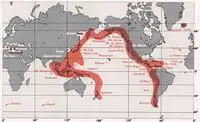
This is the name for the chain of volcanos around the edge of the Pacific Plate.
Johnny Cash
Death Valley
Ring of Fire
Circle of Ring
Which of the choices below is NOT one of the three types of rocks?
Indigenous
Metamorphic
Sedimentary
Igneous
In sea-floor spreading, molten material rises from the mantle and erupts
at the north and south poles.
along the edges of all the continents.
in deep-ocean trenches.
along mid-ocean ridges.
The place where two plates come together is known as a
divergent boundary.
transform boundary.
convergent boundary.
rift valley.
The process by which the ocean floor sinks beneath a deep-ocean trench and back into the mantle is known as
subduction.
convection.
conduction.
continental drift.
Geologists obtain indirect evidence about Earth's interior by
directly looking under the many layers.
estimating temperature inside earth.
measuring pressure differences at Earth's surface
recording and studying seismic waves
How did scientists discover that rocks farther away from the mid-ocean ridge were older than those near it?
by measuring how fast sea-floor spreading occurs
by mapping rocks on the sea floor using sonar
by determining the age of rock samples obtained by drilling on the sea floor
by observing eruptions of molten material on the sea floor
Heat transfer within a fluid takes place through
conduction
radiation
density
convection currents
A place where two plates slip past each other, moving in opposite directions, is known as a
convergent boundary
divergent boundary
transform boundary
rift valley
When the heat source is removed from a fluid, convection in the fluid will
eventually stop
speed up
change direction
continue at the same rate forever
Which type of evidence was not used by Alfred Wegener to support his continental drift hypothesis?
evidence from fossils
evidence from human remains
evidence from landforms
evidence from climate
A boundary in which 2 plates move together
convergent
divergent
transform
A region where the rigid plates are moving apart (away from each other)
Convergent
Divergent
Transform
A boundary in which 2 plates slide past each other
transform
Divergent
Convergent
A fracture in Earth where movement has occurred
rift valley
fault
volcano
Deep faulted structure found at divergent plate boundaries
rift valley
fault
mountain
Process that forms new sea floor
mid-ocean ridge
continental drift
sea-floor speading
Place where sea floor is forced down into the mantle
trench
fault
continental drift
An underwater mountain range
Appalachian
Glacial deposits
Mid-ocean ridge
Clues that support the continental drift
glacial deposits
continental drift
rocks, fossils and climate
Movement of the continents
sea-floor spreading
continental drift
mid-ocean ridge
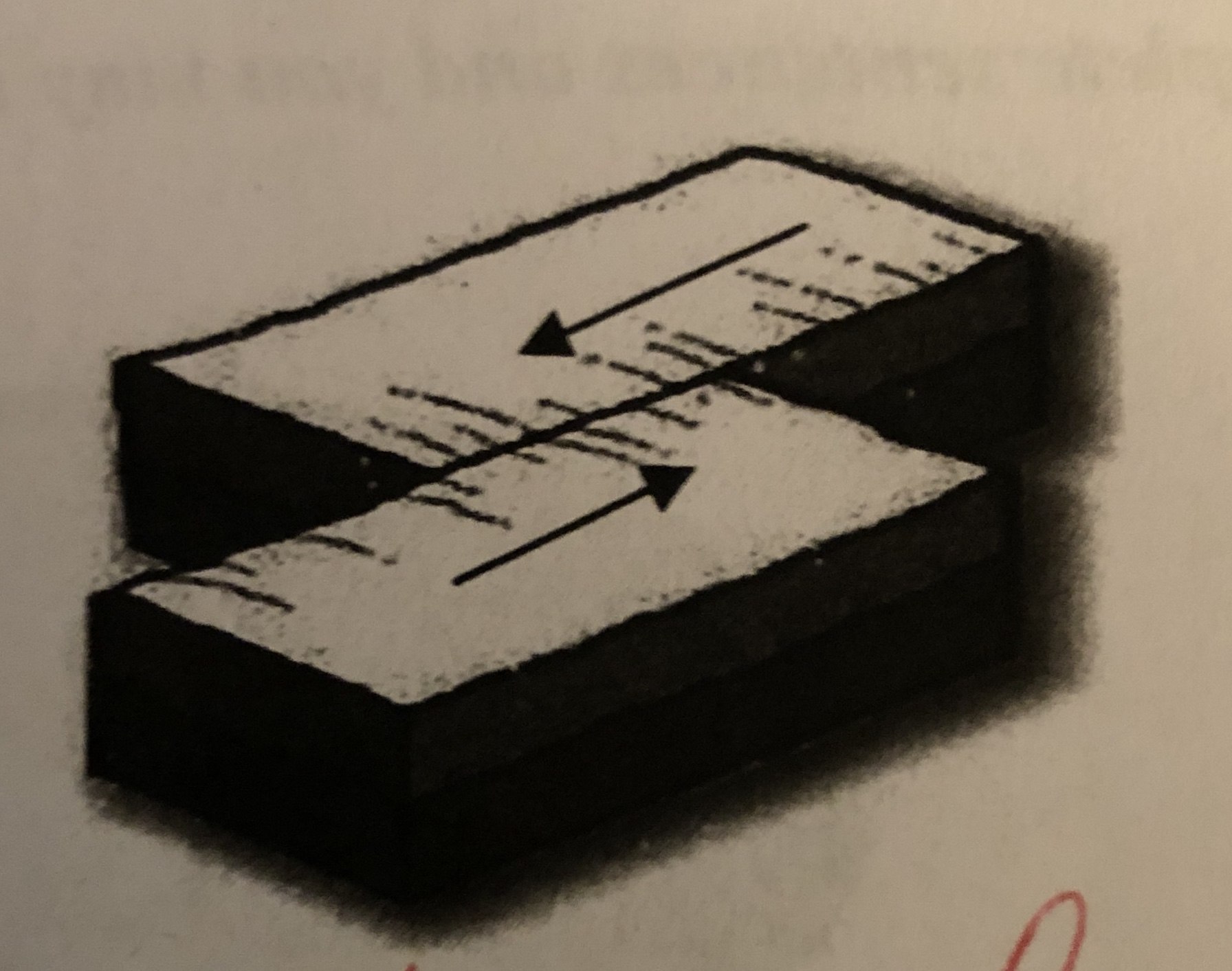
What type of boundary is this?
convergent
divergent
transform
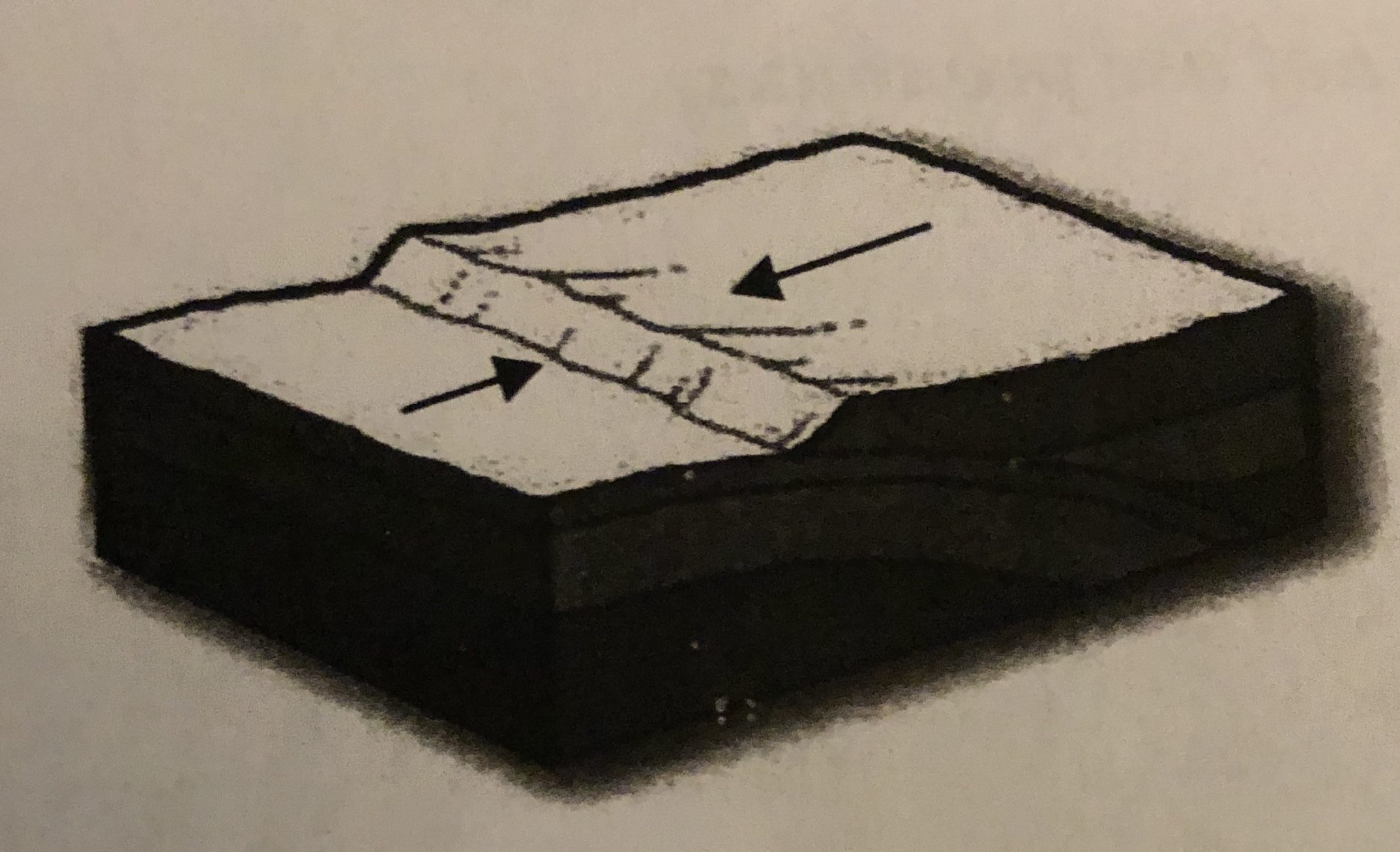
What type of boundary is this?
convergent
transform
divergent
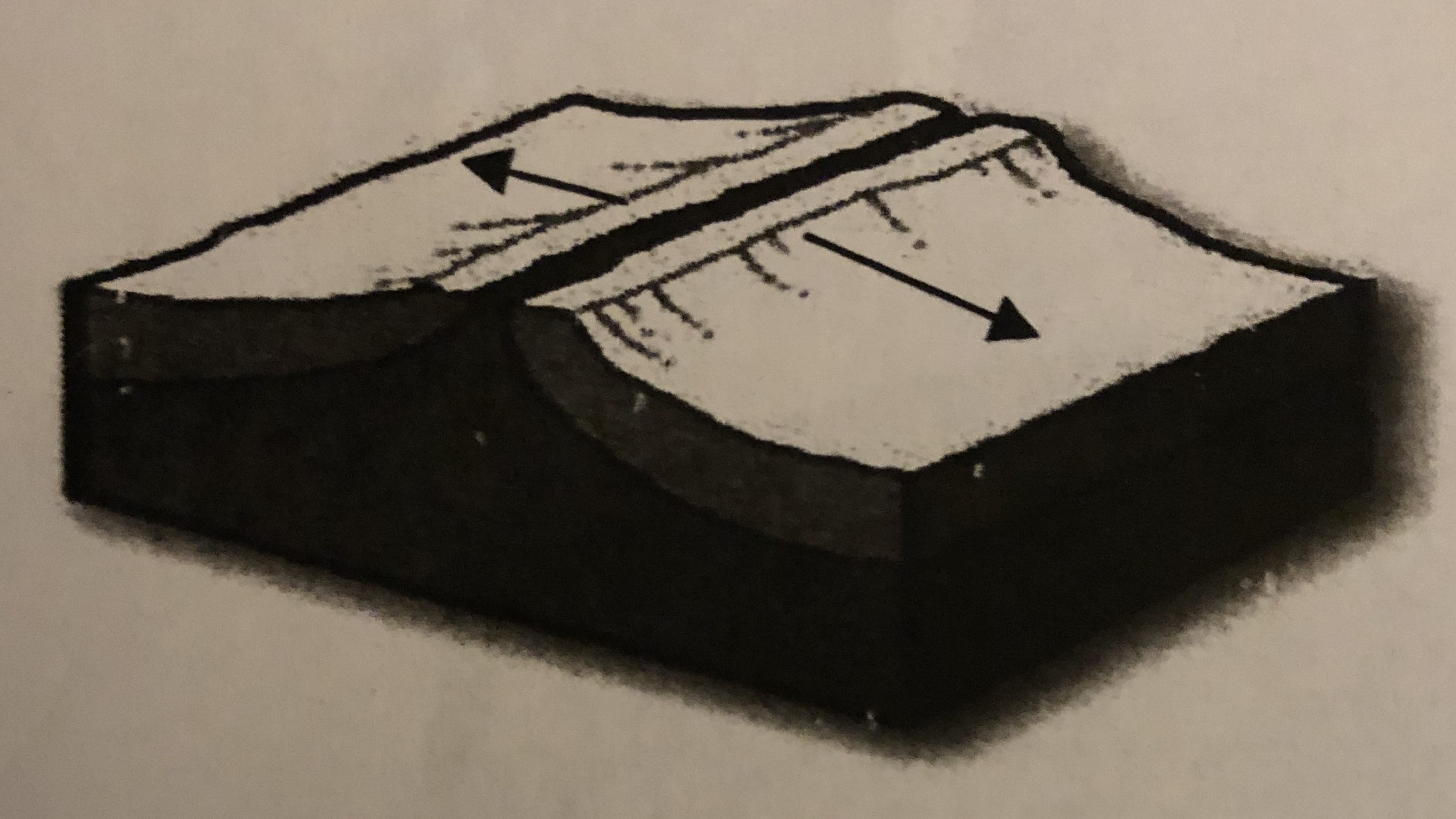
What type of boundary is this?
convergent
divergent
transform
Any trace of an ancient organism that has been preserved in rock is called a
landform
continent
fossil
landmass
What are breaks in Earth's crust where rocks have slipped past each other?
sea floor spreading
subduction
plates
faults
What is the process that continually adds new crust to the ocean floor along both sides of the mid-ocean ridge?
subduction
continental drift
convergent
sea floor spreading
What is a plate boundary where two plates move toward each other?
transform
convergent
divergent

What type of landform is at C?
mid-ocean ridge
continental crust
deep ocean trench
sea floor spread
In sea floor spreading, molten material rises from the mantle and erupts
along the edge of the continents
along the mid-ocean ridges
in deep ocean trenches
at the North and South pole

Identify the landform labeled A
mid-ocean ridge
deep ocean trench
sea floor spread
What is the process by which the ocean floor sinks beneath a deep ocean trench and back into the mantle?
continental drift
mid-ocean ridge
faults
subduction
What is Wegener's idea that continents are slowly moving over Earth's surface called?
divergence
faults
plates
continental drift
Most geologists think that the movement of Earth's plates is caused by
conduction
earthquakes
convection currents in the mantle
Earth's magnetic field
Geologic time is broken down according to :
index fossils
rock layers
minerals
continent layer
The law of superposition states that :
the oldest layer of rocks are on top
the youngest layers of rock are on top
the oldest rock in the middle
the youngest rock is at the bottom
The layer of earth we walk upon in the:
crust
mantle
core
inner core
The layer of the earth where plates move apart is called:
divergent plate boundaries
convergent plate boundaries
sub-ducting plate boundaries
transform plate boundaries
Which of these events breaks down rocks into smaller pieces?
Sedimentation
Deposition
Weathering
Erosion
How are weathering and erosion the same?
Both move sediment from one place to another.
Both leave sediment in new places.
Both change Earth's surface.
Both leave sediment in new places.
What are the parts of Earth's mantle?
Inner core, asthenosphere, lithosphere
Lithosphere, asthenosphere, mesosphere
Crust, lithosphere, asthenosphere
Mesosphere, asthenosphere, troposphere
What process uses rock layers and index fossils to determine an object's estimated age?
Radioactive dating
Law of superposition
Relative dating
Relative dating

