
 Worksheets
Selection and Adaption Exam Review
Total questions: 164
Worksheet time: 2hrs 48mins
Imagine you're a scientist with the power to change a species' traits! How would you do it? By choosing which organisms will reproduce, right?
By controlling their sex?
By controlling their predators?
By controlling their traits?
By controlling their food?
Imagine you're a time traveler, and you've just landed in the 1800s. You meet a person who's about to embark on a voyage around the Galápagos Islands. This person will propose an idea that will eventually lead to the Theory of Evolution. Who is this adventurous individual?
Charles Darwin
Rosalind Franklin
Francis Crick
James Watson
Imagine you're a tiny explorer journeying through the strands of a DNA code on a chromosome. What would you say is a part of your path?
gene
genotype
phenotype
gender
Pop quiz time! Can you tell us which one of these is NOT a part of a chromosome? Choose wisely!
Proteins
Cell
Deoxyribonucleic acid (That's a mouthful, isn't it?)
DNA (The secret code of life!)
Ready for a DNA detective game? Can you identify the bases that are part of the DNA structure? (Choose all that apply)
adenine (A)
uracil (U)
guanine (G)
cytosine (C)
Who is the mastermind behind the discovery of the base pair complements in DNA? This person's discovery was a game-changer in the field of genetics!
Chargaff - The DNA Detective
Frankland - The Chemical Crusader
Watson - The Molecular Maestro
Watkins - The Biological Brainiac
Imagine you're a tiny scientist living inside a DNA molecule. You come across a guanine (G). Who would be its perfect pair?
cytosine (C)
adenine (A)
thymine (T)
uracil (U)
Imagine you're a tiny molecule traveling through a strand of DNA. You come across a thymine (T). Who would be your perfect match?
cytosine (C)
adenine (A)
guanine (G)
uracil (U)
Imagine you're a tiny scientist living inside a cell. You notice that mutations are causing changes in _____. What are they changing?
elements
essential nutrients
compounds
proteins
Pop Quiz! All mutations are always harmful. True or False?
True
False
Imagine you're a tiny scientist, exploring the world of chromosomes. How many variants of a gene would you find in each pair of chromosomes?
Just one, it's a lonely world out there
Two, like a pair of dancing genes
Three, it's a gene party!
Four, it's a gene festival!
Imagine you're a tiny letter in a big, big word. If you decide to change yourself, you'd be like a/an _______________ in a gene. What would you be?
mutation
knot
untying
cut
Who was the super-sleuth scientist that used X-rays to uncover the secret of the DNA molecule, leading to the discovery of the double helix?
The legendary Charles Darwin
The brilliant Rosalind Franklin
The insightful Francis Crick
The ingenious James Watson

Ready for a fun fact? Darwin's groundbreaking book 'On The Origin of Species' was actually inspired by his adventurous trip around the Galapagos Islands. True or False?
True
False
Can you guess the theory of creation that Darwin proposed? It's a fascinating one!
Natural Selection
Theology
Chance
Philosophy
Imagine you're a scientist studying genetics. You come across a hybrid organism. This would be an example of what?
A result of artificial selection
A result of natural selection
A result of minute selection
A result of mixed selection
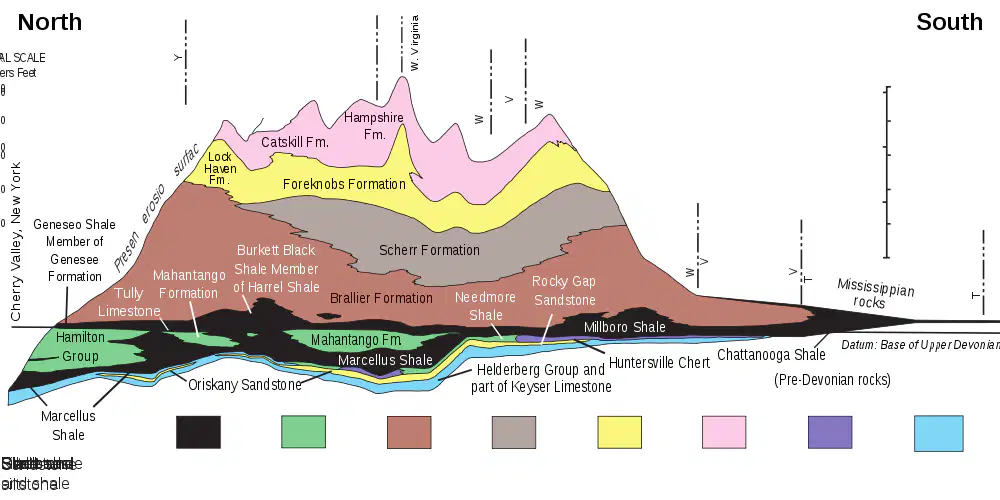
Let's take a trip back in time! Can you tell me which of these statements is true about the rock layers we'll encounter?
Only the older rocks are home to fossils of complex life forms. Is that so?
Only the younger rocks are the party place for simple life forms. Could this be true?
Both older and younger rocks are a hub for more complex life forms. What do you think?
Only the younger rocks are the treasure trove of fossils of complex life forms. Is this the truth?
Imagine you're a species in a rapidly changing environment. If you can't adapt, what happens to you?
You go on a date (mating)
You disappear forever (extinct)
You get a sudden craving for a burger (hungry)
You hit the gym and bulk up (bigger)
Imagine you're a time traveler! You notice that the inherited traits of a type of organism are changing over time. What would you call this phenomenon?
Is it growth?
Could it be biogenesis?
Maybe it's spontaneous generation?
Or is it evolution?
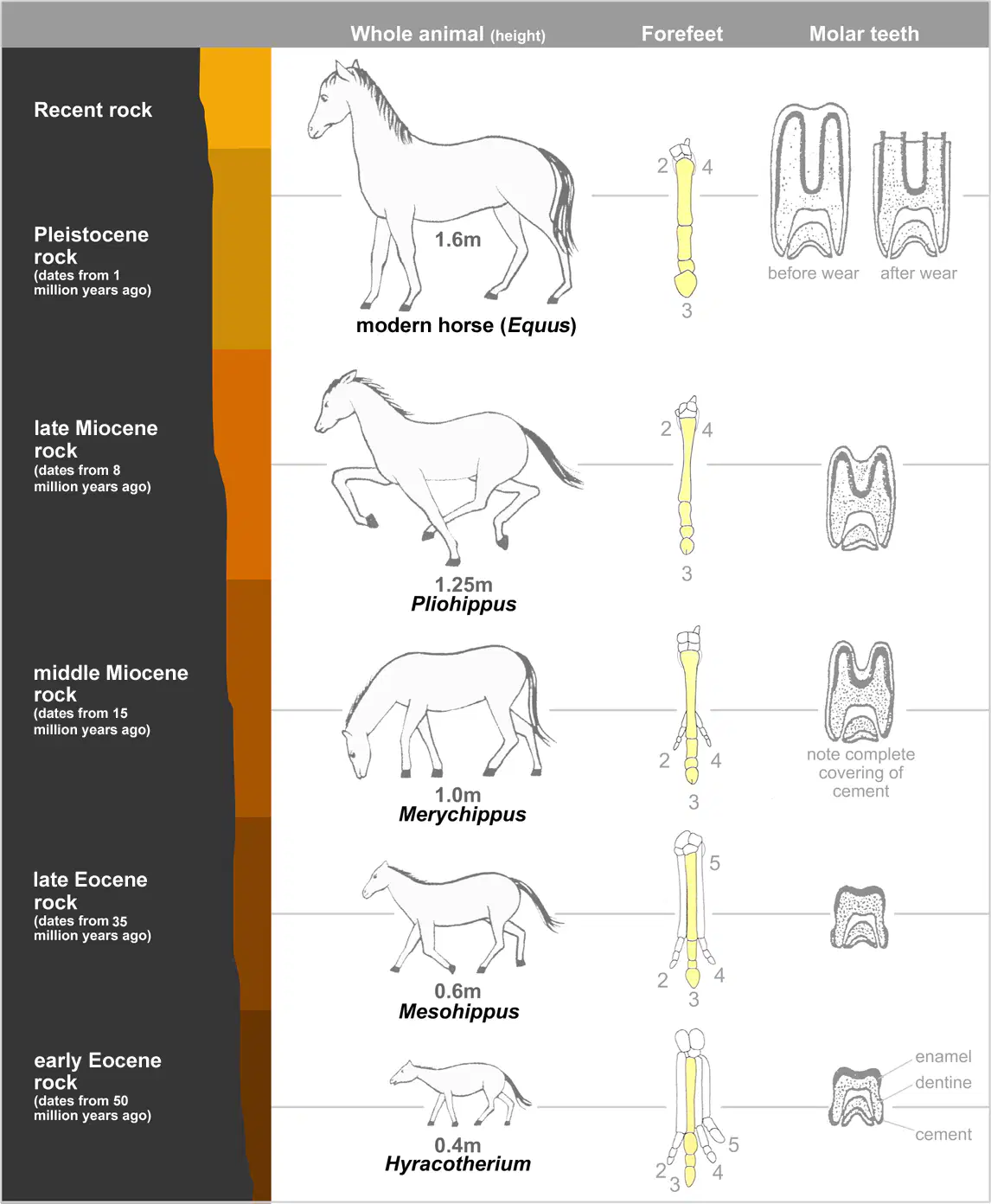
Can you guess what the figure is trying to tell us?
Did horses just pop up a million years ago without any ancestors? That's what the figure suggests, right?
Could it be that between 55 and 50 million years ago, there were no horse-like creatures at all?
Or does the figure hint that our modern horses have some extinct relatives?
Or is it suggesting that the Hyracotherium is just another name for our modern horse?
Hey there, bio-geek! Can you tell us what the bases for DNA and RNA are also known as?
Nucleotides
Deoxyribonucleic acid
Ribonucleic acid
None of these
Can you guess the twisty-turny shape of our DNA?
Double helix
Single stranded
Circle
Double square
Can you guess the shape of RNA? Is it more like a...
A twisty double helix?
A single strand of awesomeness?
A perfect circle?
Or a double square?
Let's take a trip back in time! Can you guess when the shape of DNA was discovered?
Was it way back in the 1850s?
Or perhaps a bit later in the 1840s?
Maybe it was as recent as the 1950s?
Or could it be the 1940s?
Imagine you're an adventurer, exploring ancient lands. You stumble upon the remains or impression of a prehistoric creature, preserved in petrified form or as a mold or cast in rock. What would you call this exciting discovery?
Fossils
Bones
Minerals
Statues
Imagine you're a scientist! You want to create a new breed of roses with a unique color. What kind of selection would you use to achieve this?
Natural selection, let nature do its thing!
Artificial selection, I'm the scientist here!
Common selection, because why not?
Rushed selection, I'm in a hurry!
Imagine you're a time-traveling geologist, and you've just landed on a rocky terrain. Can you tell which rocks are older and which are younger? Remember, older rocks are on the ________, and younger rocks are on the ________.
top, bottom
left, right
right, left
bottom, top
Where would you expect to find the simplest life forms?
Hidden in ancient fossils.
Preserved in fresh fossils.
Underneath layers of old sand.
Surviving in active volcanos.
Hey there, do you know what's one common feature that all mammals, including you and me, share?
Is it hair?
Could it be skin?
What about retractable claws?
Or is it walking upright?
Pop Quiz! True or False: The environment is the place where plants and animals hang out and do their thing. Can you guess the answer?
Nope, that's not it.
Yep, you got it!
Imagine you're a detective in the wild! Can you tell me what an adaptation is?
Is it a feature that only helps a plant grow?
Or, is it a feature that helps a living thing survive?
Maybe, it's a feature that helps a living thing walk?
Or, could it be a feature that only helps animals survive?
Let's play a fun game! Can you tell me what behavioral adaptations are?
Are they body parts that help a living thing survive in its environment?
Or, are they behaviors that help a living thing thrive in its environment?
Can you guess what physical adaptations are?
Are they body parts that help a creature thrive in its environment?
Or are they behaviors that assist a creature in surviving in its habitat?
Imagine you're a scientist studying animals in the wild. What term would you use to describe the changes in physical features or behaviors of a species when their environment changes?
Adapt
Naturalist
Organism
Species
Imagine you're a creature in the wild! How would adaptations help you out there?
To slip away from those sneaky predators
To hunt down some delicious food
To thrive in your wild, wonderful habitat
All of these are spot on
Who do you think was the brilliant mind that came up with the fascinating ideas of 'Survival of the Fittest' and 'Evolution'?
Charles Darwin
Albert Einstein
Steven Hawking
Isaac Newton
Imagine you're a creature in the wild. Where would you, being a well-adapted organism, survive and pass your awesome traits to your little ones?
Evolution
Natural Selection
Extinction
Artificial Selection
Hey, do you know which animals are the superstars of scientific study in the Galapagos?
Finches
Tortoises
Turtles
Lizards
Imagine you're a bird! Why would you want a beak that's different from your feathered friends?
So you can stand out in the bird crowd.
So you can munch on the yummy food that's available in your environment.
So you can defend yourself against those scary predators.
So you can protect yourself from your lunch.
Imagine you're a time traveler! As you journey through the ages, what would you observe changing over time according to the theory of evolution by natural selection?
The inherited traits of a population.
The acquired traits of a population.
Hair color and eye color.
Attractive features.
Imagine you're a trait in a species. Why would you, being advantageous, have a higher chance of being passed onto the next generation?
Because you, as an advantageous trait, are more likely to help the species survive and reproduce.
Because you come from dominant alleles.
Because you come from recessive alleles.
Because you are an acquired phenotype.
Imagine you're a tiny scientist, traveling inside a cell. You notice something is different - something has changed. What could it be?
The DNA has changed!
The tRNA looks different!
The genotype has transformed!
The phenotype has altered!
Imagine you're a creature in the wild. What would you call the special trait that helps you thrive and survive in your environment?
Is it Natural selection?
Could it be Mutation?
Maybe it's Camouflage?
Or is it Adaptation?
Pop Quiz! Can you guess what almost all adaptations originally started off as?
Is it Selective breeding?
Could it be Physiological?
Maybe it's Structural?
Or is it Mutation?
Imagine you're a scientist studying genetics. Which of these terms would you use to describe 'genetic change over time'?
natural selection
speciation
evolution
fitness
Imagine you're a bird-watcher and you notice that not all bird beaks are the same! What would you call these differences among a species, like different bird beaks?
Would you call them genes?
Or, would you call them variations?
Maybe, you'd call them traits?
Or, would you call them theories?

Can you guess the process depicted in this intriguing image?
Variation
Natural Selection
Selective Breeding
Homeostasis
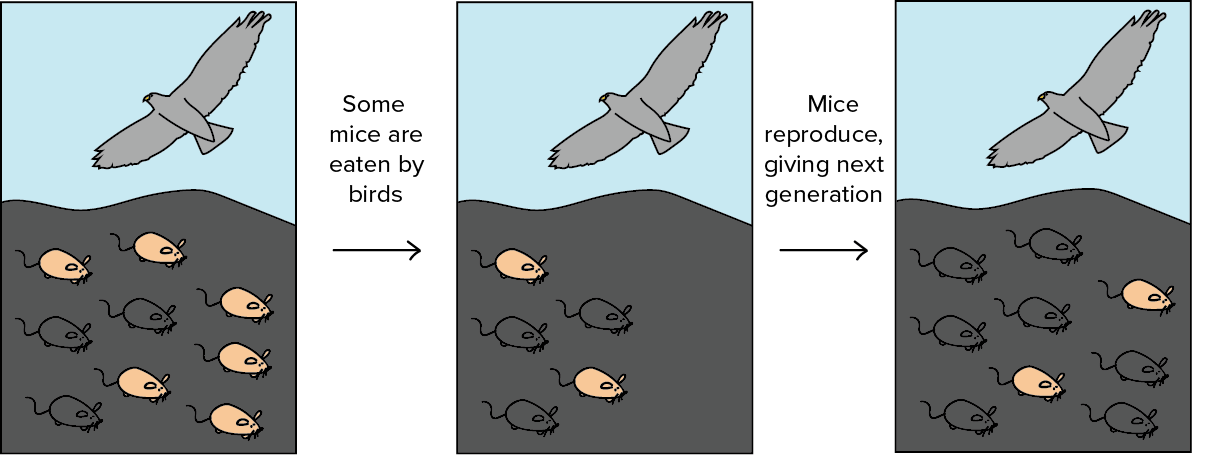
Why do you think the number of mice changes over time? Let's think about it together!
Could it be because the light-colored mice are better at making baby mice than the dark-colored ones?
Or maybe the hawks prefer the taste of dark mice over light mice, so they eat more of them?
What about this - the hawks can spot the light mice more easily, so they end up eating more of them?
Or could it be that the hawks can see the dark mice more easily, so they eat more of them?
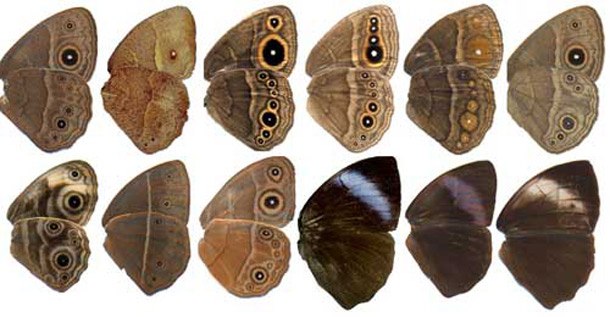
Imagine you're a scientist observing a group of moths, all from the same species. You notice that their wings are all different! What would you call this phenomenon?
Natural Selection
Variation
Homeostasis
Extinction
Who do you think was the brilliant mind that came up with the fascinating ideas of 'Survival of the Fittest' and 'Evolution'?
Charles Darwin
Albert Einstein
Steven Hawking
Isaac Newton
Imagine you're a tiny creature in a vast jungle, and you've just developed a cool new skill that helps you survive better. This is known as an acquired trait. Can you guess another term for this?
Variation
Adaptation
Behavior
Environment
Imagine you're a time traveler! You've just landed in a time where every single creature of a certain species has vanished. What would you call this phenomenon?
Is it Evolution?
Could it be Natural Selection?
Oh, is it Extinction?
Or is it Artificial Selection?
Imagine you're a creature in the wild. Where would you, being a better-adapted organism, survive to pass your super cool traits along to your little ones?
Evolution
Natural Selection
Extinction
Artificial Selection
Ready for a fun fact? Do you know which animals are the superstars of scientific studies in the Galapagos?
Finches - the little chirpy ones
Tortoises - the slow and steady ones
Turtles - the cool swimmers
Lizards - the sun-loving creatures
Imagine you're a bird! Why would you want a beak that's different from your feathered friends?
So you can stand out in the bird crowd.
So you can munch on the yummy food in your habitat.
So you can defend yourself against those scary predators.
So you can protect yourself from your lunch.
Imagine you're a time traveler! As you journey through the ages, what would you observe changing over time according to the theory of evolution by natural selection?
The inherited traits of a population.
The acquired traits of a population.
Hair color and eye color
Attractive features.
Imagine you're a trait in a living organism. Why would you, as an advantageous trait, have a higher chance of being passed onto the next generation?
Because as an advantageous trait, I'm more likely to help the organism survive and reproduce.
Because I come from dominant alleles.
Because I come from recessive alleles.
Because I'm an acquired phenotype.
Imagine you're a tiny scientist, traveling inside a cell. You notice something is different. What could have changed due to a mutation?
The DNA
The tRNA
The genotype
The phenotype
Imagine you're a creature in the wild! What would you call the special trait that helps you thrive and survive in your environment?
Is it Natural selection?
Could it be Mutation?
Maybe it's Camouflage?
Or is it Adaptation?
Ever wondered why frogs and other creatures lay so many eggs or have so many babies?
Is it so that their little ones can have a big party with lots of friends?
Or is it because the more babies they have, the better the chances of survival for some?
Maybe, the more babies they have, the lesser the chances of survival for each?
Or could it be that more babies mean less competition?
Imagine you're in a wild jungle! Which creatures do you think are most likely to survive?
The ones who are best adapted to the jungle life
The fastest runners
The strongest beasts
The most domesticated (tamed) ones
Imagine you're a scientist studying evolution. Can you tell me what almost all adaptations initially start off as?
A result of selective breeding?
A physiological change?
A structural modification?
A random mutation?
Imagine you're a time-traveling scientist! Can you tell which term describes the fascinating process of 'genetic change over time'?
Is it Natural selection?
Could it be Speciation?
Or is it Evolution?
Maybe it's Fitness?
Imagine you're a creature in the wild. You've just developed a new behavior that helps you survive better in your environment. Cool, right? This is known as an acquired trait. But hey, there's another term for this. Can you guess what it is?
Variation
Adaptation
Behavior
Environment
Imagine you're a bird-watcher and you notice that not all birds have the same type of beak. What would you call these differences within a species, like the various bird beaks?
Are they called genes?
Could they be variations?
Are they traits?
Or are they theories?
Imagine you're a time traveler, and you've just landed in a time where every single creature of a certain species has vanished! What would you call this phenomenon?
Natural Selection
Homeostasis
Extinction
Selective Breeding
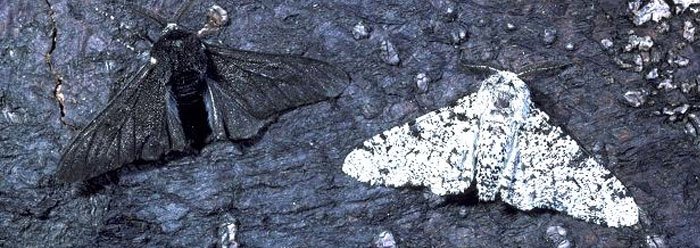
Imagine you're a tiny moth in a world that's just turned topsy-turvy! Your home, once a pristine white tree, is now covered in soot from nearby coal factories. Who do you think will have a better chance of survival in this new, darker environment?
The stealthy dark moth
The bright and light moth
Both moths, because they're equally awesome
Neither moth, because it's a tough world out there

Imagine you've hopped into a time machine and landed in the 1800s. You notice that humans have stopped burning coal and the trees are back to their lush, original color. Now, think about this: which moth do you think will have a better chance of survival in this environment?
The mysterious dark moth
The radiant light moth
Both moths, they're equally tough!
Neither, they've decided to take a vacation
Can you guess the process depicted in this intriguing image?
Variation
Natural Selection
Selective Breeding
Homeostasis
Imagine you're a tiny mouse in a big world. Why do you think your mouse family's population changes over time?
Is it because your light-colored mouse cousins can have more babies than your dark-colored mouse cousins?
Or maybe the hawks prefer the taste of dark mice over light mice, so they eat more of them?
Could it be that the hawks can spot your light-colored mouse cousins more easily, so they eat more of them?
Or do the hawks have better eyesight for dark mice, making them an easier target?
Imagine you're a scientist observing a group of moths, all from the same species. You notice that their wings are all different! What would you call this phenomenon?
Natural Selection
Variation
Homeostasis
Extinction
Imagine you're a tiny organism in a vast environment. Only the fittest survive here and pass their traits to their little ones. What's this phenomenon called?
Natural Selection
Homeostasis
Selective Breeding
Extinction

Imagine you're a bunny whisperer, and you've found yourself in Bunnyland where all the rabbits live. What would you call this group of rabbits in scientific terms?
population
species
fossil
individual organism
Imagine you're on a thrilling adventure in the Galápagos Islands, and you notice some fascinating differences among the local tortoises. Which concept from Darwin's theory would best explain these variations?
You're witnessing the effects of artificial selection
It's a clear case of adaptation
The tortoises have acquired these characteristics over time
The tortoises are showing a tendency towards perfection

Imagine you're Charles Darwin, exploring the Galapagos Islands off the coast of South America. What fascinating observation do you make about the finch populations on these islands?
You notice different species of finches on different islands
You find all species of finches on one single island
You see identical species of finches on all the islands
You spot the same species of finches as in North America
Imagine you're in the wild, who do you think decides which traits get passed on in the game of natural selection?
Mother Nature herself
A random human passing by
Mr. Holt, your biology teacher
The secret society of The Illuminati

Can you guess what we call the super cool people who study fossils?
Are they Meteorologists?
Maybe Fossilologists?
Could they be Paleontologists?
Or are they Fossil Hunters?
Imagine you're a time-traveling geologist! In which type of rock would you most likely discover a fossil on your adventures?
Sedimentary rock
Metamorphic rock
Igneous rock
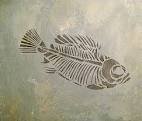
Imagine you're a scientist and you've just discovered this fossil! What exciting conclusion could you draw from your discovery?
What fish are like today
That this fish didn't have enough oxygen
What kind of creature might have had this fish for dinner
That this area was once covered in water
Imagine you're in the wild, what would you call the process where only the strongest and most adaptable creatures survive?
Is it the Survival of the smartest?
Maybe, Survival of the fastest?
Could it be Survival of the biggest?
Or, is it the Survival of the fittest?

Can you guess who the adventurous naturalist was who journeyed across the globe to study the fascinating world of plants and animals?
Albert Einstein
Charles Darwin
Charles Barkley
Isaac Newton
Imagine you're Charles Darwin, exploring the Galapagos Islands. What unique feature did you notice about the finches there?
Their vibrant feather colors
Their genotypes
Their uniquely shaped beaks
Their varying body sizes
Imagine you're a time traveler, zipping through millions of years. You notice that populations of creatures are slowly changing. What's this process called?
Is it Selective breeding?
Could it be Adaptation?
Maybe it's Speciation?
Or is it Evolution?

Imagine you're a time-traveling scientist, and you've just discovered a diagram showing fossils in different rock layers. Can you figure out which of these statements about the age of these fossils is most likely correct?
Fossil A and C are partying together because they are the same age
Fossil B is the wise old one, older than fossil C
Fossil A is the big brother, older than fossil B
Fossil D is the grandpa here, older than fossil C
Who do you think was the brainy boffin who came up with the ideas of 'Survival of the Fittest' and 'Evolution'?
Charles Darwin
Albert Einstein
Steven Hawking
Isaac Newton
Imagine you're a time traveler! As you journey through the ages, what would you observe changing over time according to the theory of evolution by natural selection?
The inherited traits of a population.
The acquired traits of a population.
Hair color and eye color.
Attractive features.
Imagine you're a scientist studying animals in the wild. You notice a trait in an animal that seems to give it an edge in its environment. What would you call this inherited trait?
a mutation
an adaptation
evolution
natural selection
Imagine you're a time-traveling scientist! Can you tell which term describes the 'genetic change over time' that you'd observe in species?
Is it natural selection?
Could it be speciation?
Or is it evolution?
Maybe it's fitness?
Imagine you've hopped into a time machine and traveled back to the 1800s. Humans have stopped burning coal and the trees have regained their original color. In this new world, which moth do you think will have the upper hand?
The mysterious dark moth
The radiant light moth
Both moths, living in harmony
Neither, it's a tough world for moths
Imagine you're a scientist observing a group of moths, all from the same species. You notice that their wings are all different! What would you call this phenomenon?
Natural Selection
Variation
Homeostasis
Extinction
Imagine you're on a thrilling adventure, exploring the Galapagos Islands. You stumble upon a person studying finches and making groundbreaking discoveries about evolution. Can you guess who this person is?
Jean Baptiste
Charles Darwin
Imagine you're an explorer, sailing the vast oceans, and you stumble upon a group of islands teeming with creatures you've never seen before. These islands, which inspired Charles Darwin, are known for their unique and diverse life forms. Can you name these islands?
Turks and Caicos
Galapagos Islands
Pop quiz time! Charles Darwin, the father of evolution, sailed on a ship named the Baker to conduct his studies. True or false?
True
False
Let's take a trip back in time! Do you know if it was Charles Darwin who penned down the book "The Origin of Species"?
Yes, indeed!
Nope, not him.
Hey there, smarty pants! Can you tell us what we call the slow and steady transformation of a species over time?
Is it Variation?
Could it be Darwin's Finches?
Or is it Evolution?
Or maybe you're thinking, Who Cares!
Imagine you're an explorer, venturing through an ecosystem. The place where a population of creatures resides is known as a _________. Can you guess the term?
community
habitat
evolution
limiting factor
Imagine you're a tiny moth in a world that's just turned topsy-turvy! Your home, once a pristine white tree, is now covered in soot from nearby coal factories. Who do you think will have a better chance of survival in this new, darker environment?
The stealthy dark moth
The bright and light moth
Both moths, because they're equally awesome
Neither moth, because it's a tough world out there
Imagine you've hopped into a time machine and traveled back to the 1800s. Humans have stopped burning coal and the trees have regained their original color. In this new world, which moth do you think will have a better chance of survival?
The mysterious dark moth
The radiant light moth
Both moths, living in harmony
Neither, it's a tough world for moths
Let's play a game of time travel! Can you tell me which term is used to describe the fascinating process of change over time?
Natural Selection
Selective Breeding
Homeostasis
Evolution
Can you guess the process depicted in this intriguing image?
Variation
Natural Selection
Selective Breeding
Homeostasis
Imagine you're a biologist on a thrilling adventure! Can you tell me what we call a group of the same species that hang out together in the same area?
Population
Community
Biome
Ecosystem
Imagine you're a scientist observing a group of moths, all from the same species. You notice that their wings are all different! What would you call this phenomenon?
Natural Selection
Variation
Homeostasis
Extinction
Imagine you're in a wild, untamed environment. Which organism do you think would have the upper hand?
The one that's the fastest runner
The one that's the strongest
The one that's best adapted to its surroundings
The one that's the most tamed
Imagine you're a creature in the wild. Any trait you inherit that gives you a leg up in your environment is called a _________. What would you call it?
Mutation
Adaptation
Homeostasis
Selection
Can you guess the name of the brilliant mind who introduced us to the fascinating theory of evolution?
Lamarck
Einstein
Washington
Darwin
Let's dive into the world of science! Can you tell me what evolution is considered as?
A strict law
An intriguing theory
A simple hypothesis
A final conclusion
Imagine you're a time traveler! As you journey through the ages, what would you observe changing over time according to the theory of evolution by natural selection?
The inherited traits of a population.
The acquired traits of a population.
Hair color and eye color.
Attractive features.

Imagine you're a creature in the wild with vibrant, eye-catching colors that scream 'I'm dangerous, stay away!' to any predator that dares to approach. Now, think about another creature that isn't harmful at all but cleverly mimics your flashy colors. How could this color-copycat strategy help these harmless creatures in the game of survival and reproduction?
Could the dazzling colors help them attract more partners and boost their chances of reproduction?
Could they, thanks to their similar colors, mate with the harmful species and create a new generation of hybrid creatures?
Do the bright colors help them stand out in the dark, considering most of the wild romance happens after sunset?
Or, could the similar markings and colors trick the predators into thinking they're harmful, thus increasing their survival rate and chances to reproduce?
Imagine you're a scientist studying animals! You notice that some animals have different body structures. What would you call these differences? Are they structural adaptations or...
a result of natural selection?
just genes and traits?
behavioral adaptations?
physical adaptations?
Imagine you're in a world where only the strongest and smartest organisms survive. This concept is popularly known as?
Theory of evolution.
Variations.
Survival of the fittest.
Ecosystems.

Can you guess what type of adaptation this sneaky gecko is using to survive in its environment?
Is it using Behavioral: Camouflage?
Or maybe it's using Behavioral: Migration?
Could it be Physical: Camouflage?
Or is it Physical: Migration?
Imagine you're a bird-watcher and you notice that not all bird beaks are the same! What would you call these differences among a species, like different bird beaks?
Are they called Genes?
Could they be Variations?
Maybe they're Traits?
Or are they Theories?
Ready for a brain teaser? Can you tell me what 'natural selection' is?
Is it a process where helpful traits become more common over time?
Or, is it a trait that helps an organism survive better?
Imagine you're a creature in the wild! Which of these abilities would you consider as adaptations to survive?
Mastering the art of camouflage
Developing the power to withstand freezing temperatures
Acquiring exceptional hunting skills
All of the above
Let's play a game of 'Spot the Difference'! Can you tell me what we call differences in traits?
Is it Natural selection?
Could it be Genetic variations?
Maybe it's Artificial selection?
Or is it Adaptations?
Imagine you're a cute little species in a vast ecosystem. What could possibly make you go extinct?
What if food suddenly becomes more plentiful? Yummy!
What if you and your buddies develop cool adaptations to enhance survival? Sounds like a superhero movie, right?
What if the environment changes drastically and no one can adapt? Uh-oh!
What if there is less competition for resources? More for everyone, yay!
Imagine you're a tiny organism experiencing life. Would you say that natural selection happens during your short, exciting lifetime?
Definitely, yes!
Nope, not really.

Imagine you're a tiny moth in a world full of predators. What do you think will happen to the moth populations in the picture shown?
Light moths become an easy target, while dark moths see a population boom.
Dark moths become an easy target, but somehow, dark moths still increase in number.
Light moths are hunted down easily, but surprisingly, light moths increase in number.
Light moths decide to change their wardrobe and start dressing like dark moths.

Can you guess the type of environment from where this data was gathered? Here's a hint: think about the color of the tree barks!
A forest where the trees mostly have white barks. Sounds magical, doesn't it?
A forest where the trees mostly have dark barks. Mysterious, right?
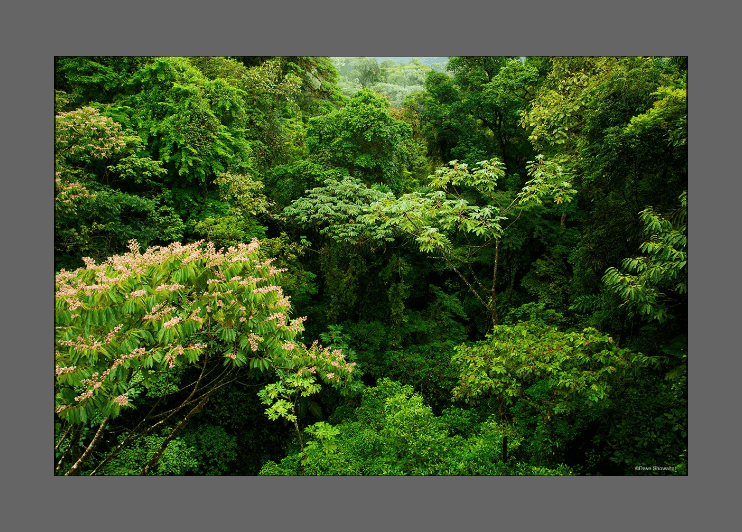
Imagine you're a tiny bug explorer in the lush rainforest canopy. You notice two types of your fellow bugs - one is a vibrant yellow, and the other is a cool green. What do you think would happen next?
The green bug population starts to outnumber the yellow bugs
Both the green and yellow bug populations remain the same
Both the green and yellow bug populations start to grow
The yellow bug population starts to outnumber the green bugs
Pop Quiz! Can natural selection still do its thing if every creature in the mix is a carbon copy, sporting the exact same traits?
Oh, Absolutely!
Nope, Not a Chance!
Ready for a fun challenge? Let's see if you can crack this: How do you become the champion of natural selection?
Just survive, that's it!
Go extinct, obviously (wink)
Survive and reproduce, like a boss!

Imagine you're a tiny fish in a pond that's slowly turning darker due to pollution. Which of your fellow fish do you think will have a better chance of survival?
The light-colored fish
The dark-colored fish
Who's the brainy boffin who came up with the ideas of 'Survival of the Fittest' and 'Evolution'?
Charles Darwin
Albert Einstein
Steven Hawking
Isaac Newton
Imagine you're a bird! Why would you want a beak that's different from your feathered friends?
So you can stand out in the bird crowd.
So you can munch on the yummy food that's available in your environment.
So you can defend yourself against those scary predators.
So you can protect yourself from your lunch (prey).
Imagine you're a creature in the wild! What would you call the special trait that helps you thrive and survive in your environment?
Is it Natural selection?
Could it be Mutation?
Maybe it's Camouflage?
Or is it Adaptation?
Imagine you're a tiny mouse in a big field. Why would your population change over time?
Is it because the light-colored mice can have more babies than the dark-colored mice?
Or maybe the hawks prefer the taste of dark mice over light mice?
Could it be that the hawks can spot the light mice more easily, making them an easy target?
Or do the hawks have an easier time seeing the dark mice, making them more likely to be eaten?
Can you guess the process depicted in this intriguing image?
Variation
Natural Selection
Selective Breeding
Homeostasis
Imagine you're in a wild jungle! Which creatures do you think are most likely to survive?
The ones who are best adapted to the jungle life
The fastest runners
The strongest beasts
The most domesticated (tamed) ones
Imagine you're a tiny organism in a big, big world. Do you think you can just 'decide' to evolve and change yourself?
Yes, I know I need to change to survive in this vast world.
No, I change because of the mysterious force of natural selection.
Imagine you're a creature living in a chilly, frosty environment. What cool adaptations might you have to survive? Choose all that apply.
A thick layer of blubber to keep you warm
A cozy, thick fur coat
A thin fur coat
Strong muscles for heavy lifting
Imagine you're a nature detective! Can you figure out why competition is so crucial for natural selection?
Is it because it showcases which variations are more successful, allowing the organisms with those variations to survive?
Or does it cause organisms, regardless of their traits, to die out, reducing the population size?
Maybe it causes organisms to become stronger due to having to outcompete other species?
Or do you think competition is not important for natural selection at all?
Ever wondered why frogs and other creatures lay so many eggs or have so many babies?
Is it so that their little ones can have a big party with lots of friends?
Or is it because the more babies they have, the better the chances of survival for some?
Maybe, the more babies they have, the lesser the chances of survival for each?
Or could it be that more babies mean less competition?
Imagine you're a tiny DNA molecule, chilling in a cell. Suddenly, a mutation occurs! Why is this important?
Oh no, this could mean the end for the organism!
Awesome, this could lead to genetic variation and help the population evolve!
Great, this could bring benefits for me, but not for the population.
Interesting, this could change my genotype, but not my phenotype.
Imagine you're a tiny gene in a big population. The more friends (genetic variation) you have, the more likely you are to:
Start a revolution (Evolve)
Go on a world tour (Migrate)
Be the last one standing (Survive)
Change your style (Mutate)
Imagine you're a bunny explorer, hopping around in a field. All the other bunnies you see around you, who are of the same species, are part of a(n)
population
species
community
ecosystem
Imagine you're a bird-watcher and you notice that not all birds have the same beak! What would you call these differences among a species, like different bird beaks?
Are they called Genes?
Could they be Variations?
Maybe they're Traits?
Or are they Theories?
Imagine you're a tiny scientist, traveling inside a cell. You notice a mutation happening! What is it directly causing a change in?
DNA
tRNA
protein
rRNA
Pop quiz time! Can you guess what almost all adaptations originally started off as?
Is it Selective breeding?
Could it be Physiological?
Maybe it's Structural?
Or is it Mutation?

Imagine you're a time traveler! What would you call the process of changes you observe over time?
A magical phenomenon called Natural Selection
A mysterious process known as Evolution
An intriguing method called Selective Breeding
A fascinating system named Homeostasis
Whoa! Do you know which theory is described by the phrase "Survival of the fittest"? Give it a shot!
Natural selection
Selective breeding

Imagine you're a tiny bird, pecking away at a tree with your long, sharp beak. This is a classic example of what?
Natural selection
Selective breeding

Imagine you're a trait in a species. Who would be the boss deciding if you get to be passed on to the next generation?
Mother Nature herself
A random human
The trait next to you
The process of evolution
Imagine you're in the wild! Which scenario would best illustrate the concept of natural selection?
A lion outsmarting and devouring its prey.
A farmer handpicking the cows for breeding.
A dog breeder selecting the cutest puppies.
A botanist inventing a new, vibrant colored flower.

Imagine you're a buzzing bee, flying around a garden. You suddenly catch a whiff of a sweet smell. It's coming from a honeysuckle flower! This delightful aroma didn't just happen overnight. What process do you think the honeysuckle used to develop this sweet smell to attract you and your fellow pollinators?
Did it use selective breeding?
Or was it a result of extinction?
Could it be natural selection?
Or is it a case of evolution?
Imagine you're a detective, and your mission is to study the similarities and differences in body structures between various species. What would be your method?
Comparative anatomy
Embryology
Molecular biology
Archaeology
Imagine you're a detective in the world of biology! Can you tell us what those body parts of organisms are called that seem to be twins in terms of structure and position, but when it comes to function, they couldn't be more different?
Are they Embryos?
Could they be Homologous structures?
Maybe they are Analogous structures?
Or are they Vestigial structures?
Imagine you're a detective in the world of biology! Your mission is to identify body parts that work in the same way, but look different. What would you call these?
Are they called embryos?
Or, are they known as homologous structures?
Maybe, they are termed as analogous structures?
Or, are they referred to as vestigial structures?
Imagine you're an explorer on a quest to discover the mysteries of the human body. You stumble upon body parts that seem to have lost their original function. What would you call these mysterious parts?
Are they called embryos?
Could they be homologous structures?
Maybe they are analogous structures?
Or are they known as vestigial structures?
Imagine you're a detective in the world of biology! You come across organisms with certain body parts that aren't in use anymore. These body parts are clues that these organisms are related to an ancestor who once used them. What are these body parts called?
Are they called analogous structures?
Or maybe they're known as homologous structures?
Could they be vestigial structures?
Or are they simply referred to as gills?
Imagine you're a tiny creature in a vast jungle. You're born with a special trait that gives you an edge over others in your environment. This trait is known as an adaptation. Is this statement true or false?
true
false
Who do you think was the brainy boffin who came up with the cool ideas of 'Survival of the Fittest' and 'Evolution'?
Charles Darwin
Albert Einstein
Steven Hawking
Isaac Newton
Imagine you're a creature in the wild. Where would you, being the fittest and strongest, survive and pass your awesome traits to your little ones?
Evolution
Natural Selection
Extinction
Artificial Selection
Imagine you're a trait in a species. Why would you, being advantageous, have a higher chance of being passed onto the next generation?
Because you, as an advantageous trait, are more likely to help the species survive and reproduce.
Because you come from dominant alleles.
Because you come from recessive alleles.
Because you are an acquired phenotype.
Imagine you're a scientist observing a group of moths, all from the same species. You notice that their wings are all different! What would you call this phenomenon?
Natural Selection
Variation
Homeostasis
Extinction
Imagine you're a tiny creature in a vast jungle. Your survival and ability to reproduce depends on a special skill. What would you call this skill?
Is it Diversity?
Could it be Evolution?
Maybe it's Adaptation?
Or is it Fitness?
Can you guess who the adventurous naturalist was who journeyed across the globe to study the fascinating world of plants and animals?
The genius Albert Einstein
The explorer Charles Darwin
The basketball star Charles Barkley
The physicist Isaac Newton
Imagine you're a time-traveling scientist, studying the mysteries of evolution! Which of the following would you say is NOT one of the key ingredients in the recipe for evolution?
Overproduction - Nature's way of ensuring survival
Variation - The spice of life, and evolution!
Competition - The survival of the fittest
Symbiosis - The art of living together
Let's go on a time travel adventure! Can you tell me what shows how different groups of organisms have changed over time?
A time capsule called Fossil record
A blueprint named Homologous structures
A baby photo album known as Embryology
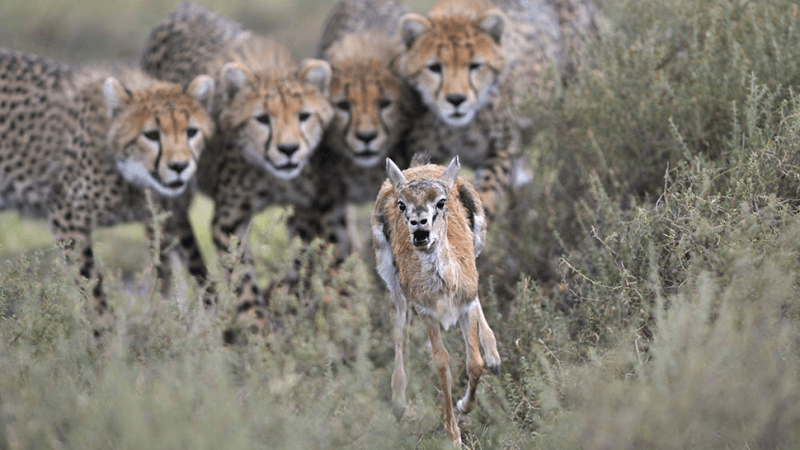
Imagine you're a bird-watcher and you spot both hawks and owls in the same area. You notice they're both after the same meal and are trying to outdo each other. What would you call this scenario?
A fierce competition
A biotic factor
A symbiotic relationship
A population problem
Ready for a wild ride through the jungle of knowledge? Here's your question: What exactly is this thing we call 'natural selection'?
Is it the survival of the fittest, where the strongest and smartest rule the roost?
Or is it about humans changing over time, like fashion trends?
Could it be that two species are exactly the same, like identical twins?
Or is it simply that more animals survive than others, like a lucky lottery?
Imagine you're a tiny molecule inside a DNA strand. You notice that genetic drift is happening all around you, but it's driven by chance, not by natural selection. Is this true or false?
true
false
Imagine you're a scientist studying genetics. In which type of population do you think Genetic Drift is more likely to occur?
A population of fish in the vast ocean
A tiny population of rabbits on an isolated island
A population of birds in a large forest
An ancient population of turtles

