
 Worksheets
AP World Spring Benchmark #2 Study Guide 2025
Total questions: 130
Worksheet time: 2hrs 38mins

Which of the following is an implicit claim that the author makes in the second paragraph?
A
In some cases, governments need to stifle freedom of speech.
B
Religion has been a force holding back the progress of humanity.
C
Man’s natural condition is one of suffering and a struggle for survival.
D
Loyalty to one’s nation is the greatest virtue a person can aspire to have.

Together with access to coal deposits, which environmental factor most directly contributed to Great Britain’s early industrialization?
A
Its location on an island group separate from continental Europe
B
Its abundance of iron ore
C
Its cold climate, unsuitable for cultivating many crops
D
Its plentiful domestic sources of gold and silver

Unlike the four scenes in the top two rows of the lithograph, the inclusion of the two scenes in the bottom row is best explained by
A
state-sponsored industrialization policies motivated by social welfare programs
B
the technological innovations of the second industrial revolution
C
resistance to industrialization by organized labor motivated by socialist philosophy
D
the mathematical and physical discoveries of the Scientific Revolution

The rapid growth of industrial output in Russia during the 1890s was most likely comparable to the growth of industrial output in which other state during the same period?
A
The Ottoman Empire
B
Qing China
C
Meiji Japan
D
Brazil

The rapid growth of nineteenth-century industrial cities such as Manchester is best understood in the context of which of the following economic developments?
A
The increases in agricultural productivity that freed up laborers for work in factories
B
The adoption of protective legislation for workers that encouraged people to seek industrial jobs
C
The abolition of slavery that made plantation agriculture less profitable
D
The migration of people from colonial areas to Europe in search of better economic opportunities
Laissez-faire means
more government involvement in business
government should stay out of business
government should control all of the prices
government should control workers salaries
The Industrial Revolution started in
France
United States
Japan
Britain
This philosopher wrote in The Two Treatises of Government that everyone has the right to life, liberty, and property.
Thomas Hobbes
Mary Wollstonecraft
John Locke
Baron Montesquieu
Locke argued that we had 3 main natural rights. What are they? (Select 3)
Life
Liberty
Pursuit of Happiness
Property
Which change is associated with Meiji Japan?
expansion of feudal political and social values
modernization of the economy and government
adoption of isolationist policies
abandoning plans for an overseas empire
Who believed in a separation of powers as a way to provide checks and balances?
Montesquieu
Rousseau
Hobbes
Locke


Freedom of speech, freedom of religion, freedom of the press are included in which amendment?
13th
1st
7th
10th
According to Hobbes, If the king breaks his promise to respect the rights of his individual subjects....
they have the right to rename the country
must continue to follow their king
they have the right to leave the country
they have the right to rebel against his authority and form a new government
Who said: "I don't believe in a word you say, but I will defend to the death your right to say."
Voltaire
John Locke
Jean Jaque Rousseau
Thomas Hobbes
Hobbes or Locke: Man is driven by greed.
Hobbes
Locke
Hobbes or Locke: Citizens sacrifice their rights for protection and can't leave the social contract.
Hobbes
Locke
Hobbes or Locke: Believed people were basically good.
Hobbes
Locke
Hobbes or Locke: People have the right and duty to change a government that doesn't protect their rights.
Hobbes
Locke


What caused the Taiping and Boxer rebellions?
Foreign economic involvement in China
British selling opium to China
Indians refusing to touch the gunpowder pouches
Americans moving into West North America

What was Japan's response to foreign interference in the nineteenth century?
Adapt to Western politics and culture (Meiji Restoration)
Isolate themselves further by resisting and fighting
Became allies with the Chinese to become the dominant power in the region
Adapt to the ideas of the islanders and tribal people to resist

Which of the following was the primary reason that immigrants created ethnic enclaves?
Support and safety
Refusal to assimilate
Difficulty finding work
Segregation by the government

Why, in the time period c. 1750-1900, did European states fight to acquire overseas colonies?
To acquire raw materials to fuel their industrialization
To spread Enlightenment ideas
To abolish slavery worldwide
To stop the spread of Islam throughout the world

Which company took over other European states colonies in India?
British East India Company
British West India Company
Dutch East India Company
French East India Company

Why did European powers turn to indentured servants for labor?
The abolition of the slave trade
The shift in control in India to the British
The growth of industrialization in China
The success of the Atlantic revolutions

What was a negative effect of migrants moving to new societies looking for work?
They would receive prejudice and racism from the people
They would lose their culture because of enclaves
They would return to their home societies after saving enough money
They would loss their connections to their home societies

Why did European powers divide Africa by diplomatic agreements between each other?
Fear of going to war because of fierce competition
Rapid population increase in European colonies in Asia
Atlantic revolutions lead Europeans states to seek new troops
Creation of transnational business fostered exchange of raw materials
Many colonized people responded to European imperialism by —
organizing resistance movements against European colonists
teaching European colonists how to survive in tropical environments
cooperating with European colonists to share the profits from industrialization
aiding European colonists in establishing borders consistent with the ethnic settlements
One similarity between the Sepoy Rebellion in India and the Boxer Rebellion in China was that both were –
Reactions to European Imperialism
Movements to establish greater democracy
efforts to restore trade monopolies
struggles to Westernize their cultures

This stanza from Kipling’s poem is most closely associated with the belief that it was the duty of Western power to –
preserve traditional African and Asian cultures
teach non-European peoples how to produce manufactured goods
protect existing African and Asian economies
introduce the benefits of their civilizations to non-European peoples
During the 19th century (1800s), Europeans improved roads, built bridges, and put down railroad tracks in their colonies primarily to –
obtain raw materials for their industries
provide high paying jobs for their colonists
impress the colonists with their technological superiority
help missionaries to spread Christianity

The map above is connected to which of the following historical events?
Berlin Conference/ Scramble For Africa
Results of post World War II independence movements
Spread of Christianity throughout Africa
Abolition of slavery through Africa

Which of the following conclusions about Africa in 1913 does this map best support?
Sudan was an independent state.
Liberia was the largest independent state.
Spain controlled most of northwest Africa.
Most of Africa was controlled by European nations.
The 19th-century term “white man’s burden” reflects the idea that
Asians and Africans were equal to Europeans
Asians and Africans would be grateful for European help
Imperialism was opposed by most Europeans
Europeans had a responsibility to improve the lives of their colonial peoples

The following picture represents
The Scramble for Africa
The Division of China
The Opening of Japan
Spanish Control of the Americas
Great Britain’s primary motivation for acquiring control of the Suez Canal in the late 19thc century was --
Protect British trade interests in Asia
Introduce democratic principles in this region
Make up for the loss of the Panama Canal
Prohibit the movement of ships from Russia

Which slogan best reflects the point of view of Cecil Rhodes as shown in this cartoon?
“Unite All Africans.”
“Embrace African Diversity.”
“Imperialism Is a Glorious Pursuit.”
“Connecting Constantinople to Cairo.”

Where in Africa did King Leopold conquer?
Congo
Sudan
Libya
Nigeria

France
Russia
Great Britain
United States
The British direct control in India from 1757 until 1947
Indian National Congress
Meiji
Raj
Muslim League
Which of the following people helped lead India to independence?
Leopold II
Gandhi
Ho Chi Minh
Geyere
What occurs in nations like Rwanda & Cambodia years after Imperialism ends there?
Economic success due to increased resources
Genocide due to ethnic divisions arising from when Imperialism existed
Warfare due to invasion by Asian powers
Election of great leaders
Many African people rebelled and fought Europeans who came there to take over and...?
almost all were not successful due to less powerful weapons
many were successful and maintained their independence
a few were successful but only because of American weapons
all were successful and Africa stopped all European advances
What is Social Darwinism?
The idea that one culture or race is better than another.
The idea that the strongest person will live the longest.
The complete control of one nation over another.
What was the effect of the Sepoy Mutiny?
The British took complete control of India.
India won its independence.
India took over Britain.

What was the goal of direct control?
To use local government officials
Limited self-rule
Assimilation

What are two effects of partition in Africa and India?
peace and wealth
political instability and fighting
education and resistance

I contend that we [Britons] are the finest race in the world, and the more of the world we inhabit, the better it is for the human race...It is our duty to seize every opportunity of acquiring more territory and we should keep this one idea steadily before our eyes that more territory simply means more Anglo-Saxon race, more of the best, the most human, most honourable race the world possesses.
From: Cecil Rhodes, British imperialist in Africa, Confessions of Faith.
What reasons for expansion/imperialism is exemplified within the quote?
Economic desires.
Nationalism.
"White Man's Burden"
Social Darwinism

The British East India Company hired _______________, or Indian soldiers.
Sikhs
Muslims
Sepoys
Hindus

If a colony was run by ______________, local elites were removed from power and replaced with a new set of officials from the mother country.
indirect rule
direct rule
colonial rule
divine rule

The only free states remaining in Africa by 1914 were...
Nigeria and Rhodesia
Egypt and Morocco
Rhodesia and Algeria
Liberia and Ethiopia
Jewish people were often forced to move into separated areas of cities in cramped and horrible conditions known as ________________.
concentration camps
gestapo
genocide
ghettos
Violent crimes committed against groups with the intent to destroy the existence of the group
Swastika
Pogroms
Gestapo
Genocide
Extremists blamed _____ for Germany’s defeat in WWI.
the government
Hitler
weak men
Jews
During this time in Germany, Adolf Hitler and the Nazis passed laws, which restricted the rights of Jews called_________
the Nuremberg Laws
the Holocaust
Final Solution
Annhiliation
1917, 1918
Who was the president during World War I ?
Woodrow Wilson
William Howard Taft
William McKinley
Theodore Roosevelt

New form of warfare in which both sides defended their location with little advancement
Trench Warfare
No Man`s Land
poison gas
tank

Type of warfare that the German Kaiser declared when they began to sink all ships in enemy waters is known as
all out war
reparations
"no holds barred" warfare
unrestricted submarine
A plan for creating a permanent and fair peace after WWI, that hoped to address the MAIN causes of the war and created the League of Nations
Treaty of Versailles
Fourteen Points
Alliance
Ceasefire
Included in Woodrow Wilson's Fourteen Points, this is the idea that a nation should have the power to choose its own government and future without being controlled.
militarism
nationalism
self-determination
allied

Countries choosing sides is referred to as...
Nationalism
Imperialism
Militarism
Alliance System


Poster were used as a part of the war machine. What does this World War I poster represent?
Imperialism
Prohibition
Neutrality
Propaganda

True or False: The trenches were typically cold, wet, dirty and diseases spread quickly
True
False
Choose THREE new technologies adopted in hopes of breaking trench lines.
Tanks
Airplanes
Gas
Long-Range Missiles
"Leaders pushed for the expansion of armies and navies as a show of power" is an example of what
Militarism
Imperialism
Alliances
Nationalism
An agreement between two or more nations, usually by treaty, to defend each other if one of the countries is attacked is called a(n)
Militarism
Alliance
Imperialism
Nationalism

The process of countries building empires by gaining control of weaker nations is known as
Militarism
Alliances
Imperialism
Nationalism
.......................................................is a war in which countries use all their resources for the war
total war
rationing
Eastern front

One of the conditions of the Treaty of Versailles was that
Germany must adhere to all of the Fourteen Points.
Austria-Hungary must pay reparations to the United States.
Germany must admit its guilt in causing World War I.
Austria-Hungary must reduce the size of its military.

This chart best shows which cause of World War I?
Militarism
Alliances
Imperialism
Nationalism

What was the policy called that continually gave in to Hitler's demands in order to prevent conflict with Germany?
policy of appeasement
policy of nullification
policy of aggression
policy of enactment

What was the turning point in Eastern Europe during World War II?
Battle of Midway
Battle of Britain
Battle of Stalingrad
D-Day Invasion

The Manhattan Project led by Robert Oppenheimer was part of the World War II effort to:
ban the use of chemical and biological warfare
develop the atomic bomb
coordinate troop movements between New York and Europe
supply the Allies with more fighter planes
Germany used this type of warfare to overwhelm Poland, The Netherlands, Denmark, and France.
Blitzkrieg
The Blitz
Total War
Island Hopping
This battle was the turning point in the war in the Pacific
Midway
Pearl Harbor
Stalingrad
D-Day
The Allies invasion of France on June 6, 1944 is known as what?
D-Day
Operation Sea Lion
Battle of the Bulge
Invasion Day
The Axis Powers consisted of which countries?
Germany, Italy, Japan
Germany, France, USSR
USSR, Great Britain, USA, France
France, Germany, Great Britain, Japan
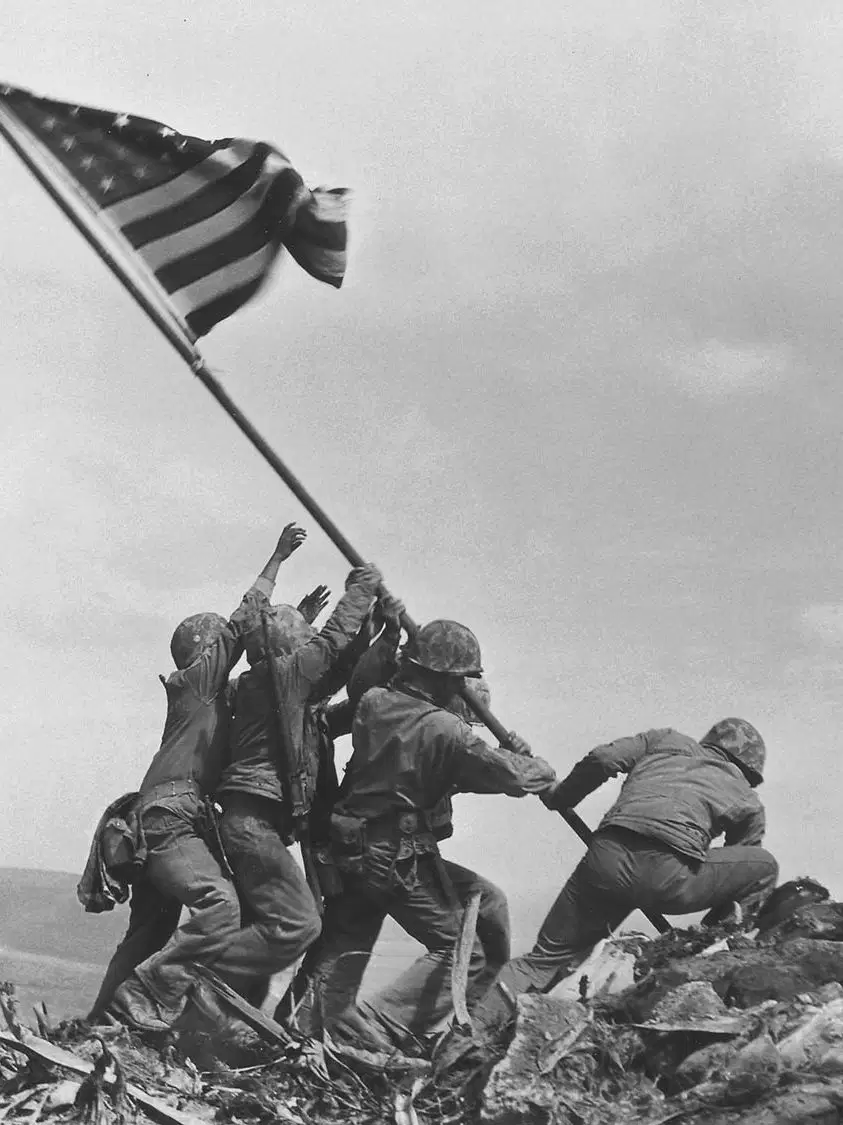
Which World War II battles were fought on small Islands located in the Pacific Ocean?
Battle of Iwo Jima
Battle of Guadalcanal
Battle of Okinawa
Battle of Wake Island
All answers are correct.

What is the name of the German law that removed citizenship of Jewish people and banned marriage with non-Jews known as?
Kristallnach
Nuremberg Laws
Dachau Laws
Final Solution
The main Allied Powers of World War II consisted of:
Britain, Germany, Soviet Union
Germany, Italy, Japan
U.S., Italy, Poland
U.S., Britain, Soviet Union

Which of the following are clauses within the Treaty of Versailles?
Germany army is limited to 100,000 men
Rhineland is demilitarized
No air force
The people were not allowed to vote on their leaders
After WWI, hyperinflation in Germany
led incredibly high costs for items
was caused by an increase in printing more money
caused money to be more valuable
led people to use the paper money to fuel fires

During World War II, the need of the United States for more war materials resulted in the:
reduction in profits for defense industries
easing of government controls on the economy
use of lengthy strikes by labor unions
rationing of some consumer goods

Which statement most accurately describes the foreign policy change made by the United States between the start of World War II (1939) and the attack on Pearl Harbor (1941)?
The traditional isolationism of the United States was strengthened.
The nation shifted from neutrality to military support for the Allies.
War was declared on Germany but not on Japan.
Financial aid was offered to both the Allied and Axis powers.

Which was an example of appeasement?
the U.S. Neutrality Acts of 1935 and 1937
the conquest of Poland in 1939
the entry of the United States into World War II in 1941
the agreement of Britain and France to give Germany the Sudetenland in 1938
Put the events of World War II in chronological order
Germany invades Poland
Japan attacks Pearl Harbor
Allies invade Europe on D-Day
United States drops atomic bombs on Japan

How did women support the war effort during WWII?
They maintained the home and allowed their husbands to concentrate on their jobs
They worked industrial jobs such as those in defense industries
They were limited to being nurses and teachers
They were encouraged to spend money to support the war effort


The independent countries that remained neutral in the Cold War competition.
Intifada
Third World
Nonaligned Nations
Warsaw Pact

A policy of lessening Cold War tensions, replaced brinkmanship.
Detente
Intifada
NATO
Brinkmanship
1947, President Truman's policy of providing economic and military aid to any country threatened by communism or totalitarian ideology, mainly helped Greece and Turkey
Marshall Plan
Truman Doctrine
EO 9906
EO 8802
The imaginary division between democratic western Europe and Communist eastern Europe was known as? (a)
The Soviet Union led the Space Race when they launched this artificial satellite into space.
Sputnik
Explorer 1
Gemini 1
Challenger

What advice does Bert the Turtle give to people during the Cold War to survive an atomic attack?
Run and Hide
Sit and Wait
Duck and Cover
Hide and Pray
Select the area of Germany that was under Communist control after WW2.
Match the following Cold War terms and descriptions.
Brinkmanship
Being on the edge of conflict
Iron Curtain
Imaginary division between democratic and communist nations
Containment
U.S. policy of preventing the spread of communism
Truman Doctrine
Financial plan to provide money to Greece & Turkey after WW2
Marshall Plan
Financial plan to support war-torn nations in Europe
Correctly label the Cold War map using the options provided.
A competition between superpowers to develop new, more deadly nuclear and conventional weapons.
Perestroika
Arms Race
Berlin Wall
Iron Curtain

The Russian leader who was in office at the downfall of the Soviet Union
Gorbachev
Breshnev
Kruschev
Stalin
The actions of Jomo Kenyatta, Kwame Nkrumah, Léopold Senghor, and Julius Nyerere were most closely associated with
a rise in nationalism in several African countries
the end of apartheid in South Africa
a resurgence of colonialism in east Africa
the revival of Islam in northern Africa
The policy of strict racial separation and discrimination that was implemented in the Republic of South Africa is called
collectivization
apartheid
intifada
communism
Who was a leader of the ANC
Nelson Mandela
F.W. de Klerk
Barack Obama
Shaka

Which claim is best supported by the evidence included in these maps?
Egypt and Ethiopia are no longer part of Africa.
By 1980, most African countries had become independent.
By 1950, most of Africa was controlled by Russia or the United States.
The Union of South Africa was renamed Namibia.
For a fortnight Gandhi’s march is intended to be only a demonstration. Then, when he expects to be at the sea, he will begin to produce salt from brine [salt water], and so infringe [violate] the Government salt monopoly, defying the Government to arrest and punish him. At the same time his supporters everywhere have been incited by him to refuse to pay local taxes.
The actions of Gandhi and his supporters, as described in this passage, helped lead to the
banning of Western books and music
removal of British control from the subcontinent
development of an economic alliance for South Asian nations
peaceful partitioning of British India into India and Pakistan
What was one reason that India was divided into two nations in 1947?
Indian leaders disagreed about India’s role in the United Nations.
Great Britain feared a unified India would be a military threat.
The Soviet Union insisted that India should have a communist government.
Differences between the Hindus and the Muslims created religious conflict.
Why is Jomo Kenyatta important to the nation of Kenya?
He ended the apartheid.
He helped the British maintain power in Kenya.
He was an independence leader and its first president.
He seized power without an election and made a military dictatorship.
Algeria fought for their independence from what nation?
France
Belgium
United States
Britain
Who was the first prime minister of India from 1947 to 1964 known for supporting western- style industrialization?
Charan Singh
Mohandas Gandhi
Indira Gandhi
Jawaharlal Nehru

Which leader is described by the list?
Nelson Mandela
Golda Meir
Gamal Abdul Nasser
Jawaharlal Nehru
When did many African groups begin to challenge European colonial rule?
in the 1800s
after World War II
before World War I
during the U.S. Civil War

