

Wayground logo

Free Printable Worksheets

Font size

S
M
L
XL
Worksheets

Unit 8 Review Guide Quizizz

Total questions: 49

Worksheet time: 26mins

Name
Class
Date
1.

What is a common group of organisms that can breed to produce fertile offspring?

a)

Members of different species

b)

Members of the same genus

c)

Members of the same species

d)

Members of the same family

2.

What is the term for a group of species with a common ancestor?

a)
tribe
b)
clade
c)
genus
d)
phylum
3.
  1. What is a shared derived characteristic?

a)
A shared derived characteristic is a trait that is unique to a single species.
b)
A shared derived characteristic is a trait that is only found in extinct organisms.
c)
A shared derived characteristic is a trait that is passed down from parent to offspring.
d)
A shared derived characteristic is a trait that is shared by a group of organisms and their common ancestor, but not by any other groups outside of that lineage.
4.
  1. What is the study of classification called?

a)
anatomy
b)
botany
c)
taxonomy
d)
geology
5.

What are the 2 taxa groups used in scientific names?

a)
genus and species
b)
family and order
c)
class and phylum
d)
kingdom and domain
6.

What is the naming system of naming species called?

a)
Monomial nomenclature
b)
Trinomial nomenclature
c)
Binomial nomenclature
d)
Duo nomenclature
7.

How many words do we use in binomial nomencature?

a)
three
b)
four
c)
two
d)
five
8.

In what font are species' scientific names written?

a)
Italics
b)
Comic Sans
c)
Underline
d)
Bold
9.

When writing species scientific name the frist letter of the first name must be _____ and the first letter of the second name must be _____?

a)
capitalized and uppercase
b)
lowercase and uppercase
c)
uppercase and lowercase
d)
Capitalized and lowercase
10.

Why do we use scientific names over common names?

a)
Scientific names are easier to remember than common names
b)
Common names are too long and complicated
c)
Common names are not unique to specific organisms
d)
Scientific names are used over common names to provide a universal and standardized way to identify organisms.
11.
  1. What are the 8 levels of the Linnaeus’ classification system starting with the most broad and ending with the most specific?

a)
Domain, Division, Order, Group, Tribe, Genus, Species, Subspecies
b)

Domain, Kingdom, Phylum, Class, Order, Family, Genus, Species

c)
Kingdom, Division, Class, Order, Family, Genus, Species, Variety
d)
Empire, Division, Rank, Group, Tribe, Family, Genus, Species
12.
  1. How does the Linnaean classification system group organisms?

a)
Based on color and size
b)
By alphabetical order
c)
According to the number of legs
d)
Based on shared characteristics and evolutionary relationships.
13.

How does the modern classification system group organisms?

a)
Based on size and color
b)
Based on geographical location
c)
Based on alphabetical order
d)
Based on evolutionary relationships and shared characteristics.
14.
  1. What is the study of evolutionary relationships?

a)
Chemistry
b)

Phylogenetics (phylogeny)

c)
Astronomy
d)
Biology
15.

According to the cladogram, which of the following is NOT a derived characteristic?

a)

light bones

b)

Allosaurus

c)

down feathers

d)

3-toed foot; wishbone

16.

The cladogram shown is a model used by scientists to represent the order in which they hypothesize organisms descended from a common ancestor based on the appearance of derived characteristics.

Which of the following traits do the salamander and the lizard share?

a)

Jaws only

b)

Jaws and Lungs

c)

Claws or nails

d)

Jaws, Lungs, and Claws or nails

17.

Cytochrome c is a protein made up of 104 amino acids. It is found in the mitochondria and aides in the electron transport chain during cellular respiration. The data table represents the number of amino acid differences in cytochrome c between organisms A, B, C, and D.

The phylogenetic trees represent possible interpretations of the data in the chart.


Which two phylogenetic trees represent the data most accurately? (choose 2)

a)
b)
c)
18.

What is the best inference about biochemical relationships that could be made from this model?

a)

The amino acid sequences of a lancelet and a tuna are more similar than that of a tuna and a salamander. This is due to the lancelet and the tuna both residing entirely in water while the salamander can survive on land.

b)

The amino acid sequences of a salamander and a turtle are less similar than that of a turtle and a leopard. This is due to the turtle and the salamander both being adapted to life in water or land.

c)

The amino acid sequences of a lancelet and a tuna are less similar than that of a tuna and a salamander. This is due to the lancelet and the tuna splitting from a common ancestor longer ago.

d)

The amino acid sequences of a salamander and a turtle are more similar than that of a turtle and a leopard. This is due to the turtle and the salamander both being adapted to life in water or land.

19.

Which trait should go where A is on the cladogram?

a)

eyes

b)

feet

c)

lips

d)

hat

20.

What is a dichotomous key used for?

a)
Measuring temperature
b)
Identifying organisms
c)
Writing essays
d)
Playing music
21.

Who is most closely related to Taxidea taxus?

a)

Lutra lutra

b)

Panthera pardus

c)

Canis latrans

d)

Canis lupus

22.

In a phylogenetic tree, the branching points represent common ancestors.

a)

True

b)

False

23.
A student discovers an arachnid with a segmented abdomen, long legs, and a tail with no stinger. The student uses the dichotomous key below to identify it. Which arachnid has the student found?
a)

Whip Scorpion

b)

Wind Scorpion

c)

Daddy long legs

d)

Scorpion

24.

Leaf S

a)

Eastern white pine

b)

balsam poplar

c)

sweet gum

d)

ginko

25.

Which characteristics are used to identify the American Robin?

a)

Head color, Beak shape, and Beak Color

b)

Head color and Beak Color

c)

Beak Shape and Beak Color

d)

Beak Color

26.

What is a Domain in biology?

a)
A type of genetic mutation
b)
A specific region of a protein
c)
A classification of plant species
d)
The highest taxonomic rank of organisms grouping all life forms.
27.

How many domains of life are there?

a)
3
b)
6
c)
5
d)
4
28.

What are the domains of life?

a)
Bacteria, Archaea, Eukarya
b)
Fungi
c)
Protista
d)
Prokarya
29.

Which domain contains organisms that live in harsh environments (extremophiles)?

a)
Eukarya
b)
Bacteria
c)
Fungi
d)
Archaea
30.
  1. Which domain contains organisms that consume their food?

a)
Eukarya
b)
Plantae
c)
Archaea
d)
Prokarya
31.

How many kingdoms are there?

a)
10
b)
8
c)
4
d)
6
32.

List the kingdoms of life

a)

Eukarya / Prokarya

b)
Animalia, Plantae, Fungi, Protista, Archaea, Bacteria
c)

Plants, animals, fungi, protists

d)

Monera, Plantae, Fungi, Bacteria

33.

What is the difference between a prokaryote and a eukaryote?

a)
Prokaryotes have a nucleus and membrane-bound organelles, while eukaryotes lack these structures.
b)
Prokaryotes lack a nucleus and membrane-bound organelles, while eukaryotes have a nucleus and membrane-bound organelles.
c)
Prokaryotes are multicellular organisms, while eukaryotes are unicellular.
d)
Prokaryotes are found only in plants, while eukaryotes are found only in animals.
34.
  1. Which kingdoms are prokaryotic vs eukaryotic?

a)
Bacteria and Archaea are prokaryotic kingdoms, while Protista, Fungi, Plantae, and Animalia are eukaryotic kingdoms.
b)
Bacteria and Archaea are eukaryotic kingdoms, while Protista, Fungi, Plantae, and Animalia are prokaryotic kingdoms.
c)
Archaea and Protista are prokaryotic kingdoms, while Fungi, Plantae, and Animalia are eukaryotic kingdoms.
d)
Bacteria and Protista are prokaryotic kingdoms, while Fungi, Plantae, and Animalia are eukaryotic kingdoms.
35.
  1. Which domain and kingdom are YOU (human) in?

a)
Eukaryota, Animalia
b)
Prokaryota, Plantae
c)
Bacteria, Fungi
d)
Archaea, Protista
36.
  1. Which kingdom has cell walls AND they are made of chitin: FUNGI OR PLANTS

a)
PROTOZOA
b)
FUNGI
c)
BACTERIA
d)
ANIMALS
37.

Which kingdom has cell walls AND they made of cellulose

a)
Fungi
b)
Animalia
c)
Plantae
d)
Protista
38.

List 2 ways a virus is different from living organisms

a)
1. Viruses cannot replicate on their own. 2. Viruses lack cellular structure.
b)
Viruses can perform photosynthesis.
c)
Viruses have a nucleus.
d)
Viruses are multicellular.
39.

List 2 ways a virus is the same as a living organism

a)
Viruses can undergo cellular respiration like living organisms
b)
Viruses can reproduce sexually like living organisms
c)
Viruses can replicate and evolve like living organisms. They also contain genetic material.
d)
Viruses can perform photosynthesis like living organisms
40.

Are viruses consider living or nonliving?

a)
Alive
b)
Inanimate
c)
Living
d)
Nonliving
41.
Which kingdoms are prokaryotic?
a)
Archaebacteria and Animalia
b)
Eubacteria and Archaebacteria
c)
Fungi and Protista
d)
Plantae and Eubacteria
42.
This domain is characterized by bacteria that can live in extreme environments, such as hot springs.
a)
Archaea
b)
Bacteria
c)
Eukarya
d)
Prokarya
43.
 You would find mushrooms and molds in which kingdom?
a)
Plantae
b)
Protists
c)
Fungi
d)
Animalia
44.
In which kingdom do I belong if I am unicellular, autotrophic, and eukaryotic?
a)
Archaebacteria
b)
Protista
c)
Animalia
d)
Plantae
45.
Which kingdom contains multicellular, heterotrophic organisms whose cells have NO cell walls?
a)
Protista
b)
Fungi
c)
Plantae
d)
Animalia
46.
Identify the kingdom...
Microscopic unicellular organism found in a mud puddle.  Organism's DNA is contained in a nucleus and it moves by beating tiny hairs in the water.
a)
Archaebacteria
b)
Eubacteria
c)
Protista
d)
Fungi
47.
Identify the kingdom...
Unicellular organisms with no nuclei found living in the superheated waters of a hot spring.
a)
Archaebacteria
b)
Eubacteria
c)
Fungi
d)
Protista
48.
Identify the kingdom...
Multicellular organism with cell walls made of chitin found growing on a decomposing manure pile.
a)
Archaebacteria
b)
Eubacteria
c)
Protista
d)
Fungi
49.
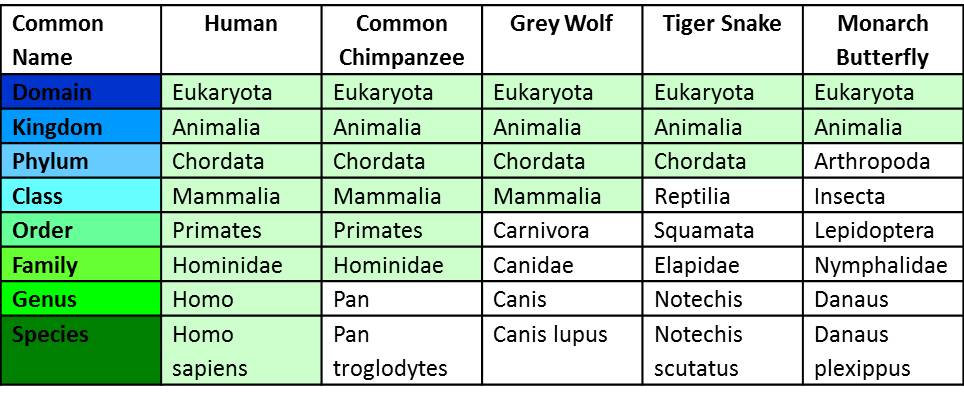
Which organism in the table is least closely related to the chimpanzee?
a)
human
b)
grey wolf
c)
tiger snake
d)
monarch butterfly
