
 Worksheets
4-19-24 Ch 9 & 10 quiz
Total questions: 118
Worksheet time: 59mins
A ______ is a repeating disturbance that transfers energy through matter or a vacuum. *
medium
frequency
wave
conductor
A ______ is a material through which a wave transfers energy. Mark only one oval.
trough
frequency
substrate
medium
When waves move through a medium, the waves move through the medium and carry the matter toward where the waves are propagating towards Mark only one oval.
True
False
Which types of waves can travel through a vacuum? Mark only one oval.
mechanical
light
sound
seismic
In ______ waves, matter in the medium moves back and forth at right angles to the direction the wave travels.
longitudinal
transverse
sound
light
Also known as compression waves
longitudinal
transverse
sound
light
In ______ waves, matter in the medium moves back and forth along the same direction the wave travels.
longitudinal
transverse
sound
light
Waves on water are examples of what type of waves
Longitudinal
Transverse
Dance Move
John Waves
Sound waves are examples of what type of waves
Longitudinal
Transverse
Dance Move
John Waves
If you squeeze a coil spring and release it. The wave that propagates would be what type?
Longitudinal
Transverse
Dance Move
John Waves
These waves can travel in a vacuum:
Light
Sound
Radio
Mechanical
A seismic wave can be made up of what type(s) of waves?
Longitudinal
Transverse
Dance Move
John Waves
Which is a type of wave?
crest
trough
frequency
seismic
If the sun's light was a mechanical wave, would we expect any changes on earth?
Yes
No
As waves propagate through a medium they lose energy and become less energetic as they move due to loss of energy.
True
False
What are the highest points of a transverse wave called? *
troughs
peaks
summits
crests
What are the lowest points of a transverse wave called?
crests
valleys
troughs
depressions
What is the more dense region of a longitudinal wave called?
Compression
Rarefaction
Wavelength
Period
Amplitude
What is the less dense region of a longitudinal wave called?
Compression
Rarefaction
Wavelength
Period
Amplitude
____ is the distance between one point on a wave and the nearest point just like it.
Compression
Rarefaction
Wavelength
Period
Amplitude
____ is the amount of time it takes one wavelength to pass a point.
Compression
Rarefaction
Wavelength
Period
Amplitude
The ____ of a wave is how many wavelengths pass a fixed point each second.
frequency
amplitude
velocity
compression speed
As frequency increases, wavelength _______.
decreases
increases
remains constant
becomes faster
What is the wavelength of a wave traveling through a rope if the distance from one crest to the next is 1 m?
2 m
1 m
0.5 m
3 m
What is the speed of a wave with a frequency of 50 Hz and a wavelength of 10m?
5 m/s
50 m/s
500 m/s
5000 m/s
What is the speed of a wave with a frequency of 200 Hz and a wavelength of 0.5 m?
100 m/s
400 m/s
200 m/s
50 m/s
What is the frequency of a wave with a speed of 500 m/s and a wavelength of 0.1 m?
50 Hz
500 Hz
5 Hz
5000 Hz
What is the frequency of a wave with a speed of 270 m/s and a wavelength of 10 m?
2700 Hz
27 Hz
2.7 Hz
27,000 Hz
What is the wavelength of a wave with a speed of 30,000 m/s with a frequency of 125 Hz?
240 m
3,750,000 m
76,520 m
12.6 m
What is the wavelength of a wave with a speed of 300,000 m/s with a frequency of 36,000 Hz?
10,800,000,000 m
8.3 m
15,756 m
472,564 m
_____ is a measure of the size of the disturbance from a wave.
Compression
Rarefaction
Wavelength
Period
Amplitude
Longitudinal Waves with large amplitude have...
coils are closer together in compression
coils are farther apart in compression
distance between the rest position and crest/trough is greater
distance between the rest position and crest/trough is smaller
Longitudinal Waves with low amplitude have...
coils are closer together in compression
coils are farther apart in compression
distance between the rest position and crest/trough is greater
distance between the rest position and crest/trough is smaller
Transverse Waves with low amplitude have...
coils are closer together in compression
coils are farther apart in compression
distance between the rest position and crest/trough is greater
distance between the rest position and crest/trough is smaller
Transverse Waves with large amplitude have...
coils are closer together in compression
coils are farther apart in compression
distance between the rest position and crest/trough is greater
distance between the rest position and crest/trough is smaller
Reflection occurs when a wave _____. *
strikes an object and bounces off of it
causes ripples in a pool of water
compresses air particles as it travels
bends and changes speeds as it travels
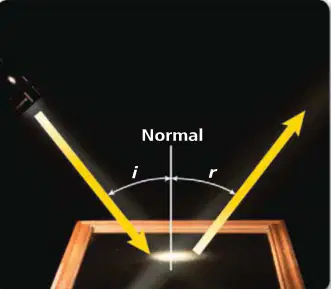
The beam sticking a mirror is called the _________. Below is a diagram illustrating the concept. Please refer to the diagram to answer the question.
Incident Beam
Reflected beam
angle of reflection
Angle of incidence
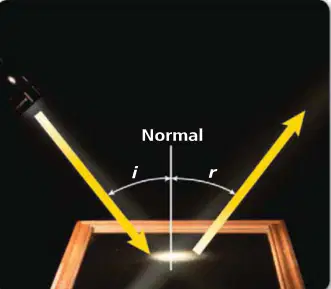
The beam that bounces off the mirror
Incident Beam
Reflected beam
angle of reflection
Angle of incidence
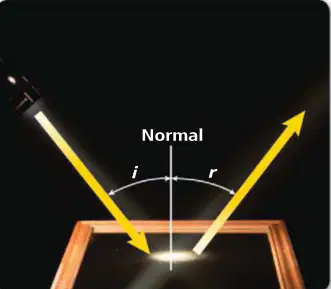
The angle formed by the reflected beam and the normal is the______.
Incident Beam
Reflected beam
angle of reflection
Angle of incidence
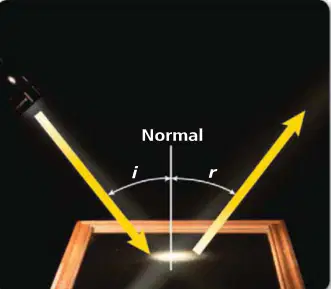
The angle formed by the incident beam and the normal is the______.
Incident Beam
Reflected beam
angle of reflection
Angle of incidence
The angle formed by the reflected beam and the normal is the______.
Incident Beam
Reflected beam
angle of reflection
Angle of incidence
If you stand next to a swimming pool and see an object under water, it will seem to be _____.
closer to the surface than it really is
farther from the surface than it really is
bent in the middle
moving more than the water around it
The _____ is an imaginary line perpendicular to the surface of a medium where a wave strikes it.
normal
incidence
diffraction grating
interference
According to the law of reflection the angle of incidence is sometimes equal to the angle of reflection.
True
False
____ is the bending of a wave caused by a change in its speed as it travels from one medium to another.
Refraction
Standing Wave
Node
Resonance
If an object is much smaller than the wavelength we would expect diffraction of the wave.
True
False
If an object is much larger than the wavelength we would expect diffraction of the wave.
True
False
____ occurs when waves bend around a barrier.
Reflection
Diffraction
Refraction
Interference
The process in which two waves overlap and form a new wave is called _____. Mark only one oval.
wave joining
interference
refraction
diffraction
Is a process in which waves interact in which the amplitude of the resulting wave increases. Mark only one oval.
Resonance
Constructive Interference
Destructive interference
standing wave
Is a process in which waves interact in which the amplitude of the resulting wave decreases. Mark only one oval.
Resonance
Constructive Interference
Destructive interference
standing wave
Sound waves are longitudinal waves, if the compression of 2 different sound waves overlap we would expect what?
Resonance
Constructive Interference
Destructive interference
Standing wave
________ is a special type of wave pattern that forms when waves equal in wavelength and amplitude but traveling in opposite directions continuously interfere with each other.
Refraction
Node
Resonance
Locations where the interfering waves always cancel.
Refraction
Standing Wave
Node
Resonance
____ is the process by which an object is made to vibrate by absorbing energy at its natural frequencies.
Refraction
Standing Wave
Node
Resonance
What is the primary misconception about electricity transmission debunked in the video?
Electricity can only travel through wires
Electrons carry energy directly to devices
Electricity is a flow of water
Electricity is generated by electrons
Who developed the equations that govern the behavior of electric and magnetic fields?
Nikola Tesla
James Clerk Maxwell
Isaac Newton
Albert Einstein
How is energy transmitted to the light bulb in the circuit?
By electrons carrying potential energy
Via the electric and magnetic fields around the wires
Through thermal conduction
Through the wires directly
What incorrect view did William Thomson have about electrical signals in submarine cables?
They were carried by electromagnetic fields
They moved like water through a tube
They were unaffected by the iron sheath
They moved like light through a vacuum
What is the correct answer to the giant circuit light bulb question?
1/c seconds
Half a second
One second
Two seconds
What does the electric field in a wire result from?
The resistance of the wire
Both the battery's charge and surface charges on the wire
Only the electrons' movement
Only the battery's charge
What analogy was used to describe the role of the battery in a circuit?
A switch in a light circuit
A generator in a power plant
A shepherd guiding sheep
A pump in a water circuit
What role do surface charges play in a circuit?
They create the electric field in the wire
They resist the flow of electrons
They store energy for later use
They generate magnetic fields
How fast does the change in electric field travel through the circuit?
At the speed of light
At the speed of sound
Instantaneously
At the drift velocity of electrons
What was the purpose of adding capacitors in the circuit diagram?
To reduce the circuit's overall resistance
To store extra electrons
To increase the voltage
To simulate the effect of surface charges
What did the experiment aim to measure?
The capacitance of the circuit
The resistance of the wire
The voltage across a resistor
The speed of electrons
What was the result of the experiment?
No voltage was detected
Voltage appeared almost instantly
Only leakage current was observed
The bulb did not light up
Why are wires more efficient for energy transfer?
They prevent energy loss
They channel the fields effectively
They increase the speed of electrons
They generate more electric fields
What misconception about electric circuits does the Poynting vector challenge?
Energy is only transferred by electrons
Energy flows inside the wires
Magnetic fields do not affect circuits
Electric fields are irrelevant
What does the characteristic impedance of a transmission line depend on?
The battery's voltage
The wire's resistance
The electric field's strength
The inductance and capacitance
Why is the lumped element model used in circuit analysis?
To visualize the electric field
To increase the accuracy of calculations
To simplify complex field interactions
To measure the speed of electrons
What was a key takeaway from the thought experiment?
Wires are unnecessary for circuits
Electric fields are the primary actors in circuits
Batteries supply infinite energy
Electrons move at the speed of light
Sounds are produced by _______.
pitch
frequencies
vibrations
reverberations
What type of waves are sound waves?
longitudinal
transverse
radio
sonar
The two types of regions that make up longitudinal waves are _______.
compressions and rarefactions
compressions and extensions
vibrations and transmissions
compressions and transmissions
The matter through which a sound wave travels is always called _______.
a medium
air
water
atmosphere
Sound waves cannot travel through ________.
solids
a vacuum
liquids
gases
The colder something is the faster sound moves through it.
True
False
In which does sound move the fastest?
solids
a vacuum
liquids
gases
The more dense a substance the faster sound travels.
True
False
The more elastic a substance the slower sound moves through it.
True
False
What is the tough membrane that is about 0.1 mm thick that transmits sound from the outer ear to the middle ear?
eardrum
hammer
anvil
stirrup
cochlea
Which bone is in the middle ear near the eardrum that vibrates and carries sound to the anvil?
eardrum
hammer
anvil
stirrup
cochlea
Which bone in the middle ear is connected to the oval window?
Eardrum
Hammer
Anvil
Stirrup
Cochlea
What is a spiral-shaped structure that is filled with liquid and contains tiny hair cells?
Eardrum
Hammer
Anvil
Stirrup
Cochlea
When someone has hearing loss, it is usually due to what?
Exposure to toxic chemicals
A broken bone in middle ear
Damaged hair cells in cochlea
Ear infection
Humans and birds can regrow hair cells in cochlea.
True
False
_______ is the amount of energy that is transferred across a certain area in a specific amount of time.
Intensity
Frequency
Pitch
Loudness
The human perception of sound volume is ________.
frequency
loudness
pitch
acoustics
If a speaker was very loud we would expect the cone which is the part that produces sound with its vibrations to be
moving quickly a far distance to make a strong compression wave
moving slowly a far distance to make a spread out compression wave
Moving quickly a smaller distance to make a strong compression wave
Moving slowly a smaller distance to make a spread out compression wave
If a speaker was loud we would expect
Tight Compressions
Tight Rarefactions
Tight Troughs
Tight Crests
To deaden sound we would want to employ a material that is ________.
soft
hard
highly elastic
dense
The intensity of sound is measured in units called ________.
decibels
hertz
dopplers
reverberations
If one sound is 30 decibels and the 2nd sound is 50 decibels how much louder is the 2nd sound?
66% louder
10 times louder
20 times louder
100 times louder
The human perception of pitch primarily depends on ________.
frequency
intensity
loudness
resonance
What is the audible frequency range for humans?
20 Hz - 20,000 Hz
30 Hz - 25,000 Hz
18 Hz - 22,000 Hz
10 Hz - 15,000 Hz
Which will you hear as the highest pitch?
sound wave with frequency of 50 Hz
sound wave with frequency of 10,000 Hz
sound wave with frequency of 15,000 Hz
sound wave with frequency of 30,000 Hz
How high or low a sound seems to be is known as what?
Pitch
Loudness
Doppler Effect
Intensity
What is a change in wave frequency due to a wave source moving relative to a wave source called?
Pitch
Loudness
Doppler Effect
Intensity
What are sound waves?
Sound waves are color vibrations that propagate through space.
Sound waves are temperature vibrations that propagate through water.
Sound waves are pressure vibrations that propagate through a material medium, such as air.
Sound waves are light vibrations that propagate through the vacuum.
How is frequency defined in relation to sound waves?
The wavelength of a sound wave
The number of cycles per second that a sound wave completes in its back-and-forth motion.
The amplitude of a sound wave
The speed of propagation of a sound wave
The speed of sound at ground level is approximately 761 mph. If you are moving at 770 mph and 3 feet behind you an avalanche happens, do you hear the sound?
Yes, the sound reaches us with an extreme doppler shift
Yes, the sound reaches us
No, the sound is not moving fast enough to catch us
No, we are deaf
If a car has a siren and it is moving sufficiently fast enough toward us, is it possible for us NOT to hear the siren?
No, sirens are within our hearing range and we would hear the sound
Yes, it is moving away from us
Yes, if fast enough the doppler effect could shift the frequency high enough for it to be about 20,000 Hz
No, the sound is not moving fast enough to catch us
What is the difference between music and noise?
Music has a wider range of frequencies than noise.
Noise has a greater intensity than music.
Music follows a specified pattern of sounds and pitches; noise has no pattern.
It is strictly a matter of opinion.
The ________ is the frequency at which a material tends to vibrate when it is disturbed.
quality
natural frequency
pitch
resonance
________ is the ability of a medium to vibrate by absorbing energy at its natural frequency.
Resonance
Overtone
Quality
Reverberation
What describes the differences among sounds of the same pitch and loudness?
reverberation
sound quality
resonance
acoustics
A(n) ________ is a vibration whose frequency is a multiple of the fundamental frequency.
natural frequency
overtone
resonant frequency
reverberation
________ is a hollow chamber filled with air that amplifies sound when the air inside of it vibrates.
natural frequency
overtone
resonant frequency
resonator
The echoing effect produced by many reflections of sound is called ________.
resonance
reverberation
intensity
rarefaction
In __________, the length of the vibrating tube of air determines the pitch of the sound produced.
Percussion instruments
String instruments
Key instruments
Wind and brass instruments
In __________, tightening or loosening of the membrane determines the pitch of the sound produced.
Percussion instruments
String instruments
Key instruments
Wind and brass instruments
The study of sound is __________.
sonar
acoustics
linguistics
ultrasonics
The process of locating objects by emitting sounds and interpreting the reflected sound waves is _______.
resonance
radar
ultrasound
echolocation
If moths were covered in sound deadening material this would help them avoid detection via echolocation
True
False
_______ is a system that uses the reflection of underwater sound waves to detect objects.
Radar
Reverberation
Sonar
Ultrasound
Ultrasonic waves have ______ than the sound waves that humans can detect with their ears.
lower frequencies
higher frequencies
longer wavelengths
higher speeds
What techniques use ultrasound? (Check all that apply)
Music
Sonar
Ultrasound
Bat Echolocation

