wayground logo

Free Printable Worksheets

Font size

S
M
L
XL
Worksheets

Revision q1 G9

Total questions: 113

Worksheet time: 2hrs 0mins

Name
Class
Date
1.
Which one is balanced?
a)
top
b)
bottom
c)
both
2.
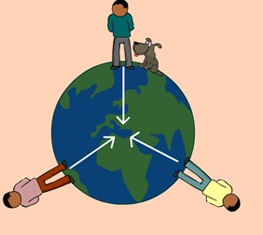
The force that pulls things toward earth.
a)
Speed
b)
Gravity
3.
What will cause an object to move?
a)
Applied forces
b)
Balanced forces
c)
Unbalanced forces
4.

If the net force is equal to zero, the forces acting on the object are

a)

balanced

b)

unbalanced

5.
Balanced forces do not change the objects speed or 
a)
direction
b)
distance 
c)
time
d)
mass
6.
The unit of force is
a)
m/s
b)
m/s^2
c)
newton
d)
kg
7.
Forces that have a net force of zero ( the object is still).
a)
Balanced force
b)
Unbalanced force
8.
What is the net force?
a)
5000 N right
b)
4000 N right
c)
40 N left
d)
4000 N left
9.
What is the net force in this picture?
a)
50 Newtons to the right
b)
950 Newtons to the right
c)
950 Newtons to the left
d)
50 Newtons to the left
10.
What will cause an object to move?
a)
Applied forces
b)
Balanced forces
c)
Unbalanced forces
11.
What are balanced forces?
a)
Forces in the same direction
b)
Forces of the same size
c)
forces of the same size in opposite directions
12.
The force that opposes the motion of two surfaces sliding past each other is called ___________.
a)
acceleration
b)
inertia
c)
friction
d)
unbalanced
13.
What is the unit of force?
a)
Kilogram
b)
Meter
c)
Pascal
d)
Newton
14.
What force brings the pencil down?
a)
Applied
b)
Magnetic
c)
Normal
d)
Gravitational
15.
What happens when two north poles of a magnet are placed together?
a)
they repel
b)
they attract
c)
they cancel each other out
d)
the strength of the magnet is doubled
16.
What is the name of the units that we measure force in?
a)
Einsteins 
b)
Newtons
c)
Kg
d)
Metres
17.
When two objects rub together, what force do they produce
a)
Gravity
b)
Air resistance
c)
Friction
d)
Water resistance
18.
What is this graph representing?
a)
Constant Speed
b)
Acceleration (speeding up)
c)
Deceleration (slowing down)
d)
No motion
19.
A measurement of how fast an object is moving
a)
Velocity
b)
Speed
c)
Vector
d)
Acceleration
20.
A description of the speed and direction of an object's motion
a)
Velocity
b)
Speed
c)
Acceleration
d)
Vector
21.
Can be measured in seconds (s)
a)
Distance
b)
Time
c)
Speed
d)
Acceleration
22.
What is velocity?
a)
the quickness of an object
b)
the location of an object
c)
acceleration
d)
speed in a specific direction
23.
What is speed?
a)
how far you go
b)
how much distance is covered over a period of time
c)
how fast you accelerate
d)
the change in the location of a object
24.
The correct equation to calculate speed is
a)
distance/time
b)
time/distance
c)
distance x time
d)
distance/time2
25.
What is velocity?
a)
the quickness of an object
b)
the location of an object
c)
acceleration
d)
speed in a specific direction
26.
What is speed?
a)
how far you go
b)
how much distance is covered over a period of time
c)
how fast you accelerate
d)
the change in the location of a object
27.
Total distance divided by total time is
a)
average speed
b)
constant speed
c)
instantaneous speed
d)
acceleration
28.
An archer pulls the bowstring back, then releases the string and the arrow flies forward. Pulling the string back is the...
a)
action force
b)
reaction force
c)
net force
d)
inertia
29.
A cannonball with a mass of 0.5 kg is flying at an acceleration of 10 m/sec/sec. What is it's force?
a)
50 Newtons
b)
5 Newtons
c)
20 Newtons
d)
9.5 Newtons
30.
A cannonball with a mass of 10 kg is flying at an acceleration of 5 m/sec/sec. What is it's force?
a)
50 Newtons
b)
5 Newtons
c)
20 Newtons
d)
9.5 Newtons
31.
Gravity is increased with...
a)
greater mass & shorter distance
b)
greater mass & farther distance
c)
lower mass & shorter distance
d)
lower mass & farther distance
32.

Weight is a force that depends on mass and:

a)

friction

b)

gravity

c)

magnetism

d)

energy conservation

33.

Luka pushes a box across the floor in the direction shown by the arrow in the diagram below:


The direction of the friction force acting on the box is:

a)

up

b)

down

c)

left

d)

right

34.
When forces are _________ the object DOES NOT move.
a)
unbalanced
b)
balanced
c)
heavy
d)
light
35.
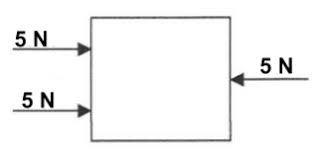
Calculate the net force.
a)
5 N
b)
10 N
c)
45 N
d)
500 N
36.
Units for Mass
a)
kg
b)
N
c)
m/s^2
d)
m/s
37.
What is the net force?
a)
17 N Right
b)
3 N Right
c)
3 N Left
d)
17 N Left
38.
What is force?
a)
A push exerted on an object
b)
A push or pull exerted on an object
c)
A pull exerted on an object
d)
Nothing
39.
What force holds the planets in motion around the sun?
a)
Magnetic
b)
Electrical
c)
Gravitational
d)
Air Resistance
40.

Which statement is true about balanced and unbalanced forces?

a)

Neither balanced or unbalanced forces cause motion

b)

Balanced forces can either have no motion or have an object moving at a constant speed

c)

Unbalanced forces do not change motion and balanced forces change motion

41.
Forces can change the ________ of a moving object.
a)
direction
b)
push
c)
pull
d)
friction
42.
When forces are ___________ the object will move.
a)
unbalanced
b)
balanced
c)
light
d)
gravity
43.
Forces that happen between objects that touch are called _____________.
a)
magnetism
b)
gravity
c)
slippery
d)
contact forces
44.
The measure of the pull of gravity on an object is its ___________.
a)
force
b)
volume
c)
height
d)
weight
45.
There is very little friction between ____________ or slippery surfaces.
a)
smooth
b)
rough
c)
hard
d)
soft
46.
Is this and example of a balanced or unbalanced force?
a)
balanced
b)
KITTIES!
c)
unbalanced
d)
pshhh
47.
What is the net force?
a)
5000 N right
b)
4000 N right
c)
40 N left
d)
4000 N left
48.
What is the net force?
a)
40 N left
b)
0 N Balalnced
c)
400 N right
d)
40 N right
49.
What is the net force
a)
10 N
b)
0 N
c)
25 N
d)
1 N
50.

What is the value of acceleration due to gravity?

a)

10m/s2

b)

9.8m/s2

c)

100m/s2

d)

980m/s2

51.
Energy stored in atomic bonds that form molecules
a)
Thermal Energy
b)
Chemical Energy
c)
Electrical Energy
d)
Electromagnetic Energy
52.
Energy of moving particles of atoms that make up all  matter. 
a)
Thermal Energy 
b)
Chemical Energy 
c)
Electrical Energy 
d)
Electromagnetic Energy 
53.
Energy stored in the nucleus of an atom, released when protons or neutrons are added to or removed from the nucleus 
a)
Chemical Energy 
b)
Electrical Energy 
c)
Mechanical Energy 
d)
Nuclear Energy 
54.

Energy that is stored is called...

a)

Kinetic Energy

b)

Potential Energy

c)

Mechanical Energy

d)

Thermal Energy

55.
At what position does the pendulum have the greatest gravitational potential energy?
a)
Position D
b)
Position C
c)
Position B
56.
At what position does the pendulum have the greatest kinetic energy?
a)
Position D
b)
Position C
c)
Position B
57.

When you eat fruits and vegetables, chemical bonds are releasing stored energy, this is...

a)

a. thermal energy

b)

b. sound energy

c)

c. electrical energy

d)

d. chemical energy

58.

Energy in the form of motion.

a)

mechanical energy

b)

potential energy

c)

kinetic energy

d)

momentum

59.

The ability to do work or cause change:

a)

work

b)

energy

c)

momentum

d)

power

60.

Stored energy in the form of position or condition.

a)

potential energy

b)

kinetic energy

c)

momentum

d)

mechanical energy

61.
What is the energy of position or shape that depends on weight and height, also called stored energy?
a)
Energy
b)
Kinetic energy
c)
Potential energy
d)
Sound energy
62.
What is velocity?
a)
the quickness of an object
b)
the location of an object
c)
acceleration
d)
speed in a specific direction
63.

The net force acting on the object is acting _____.

a)

to the right

b)

to the left

c)

up

d)

down

64.

Velocity has both _____ and _____.

a)

mass and direction

b)

speed and acceleration

c)

speed and direction

65.

Is the Net Force balanced or Unbalanced?

a)

Balanced

b)

Unbalanced

66.

When a student runs and kicks a ball, they have applied an ___________ force to move the ball.

a)

Balanced

b)

Magnetic

c)

Spring

d)

Unbalanced

67.

The __________ between the sole of you shoe and the floor keeps you from slipping.

a)

friction

b)

gravity

c)

acceleration

d)

motion

68.
For every action, there is an equal and opposite reaction.
a)
Newton's
1st
Law of Motion
b)
Newton's
2nd
Law of Motion
c)
Newton's
3rd
Law of Motion
69.
F=ma
a)
Newton's
1st
Law of Motion
b)
Newton's
2nd
Law of Motion
c)
Newton's
3rd
Law of Motion
70.
Newton's First Law of Motion, Inertia, is dependent on
a)
the speed of an object 
b)
the gravitational attraction on an object
c)
the elevation of an object
d)
the mass of an object
71.
Frictions acts in the direction _____to the direction of the object's motion.
a)
Perpendicular
b)
Parallel
c)
Opposite
d)
Diagonal
72.
What is Sliding Friction?
a)
Opposes submarines in the water and airplanes in the air
b)
Opposes the dirrection of an 0bject as it slides over a surface
c)
None of the above
d)
Change in shape the point of rolling contrast because of friction
73.
What is Newton's First Law
a)
F=ma
b)
Every action has an equal and opposite reaction
c)
An object at rest stays at rest, an object in motion stays in motion. 
d)
Friction 
74.
Which one is balanced?
a)
top
b)
bottom
c)
both
75.
What is Newton's Third Law?
a)
Object in motion stays in motion and an object at rest stays at rest unless acted on by a outside force
b)
Force = mass x acceleration
c)
For every action there is an equal and opposite reaction
76.
What is gravity?
a)
A force
b)
Energy
c)
A push
d)
All of them
77.
What is the net force on the block? (click on the words to view the picture)
a)
5 Newtons up
b)
5 Newtons down
c)
15 Newtons up
d)
15 Newtons down
78.
If these boys are pulling with the same amount of force.  What will happen?
a)
The boy in blue will win.
b)
They will not move at all.
c)
The boy in red will win.
d)
Both will fall down.
79.
<--------8N  4N-------->
a)
2N
b)
12N
c)
4N
d)
32N
80.
-------->17N  17N<--------
a)
0N
b)
17N
c)
34N
d)
49N
81.
-------->6N  12N------->
a)
  6N
b)
  18N
c)
  72N
d)
2N
82.
If these boys are pulling with the same amount of force, is it a balanced or an unbalanced force?
a)
Balanced force
b)
Unbalanced force
83.
A picture is hanging on a wall and does not move.
a)
Newton's 1st Law
b)
Newton's 2nd Law
c)
Newton's 3rd Law
d)
None of them
84.
For every action there is an equal and opposite reaction.
a)
Newton's 1st Law
b)
Newton's 2nd Law
c)
Newton's 3rd Law
d)
None of them
85.
a push or pull is
a)
mass
b)
force
c)
inertia
d)
gravity
86.
a force that brings a body towards the center of the earth or another body having mass
a)
friction
b)
inertia
c)
gravity
d)
distance
87.
What is acceleration a change in?
a)
velocity
b)
inertia
c)
gravity
d)
force
88.
the amount of matter in an object
a)
velocity
b)
gravity
c)
meters
d)
mass
89.
The rate at which something is moving.
a)
Speed
b)
Velocity
c)
Average Speed
d)
Constant Speed
90.
Balanced or Unbalanced
a)
balanced
b)
unbalanced
91.
Balanced or unbalanced?
a)
balanced
b)
unbalanced
92.
By creating unequal forces on an object there will be a change in 
a)
attract
b)
force
c)
gravity
d)
motion
93.

Pushing in a chair is an example of...

a)

gravitational force

b)

applied force

c)

normal force

d)

friction force

94.

What is the magnitude and direction of the force in the free body diagram shown?

a)

70 N right

b)

70 N left

c)

50 N right

d)

50 N left

95.

What is the magnitude and direction of the force in the free body diagram shown?

a)

20 N, no change in motion

b)

20 N right

c)

20 N left

d)

0 N , no change in motion

96.

What is the magnitude and direction of the force in the free body diagram shown?

a)

2000 N forward

b)

800 N backward

c)

1200 N forward

d)

2800 N forward

97.

What is the magnitude and direction of the force in the free body diagram shown?

a)

35 N right

b)

17 N right

c)

11 N right

d)

5 N right

98.

What is the magnitude and direction of the force in the free body diagram shown?

a)

5 N down

b)

0 N, no change in movement

c)

15 N up

d)

15 N down

99.

When an object is moving, friction acts in the _______ direction as the motion.

a)

perpendicular

b)

same

c)

opposite

d)

precise

100.
Which of the following is always true?
a)
Fnet = ma
b)
Fnet = m + a
c)
Fnet = m - a
d)
Fnet = m/a
101.

What is energy?

a)

moving energy

b)

stored energy

c)

renewable energy

d)

The ability to do work.

102.

What is potential energy?

a)

moving energy

b)

stored energy

c)

renewable energy

d)

non renewable energy

103.

What is kinetic energy?

a)

moving energy

b)

potential energy

c)

stored energy

d)

renewable energy

104.

What is NOT a renewable energy source?

a)

coal

b)

wind

c)

solar

d)

water

105.

Which is NOT a non-renewable energy source?

a)

coal

b)

oil

c)

wind

d)

gas

106.

Energy cannot be created or destroyed.

a)

True

b)

False

107.

What is nuclear energy?

a)

Energy in the nucleus of an atom

b)

Energy in the particles of an object

c)

Energy that is carried by electromagnetic waves

d)

Energy in a system of objects

108.

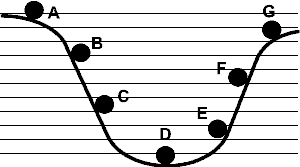
At which point does the ball has the greatest gravitational potential energy (GPE)?

a)

A

b)

G

c)

D

d)

C

e)

G

109.

____________ is the ability to do work.

a)

Energy

b)

Force

c)

Friction

d)

Motion

110.

You throw a ball into the air as shown in the diagram. At what point does the ball have the most gravitational potential energy?

a)

W

b)

X

c)

Y

d)

Z

111.

At which point on the roller coaster is the gravitational potential energy the greatest?

a)

W

b)

X

c)

Y

d)

Z

112.

Which of these is not a source of chemical energy?

a)

Spaghetti

b)

The Sun

c)

Battery

d)

Petrol

113.

Which type of energy is stored energy?

a)

Potential Energy

b)

Kinetic Energy