wayground logo

Free Printable Worksheets

Font size

S
M
L
XL
Worksheets

Physics mid-term exam

Total questions: 110

Worksheet time: 2hrs 51mins

Name
Class
Date
1.

Units of Force (F)

a)

s

b)

kg

c)

m

d)

N

2.

Units of mass (m)

a)

s

b)

N

c)

kg

d)

kg m/s

3.

Units of velocity (v)

a)

m/s2

b)

m/s

c)

N

d)

kg m/s

4.

Units of acceleration (a)

a)

m/s

b)

kg

c)

m/s2

d)

N

5.

Units of energy (KE, PE, EE)

a)

kg

b)

J

c)

kg m/s

d)

m/s2

6.

Units of work (W)

a)

J

b)

W

c)

kg m/s

d)

m

7.

Units of power (P)

a)

kg

b)

N

c)

m

d)

W

8.

A train travels 25 km in 0.5 hrs. How fast is the train going?

a)

25 miles/hr

b)

5 miles/hr

c)

125 km/hr

d)

50 km/hr

9.
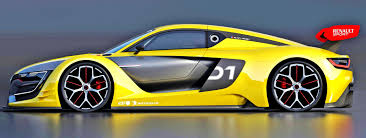
Mr. Rudman drives his race car for 4 hrs at 150 miles/hr. How far will he travel?
a)
600 km
b)
60 miles
c)
6 miles
d)
600 miles
10.
If a robot chases you down at a speed of 900 m/s for a distance of 200 m. How long has the robot been chasing you?
a)
0.22 s
b)
4.5 s
c)
180000 s
11.
How far will a person go if they jog for 2 hours at a speed of 12 km/hr?
a)
6 km
b)
0.5 km
c)
10 km
d)
24 km
12.
A speed boat travels 200 miles at a speed of 20 miles/hr. How much time will it take to travel the 200 miles?
a)
10 hrs
b)
10 miles
c)
400 hrs
d)
100 km
13.
A car travels 300 km in 6 hours. What is the average speed of the car (in km/hr)?
a)
0.02 km/hr
b)
1,800 km/hr
c)
50 km/hr
d)
50 km
14.

In each of the following cases, determine where the car has no acceleration?

a)

A car speeds up after a stoplight turns green.

b)

A car slows down as it approaches a red light

c)

A car with the cruise control set at 80 km/h going down a straight highway

d)

A car turning a curve at a constant speed

15.
A negative acceleration means that your object is _____. 
a)
not accelerating
b)
not moving
c)
speeding up 
d)
slowing down 
16.
A box sliding down an inclined plane attains a velocity of 27 m/s in 3 seconds from rest.  Find the acceleration.
a)
30 m/s
b)
24 m/s2
c)
9 m/s2
d)
81 km/hr
17.
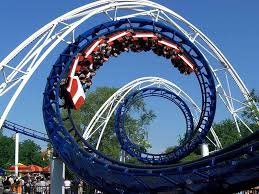
A roller coasters accelerates from an initial velocity of of 6.0 m/s to a final velocity of 70 m/s over 4 seconds.  What's the acceleration?
a)
24 m/s2
b)
18 m/s2
c)
16 m/s2
d)
16 m/s
18.
A ball of clay is thrown at a wall at a velocity of 28.0 m/s.  After it hits the wall, it takes 0.020 s to stop.  What is the acceleration of the clay when it hits the wall?
a)
1400 m/s2
b)
-1400 m/s2
c)
0.56 m/s2
d)
-0.56 m/s2
19.
Billy was driving his car and when he reached the tollbooth he slowed from 190m/s to 12m/s in 20 second.
a)
-8.9m/s²
b)
8.9m/s²
c)
9.8m/s²
d)
-9.8m/s²
20.
The speed boats speed increased from 0m/s to 24m/s in a time span of 12 seconds.
a)
4 m/s²
b)
2 m/s²
c)
8 m/s²
d)
6 m/s²
21.
A wagon goes 35 meters and accelerates to 60 meters in 5 seconds. What was the wagon’s acceleration?
a)
25 m/s²
b)
30 m/s²
c)
6 m/s²
d)
5 m/s²
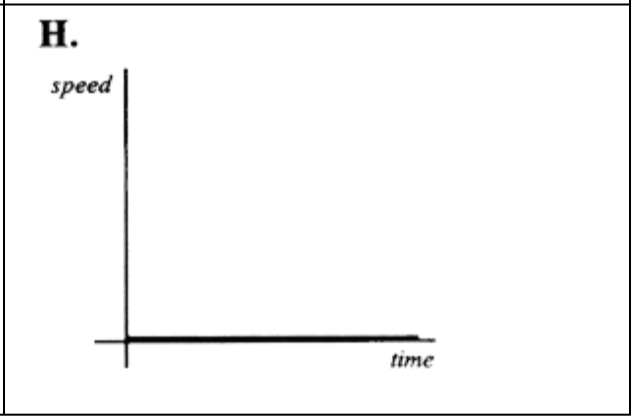
22.

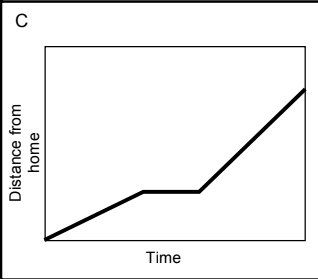
Match the description to the graph:

"The car is stopped."

a)
b)
c)
d)
23.

Match the description to the graph:

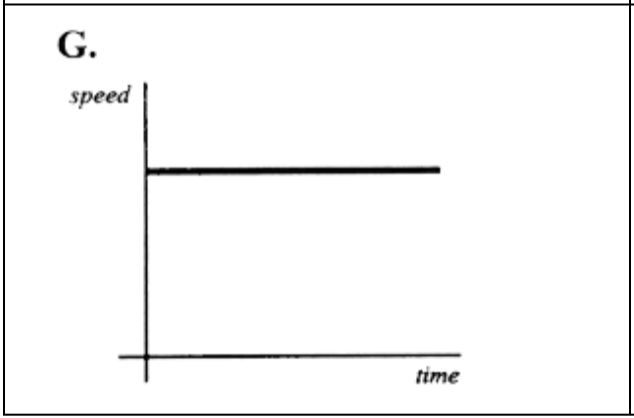
"The car is traveling at a constant speed."

a)
b)
c)
d)
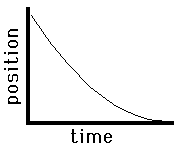
24.

Match the description to the graph:

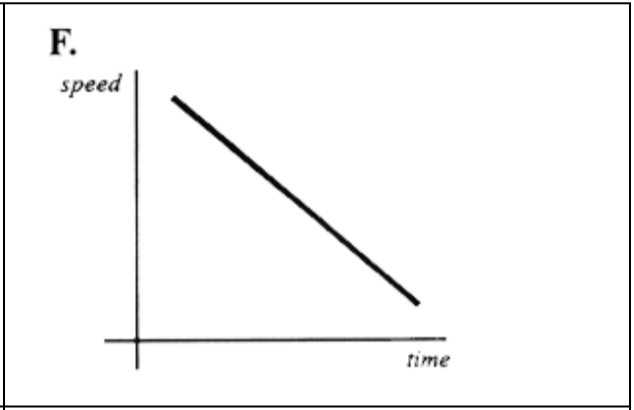
"The speed of the car is decreasing."

a)
b)
c)
d)
25.

Which runner stopped for a rest?

a)

Albert

b)

Bob

c)

Charlie

26.

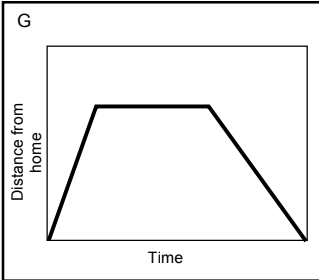
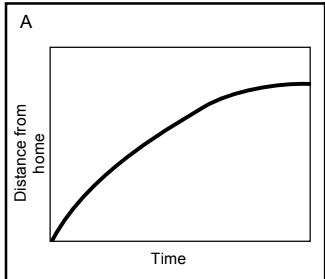
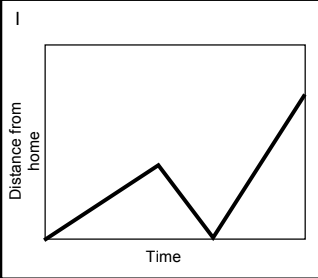
Susie went to the store, when she got there she realized that she forgot her wallet and returned home.


Which graph matches this motion?
a)
b)
c)
d)
27.
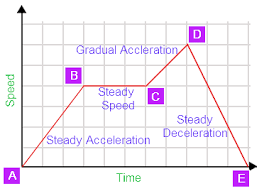
What is happening at D?
a)
Stationary
b)
Accelerating
c)
Fast steady speed; moving away from the starting position
d)
Slower steady speed; moving away from the starting position
28.

At what point is the speed the greatest?

a)

C-D

b)

B-C

c)

A-B

d)

D-E

29.

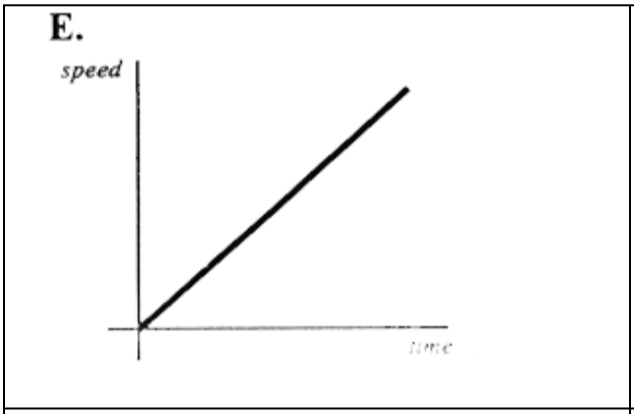
Match the graph to the description:

"The car is traveling at a constant speed."
a)
b)
c)
d)
30.

Match the graph to the description:

"The car is accelerating."

a)
b)
c)
d)
31.

A car has an oil drip that drops every second. What is happening to the motion of the car shown above?

a)

Car is moving with a constant velocity

b)

Car is accelerating or speeding up

c)

Car is decelerating or slowing down

d)

Car is changing directions

32.
What is the speed of this object at 3 seconds?
a)
5 m/s
b)
45 m/s
c)
5 s/m
d)
45 s/m
33.

Describe the motion

a)

Slow to fast; Negative direction

b)

Fast to slow; Negative direction

c)

Fast to slow; Positive direction

d)

Slow to fast; Positive direction

34.
Balanced or unbalanced?
a)
balanced
b)
unbalanced
35.
The sum of all forces acting on an object.
a)
Contact Force
b)
Balanced Force
c)
Unbalanced Force
d)
Net Force
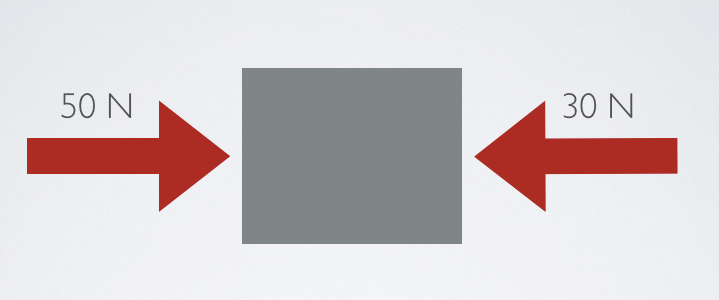
36.
How will this object move? 
a)
It won't move. 
b)
It will move to the right. 
c)
It will move to the left. 
d)
It will move up. 
37.
What is the net force?
a)
30 N left
b)
25 N right
c)
5 N left
d)
55 N right
38.
Calculate the Net Force. 
a)
40N, Left
b)
40N, Right
c)
0N, Balanced
d)
75N, Right
39.

What are force vectors?

a)

shows the net force of an object

b)

show the mechanical energy of an object

c)

shows the direction and size of the force

d)

shows the way an object reflects light

40.

Which of the answer choices is not an characteristic of a balanced force?

a)

no change in motion

b)

moving at a constant speed

c)

net force of zero

d)

causes a change in motion

41.

What is the net force of this object?

a)

400 F arrow downward

b)

400 F arrow upward

c)

800 F arrow upward

d)

800 F arrow downward

42.
What is Newtons 1st law of motion?
a)
Force= Mass multiplied by acceleration 
b)
An object at rest stays at rest unless acted on an unbalanced force. (inertia)
c)
For every action there is a equal and opposite  re-action.
d)
law of gravity 
43.
What is Newtons 2nd law of motion?
a)
Pancakes 
b)
Force= Mass multiplied by acceleration
c)
For every action there is a equal and opposite  re-action.
d)
Law of gravity 
44.
What law of motion does this picture represent?
a)
Newtons 1st law
b)
Newtons 4th law 
c)
Newtons 3rd law 
d)
Newtons 2nd law
45.
A net force of 15 N is exerted on an encyclopedia to cause it to accelerate at a rate of 5 m/s2. Determine the mass of the encyclopedia?
a)
 m = 3.0 kg
b)
m = 4.0 kg 
c)
m = 3.0 ml 
d)
m = 30.0 g
46.
For every action there is a equal and opposite...
a)
action
b)
movement 
c)
re-action 
d)
Newtons law of inertia 
47.
What Newtons law does this picture represent
a)
Newtons 2nd law 
b)
Law of gravity 
c)
Newtons 1st law
d)
Newtons 5th law
48.
Mass is a measure of an object's inertia. Objects with greater mass have a greater inertia; objects with less mass have less inertia.
a)
true 
b)
false 
49.
The swimmer moves her hand down and to the left and her body goes forward to the right.
a)
Newton's 1st Law
b)
Newton's 2nd Law
c)
Newton's 3rd Law
50.

the tendency of an object to resist a change in its motion

a)

acceleration

b)

inertia

c)

mass

d)

frame of reference

51.
If a 10 kilogram object accelerates suddenly at 15 m/s^2, how much force was applied to the object?
a)
150 Newtons
b)
15 Newtons
c)
150 kilograms
d)
100 kilograms
52.
If a force of 50 Newton's was applied to an object with a mass of 500 grams, what will the object's acceleration be?
a)
10 m/s^2
b)
.1 m/s^2
c)
100 m/s^2
d)
1 m/s^2
53.

Mass = 4 kg and a = 0.2 ms2. Calculate the force.

a)

8N

b)

80 N

c)

2 N

d)

0.8N

54.

Why does a car accelerate faster with just the driver, compared to driver + 3 passengers?

a)

Car and driver has less mass than car, driver + 3 passengers

b)

Car and driver has more mass than car, driver + 3 passengers

c)

Car has less friction (drag)

d)

Car is accelerating faster

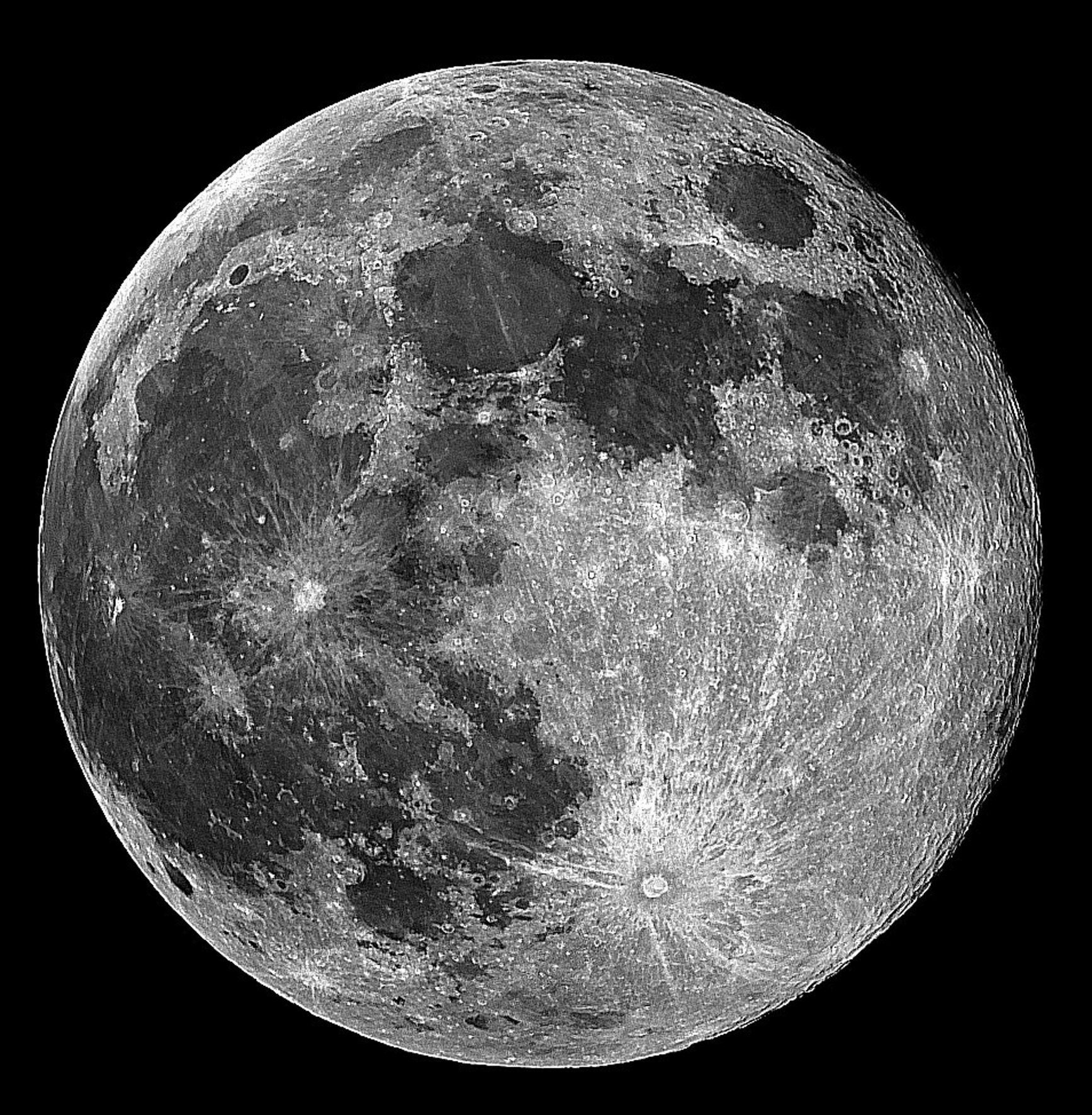
55.
Why would you weigh less on the moon compared to Earth?
a)
less air
b)
less sunlight
c)
more gravitational pull
d)
less gravitational pull
56.
What is the definition of "weight"?
a)
measure of the force of gravity on your body
b)
the time it takes to get on a ride 
c)
the amount of matter in an object
d)
the size of an object
57.
The mass of an object ___________ as it moves away from the center of Earth
a)
stays the same
b)
decreases
c)
increases
d)
doubles
58.
The masses of four objects are given in this table. If all objects are struck with the same amount of force, which one will have the greatest acceleration?
a)
Object 1
b)
Object 2
c)
Object 3
d)
Object 4
59.

If your mass is 35 kg on Earth, what would you weigh on Mars (g = 3.7 m/s2)? W=mg

a)

120 N

b)

130 N

c)

120 kg

d)

130 kg

60.
A child has a mass of 30 Kg on Earth. If the gravity on Moon is one sixth that of the Earth what is the mass of the child on Moon? 
a)
30 Kg
b)
180 Kg
c)
5 Kg
d)
0 Kg
61.

Which statement is correct about the mass of the chair on the earth and moon?

a)

mass is greater on the moon

b)

mass is less on the moon but not equals to zero

c)

mass is zero on the moon

d)

mass is the same on the moon

62.
What is the best definition for mass?
a)
how much space an object takes up
b)
how much matter an object contains
63.
19,000 g = ___ kg
a)
19
b)
18
c)
17
64.
Wind blowing at 20 mph.Vector or scalar?
a)
Scalar
b)
Vector
65.
A deer running 15 meters per second due west.Vector or scalar?
a)
Scalar
b)
Vector
66.
 Amy runs 2 miles south, then turns around and runs 3 miles north. What is displacement?
a)
5 miles
b)
1 mile 
c)
2 miles south
d)
1 mile north 
67.

Another word for "size" is...

a)

magnification

b)

magnetism

c)

magnitude

d)

magnanimity

68.

Select the scalar quantities.

a)

velocity

b)

distance

c)

energy

d)

acceleration

e)

speed

69.
This is speed in a specific direction.
a)
Velocity
b)
Motion
c)
Position
70.

What is energy?

a)

moving energy

b)

stored energy

c)

renewable energy

d)

The ability to do work.

71.

What is potential energy?

a)

moving energy

b)

stored energy

c)

renewable energy

d)

non renewable energy

72.
Which of the following types of energy are types of potential energy?
a)
Elastic, nuclear, gravitational and chemical
b)
Gravitational and light
c)
Elastic and wind
d)
Chemical, sound and light
73.

The Sun produces ______ and ______ energy

a)

thermal, light

b)

chemical, sound

c)

kinetic, light

74.

The principle of energy conservation states:

a)

Energy can be created but not destroyed

b)

Energy cannot be created, nor destroyed.

c)

Energy can be destroyed but not created

75.

What is the energy transformation that occurs in an electric pencil sharpener?

a)

mechanical energy to electrical energy

b)

electrical energy to mechanical energy

c)

radiant energy to sound energy

d)

chemical energy to mechanical energy

76.

Which object shows an energy transformation from electrical to mechanical?

a)
b)
c)
d)
77.
Which items would have this energy transformation: electrical energy -> thermal energy and light energy?
a)
toaster
b)
candle burning
c)
windmill turning
d)
Iron for your clothes
78.
Gravitational potential energy depends on the ________ and ________ of the object. 
a)
Height and mass
b)
Friction and movement
c)
Mass and Movement
d)
Height and Friction 
79.

At which point does the ball has the greatest gravitational potential energy (GPE)?

a)

A

b)

G

c)

D

d)

C

e)

G

80.

Which would have the LEAST gravitational potential energy (GPE)?

a)

A ball sitting on the ground

b)

Moon viewed from the Earth

c)

An airplane flying 30,000 feet above the ground

d)

A rock sitting on top of Mt. Everest

81.

At which position does the child on the swing have the most gravitational potential energy?

a)

W

b)

X

c)

Y

d)

Z

82.

1. Determine the gain in gravitational potential energy when a 4.00 kg block is raised 18.00 m.

Gravity is 9.8m/s.

ROUND TO THE WHOLE NUMBER.

NO COMMAS

(a)  

83.

1. An owl has a mass of 4.00 kg. It dives to catch a mouse from a height of 20m How much GPE does the owl gain?


Use Gravity as 9.8m/s.

a)

784 J

b)

80 J

c)

800 J

d)

392 J

84.

Lilly's cat ran through your yard. The cat has a mass of 5 kg. He is running at a speed of 3 m/s. What is the kinetic energy of the cat as he runs? (KE = 1/2mv2)

a)

8.5 J

b)

45 J

c)

7.5 J

d)

22.5 J

85.

Alice kicks a soccer ball with a mass of 2.1 kg. The ball leaves the ground moving 30 meters per second. What is the kinetic energy of the soccer ball? (KE = 1/2mv2)

a)

567 J

b)

900 J

c)

945 J

d)

30 J

86.

A 5 Kg body is having a Kinetic energy of 250 J. What is the velocity (or speed) of the body?

a)

10 m/s

b)

15 m/s

c)

20 m/s

d)

40 m/s

87.

What is the mass of a ball that has a kinetic energy of 115 J and is traveling at a speed of 9 m/s?

a)

1035 kg

b)

23.5 kg

c)

12.8 kg

d)

2.84 kg

88.

A exercise ball is on a table 2.5 m above the ground. What is the mass of the ball if it has a GPE of 56.8 J?

a)

71 kg

b)

22.72 kg

c)

142 kg

d)

2.32 kg

89.

A cheetah can run briefly with a speed of 31.0 m/s. Suppose a cheetah with a mass of 47.0 kg runs at this speed. What is the cheetah’s kinetic energy?

a)

1457 Joules

b)

22,584 Joules

c)

15 Joules

d)

45,167Joules

90.
What would have the greatest kinetic energy?
a)
A car driving down a hill.
b)
A person running down a hill. 
c)
A ball rolling down a hill. 
91.

Where would this tossed baseball have the greatest amount of kinetic energy?

a)

point W

b)

point X

c)

point y

d)

point z

92.

if you push a cart with a force of 60 N for 2 m... how much work have you done

a)

120 J

b)

30 J

c)

120 N

d)

30 N

93.

If 40N of force is applied to Rollo Koster's 10 kg cart over a distance of 50 meters, how much work is done?

a)

8000J

b)

8000N

c)

4000J

d)

2000J

94.

Two people push on a wall with 100 N. The wall doesn’t move. How much work is done?

a)

100J

b)

100N

c)

0J

d)

0N

95.
You do 90 joules of work in 30 seconds. How much power have you generated?
a)
30 watts
b)
3 watts
c)
120 watts
d)
270 watts
96.

You move a 8 N object five meters in 4 seconds. How much power have you generated?

a)

160 watts

b)

10 watts

c)

6.4 watts

d)

17 watts

97.
How much work is done in holding a 15 N sack of potatoes while waiting in line at the grocery store for 3 minutes?
a)
15 J
b)
45 J
c)
0 J
d)
5 J
98.

Check all of the things that can affect power

a)

Work

b)

Time

c)

Force

d)

Distance

99.
If 150 Joules of work is needed to move a box 10 meters, what force was used? 
a)
1500 N
b)
15 N
c)
1.5 N
d)
150 N
100.

What is an example of a force?

a)

Energy

b)

Power

c)

Pressure

d)

Weight

101.
Describe the motion at point a. on the graph.
a)
constant speed
b)
accelerating
c)
decelerating
d)
stationary
102.
If this was the journey of a parachutist, what is happening at point e. ?
a)
He is decelerating
b)
He is accelerating
c)
He has reached a faster constant speed
d)
He has reached a lower constant speed. 
103.

The graph shows the vertical speed of a parachutist. At which point did they open the parachute?

a)

A

b)

B

c)

C

d)

D

104.

Identify true statements:

a)

The parachutist has just left the plane

b)

Weight is increasing

c)

There is no drag

d)

Weight is constant

e)

Deceleration

105.

Identify true statements:

a)

The parachutist opens their parachute

b)

Deceleration

c)

Terminal velocity

d)

Weight is increasing

e)

Drag is constant

106.

Which diagram shows the forces acting on Peter when he is falling at Terminal Velocity?

a)

1

b)

2

c)

3

107.

Just after she jumps out of the plane (before the parachute opens). The net force will be

a)

zero

b)

upward

c)

downward

108.

what is the relationship between mass of object and distance between objects..

a)

mass increase, gravitational force increase

b)

mass increase, gravitational force decrease

c)

mass decrease, gravitational force increase

109.

If two objects increase their distance, it _________ the gravitational pull between the two objects

a)

increases

b)

decreases

c)

has no effect on

d)

eliminates

110.

Two spherical objects have masses of 8000 kg and 1500 kg. Their centers are separated by a distance of 1.5 m. Find the gravitational attraction between them

a)

5.4 X 10⁻⁴ N

b)

1.2 X 10⁷ N

c)

3.6 X 10⁻⁴ N

d)

5.33 N