
 Worksheets
Physics - Semester 1 Final Exam
Total questions: 109
Worksheet time: 3hrs 48mins
What is the difference between science and technology?
Science is a method of answering theoretical questions; technology is a method of solving practical problems
These two words describe basically the same thing.
Science is more fun
How does the rate of progress differ today from the rate in previous centuries?
Even not so long ago, great things could take more than a century to build
Progress in our age is much quicker than it was thousands of years ago
Some people working on spaceships today were born before jet airliners
All of these answers
Objects move only when force is exerted.
True
False
Air resistance is caused by friction between the air and an object moving through the air.
True
False
The speed of an object dropped in air will continue to increase without limit until it strikes the ground.
True
False
If the force acting on a cart doubles, what happens to the cart's acceleration?
it quadruples
it doubles
it halves
it quarters
A girl whose weight is 200 N hangs from a bar supported by two strands of rope. What is the tension from each strand?
400N
300N
200N
100N
A tennis ball and a solid steel ball the same size are dropped at the same time. IN the absence of air resistance, which ball has the greater acceleration?
the tennis ball
the steel ball
nonsense! they both have the same acceleration

speed =
2ending time − starting time
timedistance
Δt
distance x time
Free fall
is falling without accelerating
is an object moving under the influence of gravity only
involves air resistance
is falling at a constant speed
An object is moving if
it's on a bus
its position relative to a fixed point is changing
it's heavier than air
Which one of these is not a law of motion?
What goes up must go down.
An object's velocity remains constant unless an outside force acts upon it.
F=ma
Every force has an equal and opposite force.
A real car moving at 10 km/h has more momentum than a toy car moving at the same rate because ______.
its mass is greater
its mass is less
it moves faster
of friction
Newton's Second Law of Motion can be summarized by which equation?
M = F/a
F = ma
F = m/a

If each object is moving at the same velocity which will have the least momentum?
Baseball
Bowling Ball
Golf Ball
Tennis Ball


According to Newton's Laws, for every action there is an ....
equal and opposite reaction.
equal and parallel reaction.
unequal and opposite reaction.
unequal and unrelated reaction.
Pretend that you are in a car and not wearing a seatbelt. What might happen to you if the driver slammed on the brakes?
You would move sideways
You would move towards the front windshield
You would stay in your seat

Looking at the image. Decide if this is balanced or unbalanced.
Unbalanced
Balanced
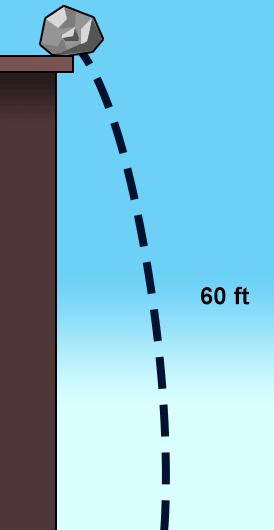
The rock in the picture is pushed over the edge and it begins to fall. Which type of energy conversion is taking place?
mechanical to heat
sound to mechanical
potential to kinetic
kinetic to potential

How does the mass of a bowling ball that has been rolled down the lane affect the kinetic energy?
The kinetic energy does not depend on the mass of the bowling ball.
The kinetic energy is increasing proportional to the mass of the bowling ball.
The kinetic energy is decreasing proportional to the mass of the bowling ball.
The kinetic energy is increasing proportional to the square of the mass of the bowling ball.

When gasoline is burned in a car engine, ________ energy is converted into _________ energy.
heat, chemical
chemical, potential
mechanical, chemical
chemical, mechanical

Muscles convert chemical energy into
light energy.
nuclear energy.
mechanical energy.
electromagnetic energy.

Energy cannot be created or destroyed. It can only be changed from one form to another. This is known as the law of conservation of ___________:
mass
energy
temperature

What energy conversion is taking place in this picture?
solar energy to thermal energy
thermal energy to chemical energy
chemical energy to thermal and light energy

What can you say about the potential energy of the two sleds shown above?
Sled B has more potential energy.
There is not enough information to know which sled has more potential energy.
The two sleds have the same potential energy.
Sled A has more potential energy.
Why does a soccer ball eventually stop rolling once it’s kicked on a grassy field?
none of these
Gravity acts upon it.
Light acts upon it.
Friction acts upon it.

What is a PUSH or PULL of an object?
Motion
Force
Friction
Gravity

What pulls a ball back to earth?
Gas
Gravity
Friction
Molecules

_______ is a force that acts between two objects which are touching. This force slows any movement between the two objects.
pressure
magnetism
friction

What surface would probably offer the least friction if you were to slide a box across it?


1. It is easier to ride a bicycle down a hill than to ride up a hill because _______ helps the bicycle move down the hill.
gravity
friction
rotation
the tendency of an object to resist a change in its motion
acceleration
inertia
mass
Objects with greater _________ also have greater inertia.
speed
mass
friction
When are you undergoing an acceleration in a car?
speed up
slow down
make turns
All of the above

Which law of motion does this picture illustrate?
1st Law
2nd Law
3rd Law


An astronaut floating alone in space throws a baseball. If the ball floats away at a speed of 20 m/s, the astronaut will
move at a higher speed in the opposite direction
move at a lower speed in the opposite direction
move in the opposite direction at a speed of 20 m/s
An object that has kinetic energy must be
in an elevated position
falling
at rest
moving
A ball rolling down an incline has its maximum speed at
the top
the exact middle
the bottom
difficult to predict without knowing the slope of the incline





What happens when you increase the amplitude of a sound?
it makes the sound louder
it makes the sound travel faster
it makes the sound softer
it changes the pitch or note of the sound
What can electromagnetic waves travel through (select all that apply)?
solids
empty space
liquids
gases
Which measurement can be identified by the unit K (Kelvin)?
Temperature
Volume
Pressure
Mass
Which measurement can be identified by the unit L (Liters)?
Temperature
Volume
Pressure
Mass
If a ball thrown straight up into the air takes 4 seconds to reach the top (peak), how long will it take to travel from the peak back to the original position?
0s
1s
3s
4s
A ball thrown straight up takes 8 total seconds to complete its journey all the way up and down. 1 second into its journey and 7 seconds into its journey the magnitude of its velocity will be ______________ and its direction _______________.
opposite, the same
the same, opposite
the same, the same
opposite, opposite
The initial horizontal velocity of a projectile is ____ its final horizontal velocity.
less than
equal to
greater than
What is true about the vertical velocity of a projectile launched horizontally?
It is initially at its maximum value.
It increases due to gravity as it falls.
It remains constant throughout its trajectory.
It decreases as it falls due to gravity.
If two projectiles are launched at two different heights, 2m and 10m, which one will reach the ground first?
2m
10m
they both will hit the ground at the same time
Which hits the ground first if they start at the same height: a dropped ball or a ball launched with a
horizontal velocity?
the launched ball
the dropped ball
they both hit at the same time
What is the velocity of an object launched straight up at its highest point?
zero
equal to its vx
½ its maximum value
equal to gravity
The path followed by a projectile is also known as its
trajectory
range
height
vertical displacement
Once a projectile is launched, what is the only force that affects its motion?
mass
friction
inertia
gravity
Which of the following would NOT be considered a projectile?
A cannonball fired towards a distant castle.
A cannonball rolling down a slope.
A cannonball fired straight outward from a castle wall.
A cannonball after it rolls off the edge of a cliff.


Is displacement a vector or scalar quantity?
Vector
Scaler

What's the sum of the vectors?
50 N -->
50 N <--
350 N -->
350 N <--

What's the sum of the vectors
13N -->
13 N <--
113 N -->
113 N <--
What is the x-component of the vector 24 N @ 30 degrees below the +x?
+24*cos30
-24*cos30
+24*sin30
-24*sin30
What is the x-component of the vector 24 N @ 30 degrees below the +x?
+24*cos30
-24*cos30
+24*sin30
-24*sin30
What is the magnitude of the vector whose x-component is -9m and y-component is -5m?
7.5 m
10.3 m
27 m
106 m
(a) is a measure of how close measurements come to each other when they are made in the same way.

Student A
Student B
Student C
Cannot be determined
How close a measurement is to the accepted value is called (a) .
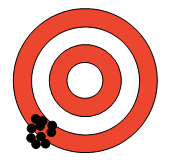
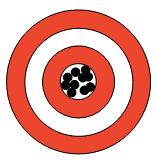
This bullseye demonstrates...
High Accuracy & High Precision
High Accuracy & Low Precision
Low Accuracy & High Precision
Low Accuracy & Low Precision
A student's measured length during a science experiment was 12.00 cm. The actual size was 14.25 cm.
What was the percent error?
*Hint: You now know how to calculate error, and you should know how to calculate a percent, so put the two together to find this answer.
15.79%
18.75%
2.25%
Jessie estimates the weight of her cat to be 8 pounds. The actual weight of the cat was 10 pounds.
What was the percent error?
*Hint: You now know how to calculate error, and you should know how to calculate a percent, so put the two together to find this answer.
15%
20%
25%
30%
Which is the more precise measurement?
4 mL
4.3 mL
4.30 mL
4.300 mL

Describe the accuracy and precision of the image
Very accurate and somewhat precise
Very accurate but not precise at all
Not accurate at all but very precise
not accurate and not very precise
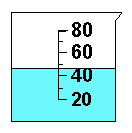
Based on the markings of this beaker, what is the estimated volume?
48 mL
48.2 mL
48.25 mL
0.04 L
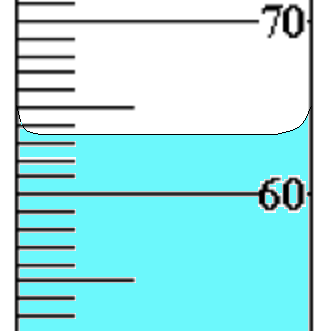
Based on the markings of this graduated cylinder, what is the estimated volume?
63.5 mL
63 mL
63.55 mL
0.063 L

This image is a great example of...
precision
accuracy

Which Student is the most Precise?
Alex
Shandra
Luis
A set of data are all close in value to each other, but they are not close to the actual value. This set of data can be described as _________________.
precise
accurate
A set of data are all close to each other, and they are close to the actual value. This set of data can be described as...
accurate
precise
Engineers must be able to clearly communicate their solution process and their proposed solution. When problem solving requires measurements and/or calculations, engineers must take care to ….
use clear definitions
state the meaning of variables
be careful about specifying units
calculate accurately
express answers with a degree of precision appropriate for the problem context
If the precision of your answer is specified, you should report your answer to that level of precision. However, if the required precision of the answer is not given (specified), what are the things to consider when deciding the number of digits to report (precision) when reporting a calculated value?
Common sense
The most precisely measured value used
Accepted convention
The targeted rule
The least precisely measure value used
Every measurement is only a(n) (a) of the true value of the quantity.
In this problem 2(9.8 in. +12.53 in.) = the answer should be.
44.0
44.7
44.6
44.66
45.00
Reporting a calculated measurement, and you are reporting it to the appropriate precision, what is the number one thing to NOT forget?
*Hint: It's one word.
(a)

