
 Worksheets
Unit 1 Review
Total questions: 112
Worksheet time: 1hrs 20mins


The change in the wavelength of light due to an object moving away from the observer.
Big Bang Theory
Blue Shift
Red Shift
Violet Shift
The displacement of the spectrum to shorter wavelengths in the light coming from distant celestial objects moving toward the observer.
Big Bang
Blue Shift
Red Shift
Violet Shift
Hubble's observations suggested not only is everything moving away from everything else but that all matter has taken the same amount of time to get where it is today. This best explains which:
The Universe is expanding
Galaxies are moving away from us.
Galaxies are moving toward us.
A and B
Research proved the universe still expanding; proved galaxies exist outside of the milky way; classification system for galaxies; hubble telescope named after him
Albert Einstein
Edwin Hubble
Fred Hoyle
Penzias and Wilson
Which term best describes conditions a few seconds after the Big Bang took place?
frigid
scorching
liquid
placid
What is one major piece of evidence that the Big Bang theory is correct?
astronomers have detected leftover radiation from the Big Bang
everything in the universe has remained the in same location for billions of years
astronomers have detected that the universe is no longer expanding
astronomers have detected that the universe is contracting
Which theory is used to explain the formation of the universe?
Big Bang Theory
Heliocentric Theory
Geocentric Theory
Creation Theory
What is a Scientific Theory?
A prediction of what will happen in an experiment.
A summary of what you found in your experiment.
An explanation of something that happens in nature that is backed up by results of many tests and experiments.
A statement that can never be proven wrong.
What is the evidence that the Universe is expanding?
first galaxies were 200 million years ago
radio telescopes
Red Shift
the Universe is not expanding
An example of the "Doppler Effect" Red Shift of Light would be which of the following?
Energy is found in the universe
A police siren sounds different when it moves away from us
Satallites orbit the Earth
The Sun goes through an eclipse
Why is Hydrogen and Helium so important when we talk about evidence of the Big Bang?
it is components of the Sun
they were the 1st elements from following the Big Bang
their on the Periodic Table
they created atoms following the Big Bang
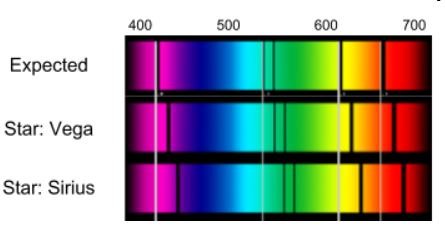

This image describes:
The redshift.
The CMB.
The distribution of each element in the universe.
The amount of time the universe has existed.
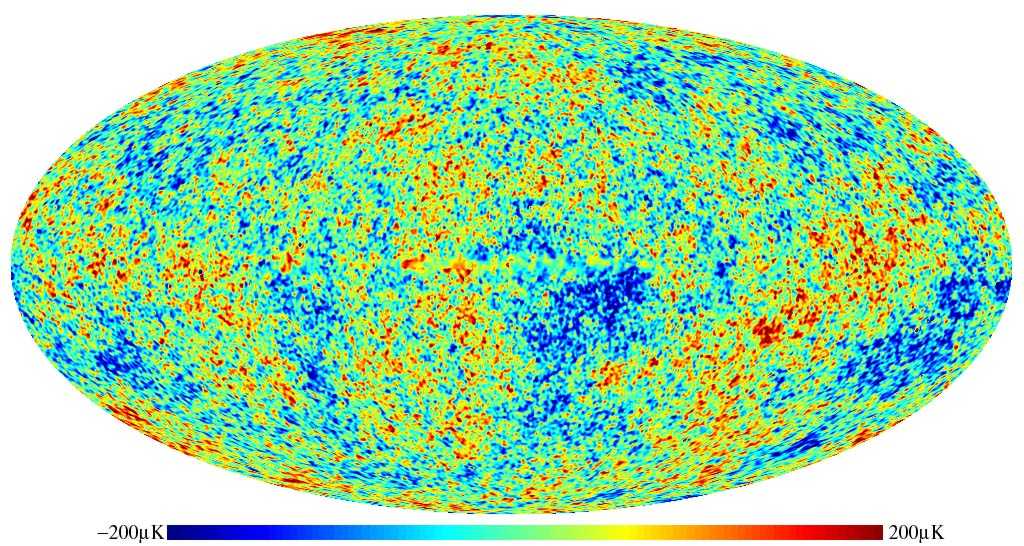
The observation that light from galaxies appears red supports the theory that...
The universe is expanding
The universe is shrinking
Galaxies are moving towards the Earth
Sound waves are moving away from the Earth
Which is NOT true? Cosmic Microwave Background Radiation is...
Is evidence for the Big Bang
Is leftover energy from the start of the universe expansion
Something that heats up our food
Something that was first discovered by accident
The universe being composed of 74% hydrogen and 25% helium is evidence of the Big Bang Theory.
True
False

In red shift, the wavelengths of light become
Longer
Shorter
Bluer
Slower

The specific wavelengths of electromagnetic radiation emitted by the electrons of atoms or molecules as those electrons return to a lower and more stable energy state
particle ionization
electron spectrum
emission spectra

A unit of length equal to the distance that light travels through space in one year.
Leap Year
Light-Year
Frequency

A reaction in which two light nuclei combine to produce a nucleus of heavier mass, resulting in the release of a large amount of energy.
Nuclear Bomb
Nuclear Fusion
Nuclear Fission

The explosion of a massive star at the end of its life cycle
Galaxy
Milky Way Galaxy
Supernova
Universe
The Big Bang Theory states that all matter started as a small volume and then...
expanded in all directions
contracted even smaller
caused an atomic explosion
burned up and exploded
all of the choices here.
The Big Bang Theory explains the formation of the...
Earth
Sun
Universe
Solar System
The big bang is described as...
a destructive explosion.
a sudden expansion.
a rapid contraction.
Hubble's Law describes that the galaxies that are the farthest away from us are...
moving away the fastest.
moving toward us the fastest.
not moving at all.
disappearing.
Which of the following is true of the Big Bang Theory
It is a theory because it has no scientific evidence.
It is also known as the slow expansion theory.
It is supported by many different kinds of scientific evidences.
It is not a theory, but actually a law.

Galaxies that are REDSHIFTED are:
actually BLUE
really NEAR earth
invisible or not visible
moving AWAY from us.

If something that makes light is moving AWAY from you, it spreads the wavelengths of light out. This application of the Doppler effect is known as ___.
blue shift
green shift
red shift
black shift

A galaxy showing BLUE SHIFT is ___.
very cold
moving TOWARDS OR TO us
dying
about to supernova
How is the "Big Bang" described?
an explosion
an expansion
a contraction
A light year is the (a) light can travel in one year.
The Universe is comprised of 74% _____________________.
Oxygen
Helium
Hydrogen
Nitrogen
The Universe is comprised of 25% _____________________.
Oxygen
Helium
Hydrogen
Nitrogen
The doppler effect is the change in the frequency of waves emitted by a moving object. When the waves being emitted by the object are LIGHT waves, the change in frequency results in a change in __________.
Brightness
Heat
Pitch
Color
A light wave with a higher frequency is going to...
have a lower wavelength
appear red
have a higher wavelength
Move much slower
In regards to sound waves, the doppler effect is going to change the frequency of the wave, resulting in a change in __________.
color
volume
pitch
size
Hydrogen was the first element to be formed after the big bang, because...
It is the simplest element
the temperature at that time was just right for hydrogen
It is used as fuel for stars
it was chosen completely at random
350,000 years after the big bang, gravity pulled all the hydrogen atoms into big balls of gas that ignited under pressure, creating the first __________.
Stars
Planets
Amoebas
Light

A stellar nebula is made up of...
clouds of gas
clouds of gas and dust
stars
planets
Our sun is known as a middle-aged, stable star. Also known as a ____________________.
Gas Giant
Nebula
Pulsar
Main Sequence Star
What is a celestial body that is composed of gas and emits light from nuclear fusion reactions?
Nebula
Star
Galaxy
Planet


What star phase happens when an average star expands its outer layers to increase in size and luminosity (brightness)?
Neutron star
White Dwarf star
Red Giant star
Black Hole

Which category of stars are very hot, but not very bright?
Blue Giants
Red Giants
White Dwarfs
Red Supergiants
Massive stars life cycles come to a close with an explosive Supernova phase which leads to which two outcomes?
A black hole and a neutron star
A black hole and a Red Supergiant
A pulsar and a main sequence star
A planetary nebula and a new planet

What type of star is the Sun classified as?
A red giant star
A red supergiant star
A neutron star
A main sequence star
Most stars of lower mass are more stable, and more common in our universe. These average stars are known as...
Main Sequence stars
White Dwarfs
Red Giants
Pulsars

A collection of gas and dust where new stars are born is known as a...
Planetary Nebula
Black Hole
Supernova
Stellar Nebula
The remnants of a Red Giant star after shedding its outer layers are the _______________ and ________________.
Planetary Nebula and a White Dwarf
Neutron Star and a Pulsar
Neutron Star and a Black Hole
Stellar Nebula and a Main sequence star

Which star would be very hot and very bright?
Rigel
Sirius
Alpha Centauri B
Betelgeuse

Which of the following pieces of information are given by an H-R diagram? Check all that apply.
Temperature of the star
Color of the star
Planets around the star
Location of the star

Which group of stars is not very hot, but is extremely bright?
White Dwarfs
Blue Giants
Red Supergiants
Main Sequence

Which category of star is the Sun found in on an H-R Diagram?
Red Giants
Main Sequence
Blue Giants
White Dwarfs
What determines the life cycle path that a star will take?
Mass of the star
Temperature of the star
Location of the star
Speed of a star's rotation
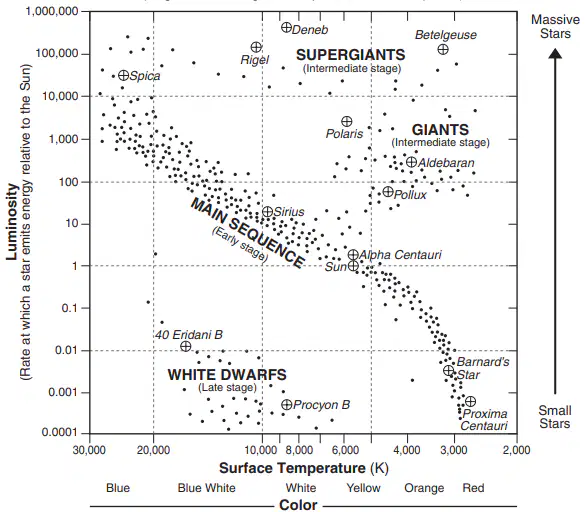
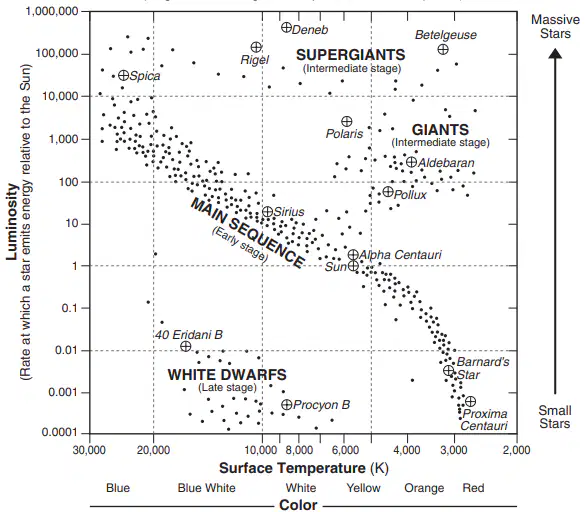
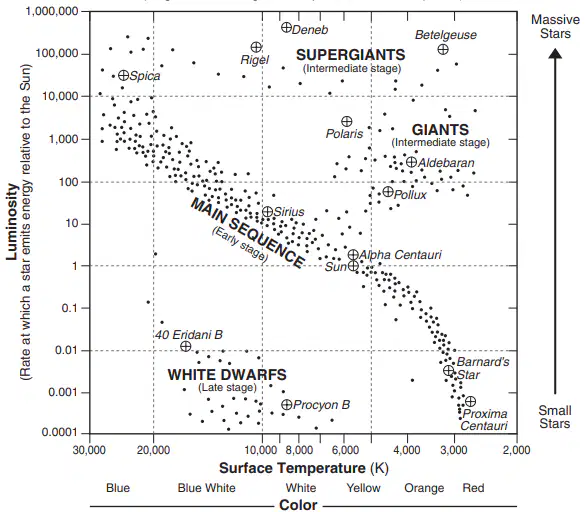
What color is Deneb?
white
red
yellow
blue or blue white
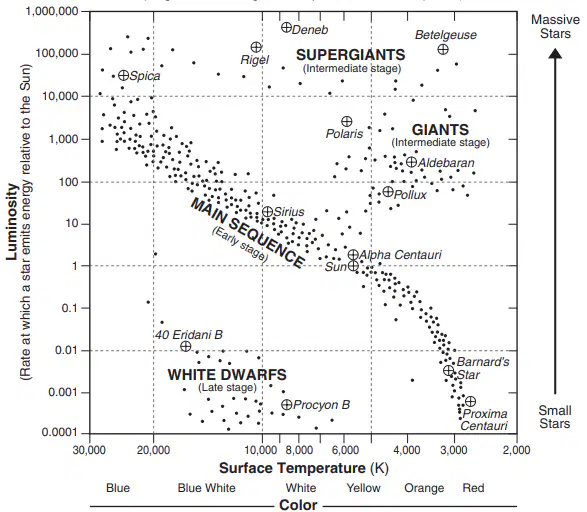
What temperature is Barnard's star?
~ 5000 C
~ 6000 C
~ 3000 C
~ 4000 C
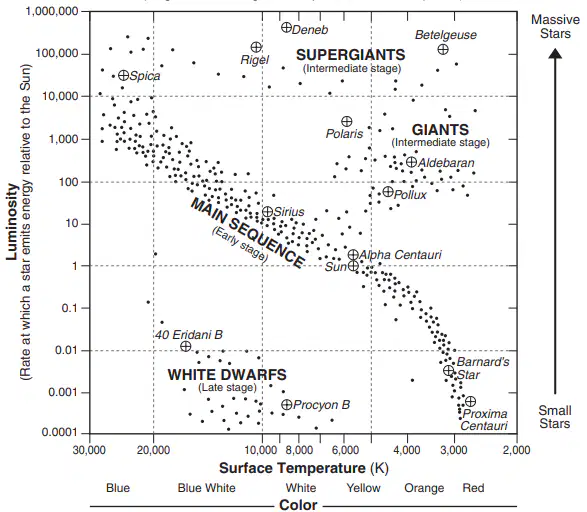
What color are the coolest stars?
blue
white
yellow
red
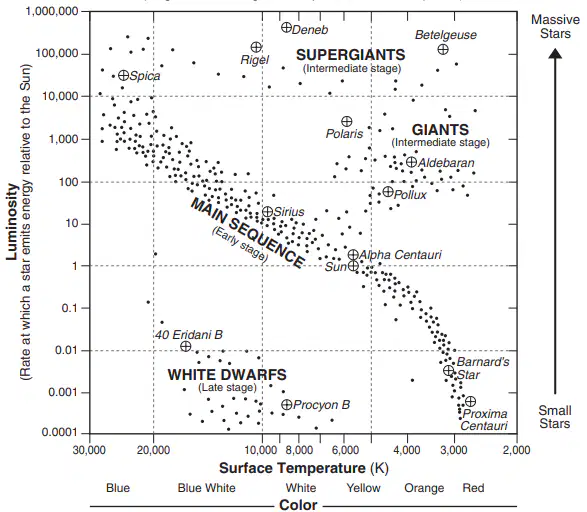
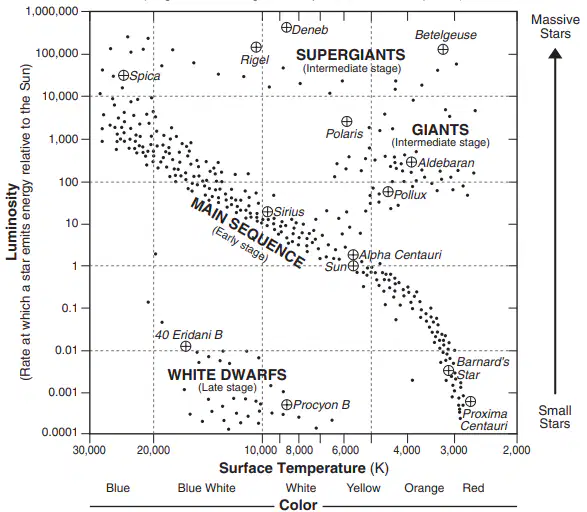
Compared to our Sun, the star Betelgeuse is
smaller, hotter, and less luminous
smaller, cooler, and more luminous
larger, hotter, and less luminous
larger, cooler, and more luminous

Which list shows stars in order of increasing temperature?
Barnard’s Star, Polaris, Sirius, Rigel
Procyon B, Alpha Centauri, Polaris, Betelgeuse
Aldebaran, the Sun, Rigel, Procyon B
Rigel, Polaris, Aldebaran, Barnard’s Star
Composition means:
The size of a star
What a star is made of
How much light energy a star makes
A light year (LY) is used by scientists to measure what?
Energy
Time
Distance
Temperature

In the diagram given, what happens as we move from the right side to the left?
Stars Get Larger
Stars get Cooler
Stars get Hotter

