wayground logo

Free Printable Worksheets

Font size

S
M
L
XL
Worksheets

Wind

Total questions: 109

Worksheet time: 1hrs 21mins

Name
Class
Date
1.

What causes wind?

a)

differences in air pressure

b)

differences in gravity

c)

difference in oxygen

d)

differences in the thermosphere

2.

What causes differences in air pressure?

a)

even heating of the Earth

b)

Even cooling of the earth

c)

uneven heating of the earth

d)

global warming

3.
Which statement correctly defines wind?
a)
Wind is the movement of air from areas of low pressure to areas of high pressure
b)
Wind is the movement of air to a colder area in the atmosphere.
c)
Wind is the movement of air from areas of high pressure to areas of low pressure.
d)
Wind is the movement of air pushed around and bouncing off Earth's surface.
4.
Why does warm air rise?
a)
Warm air is more dense than cooler air.
b)
Warm air has more pressure than cooler air.
c)
Warm air is less dense than cooler air.
d)
Warm air has a higher dew point than cooler air.
5.

Air is warmer and less dense at the equator because the equator receives more____________________.

a)

wind

b)

solar radiation

c)

air pressure

d)

condensation

6.

In the Northern Hemisphere, winds traveling north appear to curve east because of the:

a)

trade winds

b)

convection currents

c)

Coriolis effect

d)

polar easterlies

7.
The Coriolis effect is the curving of wind across Earth. What causes winds to curve?
a)
Earth's revolution
b)
Earth's magnetic field
c)
Earth's rotation
d)
Earth's gravitational pull
8.
Use the diagram to determine which statement is correct.
a)
The air at location 3 is more dense than the air at location 6.
b)
The air at location 2 is rushing in to take the place of the colder air at location 3.
c)
Location 1 heats up and cools down slower than location 7.
d)
High pressure air at location 2 is taking the place of the low pressure air at location 3.
9.
In which direction do prevailing westerlies flow?
a)
from east to west
b)
from west to east
c)
from north to south
d)
from south to north
10.
The tropical winds running from 0 to 30 degrees latitude are called:
a)
subtropical westerlies
b)
polar westerlies
c)
trade winds
d)
polar winds
11.
Wind belts are always named according to...
a)
how strong they are
b)
what temperature they are
c)
where they blow to
d)
where they come from
12.
The wind belts that surround the equator cause large amounts of hot air to rise and converge together causing what type of weather?
a)
rain
b)
dry
c)
snow
d)
clear skies
13.

Middle latitudes that border the equatorial region are characterized by

a)

dry, descending air

b)

hot, humid air

c)

heavy rain

d)

warm, low pressure

14.
Wind is caused mainly by air pressure differences that result from...
a)
a. uneven heating of the Earth's atmosphere.
b)
b. absorption of ultraviolet radiation by Earth's land masses.
c)
c. radiation of heat from Earth's land masses to water bodies.
d)
d. rotation of Earth on its axis.
15.
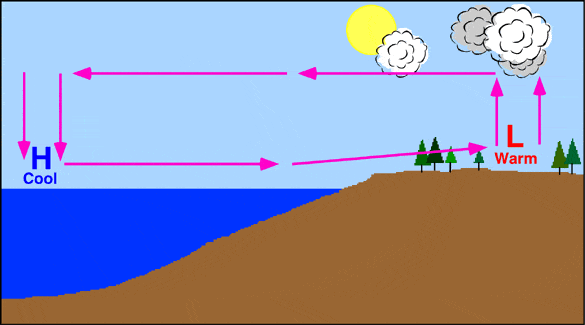
What kind of breeze is this & what time of day/night would it form?
a)
Land breeze - daytime
b)
Land breeze - nighttime
c)
Sea breeze - daytime
d)
Sea breeze - nighttime
16.
Which statement correctly defines wind?
a)
Wind is the movement of air from areas of low pressure to areas of high pressure
b)
Wind is the movement of air to a colder area in the atmosphere.
c)
Wind is the movement of air from areas of high pressure to areas of low pressure.
d)
Wind is the movement of air pushed around and bouncing off Earth's surface.
17.
Where does the initial source of energy come from that creates winds?
a)
the moon
b)
the sun
c)
the Earth's surface
d)
the rotation of the Earth
18.
Land and water absorb and release the sun’s heat in different ways. One result of this is a sea breeze. Which statement is true of sea breezes?
a)
They originate in the day and blow toward the land.
b)
They originate in the day and blow toward the water.
c)
They originate in the evening and blow toward the land.
d)
They originate in the evening and blow toward the water.
19.
Which term is best described as the movement of air from land to sea?
a)
global winds
b)
sea breeze
c)
land breeze
d)
local winds
20.
What causes global winds and convection in the atmosphere? 
a)
continental deflection
b)
the rotation of the Earth
c)
Moon's gravity
d)
unequal heating of the Earth by the sun
21.
The Coriolis effect causes ___________.
a)
the Earth to rotate on its axis
b)
continental deflection
c)
global winds and surface currents to move in a curved path instead of a straight line
d)
global winds and deep ocean currents to move in a curved path instead of a straight line.
22.
What impact does the Coriolis effect have upon global winds in the northern and southern hemispheres?
a)
Global winds blow counterclockwise in the northern hemisphere and clockwise in the southern hemisphere.
b)
Global winds blow clockwise in the northern hemisphere and counterclockwise in the southern hemisphere.
c)
Global winds flow clockwise in both the northern and southern hemispheres.
d)
The Coriolis effect has no impact upon global winds in the northern and southern hemispheres.
23.
The curving of air to the right in the Northern hemisphere is caused by ___________ and is called the _________ effect.
a)
Earth's rotation...Coriolis
b)
Earth's revolution...Coriolis
c)
Earth's rotation...Doppler
d)
Earth's revolution...Doppler
24.

Moving _________ is called wind

a)

rain

b)

force

c)

vapor

d)

air

25.

What is the name of this weather tool?

a)

Wind thine

b)

Wind vane

c)

Wind barometer

d)

Anemometer

26.

Does this picture show wind?

a)

Yes

b)

No

27.

Does this picture show wind?

a)

Yes

b)

No

28.

Kevin sees some leaves moving on the ground. Why are they moving?

a)

Monsters

b)

Wind

c)

Sun energy

d)

Wind vane

29.

What does this tool measure?

a)

Wind direction

b)

Wind speed

c)

Wind power

30.

What does this tool measure?

a)

Wind speed

b)

Wind direction

c)

Wind strength

31.

What does this tool measure

a)

Wind speed

b)

Wind direction

c)

Wind speed and direction

d)

Wind power

32.

What is the name of this tool?

a)

Wind sock

b)

Wind vane

c)

Anemometer

d)

Thermometer

33.

What is the name of this tool?

a)

Anemometer

b)

Wind vane

c)

Windsock

d)

Thermometer

34.

What is an object that cannot be moved by wind?

a)

Leaf

b)

Empty box

c)

Large rock

d)

Paper towel

35.

Where can you find air

a)

Only when the wind blows

b)

Really high in the sky

c)

All around us

d)

Only in space

36.

Tammy wants to know which direction the wind is blowing so her hair stays pretty. Which wind tool should Tammy use?

a)

Anemometer

b)

Wind vane

c)

Thermometer

37.

This bottle does not have any soda inside. What material is inside this bottle?

a)

Nothing

b)

Air

c)

Light

d)

Water

38.

Which tool is used to measure wind?

a)
b)
c)
d)
39.

What clue can you observe in the photo to let you know if it is windy outside?

a)

The sky is blue

b)

The clouds are large

c)

The palm fronds are moving in different directions

40.

Which one can measure wind's direction?

a)

1

b)

2

c)

3

41.

Which one can measure wind's speed?

a)

1

b)

2

c)

3

42.
A meteorologist predicts what the weather will be tomorrow.  The meteorologist is _________.
a)
planning an experiment
b)
controlling the weather
c)
acting on a tv show
d)
making a forecast
43.

What causes wind?

a)

differences in air pressure

b)

differences in gravity

c)

difference in oxygen

d)

differences in the thermosphere

44.

What causes differences in air pressure?

a)

even heating of the Earth

b)

Even cooling of the earth

c)

uneven heating of the earth

d)

global warming

45.

Local winds blow over:

a)

short distances

b)

long distances

c)

the poles

d)

the equator

46.
Which is NOT a characteristic of local winds?
a)
They occur within a small area.
b)
Land and sea breezes are examples.
c)
They blow over short distances.
d)
They blow steadily over long distances.
47.
Which is NOT a characteristic of local winds?
a)
They occur within a small area.
b)
Land and sea breezes are examples.
c)
They blow over short distances.
d)
They blow steadily over long distances.
48.
What is responsible for warming the Earth’s surface and creating wind?
a)
The Moon
b)
Earth's interior (inside)
c)
Coriolis effect
d)
The Sun
49.
Which statement correctly defines wind?
a)
Wind is the movement of air from areas of low pressure to areas of high pressure
b)
Wind is the movement of air to a colder area in the atmosphere.
c)
Wind is the movement of air from areas of high pressure to areas of low pressure.
d)
Wind is the movement of air pushed around and bouncing off Earth's surface.
50.
How does the air move in a land breeze?
a)
From east to west
b)
From west to east
c)
From the land to the ocean
d)
From the ocean to the land
51.
Is this a land or a sea breeze?
a)
land breeze
b)
sea breeze
52.

During the land breeze, what starts moving the cooler air out and warmer air in?

a)

conduction

b)

convection

c)

radiation

53.

Air at the poles is colder and denser so it_______________.

a)

rises

b)

circulates

c)

stagnates

d)

sinks

54.

Air is warmer and less dense at the equator because the equator receives more____________________.

a)

wind

b)

solar radiation

c)

air pressure

d)

condensation

55.

In the Northern Hemisphere, winds traveling north appear to curve east because of the:

a)

trade winds

b)

convection currents

c)

Coriolis effect

d)

polar easterlies

56.
Which is NOT a characteristic of global winds?
a)
They occur as global wind belts.
b)
They occur within small areas.
c)
They occur over large areas.
d)
They blow steadily over long distances.
57.
The Coriolis effect is the curving of wind across Earth. What causes winds to curve?
a)
Earth's revolution
b)
Earth's magnetic field
c)
Earth's rotation
d)
Earth's gravitational pull
58.
Which diagram shows the formation of a land breeze?
a)
diagram Y
b)
diagram X
c)
neither 
d)
both
59.
Use the diagram to determine which statement is correct.
a)
The air at location 3 is more dense than the air at location 6.
b)
The air at location 2 is rushing in to take the place of the colder air at location 3.
c)
Location 1 heats up and cools down slower than location 7.
d)
High pressure air at location 2 is taking the place of the low pressure air at location 3.
60.

Westerlies travel from ________ to _______.

a)

East to West

b)

West to East

61.

Easterlies travel from ________ to _______.

a)

West to East

b)

East to West

62.

Trade winds travel from ________ to _______.

a)

East to West

b)

West to East

63.

What causes wind?

a)

differences in air pressure

b)

differences in gravity

c)

difference in oxygen

d)

differences in the thermosphere

64.

What causes differences in air pressure?

a)

even heating of the Earth

b)

Even cooling of the earth

c)

uneven heating of the earth

d)

global warming

65.

Local winds blow over:

a)

short distances

b)

long distances

c)

the poles

d)

the equator

66.

Sea breezes occur?

a)

during the day

b)

during the night

c)

high noon

d)

full moon

67.
Which is NOT a characteristic of local winds?
a)
They occur within a small area.
b)
Land and sea breezes are examples.
c)
They blow over short distances.
d)
They blow steadily over long distances.
68.
What kind of air pressure does COLD air have?
a)
High pressure
b)
Low pressure
69.
What kind of air pressure does WARM air have?
a)
High pressure
b)
Low pressure
70.
What causes wind to blow?
a)
Differences in longitude.
b)
Shock waves from clouds.
c)
Differences in air temperature and pressure.
d)
The rotation of the earth.
71.
What causes warm air to rise?
a)
The fact that it's less dense than cold air.
b)
The fact that it weighs more than cold air.
c)
The fact that it has higher pressure than cold air.
d)
The fact that it's more dense than cold air.
72.
What creates the air pressure difference between the equator and the poles?
a)
The length of the seasons.
b)
The shape of the earth.
c)
More elephants pass gas near the equator.
d)
The amount of direct sunlight each area receives.
73.
If you wanted to visit an area with very little wind, where might you go? 
a)
The doldrums around the equator.
b)
The jet streams in the northern and southern hemisphere.
c)
The North or South Pole.
d)
The area around the Mediterranean Sea.
74.
How do jet streams influence the weather? 
a)
by creating clouds 
b)
by increasing the moisture in the atmosphere 
c)
by quickly moving weather from one area to another very quickly 
d)
by drying out the atmosphere 
75.
Which is these explains how the earth's rotation causes the wind to curve?
a)
jet streams
b)
Coriolis effect
c)
high pressure
d)
westerlies
76.
What is responsible for warming the Earth’s surface and creating wind?
a)
The Moon
b)
Earth's interior (inside)
c)
Coriolis effect
d)
The Sun
77.
Which statement correctly defines wind?
a)
Wind is the movement of air from areas of low pressure to areas of high pressure
b)
Wind is the movement of air to a colder area in the atmosphere.
c)
Wind is the movement of air from areas of high pressure to areas of low pressure.
d)
Wind is the movement of air pushed around and bouncing off Earth's surface.
78.
Is this a land or a sea breeze?
a)
land breeze
b)
sea breeze
79.
What causes wind to blow?
a)
Differences in longitude 
b)
Shock waves from clouds 
c)
Differences in air temperature and pressure 
d)
The rotation of the earth
80.
Which term best describes how the earth's atmosphere is heated?
a)
Spirally
b)
Unevenly
c)
Circularly
d)
Kinetically
81.
When heat rises cools then sinks 
a)
high pressure 
b)
convection current 
c)
low pressure 
d)
stratospheric pressure  
82.
Wind blows from ______ pressure areas to _____ pressure areas.
a)
high; low
b)
warm; cool
c)
cool; warm
d)
low; high
83.
Energy from the uneven heating of the Earth is called  - 
a)
solar
b)
wind
c)
geothermal
d)
biomass
84.
Energy from deep within the Earth is called  ____ energy.
a)
solar
b)
wind
c)
biomass
d)
geothermal
85.
The sun produces energy using _____.
a)
fission
b)
fusion
c)
biomass
d)
geothermal
86.
Energy from the sun is called - 
a)
solar
b)
wind
c)
biomass
d)
geothermal
87.
How does solar energy impact the environment?
a)
none
b)
loss of habitat
c)
air pollution
d)
changing water levels
88.
Where would the best location for solar power be?
a)
Florida
b)
Pennsylvania
c)
Maine
d)
Montana
89.
Which energy source does NOT use turbines?
a)
wind
b)
hydropower
c)
solar
d)
nuclear
90.
Which is NOT an advantage of geothermal power?
a)
renewable
b)
no pollution
c)
you don't have to transport it
d)
geysers and volcanoes are everywhere
91.
Which of the following can NOT trace their original energy source back to the sun?
a)
hydropower
b)
geothermal
c)
wind
d)
solar
92.
Which energy source contributes to air pollution?
a)
hydropower
b)
solar
c)
geothermal
d)
biomass
93.
What causes warm air to rise?
a)
the fact that it's less dense than cold air 
b)
The fact that it weighs more than cold air 
c)
The fact that it has higher pressure than cold
d)
the fact that its more dense than cold air 
94.
What causes wind to blow?
a)
Differences in longitude 
b)
Shock waves from clouds 
c)
Differences in air temperature and pressure 
d)
The rotation of the earth
95.
Which term best describes how the earth's atmosphere is heated?
a)
Spirally
b)
Unevenly
c)
Circularly
d)
Kinetically
96.
What creates the air pressure difference between the equator and the poles?
a)
The length of the seasons
b)
The shape of the earth 
c)
the duration of the solar year
d)
The amount of direct sunlight each area receives 
97.
How are the winds in the northern hemisphere different from winds in the southern hemisphere? 
a)
Winds int he northern hemisphere are deflected right; winds int eh southern hemisphere are deflected left
b)
winds in the northern hemisphere are deflected south; winds in the southern hemisphere are deflected north 
c)
winds in the northern hemisphere are deflected eart; winds in the southern hemisphere are deflected west
d)
winds in the northern hemisphere are deflected left; einds in the southern hemisphere are deflected right 
98.
How are the winds in the northern hemisphere different from winds in the southern hemisphere? 
a)
Winds int he northern hemisphere are deflected right; winds int eh southern hemisphere are deflected left
b)
winds in the northern hemisphere are deflected south; winds in the southern hemisphere are deflected north 
c)
winds in the northern hemisphere are deflected eart; winds in the southern hemisphere are deflected west
d)
winds in the northern hemisphere are deflected left; einds in the southern hemisphere are deflected right 
99.
How are the winds in the northern hemisphere different from winds in the southern hemisphere? 
a)
Winds int he northern hemisphere are deflected right; winds int eh southern hemisphere are deflected left
b)
winds in the northern hemisphere are deflected south; winds in the southern hemisphere are deflected north 
c)
winds in the northern hemisphere are deflected eart; winds in the southern hemisphere are deflected west
d)
winds in the northern hemisphere are deflected left; einds in the southern hemisphere are deflected right 
100.
if you wanted to find the jet steam, where would you go? 
a)
the area around the poles 
b)
the area around the equator 
c)
10 km above the earth's surface 
d)
1 km above the earth's surface 
101.
How do jet streams influence the weather? 
a)
by creating clouds 
b)
by increasing the moisture in the atmosphere 
c)
by moving weather from one area to another very quickly 
d)
by drying out the atmosphere 
102.

What causes wind?

a)

differences in air pressure

b)

differences in gravity

c)

difference in oxygen

d)

differences in the thermosphere

103.

What causes differences in air pressure?

a)

even heating of the Earth

b)

Even cooling of the earth

c)

uneven heating of the earth

d)

global warming

104.
Which statement correctly defines wind?
a)
Wind is the movement of air from areas of low pressure to areas of high pressure
b)
Wind is the movement of air to a colder area in the atmosphere.
c)
Wind is the movement of air from areas of high pressure to areas of low pressure.
d)
Wind is the movement of air pushed around and bouncing off Earth's surface.
105.
Which statement correctly defines wind?
a)
Wind is the movement of air from areas of low pressure to areas of high pressure
b)
Wind is the movement of air to a colder area in the atmosphere.
c)
Wind is the movement of air from areas of high pressure to areas of low pressure.
d)
Wind is the movement of air pushed around and bouncing off Earth's surface.
106.
Why does warm air rise?
a)
Warm air is more dense than cooler air.
b)
Warm air has more pressure than cooler air.
c)
Warm air is less dense than cooler air.
d)
Warm air has a higher dew point than cooler air.
107.

Air is warmer and less dense at the equator because the equator receives more____________________.

a)

wind

b)

solar radiation

c)

air pressure

d)

condensation

108.
The Coriolis effect is the curving of wind across Earth. What causes winds to curve?
a)
Earth's revolution
b)
Earth's magnetic field
c)
Earth's rotation
d)
Earth's gravitational pull
109.
Use the diagram to determine which statement is correct.
a)
The air at location 3 is more dense than the air at location 6.
b)
The air at location 2 is rushing in to take the place of the colder air at location 3.
c)
Location 1 heats up and cools down slower than location 7.
d)
High pressure air at location 2 is taking the place of the low pressure air at location 3.