wayground logo

Free Printable Worksheets

Font size

S
M
L
XL
Worksheets

6th Grade Georgia Science Final Exam Review

Total questions: 106

Worksheet time: 2hrs 46mins

Name
Class
Date
1.

In which layer does convection occur?

a)

a. Core

b)

b. Mantle

c)

c. Crust

d)

d. Ozone

2.

A shadow forms from perfect alignment of the moon between the Sun and the Earth. What is most likely occurring?

a)

a. A lunar eclipse

b)

b. A solar eclipse

c)

c. A season

d)

d. an orbit

3.

Which state of matter has the highest density?

a)

a. Solid

b)

b. Solvent

c)

d. Liquid

d)

d. Gas

4.

Adam picked up a bottle of water from his fridge, it felt cold on his hand. What type of heat transfer was this?

a)

Convection

b)

Conduction

c)

Radiation

d)

Weathering

5.

What type of energy comes from the sun?

a)

Convection

b)

Conduction

c)

Radiation

d)

Light Speed

6.

Two tectonic plates collided. What caused this?

a)

Divergent Boundary

b)

Subduction

c)

Transform Boundary

d)

Convergent Boundary

e)

Godzilla

7.

What is the largest layer of the earth

a)

Inner Core

b)

Mantle

c)

Crust

d)

Outer Core

8.

How is wind caused?

a)

When air movies from areas of high to low pressure

b)

when air movies from areas of low to high pressure

c)

when there is a tornado

d)

when clouds pass by

9.
Heat transfers from an area of ____temperature to an area of ___ temperature.
a)
high to low
b)
low to high
c)
high to high
10.
On a cold rainy day a baby is touching a cold window.  It feels so cold. Which way is the heat moving moving? 
a)
Cold is moving from the window to the hand.
b)
Heat is moving from the hand to the window.
c)
Heat doesn't move.
d)
It moves in currents
11.

The average weather conditions of a region--

a)

daily temperature

b)

weather

c)

climate

12.

Land closer to the equator is

a)

colder.

b)

warmer.

c)

dry.

13.

Two factors that determine climate are

a)

precipitation and temperature.

b)

hurricanes and tornadoes.

c)

humidity and pressure.

14.
A high pressure system means we might have this weather.
a)
Snow blizzard
b)
Sunny and dry
c)
Rain storm
d)
Tornado
15.
A low pressure system means we might have this weather.
a)
Sunny 
b)
A clear sky
c)
Dry day
d)
Stormy or wet
16.
What is an air mass? 
a)
A place where weather always changes in an extreme way.
b)
Air that is wet and freezing
c)
A cloud that produces rain, snow, sleep, or hail.
d)
A large body of air with the same moisture and temperature throughout.
17.
A front is
a)
where warm air is cooling at earth's surface
b)
a line where hot and cold air are separating
c)
a line where two different air masses meet
d)
where cold air is rising and forming rain clouds
18.
Warm air rises and the cool air sinks demonstrates this type of heat transfer. 
a)
conduction
b)
convection
c)
radiation
d)
Insolation 
19.
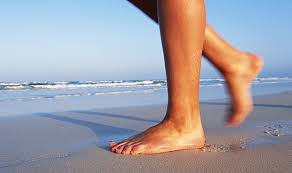
Walking on the warm sand sand with your bare feet demonstrates this type of heat transfer. 
a)
conduction
b)
convection
c)
radiation
20.
A group of friends gather around a fire to stay warm.
a)
conduction
b)
convection
c)
radiation
21.
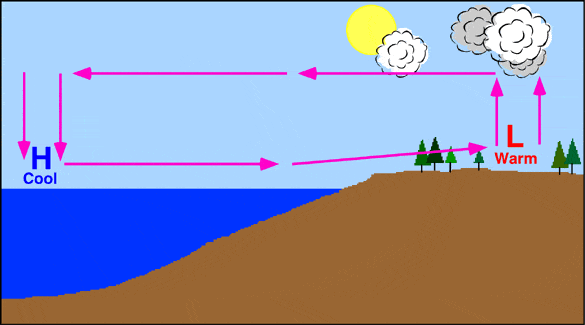
Is this a land or a sea breeze?
a)
land breeze
b)
sea breeze
22.
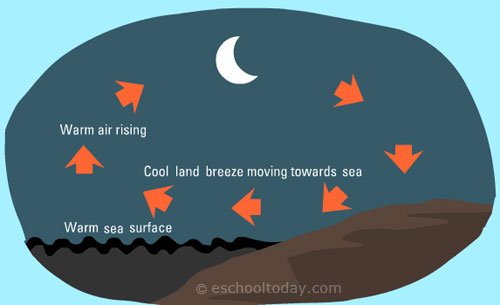
Is this a land or a sea breeze?
a)
land breeze
b)
sea breeze
23.

Which of the following lists the correct order of the planets from the sun?

a)

Mercury, Venus, Mars, Earth, Jupiter, Saturn, Uranus, Neptune

b)

Mercury, Venus, Earth, Mars, Saturn, Jupiter, Uranus, Pluto

c)

Mercury, Venus, Earth, Mars, Jupiter, Saturn, Uranus, Neptune

d)

Mars, Venus, Earth, Mercury, Jupiter, Saturn, Uranus, Neptune

24.

Select all of the following that are considered "inner planets".

a)

Venus

b)

Neptune

c)

Earth

d)

Saturn

25.

Which group of planets are only made of gases and liquids and have no solid surface?

a)

Uranus, Neptune, Saturn

b)

Earth, Mercury, Mars

c)

Neptune, Venus, Jupiter

d)

Mercury, Uranus, Earth

26.

Which group of planets has a terrestrial, or rocky, surface?

a)

Mercury, Venus, Neptune

b)

Saturn, Jupiter, Uranus

c)

Neptune, Earth, Pluto

d)

Venus, Mars, Mercury

27.

Which best describes the inner and outer planets?

a)

the inner planets are gaseous and much closer together than the outer planets

b)

the inner planets are much smaller and more spread out than the outer planets

c)

the outer planets are terrestrial and much further apart than the inner planets

d)

the outer planets are much larger and more spread out than the inner planets

28.

Which planet has a huge storm called "The Great Red Spot"?

a)

Mars

b)

Venus

c)

Jupiter

d)

Mercury

29.

Which planet is the only planet that is able to support life?

a)

Mars

b)

Venus

c)

Earth

d)

Uranus

30.
How long does it take to the Earth to do the ROTATION MOVEMENT?
a)
365 days
b)
24 hours
c)
24 hours + 6 hours
d)
28 days
31.
What is the Moon?
a)
It is a planet
b)
It is a satellite
c)
It is a star
d)
It is a comet
32.
What is the Sun?
a)
It is a satellite
b)
It is a Star
c)
It is a comet
d)
It is a planet
33.

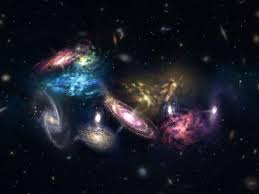
Galaxies are:

a)

gropus of Asteroids

b)

Groups of planets

c)

Groups of stars, gas and dust.

d)

Group of satellites

34.

Which layer of the Earth?

a)

Atmosphere

b)

Hydrosphere

c)

Geosphere

35.

What´s the red planet ?

a)

Mars

b)

Saturn

c)

Venus

36.
Venus is called Earth's twin because they are about the same size
a)
True 
b)
False
37.
The gas giants are different from the terrestrial planets because they
a)
have smaller atmospheres
b)
are less dense
c)
have larger atmospheres
d)
are more colorful
38.
One factor that makes life possible on Earth is
a)
an atmospher
b)
water
c)
greenhouse effect
d)
gravity
39.

Our galaxy is called

a)

Centaurus A

b)

Andromeda

c)

the Milky Way

d)

Triangulum

40.

According to latest theories, the Big Bang happened

a)

3 million years ago

b)

about 13.8 billion years ago

c)

3 billion years ago

d)

4.5 billion years ago

41.

Our Sun is just one of many millions of stars in a froup of stars called a

a)

universe

b)

solar system

c)

cosmos

d)

galaxy

42.

Which scientist was the first to find evidence that the universe is expanding

a)

Albert Einstein

b)

Galileo Galilei

c)

Edwin Hubble

d)

Stephen Hawking

43.

Edwin Hubble's discoveries were so important that he had something named after him.

What was it?

a)

The Hubble bridge

b)

The Hubble satellite

c)

The Hubble space orbiter

d)

The Hubble space telescope

44.

The explosion that sent the universe flying out is called _____.

a)

The Big Bang

b)

The Milky Way

c)

The Solar System

d)

The Sun

45.

Since the Big Bang, and even today, the universe is still _____.

a)

Expanding

b)

Shrinking

c)

Cooking

d)

Spinning

46.

Most scientists believe the Big Bang Theory explains which of the following questions?

a)

How our planets and moons formed

b)

How our universe began

c)

How the sun turns hydrogen into helium

d)

How fast light travels through space

47.

Which statement is true?

a)

The galaxies are moving toward us.

b)

The galaxies are moving away from us.

c)

The universe remains static or unchanged in motion.

d)

None of the above

48.

As galaxies move away from our galaxy

a shift on the electromagnetic spectrum

(EMS) is noticed. This phenomena is

called _____________.

a)

redshift

b)

blueshift

c)

unshift

d)

blackshift

49.

The attractive force between objects is called....

a)

force

b)

Gravity

c)

inertia

d)

motion

50.
The force keeping a planet in orbit around the sun is...
a)
Friction
b)
Tension
c)
Gravity
d)
weight
51.

What prevents planets from drifting off into space and keeps it in the planets in our Solar System?

a)

Gravity

b)

Weight

c)

Friction

d)

Forward Motion

52.
Space and all the matter and energy in it.
a)
Space
b)
Solar System 
c)
Universe
d)
Sun
53.
Which of the following is the largest?
a)
star
b)
universe
c)
cluster
d)
galaxy
54.
Gravity is the force objects put on each other because of their ______.
a)
mass
b)
friendliness
c)
acceleration
d)
speed
55.

What is the biggest difference between the Geocentric Model and the Heliocentric Model?

a)

the shape of the planets' orbits

b)

the movement of the moon

c)

the center of the solar system

56.
This image shows the:
a)
Geocentric Solar System
b)
Heliocentric Solar System
57.

Who came up with this model?

a)

Copernicus

b)

Kepler

c)

Galileo Galilee

d)

Ptolemy

58.

Which scientific instrument did Galileo use to change the world?

a)

telescope

b)

spyglass

c)

mirror

d)

magnifying glass

59.

Which object is the center of the solar system according to Galileo?

a)

Earth

b)

Moon

c)

Sun

d)

Neptune

60.
What is the water cycle?
a)
the 3 forms of water
b)
the movement of water on, above, or below the surface of the Earth
c)
when water melts
d)
when clouds form
61.
What part of the water cycle does this picture show?
a)
condensation
b)
precipitation
c)
evaporation
62.
Which best explains why runoff is important?
a)
It returns water to other locations on Earth
b)
It increases the chance of flooding
c)
It makes evaporation occur faster
d)
It increases condensation
63.
Snow, sleet, hail, and rain are all examples of  ________________. 
a)
evaporation
b)
condensation
c)
accumulation
d)
precipitation
64.
What is it called when plants give off water vapor as a waste product?
a)
condensation
b)
evaporation
c)
sublimation
d)
transpiration
65.
What is the energy source for the water cycle?
a)
the sun
b)
the earth
c)
water
d)
the moon
66.
Precipitation happens when clouds of water droplets are too ______________.
a)
cold
b)
light
c)
heavy
d)
hot
67.

In which area would the rate of evaporation be the lowest?

a)

Over the ocean

b)

Over the mountains

c)

Over the rainforest

d)

Over the desert

68.

As a part of the water cycle, water from Earth's surface enters the clouds and finally falls back to the ground in the form of rain. What is the correct sequence of processes water undergoes?

a)

Evaporation, Condensation, Precipitation

b)

Precipitation, Condensation, Evaporation

c)

Condensation, Evaporation, Precipitation

d)

Evaporation, Precipitation, Condensation

69.

What would happen if the Sun is removed from the water cycle?

a)

The water cycle would not include precipitation but would continue with groundwater flow.

b)

The water cycle would no longer occur because the Sun provides the energy for evaporation and transpiration.

c)

The water cycle would no longer occur because the Sun provides energy for the formation of clouds.

d)

The water cycle would not include evaporation and transpiration but would continue with condensation.

70.

The image shows various stages in the water cycle. During which stage does water flow back towards the sea as runoff?

a)

W

b)

X

c)

Y

d)

Z

71.

On Earth, what process generates most of the water vapor?

a)

Condensation

b)

Evaporation

c)

Precipitation

d)

Transpiration

72.

What is another name or synonym for the water cycle?

a)

Geologic cycle

b)

Hydrologic cycle

c)

Geosphere

d)

Carbon cycle

73.

The movement caused within a fluid by the tendency of hotter and therefore less dense material to rise, and colder, denser material to sink under the influence of gravity, which consequently results in transfer of heat. ____________________

a)

Evaporation

b)

Convection

c)

Precipitation

d)

Transpiration

74.
Warm, less dense air (including vapor) rises in the atmosphere. Cool, more dense air (including vapor) sinks. This transfer is . . . .
a)
convection
b)
conduction
c)
radiation
d)
gravity
75.

Which of the following is a characteristic of all minerals?

a)

Crystalline structure

b)

Fills the shape of its container

c)

Usually organic

d)

Random chemical composition

76.

Which of the following is NOT a way to identify a mineral?

a)

Streak

b)

Denisty

c)

Luster

d)

Crumble

77.

Two types of igneous rocks are:

a)

Interior and exterior

b)

Intrusive and extrusive

c)

Inside and outside

d)

Enter and exit

78.

Lava is found...

a)

after a volcano erupts.

b)

on the inside of a volcano.

c)

both inside and outside a volcano.

79.

The process for sedimentary rocks DO NOT include:

a)

Cementation

b)

Cooling

c)

Deposition

d)

Erosion

80.

Which is a type of sedimentary rock:

a)

inorganic

b)

intrusive

c)

clastic

d)

mineral

81.

Fossils are a form of:

a)

mineral

b)

igneous rock

c)

sedimentary rock

82.
Which type of rock results from melting and cooling of magma?
a)
Igneous
b)
Metamorphic
c)
Sedimentary
d)
Extrusive
83.
Which type of rock forms from extreme heat and pressure?
a)
Igneous
b)
Sedimentary
c)
Organic
d)
Metamorphic
84.
A metamorphic rock changes into an igneous rock by what two processes?
a)
Melting and cooling
b)
Extreme heat and pressure
c)
Compaction and cementation
d)
Weathering and erosion
85.
When sediments are pressed together tightly, this is called ____________.
a)
Compaction
b)
Cementation
c)
Weathering
d)
Erosion
86.
This rock started as lava that cooled and then was heated and put under pressure over time. What type of rock is this?
a)
Sedimentar
b)
Igneous
c)
Metamorphic
87.
The color of a mineral in powder form is called the mineral's 
a)
hardness
b)
specific gravity
c)
luster
d)
streak
88.
How light reflects off of a mineral is called the mineral's 
a)
luster
b)
streak
c)
cleavage
d)
fracture
89.
Diamond has a hardness of ___ on Mohs Hardness Scale.
a)
1
b)
5
c)
8
d)
10
90.
By definition, a mineral has which of the following characteristic(s)?
a)
definite chemical composition
b)
crystal structure
c)
naturally occuring
d)
all of the above
91.
How do you test the hardness of a mineral? 
a)
Throw it against a wall
b)
Step on it
c)
Scratch Test
d)
Kick it until it breaks
92.
When determining the color of a minerals powder, what tool would you need?
a)
streak plate
b)
hand lens
c)
microscope
d)
triple-beam balance
93.
Why is the Inner Core solid?
a)
Extreme Heat
b)
High Pressure
c)
All the layers are solid
d)
It's made of rock
94.
Which layer of the Earth is responsible for Earth's magnetic field?
a)
outer core
b)
inner core
c)
mantle
d)
crust
95.
What is the thinnest layer of the earth’s composition?
a)
mantle
b)
inner core
c)
crust
d)
outer core
96.
The thickest layer of the earth is the 
a)
crust
b)
mantle
c)
inner core
d)
outer core
97.
Temperature _____________________ as you go deeper into the earth.
a)
increases
b)
decreases
c)
goes up and down depending on the layer
d)
stays the same
98.
What are the two types of crust
a)
continental and oceanic
b)
ocean and upper
c)
lower and upper
d)
pizza and subway
99.

The lithosphere combines what two layers?

a)

Athenosphere & Crust

b)

Crust & Upper Mantle

c)

Mantle & Athenosphere

100.

The point of the earths surface directly above the point where an earthquake occurs is called the:

a)

Focus

b)

Epicenter

c)

Fracture

d)

Fault

101.

Which observation about the Mid-Atlantic Ridge region provides the best evidence that the seafloor has been spreading for millions of years?

a)

the bedrock of the ridge and nearby seafloor is igneous rock

b)

the ridge is the location of irregular volcanic eruptions

c)

several faults cut across the ridge and nearby seafloor

d)

seafloor bedrock is younger near the ridge and older farther away

102.

Active volcanoes are most abundant along the

a)

edges of tectonic plates

b)

equatorial ocean floor

c)

23.5oN and 23.5oS parallels of latitude

d)

eastern coastlines of continents

103.
What is a convergent boundary?
a)
When two plates move away from each other.
b)
When two plates move toward each other.
104.
Most earthquakes happen along the _________________. 
a)
coast
b)
faults
c)
desert
d)
directions
105.
Earthquakes under the water can cause _________________________________.
a)
tornadoes
b)
tsunamis
c)
lightening
d)
hailstorms
106.
What are the three types of plate boundaries?
a)
Transform, Convergent, Divergent
b)
Apart, Together, Slide
c)
Slide, Pull away, Push together