
 Worksheets
Science Review Practice
Total questions: 110
Worksheet time: 57mins

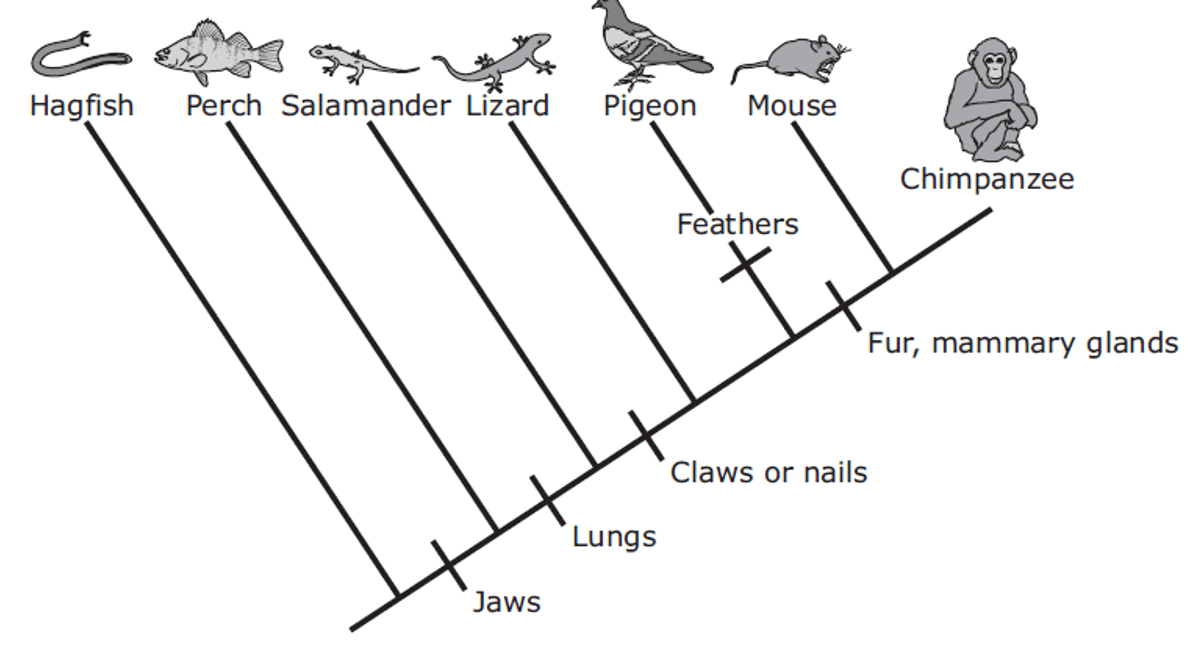
Which do the images represent?
analogous structures
embryological structures
homologous structures
vestigial structures
Which is an example of a sudden change that could lead to the extinction of species?
a mountain range isolates a species
Earth's tectonic plates move
a volcano erupts
sea level changes


In the punnett square below, what belongs in the missing square

In the punnett square, what is the probability for white fur?

arachnids and insects?


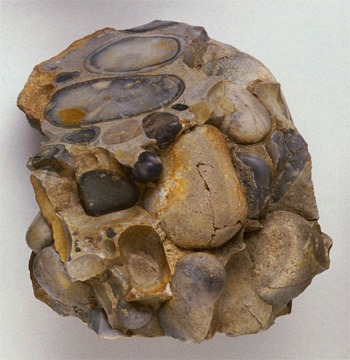
What type of fossil is pictured here?
Mold fossil
Trace fossil
Cast fossil
Body fossil

What type of fossil is pictured here?
Mold fossil
Trace fossil
Cast fossil
Body fossil

What type of fossil is pictured here?
Mold fossil
Trace fossil
Cast fossil
Body fossil

Which statement is true?
Layer C is the oldest
Layer B is older than Layer A
Layer B is older than Layer C
Layer A is the youngest

What is a wavelength?
How many waves pass a certain point
The distance from one wave crest to another
The entire length of a wave
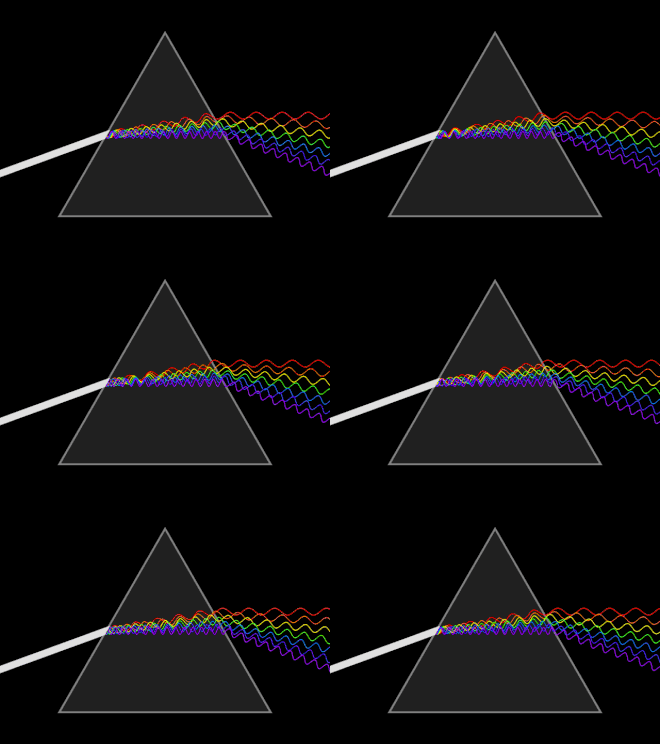
What is the process called for how rainbows are formed?
Reflection
Refraction (bending)
Transmission
Scattering
In order to make a rainbow, what is needed?
Light
Rain
Leprechauns
Surface

The first major optical space telescope to be put into space was the
Hubble Telescope
Mir
James Webb Space Telescope
Voyager

A small robotic space probe that can move about on the surface of a planet or moon is
Orbiter
Rover
Space Station
Apollo

Unmanned space vehicles that take instruments into space to collect data are called
Satellite
Space Shuttle
Rocket
Space Probe

A Telescope that uses a set of lenses to gather and focus light from distant objects is called a
refracting telescope
optical looking device
spectroscope
reflecting telescope

A telescope that uses a curved mirror to gather and focus light from distant objects is called a ____________
reflecting telescope
refracting telescope
spectroscope
optical looking device

According to the Big Bang Theory, what is happening to the size of the universe?
The universe is growing
The universe is shrinking
The universe is staying the same size
The universe rides on the back of four elephants, supported by a turtle.
What does the BBT hypothesize about the size of the early universe?
The universe used to be much much larger than it is today.
The universe used to be a tiny speck of super-dense matter.
The universe has always been the same size
How old was the universe when the very first atoms started to form?
Atoms formed at the instant of the Big Bang
Atoms formed a few hundred million years after the Big Bang
Atoms formed in the first seconds after the Big Bang
Atoms still haven't formed. We can't see them, so they don't exist.
What is a galaxy?
Like a solar system, but made of dust
A cluster of thousands of stars all floating together in space
A cellphone made by the Nokia company
A grouping of hundreds of millions of stars held together by gravity
What is the name of our home galaxy?
The Snickers
The Milky Way
The Twix
The Baby Ruth
Which of the following objects is the biggest?
Solar system
Universe
Galaxy
Star
Which of the following objects is the biggest?
Jaws the goldfish
Galaxy cluster
Solar system
Galaxy
Which of the following objects is the biggest?
Galaxy
Star
Planet
Solar system
Which of the following objects is the biggest?
Star
Solar system
Planet
Jaws the goldfish
Which of the following objects is the biggest?
Star
Planet
Jaws the goldfish
Two bears high-fiving each other
What is Hubble's Law?
The farther away a galaxy is from us, the faster it moves away from us.
The farther away a galaxy is from us, the slower it moves away from us.
The closer a galaxy is to us, the faster it moves away from us.
The more red light we observe from another galaxy, the closer we are to that galaxy
If a galaxy is moving very quickly away from us, the light we receive from that galaxy will be:
more red
more blue
more green
more yellow
If an object is making noise and moving quickly towards us, we will observe:
the pitch of the noise will be higher than if the object wasn't moving
the pitch of the noise will be lower than if the object wasn't moving
the volume of the noise will be louder than if the object wasn't moving
the volume of the noise will be softer than if the object wasn't moving
What shape is Earth's orbit?
circle
ellipse
square
spiral
What is Kepler's 1st law?
The planets orbit in an ellipse
The plants move faster when they are closer to the sun and slower when they are further from the sun
The farther a planet is from the sun the slower the orbit
(P2 = a3)
What is Kepler's 2nd law?
The planets orbit in an ellipse
The plants move faster when they are closer to the sun and slower when they are further from the sun
The farther a planet is from the sun the slower the orbit
(P2 = a3)

Galaxies are colossal collections of stars, gas & dust held together by _____.
space/time
gravity
black holes
dark matter
What is the name of the Supercluster where the Milky Way is found?
Scorpio Supercluster
Aries Supercluster
Libra Supercluster
Virgo Supercluster
About 4.6 billion years ago, a cloud of stellar dust or nebula exists within the Milky Way. What happened next?
Shock waves hit the nebula causing it to collapse.
The energy enriched nebula begins to contract further due to gravity.
Supernova of a nearby star occurs.
The nebula begins to spin and flatten. Then what?
The center of the nebula begins to get hot and dense.
Gravity causes light gases to move to the center while heavier materials and ice stay in outer areas.
A protostar forms in the center of the nebula.
What are the inner planets made of (primarily)?
hydrogen and helium
rock
ice
gas
What are the outer planets made of?
rock
Carbon dioxide
gas and ice
oxygen


____ rocks form when rock buried deep inside the earth change without melting or weathering
igneous
sediment
metamorphic
sedimentary
Rocks formed under great pressure but no heat are _____.
igneous
metamorphic
sedimentary
sediment
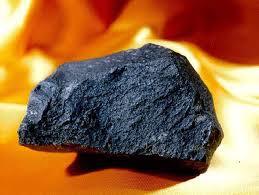
A rock that has cooled fast and may look like glass.
igneous
metamorphic
sedimentary
sediment
Movement of the Earth's tectonic plates creates extreme _____ below Earth's surface.
compaction/cementation
weathering/erosion
heat/pressure
explosions/exchanges

The best answer for section "A" in the diagram
metamorphic/melting
compaction/cementation
weathering/erosion
heat/pressure

The best answer for section "C" in the diagram
metamorphic/melting
compaction/cementation
weathering/erosion
heat/pressure

The best answer for section "B"
metamorphic/melting
compaction/cementation
weathering/erosion
heat/pressure
composition of the Earth
the outermost layer of Earth (thinnest layer)
the 3 layers that make up the Earth (crust, mantle, core)
the middle layer (most of the Earth's mass)
a substance composed of 2 or more elements
crust
outermost layer of Earth (thinnest layer)
the 3 layers that make up the Earth (crust, mantle, core)
a substance composed of 2 or more elements
the middle layer (most of the Earth's mass)
mantle
outermost layer of Earth (thinnest layer)
the 3 layers that make up the Earth (crust, mantle, core)
a substance composed of 2 or more elements
the middle layer (most of the Earth's mass)
continental crust
the layer that extends from below the mantle to the center of the Earth
the thinner crust that lies under the ocean
the 5 physical properties of the layers of the Earth
the thicker crust that is land
oceanic crust
the layer that extends from below the mantle to the center of the Earth
the thinner crust that lies under the ocean
the 5 physical properties of the layers of the Earth
the thicker crust that is land
outer core
liquid layer of the Earth's core that lies beneath the mantle
strong, lower part of the mantle
the plastic layer of the mantle on which pieces of lithosphere move
outermost, rigid layer of the Earth (the crust and the upper, rigid part of the mantle)
inner core
the dense center of the Earth
vibrations through the Earth that happen when there is an earthquake
a machine that measures the times at which seismic waves arrive at different distances from an earthquake
pieces of lithosphere that move around on top of the astenosphere
seismic waves
dense center of the Earth
vibrations through the Earth that happen when there is an earthquake
a machine that measures the times at which seismic waves arrive at different distances from an earthquake
pieces of lithosphere that move around on top of the asthenosphere
seismograph
the dense center of the Earth
vibrations through the Earth that happen when there is an earthquake
a machine that measures the times at which seismic waves arrive at different distances from an earthquake
pieces of lithosphere that move around on top of the astehnosphere
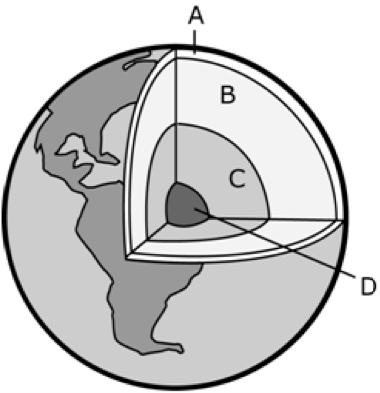
Which letter in the diagram identifies the layer of Earth made up of solid nickel and iron?
layer A
layer B
layer C
layer D
Sally is researching the differences that exist in each layer of the Earth. Which of the following best describes Earth's crust?
Solid, rocky
Liquid, metallic
Semisolid, convecting
Dense, extremely hot
Which of Earth's layers is best described as liquid metal?
crust
mantle
outer core
inner core


As you go deeper into the Earth select the three things below you would expect to increase.
Temperature
Density
Pressure
Volume
Main type of seismic waves that can only travel through the surface of the Earth.
seismic waves
surface waves
body waves
primary waves
Main type of waves that can travel the earth`s inner layer.
surface waves
body waves
Love waves
Rayleigh waves
This is known as the sudden shaking of the ground and known as the sources of seismic waves.
earthquake
tsunami
flood
typhoon
This is considered as the fastest kind of seismic waves.
Love waves
Body waves
Primary waves
Secondary waves
The most damaging type of waves
Love waves
Rayleigh waves
Primary waves
Secondary waves
It can travel through solids only
Love waves
Rayleigh waves
Primary waves
Secondary waves
Two types of surface waves
Love waves and Rayleigh Waves
P waves and S waves
Two types of body waves
Love waves and Rayleigh waves
P waves and S waves
The movement of the tectonic plates is caused by
the rotation of the Earth.
convection currents in the Asthenosphere
the gravity of the iron-nickel core.
the Moho discontinuity.
In some areas of the world, like California and Japan, earthquakes are a common occurrence. How can this best be explained?
The strong ocean currents are undermining both areas causing earthquakes.
Both areas are located near the edge of the Pacific Ocean, the unstable sand causes earthquakes.
Both areas are subjected to strong ocean wind and waves that causes earthquakes.
Both areas are on the boundary of active plates, the motion of the plates causes earthquakes.
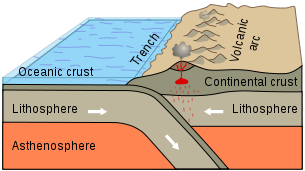
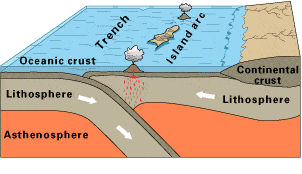
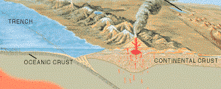
Observe this diagram of a plate boundary. One statement BEST describes what is happening. It is that
the oceanic crust is melting.
the denser ceanic crust is subducting under the less dense oceanic crust
volcanic islands are forming.
the tectonic plates are moving away from each other.
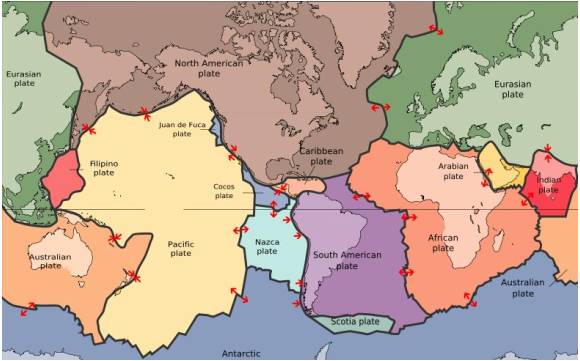
The map in the picture shows tectonic plate boundaries. This map would be useful in predicting the location of future
droughts
hurricanes
earthquakes
tornadoes
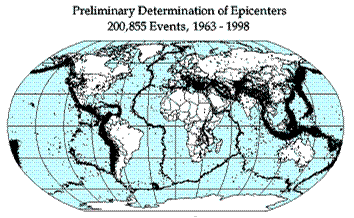
Earthquake epicenters (center of where the earthquakes started) were mapped for a 35 year period in the diagram above. The black dots indicate these epicenters. The black dots appear along what feature on Earth?
hot spots
plate boundaries
rift zones
sea floor spreading
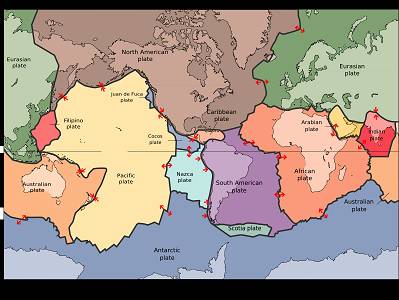
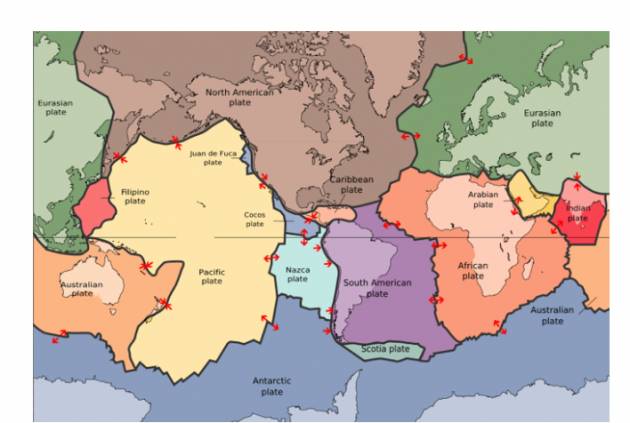
Where are earthquakes MOST LIKELY to occur?
close to the equator
close to the center of tectonic plates
at divergent or convergent plate boundaries
at transform plate boundaries
___________ currents in the Earth's asthenosphere cause plate to shift at their boundaries. This movement also causes earthquakes and volcanic activity.
conduction
convection
radiation
ocean
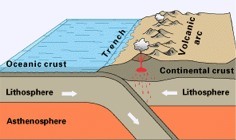
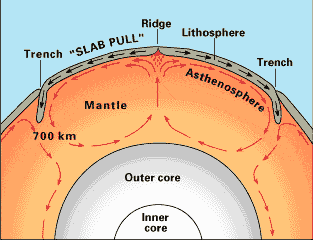
What is the source of energy that drives plate movement?
the subducton of the sea floor
the different densities of the oceanic and crustal plates
convection currents in the asthenosphere
the friction force between the plates that move past each other
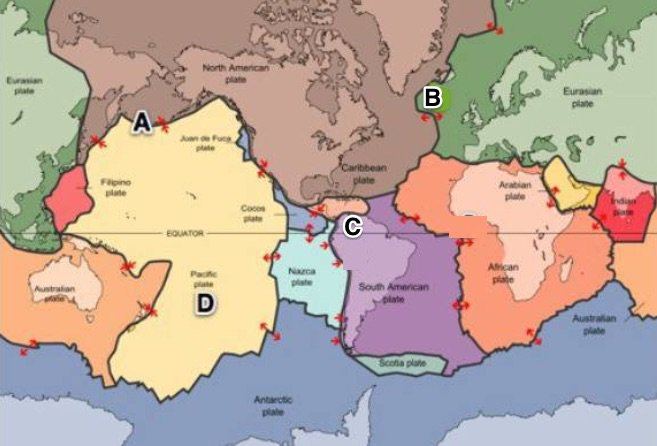
Where would sea floor spreading most likely occur?
At convergent boundaries (oceanic vs. oceanic)
At convergent boundaries (oceanic vs. continental)
At divergent plate boundaries (oceanic vs. oceanic)
At transform plate boundaries
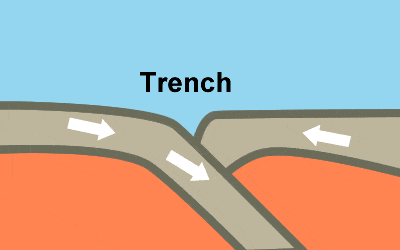
The Marianas Trench, where the Pacific Plate descends under the leading edge of the Eurasian Plate, is the deepest sea floor in the world. These ocean trenches form when two oceanic plates collide
and the older, less dense of the two plates rides over the edge of the older plate.
when convection currents in the mantle force the older plate downward.
and the younger, denser of the two plates, rides over the edge of the older plate.
and the plates are approximately the same age and density.

