
 Worksheets
Cladogram Practice
Total questions: 106
Worksheet time: 2hrs 28mins
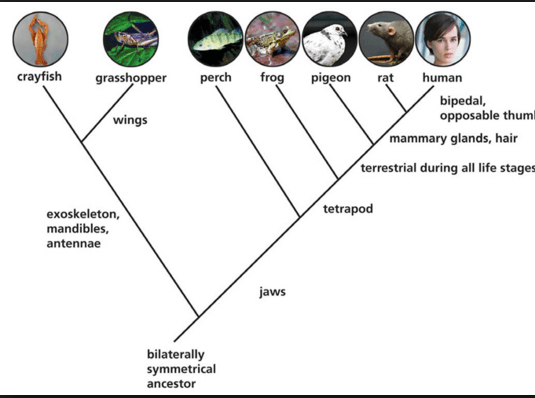

Which is more closely related?
Lamprey and tiger
Gorilla and Human
Salamander and Tiger
Shark and Lizard

The lizard has all these derived characteristics EXCEPT
Jaws
Lungs
Bipedal
Amniotic Membrane

How many derived characteristics are represented on the diagram above?
2
3
4
5

Which animals have amniotic eggs?
Turtle and Tuna
Turtle and Leopard
Lancelet and Lamprey
Tuna and Slaamander

Which organism does not have a Vertebral Column?
Lamprey
Lancelet
Tuna
Salamander
Cladograms are constructed by grouping organisms together based on their____________ characteristics.
shared
similar
different
shared

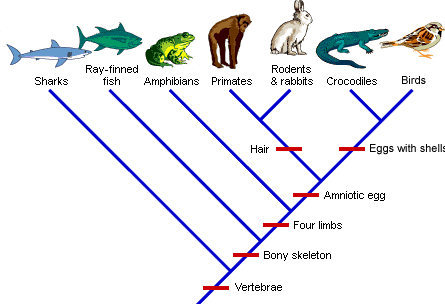
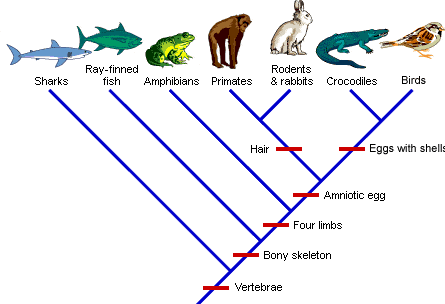
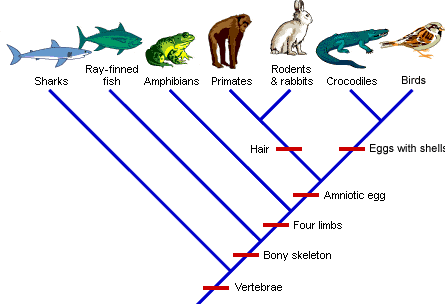
According to this cladogram, sharks are MOST closely related to which organism?
Amphibians
Ray-Finned Fish
Primates
Birds

According to this cladogram, birds are LEAST related to:
Amphibians
Birds
Crocadilles
Sharks

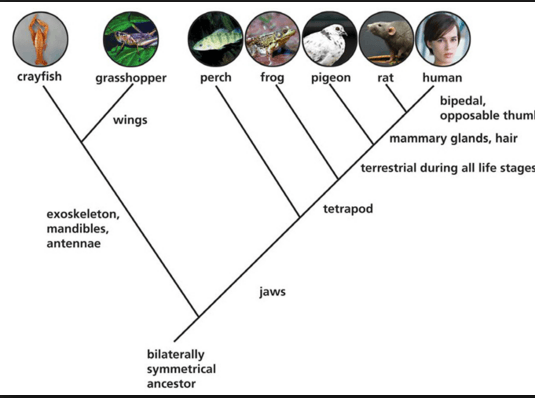
Which trait do only humans have, according to the cladogram?
Bipedal and Opposable Thumbs
jaws
tetrapod
terrestrial during all life stages

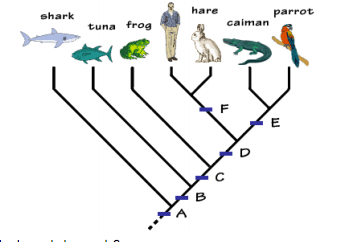
On the cladogram, which organism is the closest relative of the human?
Parrot
Shark
Hare
Frog

How long ago was common ancestor in this phylogenetic tree alive?
53.7-54.1 mya
61.5-61.9 mya
50.7-54.9 mya
37.9-46.5 mya

What is the common ancestor of Letters A, B, C, D, E?
1
2
3
4

Which species is most closely related to species D?
A
B
C

Species B is more closely related to C than to A.
True
False

Which species is most closely related to species C?
A
B
D
Species D is more closely related to A than to B.
True
False

Which species is most closely related to species B?
A
C
D
Species B is more closely related to A than to D.
True
False

Which species is most closely related to species F?
A
B
C
D
E
Species E is more closely related to D than to B.
True
False
Species B is more closely related to D than to A.
True
False

Which species is most closely related to E?
A
B
C
D
F
Species E is more closely related to B than F.
True
False
True or False: Species E is more closely related to B than F.
True
False

Which species is most closely related to B?
A
C
D
E
F
Species D is more closely related to A than to F.
True
False
Species B is more closely related to D than to E.
True
False

Which of the following is most closely related to species C?
A
B
D
E
F
D is more closely related to A than to C.
True
False
C is more closely related to B than to F.
True
False
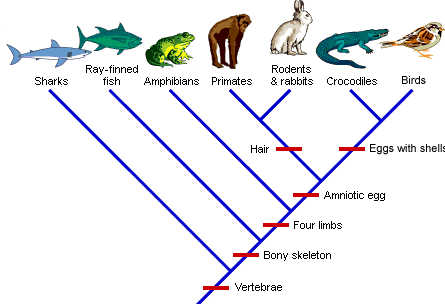
According to this cladogram, primates are most closely related to....
Amphibians
Rodents & rabbits
Crocodiles
Birds

Which trait do only humans have, according to the cladogram?
jaws
mammary glands & hair
terrestrial during all life stages
bipedal & opposable thumbs
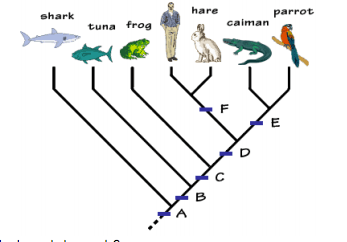
On the cladogram, which organism is the closest relative of the parrot?
Frog
Hare
Caiman
Parrot
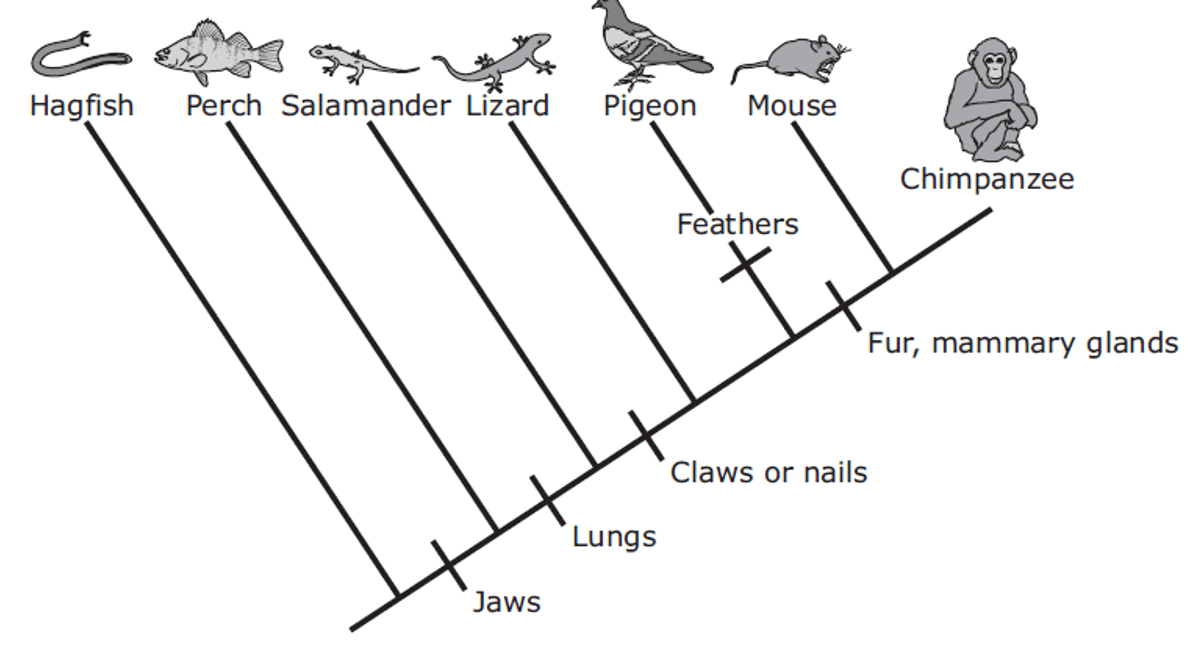
All the animals to the right of the salamander would have the common characteristic of...
Fur
Claws or nails
Lungs
Jaws
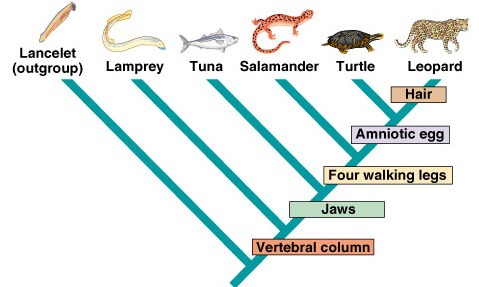
Which is the newest trait?
Amniotic egg
Walking legs
Jaws
Hair
According to this cladogram, sharks are MOST closely related to which organism?
Amphibians
Ray finned fish
Crocodiles
Birds

What is this a picture of?
Pedigree
Cladogram
Family Tree
Oak Tree
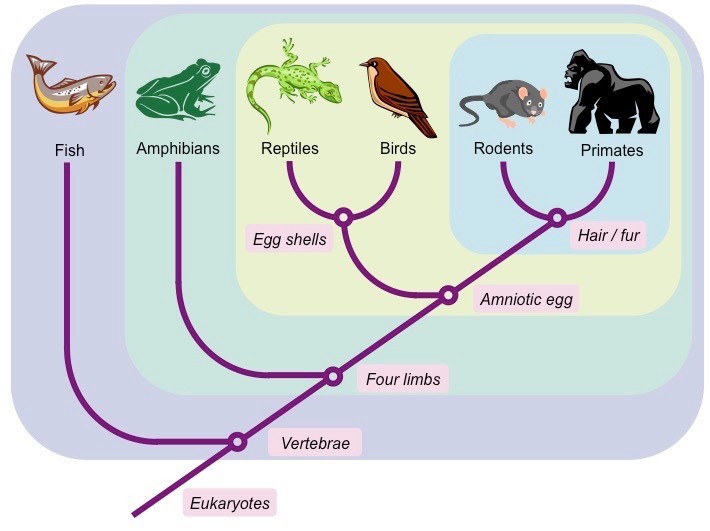
What characteristic distinguishes amphibians from birds and reptiles?
Amniotic egg
Egg shells
Vertebrae
Hair/fur

What distinguishes zebras from from giraffes?
un-branching horns (in males)
even number of toes
fur
carnivorous teeth

What characteristic do all the organisms on this cladogram share?
Being bi-pedal & having language
Complex brains
Fully binocular vision
Partial binocular vision & opposable thumbs
All the animals to the right of the salamander would have the common characteristic of...
Fur
Claws or nails
Lungs
Jaws
What characteristic do all the organisms on this cladogram share?
Being bi-pedal & having language
Complex brains
Fully binocular vision
Partial binocular vision & opposable thumbs

Among the living species, which two organisms are most closely related?
A and G
C and F
B and G
E and F

Which statement is supported by the cladogram?
The tuna does not have a jaws.
The leopard does not walk on four legs.
The lamprey does not have a vertebral column
The salamander does not produce an amniotic egg.

Which statement is best supported by the diagram?
Species X evolved later than Species U but before Species S.
Species T and Species U are related to species X.
Species T is the ancestor of Species S.
Species U and V evolved from Species S.

In the modern classification system, organisms
are classified based on evolutionary
relationships. The illustration below shows how
several groups of organisms are classified. Among the living species, which two organisms are most closely related?
A and G
C and F
B and G
E and F
In an evolutionary classification scheme, what is true of species within one genus?
They have identical genes.
They will not be similar in appearance.
They will be limited to species that can interbreed.
They will be more similar to each other than they are to other species.

This is a cladogram for marine mammals. Using the cladogram, which organisms exhibit the most similar structures?
dolphins and cats
dolphins and true seals
dolphins and porpoises
dolphins and sperm whales

What type of structures are shown?
Homologous
Analogous
Vestigial
Heterologous

What type of structures are shown?
Homologous
Analogous
Vestigial
Heterologous

What type of structures are shown?
Homologous
Analogous
Vestigial
Heterologous
The "Buzz Word" for evolution is-
Cannon Ancestor
Common Ancestor
Common Analogy
Common Anteater

The "Best" form of evidence for evolutionary relationships is-
Molecular- DNA
Fossils
Homologous Structures
Analogous Structures

According to fossil records, the horses that lived 50 million years ago were much smaller, weaker and slower than modern horses. Which process is most likely responsible for the changes that have led to the increased size, strength, and speed in horses?
evolution by natural selection
migration
inbreeding
commensalism

What is shown ?
embryology
fetalology


What does it mean when organisms share a common ancestor?
They evolved from 1 species that lived in the past
They are the same species
The organisms have exactly the same traits
The organisms are very different from one another


Evolution is a THEORY and is subject to change if new evidence is found.
True
False


________ structures are reduced in size or function due to lack of use.
vestigial
homologous
cladistic
phylogenic
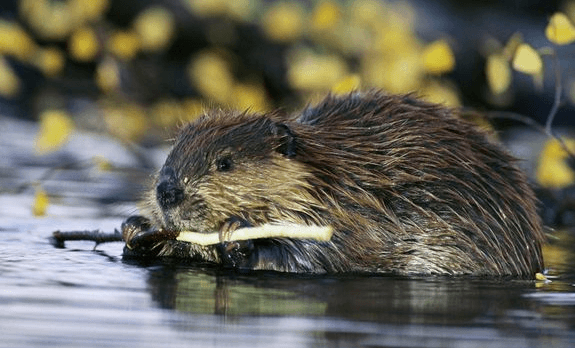

Structures with the same structure have different functions; suggests that organisms share a common ancestry
vestigial structures
homologous structures
adaptive radiation
fossil

What type of evidence is shown in the picture above?
Ancestral traits
Embryonic Development
Homologous Structures
Vestigial Structures
Structures are similar in function but not in structure
Vestigial
Homologous
Analogous Structures
Embryonic
Charles Darwin observed that finches of different species on the Galápagos Islands have many similar physical characteristics, this supports the hypothesis that these finches
are twins
acquired traits through use and disuse.
all eat the same type of food.
descended from a common ancestor.
A proposed idea or hypothesis that has considerable evidence but cannot be entirely proven or dis-proven.
Fact
Smart Idea
Gossip
Theory

Each of these limbs have different functions, but have very similar bone structure. This is an example of....
Vestigal Structures
Homologous Structures
Analogous Structures
Transitional Structures

This image supports life has changed through time because it supports all of these organisms formed from......
a common ancestor
artificial selection
natural selection
polygenic traits

The femur and pelvis bone found in whales is an example of a....
Vestigal Structure
Homologous Structure
Analogous Structure
Transitional Structure
How old is the Earth?
46 million years old
4.6 million years old
4.6 billion years old
14.6 billion years old

What phenomenon explains this occurrence?
Continental Drift
transitional fossils
Radioactive Dating
Relative Dating
The definition of evolution is...
Change in an individual over time
Change in a population over time
Natural selection of organisms TRYING to adapt
Survival of only the healthiest, strongest, and fastest organisms

The following is an example of what piece of evidence for evolution?
Homologous structure
Vestigal structure
Transitional structure
Artificial Selection

Which fossil is the youngest by the principle of relative aging (dating)?
E
D
C
B

Which fossil is the oldest by the principle of relative aging (dating)?
A
B
C
D
Fossils are most likely found in...
Igneous rock
Metamorphic rock
Sedimentary rock
Granite
Which organism would be most easily fossilized?
A rabbit dies in the middle of the prairie in iowa
A snail dies and is quickly covered by sediment
A soft bodied worm dies in your garden
A dinosaur gets eaten by a T. Rex
Which is these time periods came the earliest in Earth's history
Paleozoic
Cenozoic
Mesozoic

Embryology supports evolution by...
showing the progression of life
showing we all needed gills to live in the womb
providing evidence to support that we evolved from a common ancestor
showing evolution is a quick process

