
 Worksheets
Semester 1 Review
Total questions: 106
Worksheet time: 2hrs 2mins

Which question would be the best testable scientific question?
How long ago did dinosaurs live on the Earth?
Does the amount of salt in water affect the temperature at which it boils?
How many giraffes live in Africa?
Who made the first microscope?

A scientist hypothesizes the temperature at which an alligator's egg is incubated will determine whether the alligator will be male or female. The independent variable is
the incubator
the gender of the alligator
the male alligators
the temperature
A scientist hypothesizes the temperature at which an alligator's egg is incubated will determine whether the alligator will be male or female. The dependent variable is
the incubator
the gender of the alligator
the male alligators
the temperature

All the things in an experiment that must be the same to make it fair are called
controlled experiments
controlled variables or constants
dependent variables
independent variables

In science, an educated guess is called a/an _______.
Prediction
Hypothesis
Theory
Law

If you were measuring the mass of a fly, you should use
meters
kilograms
liters
grams
Which unit of measure is NOT used in the Metric System (International System of Units or SI)?
grams
centimeters
milliliters
inches

Who is responsible for creating the metric system?
Sir Isaac Newton
Antoine Lavoisier
Andres Celsius
Marvin Metric

Who is responsible for creating the metric temperature scale?
Sir Isaac Newton
Antoine Lavoisier
Andres Celsius
Marvin Metric
On the Celsius temperature scale ___° is water freezing and ____° is boiling water.
0, 100
100,0
32, 212
273 , 373

What is the mass?
317g
317.8g
311g
137g

How long is the line? Use the cm ruler.
15 cm
16 cm
17 cm
15.7 cm

Identify the following observations as qualitative or quantitative:
Thor is wearing a red cape.
Qualitative
Quantitative
Identify the following observations as qualitative or quantitative:
Thor flew 1500km in the air.
Qualitative
Quantitative
The metric prefix "centi" means what?
1000
100
1/100
1/1000
1,000 liters is equal to what unit?
1 km
1 m
100 kL
1 KL
Convert 43.5 mg to grams
43500 g
.435 g
.0435 g
.00435
What is the formula for density?
D = m/v
D=mv
D=v/m
D=vm
If you do not understand a lab procedure, you should
Figure it out as you do the lab
Try several methods until something works.
Ask the teacher before beginning.
Skip it and go to the next part.
Which part of the scientific method is an educated guess?
Problem
Question
Hypothesis
Conclusion
What is the density of water?
.5 g/ml
.75 g/ml
1.0 g/ml
1.5 g/ml
100N of force is pushing in the opposite direction as 25N of force. The Net force is
125N
100N
25N
75N
What happens when two equal forces act in the opposite direction?
They create a larger mass.
The stronger one prevails
They cancel each other out.
Their sum is divided by three and that is the total force.
The tendency of an object to resist a change in its motion.
Force
Inertia
Laziness
Velocity

Captain America was riding his motorcycle and traveled 500km in 4 hours. What was his average speed?
50 km/h
125 km/h
250 km/h
2000 km/h
What is the difference between speed and velocity?
Velocity includes time
Velocity includes direction
Speed includes direction
They are spelled different...duh!
The force of gravity on a person or object on the surface of a planet is called
Mass
Weight
Free Fall
Terminal Velocity
Which of these is NOT a type of friction?
Rolling
Sliding
Fluid
Stationary
Suppose that an astronaut throws a baseball in outer space at a location far from significant influences of gravity and air resistance. One would expect that the baseball would ____.
eventually stop since all objects ultimately "lose their steam"
eventually stop as its inertia slowly becomes used up
continue in motion with the same speed and direction
either a, b, or c -- depending on whether the astronaut continues to push it
A skateboard rolls down a hill, reaches the level surface and eventually comes to a stop. The fact that the skateboard ultimately stops is best explained by ____.
an unbalanced force would be required to keep the sled moving forward at constant speed
the presence of an unbalanced force (e.g., friction) can cause a moving object to stop
the presence of inertia causes it to stop
the natural tendency of any object is to ultimately stop


How fast is acceleration if the only thing acting on it is gravity?
9.8 m/s2
9.8 m/s3
9.6 m/s
9.6 m/s2
The factors that affect the amount of friction present are
Mass and size
Weight and size.
How hard things push against each other and mass
How hard things push against each other and surface type.
The factors that affect gravity are
mass and distance
mass and surface type
weight and force
force and location
A baseball is thrown a distance of 20 meters. What is its speed if it takes 0.5 seconds to cover the distance?
40 m/s
10 m/s
3 m/s
30 m/s

What kind of speed does this graph represent?
No speed.
Constant Speed.
Increasing speed.
Decreasing speed.

Thor pushes Loki off a cliff. If he has a mass of 65 kg and he accelerates towards the Earth at a rate of 9.8 m/s2 due to gravity, what is Loki's force as he screams through the air?
6.37 N
637 N
637 m/s
6.63 N
When the surface of a mirror curves inward, like the inside of a bowl, it is called a
plane mirror.
convex mirror.
concave mirror.
diffuse mirror.
What are the units of force?
kg
N
m/s
m/s2
F = ma
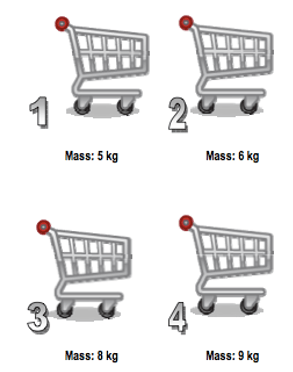


When a cannon fires a cannonball we observe Newton's third law. Which is the reaction force?
The cannon moving forward
The cannon moving backwards
The cannonball moving backwards
The cannonball moving forward

When a cannon fires a cannonball we observe Newton's third law. Which is the reaction force?
The cannon moving forward
The cannon moving backwards
The cannonball moving backwards
The cannonball moving forward

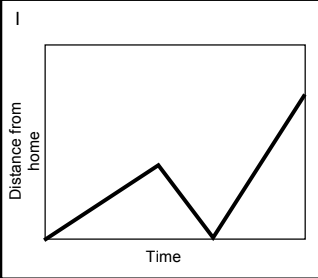
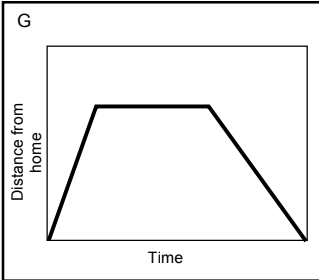
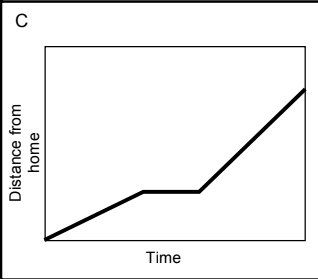
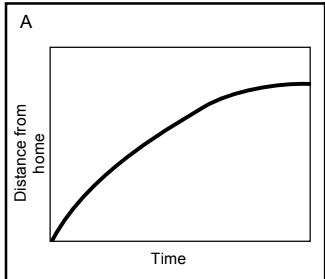


Hint: Greatest distance shortest time

Segment O-A The bus is _________________.
at rest
returning (to original position)
moving forward
Segment A-B The bus is _________________.
at rest
returning (to original position)
moving forward
Segment B-C The bus is _________________.
at rest
returning (to original position)
moving forward
Segment C-D The bus is _________________.
at rest
returning (to original position)
moving forward
Segment D-E The bus is _________________.
at rest
returning (to original position)
moving forward
Segment E-F The bus is _________________.
at rest
returning (to original position)
moving forward

What is the volume of the rock?
5 ml
25 ml
50 ml
75 ml
Electromagnetic waves can transfer energy without a(n)
medium
electric field
magnetic field
cord
Visible light has a higher frequency than
gamma rays
x-rays
ultra violet light
infrared light
The electromagnetic waves with the highest frequency is
radio
microwaves
x-rays
gamma rays
The higher an em waves frequency, the higher its _______.
wavelength
energy
volume
sound


which is a transparent object
glass
copper
iron
steel
On AM broadcasts, what remains constant?
the amplitude
the frequency
the music
the speech


What does a wave carry from place to place?
energy
matter
people
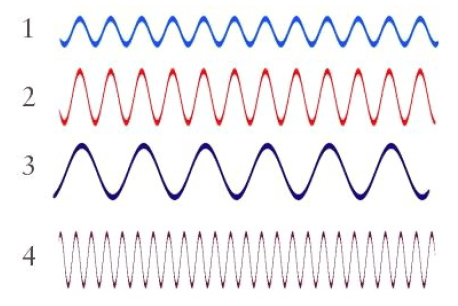
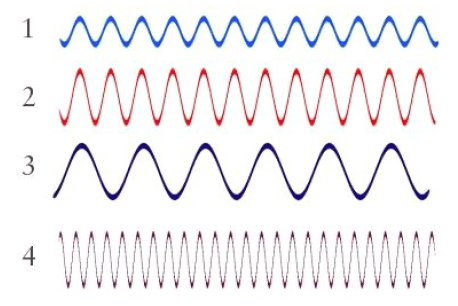


Our modern understanding of light and color is due to the efforts of which scientist?
Galileo
DaVinci
Newton
Nye
Doctors are able to make sonograms through the use of
ultrasound.
infrasound.
sonar.
acoustics.
If a tuning fork is in a vacuum (no air) what would you expect to hear?
nothing
a soft sound
a loud sound

What type of wave is used to see this picture?
sonar
ultrasound
frequency
pitch
Choose the correct order for how sound travels.
When a school bell rings, parts of the bell will vibrate, ________.
causing your eardrum to vibrate, and then a message is sent to your brain.
your eardrum to vibrate, which causes the air around you to vibrate, which causes your eardrum to vibrate.
causing the air around it to vibrate, and then a message is sent to your brain.
causing the air around it to vibrate, which causes your eardrum to vibrate, and then a message is sent to your brain.


A lens that is thicker in the center than at the edges
concave
cencentrate
concentric
convex

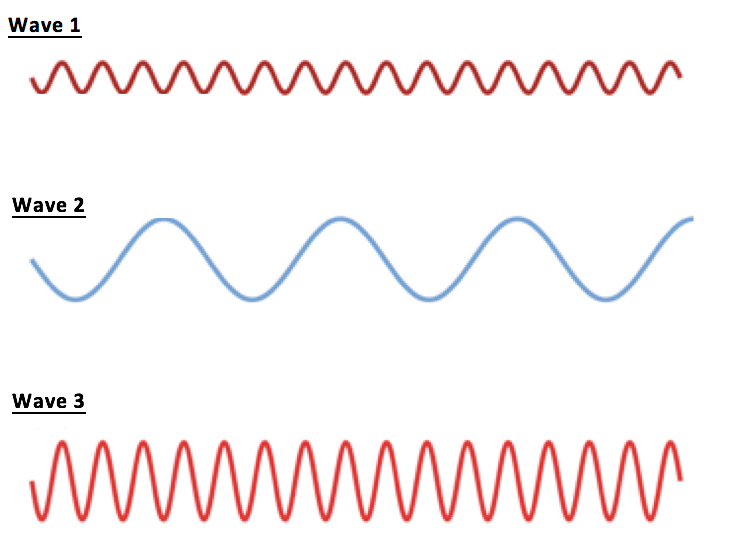
wavelength

