wayground logo

Free Printable Worksheets

Font size

S
M
L
XL
Worksheets

Newton's First and Second Law

Total questions: 102

Worksheet time: 1hrs 14mins

Name
Class
Date
1.

Newton's 1st Law is also called the Law of ...

a)

Friction

b)

Inertia

c)

Unbalanced forces

d)

Newtons

2.
An object in motion tends to stay in motion unless an ___ force acts on it.
a)
unbalanced
b)
balanced
3.
The tendency of an object to resist a change in motion is...
a)
inertia
b)
kinetic energy
c)
vector
d)
net force
4.
Objects with greater _________ also have greater inertia.
a)
speed
b)
mass
c)
temperature
d)
friction
5.
The law of inertia (Newton’s First Law) applies
a)
to both moving and nonmoving objects
b)
only to moving objects
c)
only to objects that are not moving
6.

Because of inertia, a moving object will keep ________ unless acted on by an unbalanced force.

a)

at rest

b)

moving

c)

in one spot

d)

inertia

7.
Because of inertia, a resting object will remain at ________.
a)
rest
b)
a constant speed
c)
school
d)
inertia 
8.
What kind(s) of objects have inertia?
a)
all objects with mass
b)
only objects at rest
c)
only objects in motion
d)
only objects whose motion is being changed
9.
You push on a car and it does not move.  What is true about the inertia?
a)
The inertia is changing
b)
The inertia of the car is too great 
c)
The inertia of the person is equal to the car
d)
There is not inertia because of no movement
10.
Galileo found that a ball rolling down one inclined plane would roll how far up another inclined plane? 
a)
The ball would not rull up the other plane at all. 
b)
to nearly the original height
c)
to nearly twice the original height. 
d)
to nearly half it original height
11.
An object following a straight-line path at a constant speed 
a)
has zero acceleration
b)
has no forces acting on it
c)
has a net force acting in the direction of motion
d)
none of these
12.
One object has twice as much mass as another object. The first object also has also twice as much...
a)
velocity
b)
gracitational acceleration
c)
inertia
d)
all of these
13.
If a hockey puck slides on a frictionless force it will eventually slow down because of its inertia.
a)
True
b)
False
14.
Objects at rest remain at rest and objects traveling at a steady rate in a straight line continue that way until a _________acts on them.  
a)
force
b)
velocity
c)
inertia
d)
acceleration 
15.
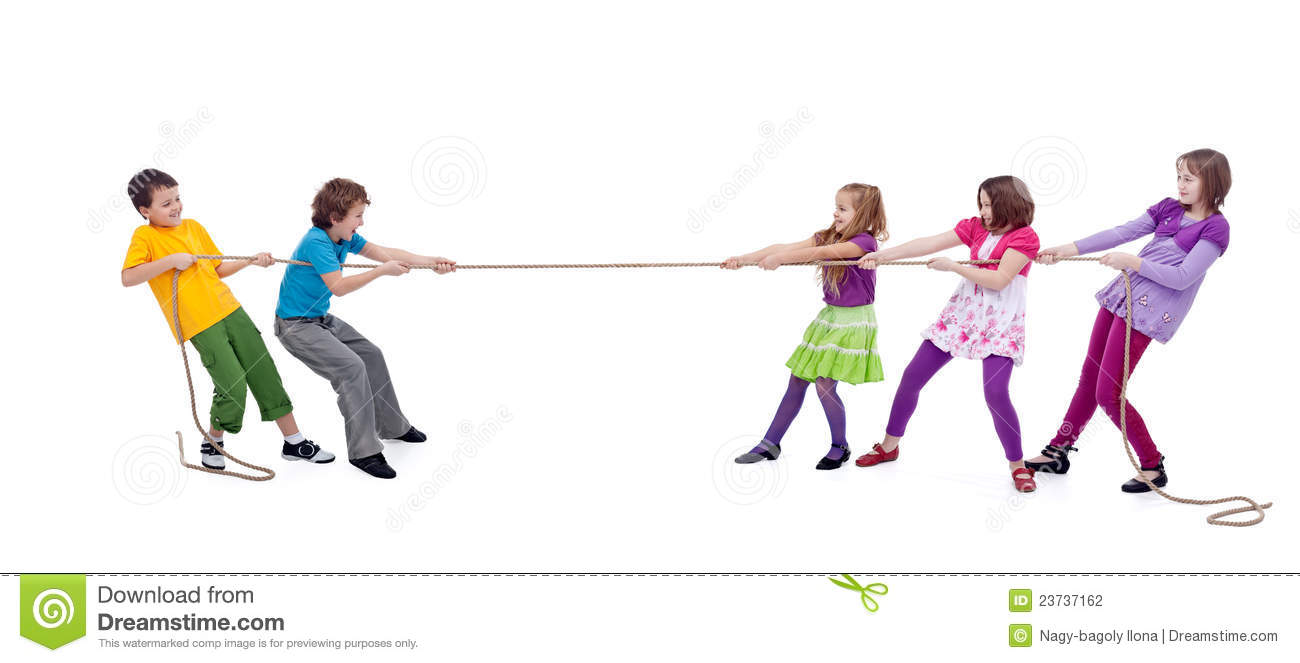
Why is the net force 0 in the image?
a)
Because the elephants are the same size
b)
Because they are both pulling the same amount of force in opposite directions
c)
Because they are elephants
d)
Because they are pulling away from each other.
16.
A change in an object's position is called ______.
a)
Speed
b)
Motion
c)
Velocity
d)
Friction
17.
If an object has a kinetic energy, it must be _____.
a)
at rest
b)
in motion
18.
If an external force is applied, the velocity will change because of the force.
a)
True
b)
False
19.
The tendency of an object to resist change in motion.
a)
Force
b)
Motion
c)
Friction
d)
Inertia
20.
Objects with more mass or heavier have LESS inertia.
a)
True
b)
False
21.
Lighter objects have LESSER inertia than heavier objects.
a)
True
b)
False
22.
____ is a force that occurs when an object rubs against another object.
a)
Motion
b)
Friction
c)
Velocity
d)
Speed
23.
Friction can make a moving object slow down or stop.
a)
True
b)
False
24.
_____ is an object’s speed in a given direction.
a)
Friction
b)
Motion
c)
Speed
d)
Velocity
25.
____ is the distance traveled divided by the time of travel.
a)
Velocity
b)
Speed
c)
Mass
d)
Volume
26.
Jasmyn can run 50 yards in 10 seconds and Jaylah can run 100 yards in 20 seconds. Who has a faster speed? (speed is distance divided by time; S = d/t)
a)
Jasmyn
b)
Jaylah
c)
Both have the same speed.
27.
An object will remain at rest or in uniform motion in a straight line unless acted upon by an external force.
a)
Newton's First Law of Motion
b)
Newton's Second Law of Motion
c)
Newton's Third Law of Motion
d)
Newton's Fourth Law of Motion
28.
It is also called the Law of Inertia.
a)
Newton's First Law of Motion
b)
Newton's Second Law of Motion
c)
Newton's Third Law of Motion
d)
Newton's Fourth Law of Motion
29.
Objects with more mass (or heavier) have greater gravitational pull.
a)
True
b)
False
30.
Objects with more mass (or heavier) have more inertia; thus,  EASIER to move or stop.
a)
True
b)
False
31.
____ means that an object in motion will stay in motion in the same direction, or it will stay at rest,  unless another force acts upon it.
a)
Inertia
b)
Friction
c)
Motion
d)
Gravity
32.

50 miles per hour, West

a)

acceleration

b)

speed

c)

velocity

d)

gravity

33.

A force is a ________________________ that acts on an object.

a)

push

b)

pull

c)

push or pull

34.

A force that opposes, or pushes back against, an object moving past another object

a)

gravity

b)

friction

c)

inertia

d)

mass

35.

Acceleration is best described as a change in an object's

a)

velocity

b)

speed

c)

direction

36.

An object at rest will stay at rest unless an unbalanced force acts on it.

a)

True

b)

False

37.

An object that is changing position (location) is

a)

at rest

b)

in motion

38.

An object's tendency to resist (not) change its state of motion.

a)

gravity

b)

force

c)

inertia

d)

friction

39.

Which of the following is not a force?

a)

gravity

b)

velocity

c)

friction

d)

a push

40.

If an object in motion is not acted on by an unbalanced force, it will continue with the same speed and direction.

a)

True

b)

False

41.

If an object is speeding up, it is accelerating.

a)

True

b)

False

42.

The rate or measure of how fast an object is moving

a)

velocity

b)

force

c)

speed

d)

acceleration

43.

Which of the following will reduce (make less) friction?

a)

make a surface rough

b)

make a surface smooth

44.

The measure of how fast an object is moving and what direction it is moving

a)

velocity

b)

force

c)

speed

d)

acceleration

45.

resistance to change. (things at rest stay at rest, things in motion stay in motion)

a)

Distance

b)

Force

c)

Intertia

d)

Speed

46.

distance traveled divided by time

a)

velocity

b)

speed

c)

friction

d)

gravity

47.

The amount of space between two things

a)

speed

b)

velocity

c)

gravity

d)

distance

48.

a push or a pull

a)

Newton's first law

b)

force

c)

speed

d)

weight

49.

An object's speed and direction

a)

speed

b)

velocity

c)

mass

d)

weight

50.

the force of gravity on an object's mass

a)

speed

b)

force

c)

interia

d)

weight

51.

the force of gravity on an object's mass

a)

speed

b)

force

c)

interia

d)

weight

52.

The force that pulls two objects toward each other.

a)

gravity

b)

speed

c)

direction

d)

Ethan's kahoot game

53.
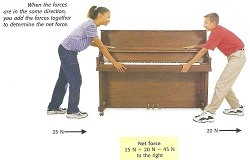
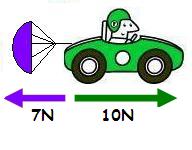
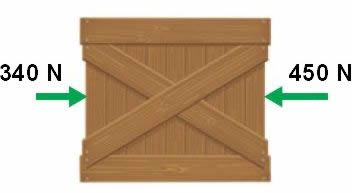
What is the net force?
a)
5 N
b)
45 N to the left
c)
5 N to the right
d)
45 N to the right
54.
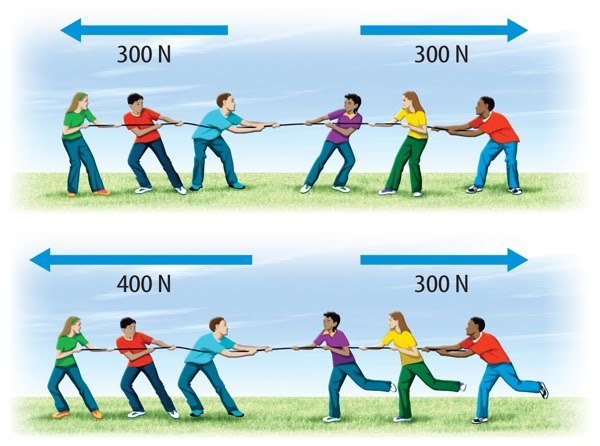
Which one is balanced?
a)
top
b)
bottom
c)
both
55.
Is it BALANCED? 
a)
Yes
b)
No
56.
What is the FORCE? 
a)
5 N
b)
10 N
c)
400 N
d)
0 N
57.
What is the unit for FORCE? 
a)
N (Newtons)
b)
lbs (pounds)
c)
g (grams)
d)
m/s (meters per second)
58.
If there are two forces going in the SAME direction, you would ...?
a)
(-) Subtract the forces
b)
(+) Add the forces
c)
Neither
d)
(x) Multiply
59.
Forces that have a force of Zero (0).
a)
Balanced force
b)
Unbalanced force
60.
The FORCE that PULLS things down or back to EARTH.
a)
Speed
b)
Gravity
61.
If the net force is 0 the object will ... 
a)
CHANGES motion
b)
STAY the SAME, NOT Move
62.
This is an example of what kind of force?
a)
Balanced Force
b)
Pushing Force
c)
Gravity Force
d)
Unbalanced Force
63.
If you have balanced forces on a ball what happens
a)
It STAYS the SAME
b)
CHANGES its MOTION
c)
:(
d)
:)
64.
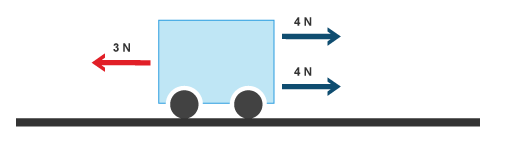
What is the net force?
a)
17 N Right
b)
3 N Right
c)
3 N Left
d)
17 N Left
65.
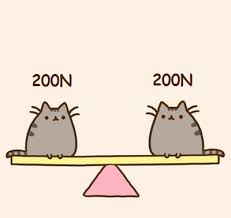
What is the net force?
a)
20 N 
b)
0 N 
c)
400 N 
d)
40 N 
66.
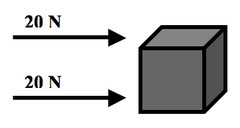
What is the net force?
a)
30 N 
b)
25 N 
c)
5 N 
d)
55 N 
67.
When forces are _________ the object DOES NOT move.
a)
unbalanced
b)
balanced
c)
heavy
d)
light
68.
If the net force is equal to zero the forces acting on the object are 
a)
balanced
b)
unbalanced
69.
Balanced or unbalanced?
a)
balanced
b)
unbalanced
70.
What happens when unbalanced forces act on an object at rest?
a)
the object remains at rest
b)
the object begins moving in an unpredictable direction
c)
the object begins moving in the direction of the net force
d)
the object begins moving opposite to the direction of net force
71.
What is the net force?
a)
40 N left
b)
0 N Balalnced
c)
400 N right
d)
40 N right
72.
F=MA
An object of mass 10 kg is accelerated upward at 2 m/s2.  What force is required? 
a)
20 N
b)
2 N
c)
5 N
d)
0 N
73.
What Unit do we Measure Force in? 
a)
Newtons
b)
Joules
c)
Force
d)
Don't know
74.
45 m/s2 is the... 
a)
Mass
b)
Force 
c)
Acceleration
d)
weight
75.
What is a Balanced Force?  Two objects where...
a)
They both have equal force 
b)
One has more force than the other
c)
Both have no force
d)
One has more gravity than the other
76.
Will it take more force to push an empty shopping cart or a shopping cart that is full?
a)
The empty shopping cart
b)
The full shopping cart
c)
They will take the same amount of force
77.
When force is 20 N, mass is 5 kg, what is acceleration?
F = ma
a)
25 m/s/s
b)
5 m/s/s
c)
100 m/s/s
d)
4 m/s/s
78.
How much force is needed to accelerate a 2 kg physics book to an acceleration of 6 m/s/s?
a)
36 N
b)
12 N
c)
3 N
d)
0.33 N
79.
Forces can change an object's motion by changing its ------, its direction, or both. (p. 62)
a)
speed
b)
velocity
c)
gravity
d)
net force
80.
A ball is rolling on the floor and a force pushes it in the same direction, what will happen?
a)
The ball will go faster.
b)
The ball will slow down.
c)
The ball will stop. 
d)
The ball will fly in the air.
81.
If a force of 26 N is exerted on two balls, one with a mass of 0.52 kg and the other with a mass of 0.78 kg, which ball will have the greater acceleration?  (F=ma)
a)
The one with a mass of .78 kg will have the greatest acceleration.
b)
The one with a mass of .52 kg will have the greatest acceleration.
c)
They will both accelerate at the same rate.
82.
A change in velocity over time is called ___________.
a)
speed
b)
force
c)
acceleration
d)
direction
83.

An object's velocity can be changed by changing its:

a)

speed

b)

direction

c)

color

d)

mass

84.
Newton's second law of motion describes acceleration as force divided by __________.
a)
mass
b)
inertia
c)
speed
d)
direction
85.
The direction of the force that pulls an object in a circular motion is toward the ___________ of the circle.
a)
outside
b)
center
c)
left side
d)
right side
86.
Football A has a greater mass than football B.  Which football will have greater acceleration when both are thrown with the same force in the same direction?
a)
Football A
b)
Football B
c)
They will have the same acceleration
d)
Mass has no effect on acceleration
87.

An object with a mass of 10 kg is accelerated upward at 2 m/s2. What force is required?

a)

20 N

b)

2 N

c)

5 N

d)

0 N

88.
Why is the net force 0 in the image?
a)
Because the elephants are the same size
b)
Because they are both pulling the same amount of force in opposite directions
c)
Because they are elephants
d)
Because they are pulling away from each other.
89.

What two things determine the gravity of an object?

a)

mass & weight

b)

mass & distance

c)

density & mass

d)

volume & distance

90.

A brick and a pencil are dropped at the same time from the same height. Which one would hit the ground first?

a)

brick

b)

pencil

c)

both would hit at the same time

91.

Which is a use of air resistance?

a)

swimming in a pool

b)

opening a parachute

c)

falling asleep

d)

going to the moon

92.

What keeps the planets in orbit around the sun?

a)

gravity

b)

friction

c)

density

d)

distance

93.

When NASA scientists send a man into outer space in a rocket, what force must the rocket overcome as it leaves the Earth's surface?

a)

weight

b)

mass

c)

gravity

d)

density

94.

When will the gravity between two objects be the LEAST?

a)

when the masses of both objects is small and the objects are close together

b)

when the masses of both objects is small and the objects are far apart

c)

when the masses of both objects is large and the objects are close together

d)

when the masses of both objects is large and the objects are far apart

95.

When will the forces of gravity between two objects be the GREATEST?

a)

when the masses of both objects are small and the objects are far apart

b)

when the masses of both objects are large and the objects are close together

c)

when the masses of both objects are small and the objects are close together

d)

when the masses of both objects are large and the objects are far apart

96.
F=MA
If you are pushing a 1000 kg car at 0.5 m/s2, how many newtons would that be? 
a)
2000 N
b)
60N
c)
500 N
d)
12 N
97.
The amount of matter in an object is 
a)
pressure
b)
weight
c)
mass
d)
force
98.
Two factors effecting the magnitude of the force of gravity between 2 objects are...
a)
mass and distance 
b)
mass and matter
c)
distance and weight 
d)
weight and mass
99.
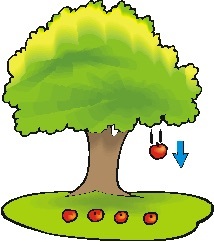
Look at the picture.  Is the force of gravity on the boy a push or a pull? 
a)
Pull
b)
Push
100.
Gravity attracts all objects towards one another. 
a)
True
b)
False 
101.
A person weights _______ on the moon than they do on Earth.
a)
the same
b)
more
c)
less
102.
Gravity on Mar's surface is much lower than it is here on Earth. This is because the mass is __________than Earth.
a)
less
b)
more
c)
the same