
 Worksheets
Earth's Strucutre
Total questions: 105
Worksheet time: 2hrs 45mins
Imagine you are drilling a hole from the surface of the Earth. You would encounter the (a) directly below the crust.
Imagine you are on a journey to the center of the Earth. After passing through the mantle, you would encounter the (a) next.
This layer is the thinnest layer of the Earth and is made of solid rock.
This layer of the Earth includes areas of soft, thick, flowing rock and areas of more solid rock.
This layer of the Earth is entirely made of molten (liquid) metal.
This layer of the Earth is a solid sphere of iron and nickel.
This layer of the Earth includes all dry land and the ocean floor.
This layer of the Earth surrounds the inner core.
Imagine you are a geologist studying Earth's magnetic field. The (a) layer of the Earth would be of most interest due to its convection currents thought to be responsible for this magnetic field.
The (a) is the thickest layer of the Earth making up two-thirds (2/3) of its mass from hot molten rock (magma) that flows like caramel or road tar.
What layer is the deepest layer beneath the Earth's surface at 1,500 miles and is considered to be a solid iron ball because of the pressure it is placed under?
Outer Core
Crust
Mantle
Inner Core
The (a) of the Earth is broken into tectonic plates like pieces of a puzzle.
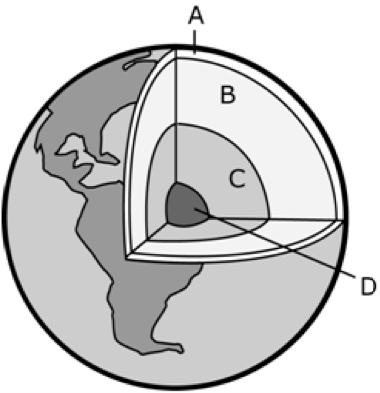
Which letter in the diagram identifies the layer of Earth made up of solid nickel and iron?
layer A
layer B
layer C
layer D
Sally is researching the differences that exist in each layer of the Earth. Which of the following best describes Earth's crust?
Solid, rocky
Liquid, metallic
Semisolid, convecting
Dense, extremely hot
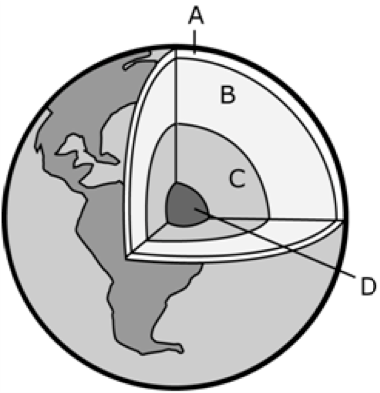
What letter in the diagram identifies the layer that is composed of continental and oceanic plates?
layer A
layer B
layer C
layer D
You are a geologist studying the Earth's structure. You need to correctly identify the order of the layers from the innermost to the outermost. Which of the following is the correct order?
inner core
outer core
mantle
crust
mantle
crust
inner core
outer core
mantle
outer core
crust
inner core
crust
inner core
mantle
outer core
Pressure decreases
Pressure increases
Pressure stays the same
Temperature increases
Temperature decreases
Temperature stays the same
What is the coolest layer?
Crust
Mantle
Outer Core
Inner Core
What is the hottest layer?
Crust
Mantle
Outer Core
Inner Core
The (a) layer is the most dense.
Which layers have convection currents?
Crust
Mantle
Outer Core
Inner Core
What are convection currents?
The cycle of heated materials rising, and cooling materials sinking
The cycle of cooling materials rising, and heated materials sinking
An electric current found in the mantle
An electric current found in the outer core
If we can't travel to the center of the Earth, how do we know so much about it?
Seismic waves, made by earthquakes and man-made explosions
special camera scopes sent through all the layers of the earth
very long thermometers that can reach to the inner core
super powerful x-rays

The layer of the Earth represented by the letter C is (a) .

What layer of the Earth is represented by the letter D?
Crust
Mantle
Outer Core
Inner Core
Bio is equivalent to (a) .
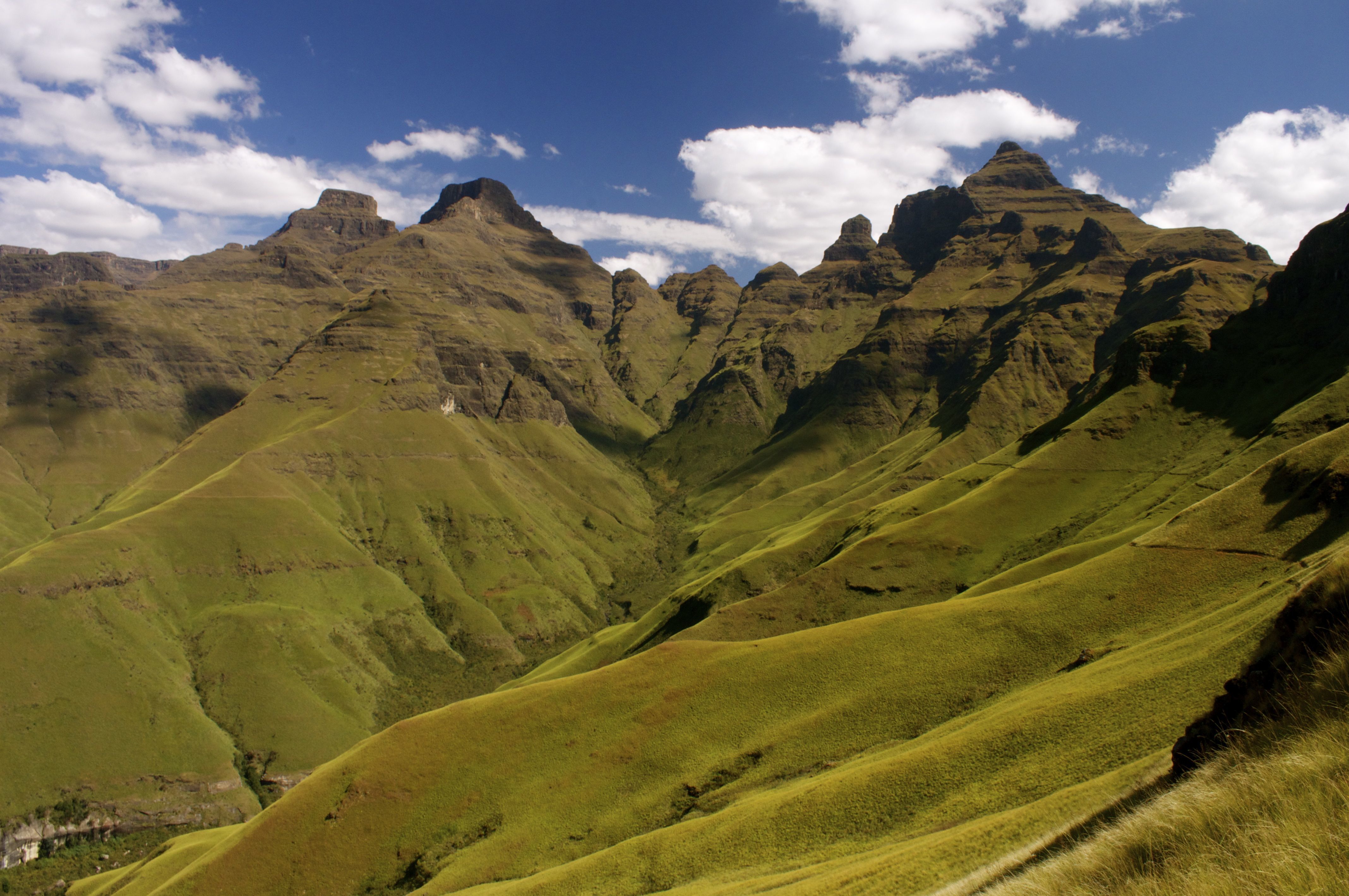

This system is made up of all the water on or near the earth's surface is called the (a) .

Hydro = (a)


Geo = (a)
If a deer was drinking from a pond, what two spheres would be interacting?
Hydrosphere and Atmosphere
Geosphere and Biosphere
Biosphere and Hydrosphere
Atmosphere and Geosphere

A change in one of Earth's spheres will...
Affect all other spheres
Affect none of the other spheres
Affect only one of the other spheres
Affect spheres on every planet in the solar system
Which one is an example of Atmosphere and Geosphere?
A volcano erupts adding Carbon Dioxide to the air.
Air temperature impacts the evaporation of lakes and streams.
Plants use essential elements such as water, carbon and nitrogen from the soil.
Which of the following is found in the Earth's geosphere?
Soil
Rocks
Minerals
All of the Above
When do particles move faster?
When they are warm
When they are cold

Which picture shows material that is more dense?
The picture of the left
The picture on the right
In convection, WARM substances
Rise
Sink
In convection, COOL substances
Rise
Sink

Convection currents happen inside the Earth. Magma is heated by ______ and rises towards the crust.
the sun
the core
plate tectonics

Convection currents happen inside the Earth. Hot magma from the mantle cools as it touches the ______ and transfers heat. Then it sinks back down again.
crust
core
mantle
What type of energy transfer occurs when two things are in direct contact (touching)?
Condensation
Conduction
Convection
Radiation
To check if an iron is hot, you place your hand near the iron and feel that it is warm without touching it. What type of heat transfer is this?
Condensation
Conduction
Convection
Radiation
When you play outside in the sun too long and receive a sunburn, which type of heat transfer is this?
Conduction
Convection
Evaporation
Radiation
Which is an example of heat being transferred by conduction?
a furnace heating the air in a school
an ice cube melting in a person's hand
a pot of water on a stove boiling
the sun heating water in a swimming pool
Which best explains why metal is a good material to make frying pans?
Metal is a good conductor of heat and transfers heat from the stove to the food.
Metal is a good conductor of heat and does not transfer heat from the stove to the food.
Metal is a poor conductor of heat and transfers heat from the stove to the food.
Metal is a poor conductor of heat and does not transfer heat from the stove to the food.
How does heat energy from the Sun reach Earth?
radiation
solar wind
conduction
convection
Sarah is stirring her hot chocolate with a metal spoon, and she notices that the spoon is getting hot. This is most likely caused by which type of heat?
conduction
convection
radiation
insulation

As an object is heated its density
increases
decreases
remains the same
Convection currents occur:
Only in liquids
When a dense substance is warmer than a less dense substance
In both liquids and gases
Weakly in solids


The area around a magnet is called the .....
attraction zone
work area
magnetic field
hot zone
Why is a compass needle attracted to the North?
There wind in the north
Because it is being attracted to the Magnetic South Pole
Because there iron in the north
It repeals from the north pole
Menu
Earth is like a giant magnet due to....
its liquid iron core
the wind patterns of Coriolis Effect
the alignment of the continents
solar particles moving through the atmosphere

How many poles does Earth have?
One pole
Two poles
Three poles
Earth has a magnetic field because of the liquid metal in the ____.
Crust
Mantle
Outer Core
Inner Core
Organize the Layers from the Surface to the Deepest.
Crust
Mantle
Outer Core
Inner Core
Match the layer to its composition.
Crust
Solid Rock
Mantle
Liquid Rock
Outer Core
Liquid Metal
Inner Core
Solid Metal
Match the layer to a handy fact.
Crust
The layer we live on
Mantle
Visible during volcanoes
Outer Core
Creates Earth's magnetic field
Inner Core
The same temperature as the Sun
What does heat do when convection currents are moving?
Sinks
Rises
Stays in place
Macaroni rises and falls in a pot of heated water.
Conduction
Convection
Radiation
The Sun warms your skin on a cold day.
Conduction
Convection
Radiation
Hot chocolate is stirred with a spoon and the spoon gets hot.
Conduction
Convection
Radiation
You burn your hand by touching a hot stove.
Conduction
Convection
Radiation
Warming your feet in front of a fire.
Conduction
Convection
Radiation
Hot air balloon rises.
Conduction
Convection
Radiation
The material in a lava lamp rises and falls.
Conduction
Convection
Radiation
Match these
Heat transfers through waves/rays
Radiation
Liquid (or air) heats up, speeds up and spreads out, becoming less dense. As it rises, it cools, slows, and comes back together. This increases density, making it sink again.
Convection
Heat transfers from objects that are touching.
Conduction
Match these heat transfers

Conduction

Convection

Radiation
Match

radiation

radiation AND conduction

convection

When molecules are heated, what happens to them?
They speed up, becomes less dense, and rise
They speed up, become more dense, and rise
They slow down, become less dense, and sink
They slow down, become more dense, and sink
Match the layer of the Earth with what it is made of.
Iron
inner core
Iron and nickel
outer core
solid rock and water
crust
rocks
Mantle

In what layer of the Earth do people live?
Outer Core
Mantle
Inner Core
Crust
Label the layers of the Earth

Water evaporating from the surface of a lake moves from the (a) to the (b)

Match root-word to the meaning
Atmos
gas
Bio
life
Geo
earth
Hydro
water
Cryo
cold
Earth’s magnetic poles are not the same at Earth’s geographic poles.
True
False

What does the magnetosphere do?
It absorbs solar radiation from the Sun and helps us to navigate
It removes solar radiation from the Sun and helps us to navigate.
It deflects solar radiation from the Sun back out into space and helps us navigate.

Many birds use the magnetosphere to help them to navigate when they are migrating.
True
False

Where´s the north pole of the magnetosphere?
It is at the geographical South Pole, at the bottom
It is at the geographical North Pole, at the top.

Where´s the GEOGRAPHIC North Pole?
It´s in the south, at the bottom.
It is in the north, at the top.

