wayground logo

Free Printable Worksheets

Font size

S
M
L
XL
Worksheets

Grade 7 Final Review

Total questions: 103

Worksheet time: 2hrs 9mins

Name
Class
Date
1.
What is this graph showing?
a)
Constant Speed
b)
Acceleration (speeding up)
c)
Deceleration (slowing down)
d)
No motion
2.
What does this graph represent?
a)
Constant speed
b)
Acceleration
c)
Not moving
3.
What happened during A to B point?
a)
not moving
b)
increasing speed at a constant rate
c)
moving at a constant speed
d)
moving at 10 m/sacceleration
4.

Condensation is...

a)

Liquid to gas

b)

Gas to liquid

c)

Solid to gas

d)

Liquid to solid

5.
Which is the opposite of condensation?
a)
runoff
b)
evaporation
c)
precipitation
d)
transpiration
6.
Snow, sleet, hail, and rain are all examples of  ________________. 
a)
evaporation
b)
condensation
c)
accumulation
d)
precipitation
7.
What is it called when WATER is FORMED from an LIQUID to a WATER VAPOR Oor an [GAS]?
a)
EVAPORATION
b)
PRECIPITATION
c)
TRANSPIRATION
8.
What is it called when plants give off water vapor as a waste product?
a)
condensation
b)
evaporation
c)
sublimation
d)
transpiration
9.
What is the water cycle?
a)
the 3 forms of water
b)
the movement of water on, above, or below the surface of the Earth
c)
when water melts
d)
when clouds form
10.
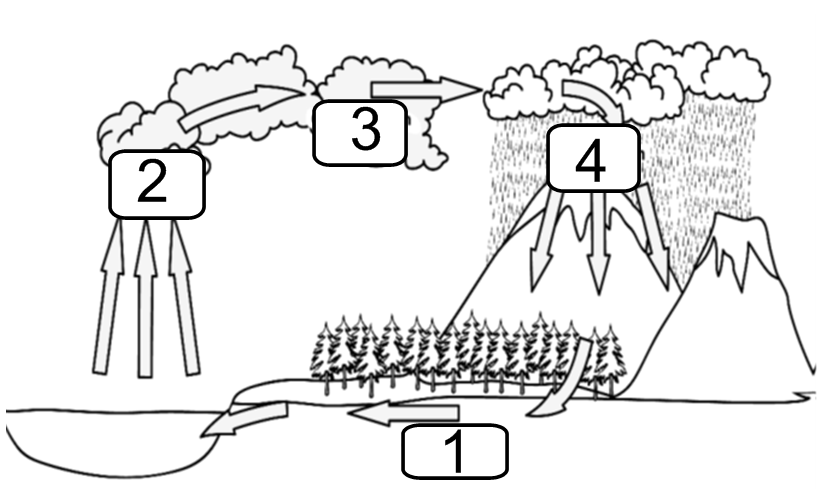
Which stage does the #2 show in the diagram?
a)
condensation
b)
evaporation
c)
precipitation
d)
run off
11.
Which stage does the #3 show in the diagram?
a)
condensation
b)
evaporation
c)
precipitation
d)
run off
12.
Which stage does the #3 show in the diagram?
a)
condensation
b)
evaporation
c)
precipitation
d)
run off
13.
What is the process during which water cools and turns from a gas to a liquid?
a)
Codensation
b)
Runoff
c)
Precipitation
d)
Evaporation
14.
The ________ is the driving force of the earth's surface.
a)
sun
b)
moon 
c)
stars
15.
The water cycle has no start or end
a)
true
b)
false
16.
This is a picture of
a)
snow
b)
rain
c)
fog
d)
hail
17.

What is the geosphere?

a)

mostly made of invisible gas

b)

all the frozen water on the Earth

c)

the mostly solid rocky part of the Earth

d)

the part of the Earth that is liquid water

18.

What is the biosphere?

a)

mostly made of invisible gas

b)

made up of living things

c)

the mostly solid rocky part of the Earth

d)

the part of the Earth that is liquid water

19.

What is the hydrosphere?

a)

mostly made of invisible gas

b)

made up of living things

c)

the mostly solid rocky part of the Earth

d)

the part of the Earth that is liquid water

20.

What is the atmosphere?

a)

mostly made of invisible gas

b)

made up of living things

c)

the mostly solid rocky part of the Earth

d)

the part of the Earth that is liquid water

21.

When a dead plant decomposes into the soil, the interaction is between the __________ and the _____________.

a)

atmosphere and hydrosphere

b)

biosphere and geosphere

c)

hydrosphere and biosphere

d)

atmosphere and geosphere

22.

When an animal or human breathes air, the interaction is between the __________ and the _____________.

a)

atmosphere and hydrosphere

b)

biosphere and geosphere

c)

hydrosphere and biosphere

d)

atmosphere and biosphere

23.

When a river current erodes the banks of the river, the interaction is between the __________ and the _____________.

a)

atmosphere and hydrosphere

b)

biosphere and geosphere

c)

hydrosphere and geosphere

d)

atmosphere and biosphere

24.

When lake water evaporates, the interaction is between the __________ and the _____________.

a)

atmosphere and hydrosphere

b)

biosphere and geosphere

c)

hydrosphere and geosphere

d)

atmosphere and biosphere

25.
All frozen water on Earth is...
a)
Hydrosphere
b)
Geosphere
c)
Cryosphere
d)
Atmosphere
26.
Geo = 
a)
Earth
b)
Sphere
c)
Life
d)
Water
27.
Hydro = 
a)
Sphere
b)
Earth
c)
Life
d)
Water
28.
What kind of energy is in a rock at the edge of a cliff?
a)
Potential
b)
Kinetic
29.
a)
A
b)
B
c)
C
30.
a)
W
b)
X
c)
Y
d)
Z
31.
a)
At the top of the slide
b)
At the bottom of the slide
32.
a)
W
b)
X
c)
Y
d)
Z
33.
a)
Potential
b)
Kinetic
34.
a)
1
b)
2
c)
3
d)
4
35.
a)
1
b)
2
c)
3
d)
4
36.

What is Acceleration?

a)

How long it takes me to win at fortnite

b)

The direction of an object

c)

A change in Motion

d)

How fast something is moving

37.
The picture of the position vs. time graph shows an object that is...
a)
accelerating/speeding up
b)
moving at a constant speed 
c)
not moving 
d)
accelerating/slowing down. 
38.

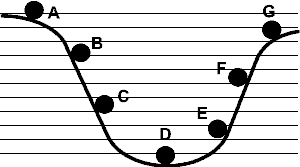
At which point does the ball has the greatest gravitational potential energy (GPE)?

a)

A

b)

G

c)

D

d)

C

e)

G

39.

How could you increase the object's gravitational potential energy (GPE) without changing its distance from the ground (height) and gravity?

a)

Decrease the object's mass

b)

Increase the object's height

c)

Increase the object's mass

d)

Decrease the object's height

40.

Gravitational potential energy depends on the strength of gravity, ________ and ________ of the object.

a)

height and mass

b)

friction and movement

c)

mass and movement

d)

height and friction

41.

At which position does the child on the swing have the most gravitational potential energy?

a)

W

b)

X

c)

Y

d)

Z

42.
What kind of energy does the skateboarder represent? 
a)
potential
b)
chemical
c)
nuclear
d)
kinetic
43.
If a lizard can run 8m across the water in 4 seconds, how fast is he travelling?
a)
32 m/s
b)
2 seconds
c)
2 m/s
d)
34 meters
44.
______________________ is any push or pull on an object.
a)
Force
b)
Mass
c)
Gravity
d)
Air Resistance
45.
Which scientist gave us the laws of motion?
a)
George Washington
b)
John Adams
c)
Sir Isaac Newton
46.
If I kick a soccer ball across the field, what vocabulary word tells me why the ball would slow down in the grass?
a)
acceleration
b)
friction
c)
gravity
47.
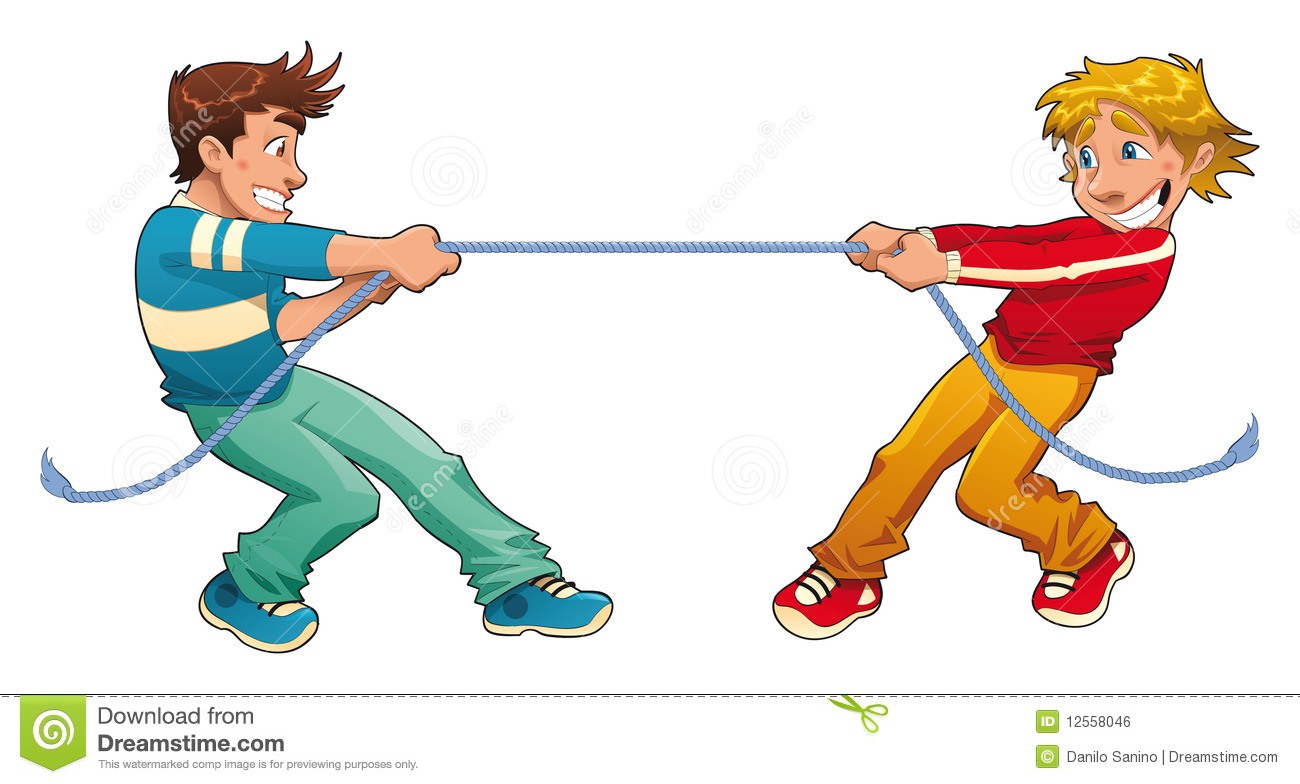
If these boys are pulling with the same amount of force.  What will happen?
a)
The boy in blue will win.
b)
They will not move at all.
c)
The boy in red will win.
d)
Both will fall down.
48.
Which force produces a change in motion?
a)
unbalanced force
b)
balanced force
c)
gravitational force
d)
frictional force
49.
Which of the following statements is true? 
a)
Balanced forces cause a change in motion. 
b)
Unbalanced forces cause a change in motion. 
c)
Forces do not effect the change in motion. 
50.
The force that pulls all objects toward each other is called_______?
a)
push
b)
pull
c)
gravity
d)
mass
51.
A German scientist Alfred Wegener was the first to hypothesize that ...........
a)
Continents were once joined
b)
The sea floor is spreading
c)
Continents are moving
d)
The Earth's magnetic pole flips
52.
Pangaea was an ancient supercontinent made up of...
a)
America, Greenland, and Europe.
b)
Antarctica, India, and America.
c)
all of Earth’s continents.
d)
South Africa, India, Australia, and South America.
53.

What type of event will occur at this boundary?

a)

Earthquake

b)

Volcano Eruption

c)

Tornado

d)

Mountain Building

54.

What is the correct order (starting from the surface) of Earth’s layers?

a)

crust, outer core, inner core, mantle

b)

mantle, outer core, inner core, crust

c)

crust, mantle, outer core, inner core

d)

outer core, inner core, crust, mantle

55.

In sea-floor spreading, molten material rises from the mantle and erupts

a)

along the edges of all the continents.

b)

along mid-ocean ridges.

c)

in deep-ocean trenches.

d)

at the north and south poles.

56.

The process by which the ocean floor sinks beneath a deep-ocean trench and back into the mantle is known as _______

a)

convection.

b)

continental drift.

c)

subduction.

d)

conduction.

57.

Most geologists think that the movement of Earth’s plates is caused by _______

a)

convection.

b)

continental drift.

c)

subduction.

d)

conduction.

58.

The geological theory of _______ states that pieces of Earth’s lithosphere are in constant, slow motion.

a)

subduction

b)

plate tectonics

c)

deep-ocean trenches

d)

sea-floor spreading

59.

A place where two plates slip past each other, moving in opposite directions, is known as a _______

a)

transform boundary

b)

divergent boundary.

c)

convergent boundary.

d)

rift valley.

60.

The place where two plates come together is known as a _______

a)

transform boundary.

b)

divergent boundary.

c)

convergent boundary.

d)

rift valley.

61.

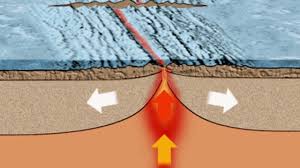
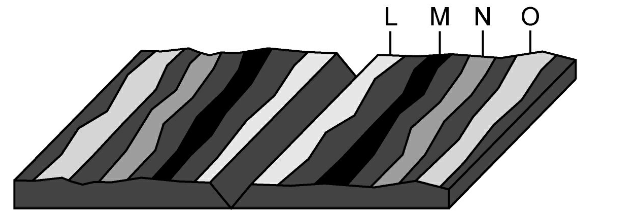
Below is a picture of sea-floor spreading. How are the ocean crusts moving?

a)

Converging

b)

Diverging

c)

Sliding

d)

No movement

62.
Where would the oldest rock be found?
a)
L
b)
M
c)
N
d)
O
63.

The San Andreas Fault in California is known as an active earthquake area. What type of

boundary is it?

a)

Converging

b)

Diverging

c)

Transform

d)

Sea Floor Spreading

64.
This layer of Earth is the thickest part
a)
crust
b)
outer core
c)
mantle
d)
inner core
65.
What are the two types of crust
a)
continental and oceanic
b)
ocean and upper
c)
lower and upper
d)
pizza and subway
66.

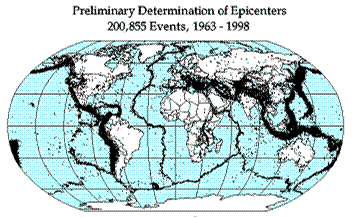
Earthquake epicenters (center of where the earthquakes started) were mapped for a 35 year period in the diagram above. The black dots indicate these epicenters. The black dots appear along what feature on Earth?

a)

hot spots

b)

plate boundaries

c)

rift zones

d)

sea floor spreading

67.
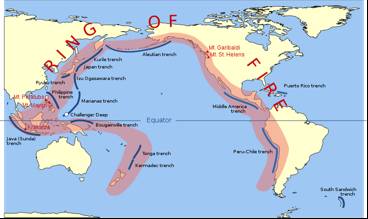
The image shows the Pacific Ring of Fire, a region of high tectonic activity. What evidence supports the theory that the tectonic activity of the region is due to the subduction of tectonic plates?
a)
The region is bound by many oceanic trenches.
b)
North America seems to be colliding with Asia at the north of the ring.
c)
The Asia-Pacific region is dotted by many small and large islands
d)
The landmasses look like they would fit together like the pieces of a jigsaw puzzle.
68.
Hawaii is not located near any plate boundaries, yet it is made up entirely of volcanoes. This occurs because Hawaii sits directly on top of a _________________.
a)
Crater
b)
Tephra
c)
Hot spot
d)
Composite volcano
69.

How does a hot spot create more than one volcano?

a)

the plate moves above the hot spot

b)

the hot spot moves

c)

subducted oceanic crust melts and breaks through the ocean floor in different locations

d)

the pipeline of magma in the mantle moves, blasting new cracks in the crust

70.
 Energy from the sun is known as......... 
a)
hydroelectric energy
b)
geothermal energy
c)
solar energy
d)
wind energy
71.
Which of the following is a nonrenewable resource?
a)
milk
b)
coal
c)
biomass
d)
water
72.
Coal is a __________ energy resource.
a)
Renewable
b)
Nonrenewable
73.
Solar Power is a __________ energy resource.
a)
Renewable
b)
Nonrenewable
74.
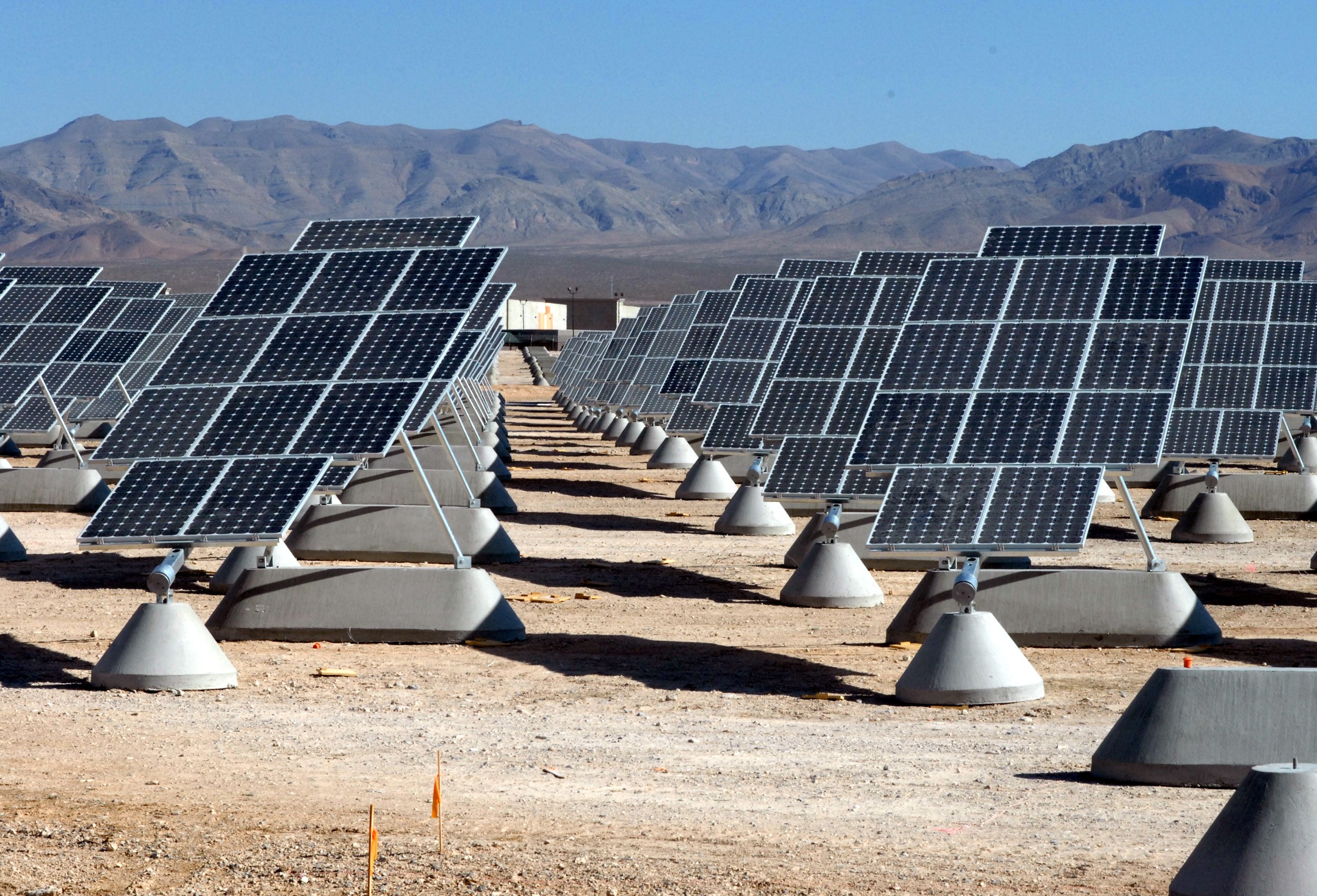
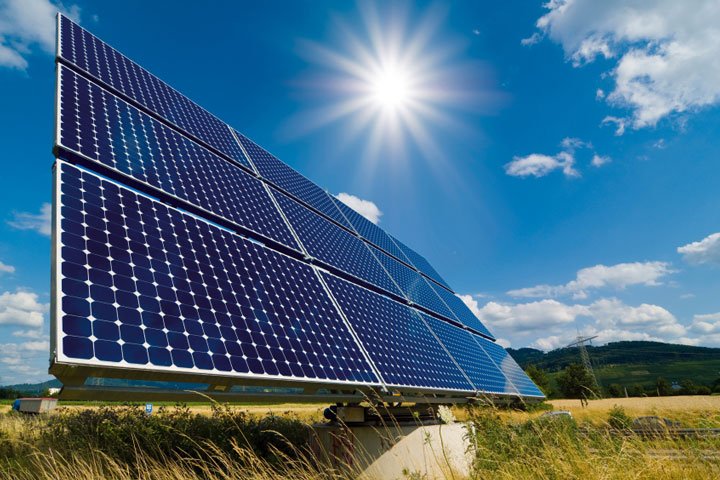
__________is the energy generated from the sun by using solar panels.
a)
Wind
b)
Hydro
c)
Nuclear
d)
Solar
75.
A disadvantage of solar energy is
a)
that the clouds can block the sunlight
b)
it is not available at night
c)
that the clouds can block the sunlight and it is not available at night
d)
the sun is too hot to be absorbed in solar panels
76.
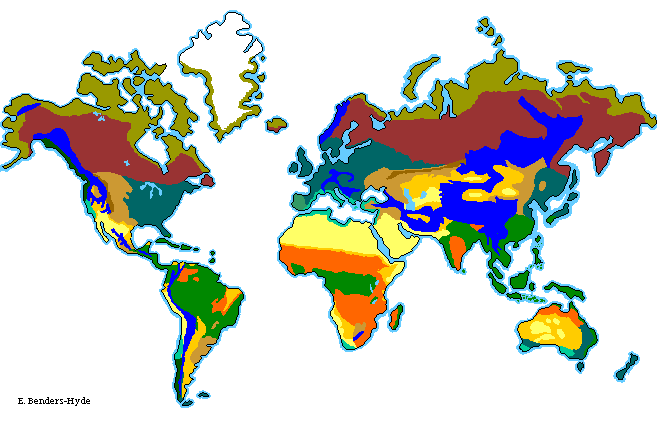
A biome is......
a)
Like a snowglobe that you shake and can see different types of animals.
b)
A large region of earth with a certain type of climate
c)
An area of earth only found in the United States.
d)
A community of living things.
77.

Oceans cover about ______ of the surface of the earth.

a)

60%

b)

70%

c)

80%

d)

90%

78.
A large ecosystem is called a ______
a)
Ecosystem
b)
Habitat
c)
Biome
d)
Niche
79.

The coral reef is found in which of the other biomes?

a)

Freshwater

b)

Marine

c)

Estuary

d)

Rainforest

80.
The diagram shows a boat using sonar to gather information in the ocean. What is most likely being measured with this technology?
a)
ocean depth
b)
ocean temperature
c)
pH level
d)
turbidity level
81.

The population of photosynthetic organisms is higher in the surface waters than in the deep ocean. Which statement best explains the reason for this?

a)

There is more space for plants to grow in these areas of the ocean.

b)

There is more dissolved oxygen for plants in these areas of the ocean.

c)

The availability of sunlight and nutrients supports photosynthetic organisms.

d)

The high salinity and cool temperature supports photosynthetic organisms.

82.
In which organism(s) does photosynthesis occur?
a)
plants
b)
algae
c)
some bacteria
d)
all of these
83.
What gas do producers need in order to perform photosynthesis?
a)
oxygen
b)
carbon dioxide
c)
hydrogen
d)
nitrogen
84.
How do organisms get the energy they need?
a)
Plants get energy from fertilizers and animals get energy from drinking water.
b)
Plants get energy from glucose produced in the soil, and animals get energy directly from sunlight.
c)
Plants break down the glucose they produced in photosynthesis, and animals get energy from eating other organisms.
d)
Plants do not require energy because they do not move, and animals get energy by performing exercise.
85.
The following diagram shows the relationship between photosynthesis and respiration.  What products of photosynthesis are starting material for cellular respiration?
a)
glucose and oxygen
b)
heat energy and ATP
c)
carbon dioxide and water
d)
light energy and chlorophyll
86.
What is the chemical equation for cellular respiration?
a)
Glucose + Oxygen -> Carbon dioxide + Water + Energy
b)
Oxygen + Carbon dioxide + Energy  -> Glucose + Water
c)
Carbon dioxide + Glucose -> Oxygen + Water + Energy
d)
Water + Carbon dioxide + Energy -> Oxygen + Glucose
87.
A plant growing in response to the sunlight. 
a)
Gravitropism 
b)
Phototropism
c)
Thigmotropism
d)
Hydrotropism
88.
What is the source of energy for photosynthesis?
a)
carbohydrates-chemical
b)
sunlight-radiant
c)
heat-thermal
d)
television-electrical
89.
The Law of Conservation of Energy states:
a)
Energy can created or destroyed but not transformed 
b)
Energy cannot be created or destroyed, it can only transformed
c)
Energy can't be created, destroyed or transformed
90.
Conduction can only occur between two objects when –
a)
one object is less dense than the other.
b)
both objects are in physical contact with each other.
c)
one of the objects is made of a metal.
d)
both objects are exactly the same temperature.
91.
Radiation is a method of thermal energy transfer that moves -
a)
through empty space.
b)
when objects touch.
c)
only through solids.
d)
in the motion of fluids.
92.
Which of the following describes a way in which heat energy will be transferred by conduction?
a)
Sample 1 to Sample 2
b)
Sample 3 to Sample 2
c)
Sample 3 to Sample 1
d)
Sample 2 to Sample 3
93.
When you leave your cold drink outside, the glass may have water drops on it.  This is an example of...
a)
condensation
b)
evaporation
c)
precipitation
d)
estuary
94.
_________________________ is a measure of the average kinetic energy of the particles in a material.
a)
thermal
b)
friction
c)
temperature
d)
expansion
95.
The movement of thermal energy from a warmer object to a cooler object is called:
a)
heat
b)
temperature
c)
motion
d)
momentum
96.

A measure of the average kinetic energy of the individual particles in an object is called:

a)

thermal energy

b)

conduction

c)

convection

d)

temperature

97.

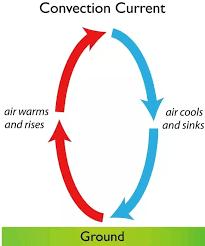
Which of the following is an example of convection?

a)

A hair dryer is drying up your hair.

b)

When the AC or heater changes the temperature.

c)

When a car engine turns hot after being turned on.

d)

When you are making soup and the water is rising and lowering.
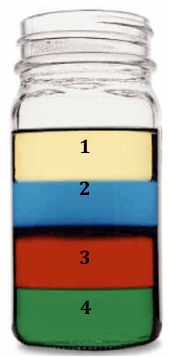
98.
Put the liquids in order from most dense to least dense?
a)
4, 3, 2, 1
b)
1, 2, 3, 4
c)
3, 4, 2, 1, 
d)
4, 3, 1, 2
99.
Why does ice float?
a)
Liquid water is less dense than solid water.
b)
Solid water is less dense than liquid water.
c)
Gaseous water is less dense than solid water.
d)
Liquid water is less dense than gaseous water.
100.
Which box has a higher density?  
a)
Box A
b)
Box B
c)
cannot be determined
d)
they are the same
101.
A piece of copper has a mass of 89g and a volume of 10 cm3.  What would be the density of the copper?
a)
0.89 g/cm3
b)
89 g/cm3
c)
8.9 g/cm3
d)
890 g/cm3
102.
What units are used to measure Density?
a)
cm3/g
b)
g
c)
g/cm3
d)
cm3
103.
Volume is ...
a)
Mass/Volume
b)
The amount of matter in an object.
c)
The amount of space an object occupies.
d)
Anything that has mass and occupies space.