
 Worksheets
8th Grade BM 2 Study guide
Total questions: 100
Worksheet time: 2hrs 54mins
An attractive force that exists between all objects that have mass.
vector
speed
gravity
friction
The gravitational force exerted on an object is _____.
field
weight
mass
gravity
The starting point you choose to describe the location or position of an object is _____.
motion
speed
reference point
contact force
The difference between the initial or starting position and the final position is _____.
Newton's second law of motion
The law of action and reaction
net force
displacement
When an object applies a force on another object, the second object applies a force of the same strength on the first object, but the force is in the opposite direction. This is stated is which of Newton's laws?
Newton's first law
Newton's second law
Newton's third law
normal force
A quantity that has both magnitude and direction is a _____.
velocity
vector
acceleration
force pair
The speed and direction of a moving object is _____.
speed
force
friction
velocity
The combination of all forces acting on an object is _____.
force
speed
net force
force pair
The tendency of an object to resist a change in motion.
speed
inertia
time
vector
The SI unit for mass is _____.
kg
N
m/s2
g
The SI unit for force is _____.
kg
N
m/s2
g
The SI unit for acceleration is _____.
kg
N
m/s2
g
1st
Law of Motion
2nd
Law of Motion
3rd
Law of Motion
A 20 kg bike accelerates at 10 m/s2. What was the force?
30 Newtons
2 Newtons
200 Newtons
10 Newtons
15 m/s2
5 m/s2
.5 m/s2
10 m/s2
What is the equation for speed?
Speed = distance/time
Speed = time/distance
Speed = distance x time
Speed = time x distance
A student walks 20 m north, 10 m south, and then 3 m north. To have a displacement of 0 m, the student should walk ____ m toward the ____.
13; south
13; north
20; south
20; north
What is the changing of position over time?
motion
reference point
acceleration
speed
_______ is the length of the path between two points.
distance
reference
statistic
law


What is this graph showing?
Constant Speed
Acceleration (speeding up)
Negative Acceleration (slowing down)
No motion

Be careful!!!!! This is a speed-time graph
What does this line represent?
constant speed
not moving
speed increasing
speed increasing at a constant rate
What is the relationship between force and mass?
inverse relationship
direct relationship
What is the relationship between force and acceleration?
inverse relationship
direct relationship
What is the relationship between mass and acceleration?
inverse relationship
direct relationship
A scalar quantity includes _____.
magnitude (size)
direction
both magnitude and direction
neither magnitude nor direction
Cutting a bar magnet in TWO will
Ruin the magnet
Create two magnets, each with both poles
Destroy the magnetic properties since the poles are separated
Create two magnets, each with only one pole
The BEST way to increase the strength of an electromagnet would be to
Increase the amount of wire
Decrease the mass of object the electromagnet will be used on
Increase the size of the battery and the amount of wire
Increase the number of wire coils and the size of the battery
Anything that has mass and takes up space is
Atoms
Material
Particles
Matter
Atoms are composed of what subatomic particles?
Neutrons
Electrons
Matter
Protons
A property that leads to electromagnetic interactions between the particles that make up matter?
Gravitational force
Electric charge
North pole of magnet
South pole of magnet
What is the center of the atom?
Electrical charge
North pole of magnet
South pole of magnet
Nucleus
What is an exerted force between two charged objects through conduction, inductions, or friction, that can either pull these charged objects together or apart?
Gravitational force
Magnetic force
Electric force
Two objects rubbed together can cause
Neutralization of the objects
Gravitational force to strengthen
No significant change to occur
The transfer of electrons
What happens to your laundry when clothes come out of the dryer sticking together?
The transfer of electrons
Electrons aligning
The transfer of protons
Protons aligning
A material through which charges can move freely?
Insulator
Conductor
A material through which charges cannot move easily?
Insulator
Conductor
Which is not a type of conductor?
Gold
Oil
Aluminum
Iron
Which is not a type of insulator?
Glass
Wood
Oil
Gold
What happens to electrons when something gets magnetized?
The electrons align
The electrons transfer
The electrons neutralize
What is the net force of an object that has a force of 10 N to the west, and 6 N to the east?
16 N
4 N
No force
60 N
The size if the electromagnet is
Directly proportional to the number of coils
Inversely proportional to the number of coils
The strength of the electric charge of objects.
Directly proportional to the number of coils
Inversely proportional to the number of coils
The continuous flow of electric charge through a material is
Magnetic current
Electric current
Gravitational pull
Electric charges will always flow from a region of
Low potential energy to high potential energy
High potential energy to low potential energy
What is a resistor?
Stops the flow of the electric current
Restricts the flow of an electric current
Accelerates the flow of electric current
When an electric current reaches an open switch the current
Stops
Continues
What type of circuit provides only 1 type of path for the flow of current?
Series circuit
Parallel circuit
What is a switch on an electrical circuit?
Device used to control the strength of the current
Device used to control the flow of the current
Device used to control the charge of the current
Device used to control the conductors used

What type of circuit is the image?
Series circuit
Parallel circuit
If you have a series circuit with a 9-volt battery and 3 light bulbs attached to it, how much voltage is each light getting?
9 volts
3 volts
12 volts
1 volt
If you have a parallel circuit with a 9-volt battery and 3 light bulbs attached to it, how much voltage is each light getting?
9 volts
3 volts
12 volts
1 volt
What will happen to the lights in a series circuit if you add another light to the circuit?
The lights will have more brightness than before
The lights will give off less light than before
There will be no change in the amount of light given off
The lights will be twice as bright
What will happen to the lights in a parallel circuit if you add another light the circuit?
The lights will have more brightness than before
The lights will give off less light than before
There will be no change in the amount of light given off
The lights will be twice as bright
Which of these bests describes an electromagnet?
A permanent magnet made from electric currents.
A temporary magnet made from electric currents.
A temporary magnet made from magnetic currents.
Which of the following will increase the strength of an electromagnet?
Increase the voltage of the battery
Decrease the voltage of the battery
Wrap the coils around the core less times
What are the components of the electromagnets?
battery, wire and bulb
battery , copper wire and paper clips
battery, copper wire and iron nail
battery, wire and aluminum
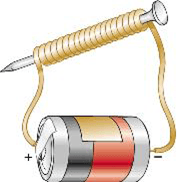
Bob made an electromagnet but it was very weak. How can he make it stronger?
Increase the flow of current
wrap the wire loosely
use less coils
Use thin core of iron
Which is not true of light waves travel?
Light waves travel around corners
Light waves can bend in different directions
Light waves can be absorbed
Light waves are electromagnetic waves
What are the properties of a wave?
Amplitude, wavelength, and frequency
Amplitude, wavelength, and production
Wavelength, frequency, and production
Mechanical and electromagnetic
A wave is a disturbance that transfers __________ from one place to another.
Matter
Mass
Energy
What types of waves can travel through empty space and mediums?
Longitudinal
Mechanical
Electromagnetic
Which of the following is a mechanical wave?
X-ray
Infrared
Radio waves
Sound
The number of waves passing a given point each second is:
Frequency
Wave speed
Wavelength
Amplitude
What is the correct formula for wave speed?
Wave speed = frequency X wavelength
Wave speed = amplitude X wavelength
Wave speed = amplitude X period
Wave speed = frequency X period
__________ refers to the number of waves produced per second by an energy source.
Amplitude
Frequency
Wavelength
__________ is the height of the wave from normal level to the highest point.
Amplitude
Frequency
Wavelength
The highest point on the wave is the __________.
Crest
Trough
Amplitude
Frequency
The distance from one peak of the wave to the next peak in the wave is the _________.
Crest
Trough
Wavelength
Frequency
What relationship does frequency and wavelength have?
directly related
inversely related
When referring to a sound wave, as the wavelength decreases the pitch of sound _____.
increases
decreases
stays the same
As the amplitude and frequency of a wave increases, the energy of the wave ________.
Increases
Decreases
Stays the same
Choose the best definition of a simple wave.
A wave that has one crest and one trough
A wave created from one pulse of energy
A wave that has a repeating and predictable pattern
A wave that only lasts 1 sec
Electromagnetic waves __________ while mechanical waves __________.
Do not have crests and troughs; do
Do not need a medium to travel; do need a medium to travel
Are only longitudinal waves; are only transverse waves
Are sound waves; are light waves
Sound waves are __________, and light waves are __________.
Mechanical; electromagnetic
Electromagnetic; mechanical
__________ refers to waves being deflected and distorting when they pass at an angle from one medium to the next.
Reflection
Refraction
Transmission
Absorption
If you shine a light through a blanket, but you see no light on the other side, the light has been __________.
Reflected
Refracted
Transmitted
Absorbed
If someone is talked above the water, but you are trying to hear them under the water, what happens to the sound under water?
It is being reflected
It is being refracted
It is being transmitted
It is being absorbed
What type of signal has an infinite amount of signal resolution?
Analog
Digital
What type of signal has only 1s and 0s in the signal?
Analog
Digital
What are the 1s and 0s called in a signal?
Analog
Digital
Binary code
Transmission
If a digital signal is trying to transmit, and it interrupted by something, what happens to the signal when the interruption goes away?
The signal will continue
The signal will need to start over in order to transmit
What type of signal degrades over long distances if amplifiers and boosters are not utilized?
Analog signal
Digital signal
Which signal is more reliable?
Analog signal
Digital signal

In the figure shown, If the angle i increases slightly, angle r will _____.
remain the same
decrease
increase
disappear
Why does sound travel at different speeds through different materials?
because long wavelengths travel farther than short wavelengths
because sound transmission involves interaction between particles in matter
because matter causes sound to echo
because sound travels fastest in low density situations
What happens as the frequency of a wave increases?
its amplitude decreases
its wavelength increases
its amplitude increases
its wavelength decreases
When light is reflected, what determines the angle of reflection?
the substance through which light is traveling
the angle of incidence
the substance reflecting the light
the brightness of the light
Loudness is the human perception of sound wave's _____.
amplitude
pitch
speed
frequency

What is frequency measured in?
Milliseconds
Miles
Hertz
Kilograms

Wavelengths are usually measured in ....
seconds
Hz
inches
meters
Which statement best describes the movement of a transverse wave?
Particles of the medium move perpendicular to the direction of the wave's movement
Particles of the medium move parallel to the direction of the wave's movement
Particles of the medium circle around the direction of the wave's movement
Particles of the medium radiate outward compared to the wave's movement
Which statement best describes the movement of a longitudinal wave?
Particles of the medium move perpendicular to the direction of the wave's movement
Particles of the medium move parallel to the direction of the wave's movement
Particles of the medium circle around the direction of the wave's movement
Particles of the medium radiate outward compared to the wave's movement
What determines the pitch of sound?
Amplitude
Frequency
Wavelength
The type of sound wave
How is amplitude related to the energy of a mechanical wave?
Directly related
Inversely related

