
 Worksheets
Earth/Space Science CFE Review 2022 Part 2
Total questions: 100
Worksheet time: 1hrs 10mins
Most stars are?
Red giants
White dwarfs
Main sequence
Supergiants
If our Sun died out, what would it become?
Pulsar
White dwarf
Black hole
Neutron Star
What type of stars are the hottest?
yellow
white
red
blue
Where are stars "born"?
from the sun
in a nebula
in a supernova
in a white dwarf
The brightness of a star depends on?
its size
its temperature
its distance from earth
All of the options
Our sun is currently in what star stage?
Protostar
Nebula
Main Sequence
Red Giant


As the _________ of a star increases, luminosity increases.
size
distance
age
composition
The luminosity of a star describes its ______________.
brightness
temperature
age
color

What is the diagram called that shows the relationship between star size and temperatures?
bar graph
HR diagram
star chart
Star diagram

Which portion of the electromagnetic spectrum includes the range of light that can be detected by the human eye?
ultraviolet light
visible light
infrared light
x-rays

In which list are forms of electromagnetic energy arranged in order from longest to shortest wavelength?
Microwave -> Radio wave -> Infrared rays
Visible light -> x-ray -> radio wave
Microwave -> infrared -> visibile light
Infrared -> radio wave -> ultraviolet
As frequency increases on the electromagnetic spectrum, what happens to the wavelength?
It stays the same
It decreases
It increases
It doubles
Scientists use the light-year to describe the relationships between objects in space. What does a light-year measure?
the distance that light can travel in one year
the brightness of light that travels through space
the number of years it takes light to travel to Earth
the time it takes light to travel 1 million km
The sun is much larger than the moon. However, as viewed from Earth, the sun and moon appear to be the same size. Why do the sun and moon appear to be the same size when viewed from Earth?
The moon is much hotter than the sun.
The moon is much denser than the sun.
The moon is much brighter than the sun.
The moon is much closer to Earth than the sun.
An astronomical unit is...
The average distance between the Earth and the Sun
The average distance between the Sun and Neptune
The diameter of the sun
The time it takes light to travel across our solar system
Astronomical units are used for
Distances within a solar system
Distances between solar systems
Distances within galaxies
Distances between galaxies
_______________ would be the best unit to use to measure the distance between the asteroid belt and Pluto
Astronomical units
Light seconds
Light years
Parsecs
_______________ would be the best unit to use to measure the distance between the our sun and Proxima Centauri (our nearest star neighbor).
Astronomical units
Light seconds
Light years
An object at the other end of the universe is billions of ___________ away.
AUs
Light seconds
Light minutes
Light years

Which distance is greatest?
1 light year
2 light years
5 Au’s
1 parsec

Proxima Centauri is the closest star to Earth after the Sun and is located 4.2 light years away from Earth. How long does it take light from Proxima Centauri to reach Earth?
4.2 years


The diagram below shows the relative positions of Earth and the Moon and rays of sunlight. Based on the diagram, which of the following best represents how the Moon would appear as seen from Earth?


What is the best explanation of moon phases?
As the moon passes behind Earth, it is covered by Earth’s shadow.
As the moon orbits Earth we see different amounts of the illuminated side of the moon.
The seasons cause the phases of the moon.
The moon is brighter when it is closer to the sun.
How much of the moon is always reflecting light from the sun?
Half of the moon is reflecting sunlight only during the new moon phase.
Half of the moon is reflecting sunlight only during the full moon phase.
All of the moon is reflecting sunlight at all times.
Half of the moon is reflecting sunlight at all times.
How do scientists believe gravity influenced the formation of the planets in our solar system?
A large cloud of gas and dust ignited into a planet.
Gravity pulled the planets out of the Sun.
A large explosion created the planets.
Large pieces of debris clumped together to form planets.
What are the steps of the Nebular Theory?
Step 1: A tiny point rapidly expanded
Step 2: Helium was compressed into stars
Step 3: The stars explode and turn into planets
Step 1: Gravity pulled together atoms in a nebula
Step 2: Nuclear fusion occurred and a star is born
Step 3: Smaller clumps around the star formed into planets
Step 1: The solar system formed because of the Big Bang
Step 2: Our solar system was the first one
Step 3: Dark energy is pushing other solar systems away
Step 1: Gaseous planets will orbit the Sun slower
Step 2: Rocky planets will orbit the Sun faster
Step 3: The Sun will vaporize all the inner planets
According to the current theory used to explain the origin of our solar system, which of the following would be a logical inference about newly discovered planetary systems?
Planetary systems contain about one-tenth the mass of their central star.
Planetary systems were formed by fusion of hydrogen in their cores.
Planetary systems were captured into orbit by their central star's
Planetary systems were formed from the same nebular cloud as their central star.
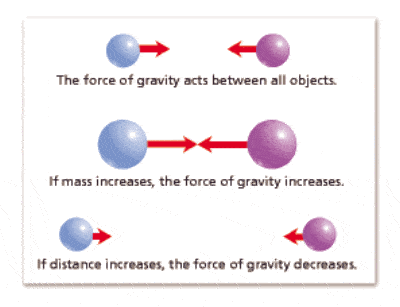
The Force of gravity is INVERSELY proportional to _________.
Mass
Weight
Distance
Time
One piece of evidence that supports the big bang theory is the observation that most galaxies are
moving toward our galaxy.
moving toward on another.
moving away from one another.
not moving.
The apparent shift in position of an abject when viewed from two different places is called
parallax
apparent magnitude
absolute magnitude
nebula
As galaxies move away from our galaxy
a shift on the electromagnetic spectrum
(EMS) is noticed. This phenomena is
called _____________.
redshift
blueshift
unshift
blackshift
When light waves are moving away from us why are the waves redshifted?
the light waves are stretched
the light waves are squished
they aren't redshifted
An Astronomical Unit is the average distance between
the Earth and the Moon.
the Earth and the Sun.
the Moon and the Sun.
the Earth and Jupiter.
What is a Parsec?
It is the distance a star's angle shifts in one day.
It is the distance a star's angle shifts in one year.
It is the distance a star's angle shifts in one month.
It is the distance a star's angle shifts in two years.
How many light years are in one parsec?
3.26
1/3600
8.2
360
What is the name given to the dispersed energy in the universe that provides evidence for the big bang?
Cosmic background radiation
Chemical blast radiation
Dispersed stellar radiation
Electromagnetic radiation
The process that heat is transferred by circulation of matter through a fluid is
radiation
convection
conduction
The process by which energy is transferred as electromagnetic waves is called
radiation
convection
conduction
The sun produces large amounts of energy. By what process does the sun produce energy?
radiation
convection
nuclear fusion
electromagnetic radiation


sort of cool, dim (not too much light), and red?

What will be the next stage in our star the sun's life cycle?
supernova
white dwarf
blackhole
red giant

All stars begin their life in a
Main Sequence
Nebula
Protostar
Black Dwarf


Based on the information in the table, list the stars from dimmest to brightest when viewed from Earth's surface.
A, B, C, D
D, A, B, C
A, C, B, D
D, B, C, A

The picture below shows a scan of a nebula. There are two images. One image was created using visible light and the other using infrared light. Notice the two arrows point to two celestial objects in the infrared image. These two celestial objects are believed to be newly developed stars.
Which of the following reason are the two celestial objects visible only in the infrared image?
The infrared image detects brighter objects.
The visible light image detects brighter objects.
The two celestial objects give off more infrared light than visible light.
The two celestial objects give off more visible light than infrared light.
Both radio waves and microwaves can be used for communication purposes. Which statement correctly compares these two types of electromagnetic waves?
Radio waves travel faster than microwaves.
Microwaves have a longer wavelength than radio waves.
Microwaves are higher in energy than radio waves.
Radio waves have a higher frequency compared to microwaves.
The energy that is radiated to Earth by the Sun includes visible light, infrared radiation, ultraviolet radiation, and other types. These different forms of radiation are distinguished based on what property?
Amplitude
Wavelength
Speed
Intensity
In 1984, Lansat 5 was launched into space. This satellite is still operating today and has produced over 700,000 images. These images contain red, blue, and green wavelengths of light. These wavelengths were produced by the sunlight that bounced off Earth’s surface. What type of electromagnetic radiation does Lansat 5 use to produce these images?
Visible light
Radio waves
Gamma Rays
Ultraviolet Light
In which list are forms of electromagnetic energy arranged in order from highest to lowest frequency?
radiowaves, gamma waves, ultraviolet waves, microwaves
x-rays, visible light, microwaves, radiowaves
visible light, infrared, ultraviolet waves, x-rays
infrared, visible light, ultraviolet waves, gamma waves

What is a body of saturated underground rock containing water?
Sinkhole
Cavern
Aquifer
Lake
This landform can be made when a sinkhole becomes plugged with sediment and fills with water.
River Delta
Cavern
Lake
RIver
This landform is made when a rivers speed slows down and sediment is deposited.
River Delta
Coastline
Dune
Lake
This landform is made when carbonic acid dissolves underground rock.
Mountain
Cavern
River Delta
Coastline
This landform is made when a cavern collapses and land falls into a cavity.
Dune
Mountain
Sinkhole
Aquifer
Earth's surface is constantly changing and new landforms are constantly taking shape due to natural processes. Which landform is most likely caused by deposition?
caves
deltas
lakes
valleys

One type of lake that can be found in Florida is perfectly round in shape. These lakes are formed when the acid in groundwater dissolves limestone underground, forming a cave. Eventually, the cave roof weakens and collapses, and then the cave fills with water. Which of the following is this type of landform called?
an oxbow lake
an volcanic lake
a glacial lake
a sinkhole lake
Lake Eola is a sinkhole lake. Which of the following statements best describes how it formed?
An underground cave collapsed due to groundwater erosion.
Plate tectonic movement cracked the Earth and it filled with water.
A cut-off meander of a stream formed a crescent-shaped lake.
A chunk of ice deposited by a glacier melted, and the glacial drift around the former ice block held the water in place.
Dissolving, Oxidation, and Acid Rain are examples of what kind of weathering?
Erosion

The physical breaking down of rocks into smaller pieces is...
Mechanical weathering
Chemical weathering
All weathering
Erosion weathering

How is mechanical weathering different from chemical weathering?
Chemical weathering happens over a much shorter time frame than mechanical weathering
Chemical weathering occurs in the tropics; mechanical weathering occurs in temperate climates
Chemical weathering occurs in mountains; mechanical weathering occurs on flat surfaces
Chemical weathering changes the chemical composition of materials; mechanical weathering does not
What is the difference between weathering and erosion?
Erosion breaks down the rocks, and weathering carries the broken pieces away.
Erosion carries broken pieces away, and weathering builds the pieces back up into another land mass.
Weathering carries broken pieces away, and erosion builds the pieces back up into another land mass.
Weathering breaks down rocks, and erosion carries the broken pieces away.

The tallest sand dunes in North America are found in Great Sand Dunes National Park and Preserve in Colorado. These dunes were formed from the sand at the bottom of a dry lake bed. Which of the following agents is most likely responsible for the formation of the sand dunes?
Wind
Water
Ice
Gravity
Sand Key is a barrier island located along the coast of Florida. Which process most likely caused Sand Key to form? SC.6.E.6.1
sudden erosion of a sandbar
deposition of sand over time
wearing down of rocky cliffs
transfer of sand along a beach

