wayground logo

Free Printable Worksheets

Font size

S
M
L
XL
Worksheets

Earth's Layers, Minerals, and Rocks

Total questions: 100

Worksheet time: 1hrs 6mins

Name
Class
Date
1.

Minerals can be formed through the cooling of?

a)

Lava

b)

Magma

c)

Rock

d)

Dirt

2.

What is ore?

a)

Ore is a mineral that contains a useful substance, like iron.

b)

Ore is a rock that the hardest minerals on Earth.

c)

Ore is what is used to heat furnaces.

d)

Ore flies through space and can crash into planets.

3.

The layers of the earth from innermost layer to outermost layer are _________, _________, __________, and ____________.

a)

inner core, outer core, crust, mantle

b)

crust, inner core, mantle, outer core

c)

inner core, outer core, mantle, crust

d)

mantle, crust, inner core, outer core

4.

The iron and nickel that comprise (make up) the inner and outer core are ____________ in the inner core, but ________ in the outer core.

a)

solid, gaseous

b)

liquid, solid

c)

solid, liquid

d)

liquid, gaseous

5.

How does sedimentary rock become metamorphic rock?

a)

Through heat and pressure, which melts sedimentary rock until it becomes metamorphic.

b)

Through heat and erosion, which boils the sedimentary rock until it becomes metamorphic.

c)

Through erosion and cooling, which changes the sedimentary rock until it becomes metamorphic.

d)

Through erosion and compacting, which changes the sedimentary rock until it becomes metamorphic.

6.
The remains of a living thing that lived long ago which have turned to rock are called____________.
a)
sediment
b)
rock
c)
soil
d)
fossils
7.
Which type of rock is most likely to have fossils?
a)
igneous rock
b)
sedimentary rock
c)
magma
d)
metamorphic rock
8.
What layer is the thinnest?
a)
Crust 
b)
Mantle
c)
Core
d)
They are all the same size
9.
A dense ball of solid iron and nickel.
a)
crust
b)
inner core
c)
mantle 
d)
outer core
10.
Temperature _____________________ as you go deeper into the earth.
a)
increases
b)
decreases
c)
goes up and down depending on the layer
d)
stays the same
11.
Pressure ______________________ as you go deeper into the Earth
a)
increases
b)
decreases 
c)
goes up or down depending on the layer
d)
stays the same
12.
Which layer of Earth is characterized by rock that is plastic, or soft enough to flow?
a)
asthenosphere
b)
crust
c)
lithosphere
d)
inner core
13.

Oceanic crust is more dense than continental crust?

a)

true

b)

false

14.

Scientists know about the Earth Layers due to _________.

a)

volcanic activity

b)

seismic waves

c)

magnetic properties

15.
This is the outermost, rigid layer of the Earth, made up of two parts, is divided into pieces call tectonic plates.
a)
Inner Core
b)
Asthensophere
c)
Lithosphere
d)
Outer Core
16.
The way in which a mineral's surface reflects light.
a)
Cleavage
b)
Fracture
c)
Density
d)
Luster
17.
The tendency of a mineral to break along smooth, flat surfaces.
a)
Cleavage
b)
Fracture
c)
Hardness
d)
Streak
18.
The color of a mineral's powder form.
a)
Streak
b)
Hardness
c)
Magnetism
d)
Luster
19.
There are over 3,500 known minerals.  90% are...
a)
Silicates
b)
Nonsilicates
c)
Native elements
d)
Oxides
20.

Minerals have a definite chemical composition.

a)

TRUE

b)

FALSE

21.

A mineral's mass to volume ratio describe the property of...

a)

Streak

b)

Hardness

c)

Density

d)

Luster

22.

A mineral always contains certain elements in definite proportions. This is referring to its

a)

streak

b)

definite chemical composition

c)

luster

d)

inorganic

23.

The repeating pattern of a mineral's particles in a solid is known as

a)

crystal structure

b)

streak

c)

fracture

d)

luster

24.

The color of a mineral's powder left behind after it is scratched on a piece of unglazed tile is its

a)

color

b)

cleavage

c)

luster

d)

streak

25.

What term means that a mineral CANNOT form from materials that were once part of a living thing?

a)

solid

b)

naturally occuring

c)

inorganic

d)

luster

26.

A substance that is formed by processes that occur in the natural world is

a)

solid

b)

definite chemical composition

c)

fracture

d)

naturally occuring

27.

How a mineral breaks apart when it does NOT split evenly is known as

a)

cleavage

b)

fracture

c)

luster

d)

solid

28.

How a mineral reflects light from its surface is known as

a)

streak

b)

element

c)

fracture

d)

luster

29.
A mineral's resistance to being scratched is called?
a)
streak
b)
luster
c)
hardness
d)
heft
30.
What are the two types of luster? 
a)
Metallic and Metallic
b)
Nonmetallic and Shiny
c)
Metallic and Nonmetallic
d)
Shiny and Dull
31.
True or False: Minerals make up rocks. 
a)
True
b)
False
32.
Formed by heat and pressure
a)
Sedimentary
b)
Metamorphic
c)
Extrusive Igneous
d)
Intrusive Igneous
33.
Formed by cooling & solidification of lava
a)
Sedimentary
b)
Metamorphic
c)
Extrusive Igneous
d)
Intrusive Igneous
34.
Formed by cooling & solidification of magma
a)
Sedimentary
b)
Metamorphic
c)
Extrusive Igneous
d)
Intrusive Igneous
35.
Formed by compacting & cementing of sediments
a)
Sedimentary
b)
Metamorphic
c)
Extrusive Igneous
d)
Intrusive Igneous
36.
Formed by weathering & erosion
a)
magma
b)
sediments
c)
sedimentary rock
d)
intrusive igneous
37.
Formed by melting
a)
magma
b)
sediments
c)
sedimentary rock
d)
intrusive igneous
38.
Has large crystals because of slow cooling
a)
sedimentary rock
b)
metamorphic rock
c)
intrusive igneous rock
d)
extrusive igneous rock
39.
Has small or no crystals because of rapid cooling
a)
sedimentary
b)
metamorphic
c)
extrusive igneous
d)
intrusive igneous
40.
Has wavy bands.
a)
sedimentary rock
b)
metamorphic rock
c)
extrusive igneous rock
d)
intrusive igneous rock
41.
Contains fossils. 
a)
sedimentary rocks
b)
metamorphic rocks
c)
extrusive igneous rocks
d)
intrusive igneous rocks
42.

A rock deep within the Earth experiences extreme temperature and pressure. After a long period of time it becomes which rock?

a)

Magma

b)

Igneous

c)

Metamorphic

d)

Sedimentary

43.

What must happen to a metamorphic rock before it becomes a sedimentary rock rock?

a)

It must be broken down into sediment

b)

It must be melted into magma

c)

Its minerals must dissolve in water

d)

It must be exposed to high temperature and pressure

44.

A natural process that slowly changes or breaks apart rocks.

a)

WEATHERING

b)

EROSION

c)

DEPOSITION

d)

FOSSIL

45.

When sediments are PICKED UP and moved to a new place.

a)

WEATHERING

b)

EROSION

c)

DEPOSITION

d)

SCHOOL BUS

46.

When sediments are DROPPED OFF at a new location.

a)

WEATHERING

b)

EROSION

c)

DEPOSITION

d)

MAILBOX

47.

How do sedimentary rocks form?

a)

Lava or magma cools and hardens

b)

Sand, mud and pebbles settles into layers and get squeezed together.

c)

Extreme heat or pressure turn old rocks into new rocks

d)

Under trampolines

48.

What type of rock would you expect to find near a volcano?

a)

METAMORPHIC

b)

IGNEOUS

c)

SEDIMENTARY

d)

BROKEN

49.

What is needed for a metamorphic rock to form?

a)

HEAT

b)

PRESSURE

c)

HEAT AND PRESSURE

d)

WIFI

50.

THE BEATLES ROCKED!

Name the Fab Four.

a)

John, Paul, George, Ringo

b)

John, Paul, George, Margo

c)

John, Paul, Peter, James

d)

Amanda, Betsy, Jenn, Bridgit

51.
A rock formed from fragments of other rocks is a(n)
a)
Metamorphic Rock
b)
Sedimentary Rock
c)
Extrusive Rock
d)
Igneous Rock
52.
A metamorphic rock in which the grains line up in parallel bands is a
a)
Clastic Rock
b)
Nonclastic Rock
c)
Nonfoliated Rock
d)
Foliated Rock
53.
The three groups of rocks are classified by
a)
How they form
b)
Color
c)
Grain size
d)
Chemical Composition
54.
The igneous rock texture that is characterized by two distinctly different crystal sizes is called
a)
Coarse grained
b)
Fine grained
c)
Glassy
d)
Porphyritic
55.
The individual particles that make up a rock are known as _____
a)
Grains
b)
Textures
c)
Metamorphs
d)
Lava
56.
What process is used to form sedimentary rocks?
a)
Lava cools and hardens to form a rock.
b)
Weathering, Erosion, Deposition, Compaction, Cementation
c)
Extreme heat and pressure from inside the Earth turn rocks into new rocks.
d)
Magma trapped under the Earth's surface cools and solidifies.
57.
Which of the words below describe broken up rock?
a)
stalactites
b)
magmas
c)
metamorphs
d)
sediments
58.
The process in which sediment are fused or glued together.
a)
compaction
b)
deposition
c)
organic rock
d)
cementation
59.
What is deposition?
a)
Dropping off sediment
b)
Movement of sediment
c)
Breaking down of sediment 
60.
The process when rocks break into smaller pieces due to exposure to natural elements is called
a)
erosion
b)
weathering
c)
sediments
d)
deposition
61.
Which type of rock is formed from INTENSE heat and pressure?
a)
igneous
b)
sedimentary
c)
metamorphic
62.

What is the correct order largest to smallest?

a)

medium, fine, coarse

b)

fine, medium, coarse

c)

coarse, medium, fine

d)

fine, coarse, medium

63.
 Granite is an igneous rock with large crystals. What does the size of the crystals tell you about granite?
a)
It turned solid immediately.
b)
It turned solid very slowly.
c)
It started out as a sedimentary rock.
d)
It is about to transform into a metamorphic rock
64.

what is the rock cycle.

a)

molten rock that is stored underground.

b)

rock material that forms where rocks are broken down into smaller pieces.

c)

a process that changes one type of rock into another type of rock.

65.
Each rock type can follow only one pathway of the rock cycle.
a)
True
b)
False
66.

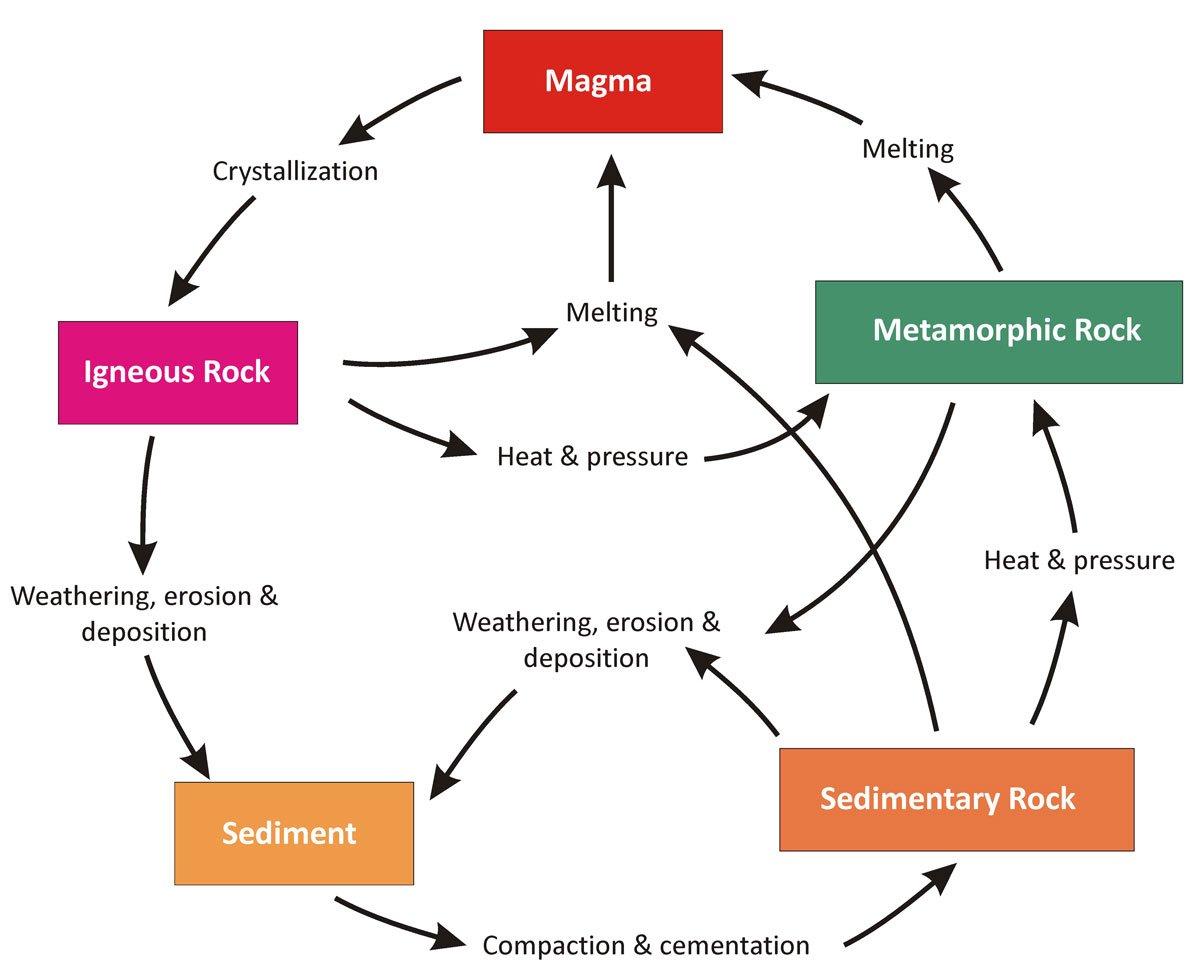
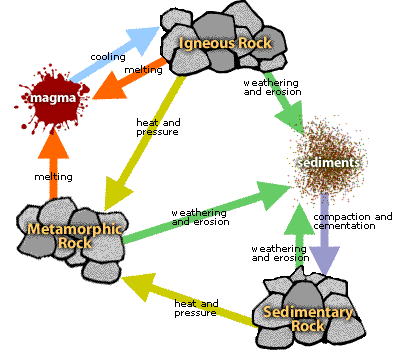
What processes can be used to complete the diagram of the rock cycle?

a)

A. 1 = cooling, 2 = weathering and erosion, 3 = pressure

b)

B. 1 = weathering and erosion, 2 = pressure, 3 = cooling

c)

C. 1 = weathering and erosion, 2 = cooling, 3 = pressure

d)

D. 1 = weathering and erosion, 2 = weathering and erosion, 3 = weathering and erosion

67.
Choose the number where the following description best fits:  Hot lava cools.
a)
1
b)
3
c)
4
d)
5
68.
Choose the number where the following description best fits:  Great pressure and heat.
a)
1
b)
2
c)
3
d)
4
69.
Choose the number where the following description best fits:  Great heat from the center of the Earth causes melting.
a)
1
b)
3
c)
4
d)
5
70.

The best answer for section "A" in the diagram

a)

metamorphic/melting

b)

compaction/cementation

c)

weathering/erosion

d)

heat/pressure

71.

The best answer for section "C" in the diagram

a)

metamorphic/melting

b)

compaction/cementation

c)

weathering/erosion

d)

heat/pressure

72.

The best answer for section "B"

a)

metamorphic/melting

b)

compaction/cementation

c)

weathering/erosion

d)

heat/pressure

73.

Identify two processes labeled in this rock cycle that must occur in order to change any rock into an igneous rock.

a)

heat and/or pressure

b)

weathering and erosion

c)

melting and solidification

d)

deposition and cememtation

74.

Identify two processes labeled in this rock cycle that change igneous rock into sediments.

a)

heat and/or pressure

b)

melting and solidification

c)

deposition and cementation

d)

weathering and erosion

75.

Identify two processes required for the formation of a sedimentary rock.

a)

heat and/or pressure

b)

melting and solidification

c)

deposition and cementation

d)

weathering and erosion

76.

What type of rock forms directly from magma?

a)

Igneous Rock

b)

Sedimentary Rock

c)

Metamorphic Rock

77.

What type of rock forms directly from heat and/or pressure?

a)

Igneous Rock

b)

Sedimentary Rock

c)

Metamorphic Rock

78.
What is the lithosphere made of?
a)
the upper mantle
b)
the crust & part of upper mantle
c)
the crust and mantle
d)
the crust
79.
Which of these is the Mesosphere?
a)
Upper Mantle
b)
Middle Mantle
c)
Lower Mantle
d)
Oceanic Crust
80.

Which crust is thicker?

a)

Oceanic

b)

Continental

c)

Divergent

d)

Convergent

81.

Which crust is more dense?

a)

Oceanic

b)

Continental

c)

Convergent

d)

Divergent

82.

Continental crust is mostly made of.........

a)

Granite

b)

Basalt

c)

Limestone

d)

Sedimentary

83.

Oceanic Crust is mostly made of...

a)

Shells

b)

Sand

c)

Basalt

d)

Obsidian

84.
What is the scale that is used to indicate hardness of a mineral?
a)
Red Scale
b)
Moh's scale
c)
Einstein Scale
d)
Fracture Scale
85.
The softest minerals is__________
a)
Quartz
b)
Topaz
c)
Talc
d)
Amethyst
86.
Diamond has a hardness of ___ on Mohs Hardness Scale.
a)
1
b)
5
c)
8
d)
10
87.
The ability of a mineral to resist scratching is called ___________.
a)
Streak
b)
Fracture
c)
Hardness
d)
Cleavage
88.
Hardness is a property that helps identify minerals. Scientists use a scale of 1-10 to show the hardness of a mineral. What number would be given to the hardest?
a)
1
b)
5
c)
6
d)
10
89.
___________ breaks in irregular or with jagged edges.
a)
properties
b)
hardness
c)
cleavage
d)
fracture
90.
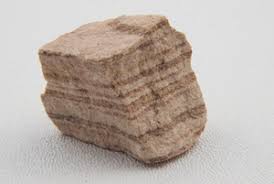
Which mineral property is being shown here?
a)
luster
b)
hardness
c)
cleavage
d)
streak
91.
Inorganic means not of living things. 
a)
True
b)
False 
92.

Which of the following is NOT a defining characteristic of a mineral?

a)

Naturally Occuring

b)

Can be solid, liquid, or gas

c)

Inorganic

d)

Crystalline Structure

93.

The formula for density is ___________.

a)

D = M x V

b)

D = M + V

c)

D = M / V

d)

D = V / M

94.

Atoms are arranged in a regular, repeating pattern. Classified by the number of faces and measure of angles. What property is this?

a)

Hardness

b)

Luster

c)

Density

d)

Crystal Structure

95.

According to the Moh's hardness scale, what is the hardness of a fingernail?

a)

1

b)

2.5

c)

5

d)

7

96.
Where is magma?
a)
inside 
b)
outside
97.
If an Igneous rock is dark-colored, what is the amount of silica?
a)
high
b)
low
c)
doesn't matter
98.
What do we call where Igneous rocks form?
a)
location
b)
destination
c)
origin
d)
spawn point
99.

How are igneous rocks classified?

a)

origin, texture and mineral composition

b)

origin, color and texture

c)

texture, color, and mineral composition

d)

by their grains

100.

Can you complete this diagram? It is on your test.

a)

Yes

b)

No

c)

I hope so

d)

I need to review