wayground logo

Free Printable Worksheets

NEW

Font size

S
M
L
XL
Worksheets

Meteorology Practice Quizizz

Total questions: 58

Worksheet time: 58mins

Name
Class
Date
1.
What kind of weather does a stationary front bring?
a)
 Light rain followed by clear weather
b)
 Many days of cloudy wet weather
c)
 Severe thunderstorms and rain
d)
 Cold and dry weather
2.
What forms when two air masses meet?
a)

Flood

b)
 Cloud
c)
Front
d)
Climate
3.
What kind of weather does a cumulonimbus cloud bring?
a)
clear and sunny
b)
light rain
c)
hurricane
d)
thunderstorm
4.
What causes changes in the weather?
a)
air masses move and come together
b)
water evaporates
c)
the air gets more humid
d)
clouds form
5.
Where have the fastest winds on Earth been recorded?
a)

In a jet stream

b)
In a tornado
c)
In a hurricane
d)
In the prevailing westerlies
6.
What will happen to a hurricane if it crosses into cooler water or moves onto land?
a)
It will strengthen and destroy everything in its path.
b)
It will cause damage to coastal areas but eventually lose strength.
c)
It will change direction and head south.
d)
All of these could happen.
7.
What properties describe cold air?
a)
high density, high pressure
b)
low density, high pressure
c)
high density, low pressure
d)
low density, low pressure
8.
What air mass is forming at point F in the map?
a)
cP
b)
cT
c)
mT
d)
mP
9.

The most common region of the United States to experience tornadoes is Tornado Alley because the warm moist air from the Gulf of Mexico interacts with the cold, dry air from the north. Which two air masses are involved in the formation of most tornadoes in the United States?

a)

cP & cT

b)

mP & cT

c)

mT & cP

d)

mP & mT

10.
What air mass is forming at point A in the map?
a)
cP
b)
cT
c)
mT
d)
mP
11.
What type of air will the air mass shown at point E bring?
a)
warm and humid air
b)
warm and dry air
c)
cold and humid air
d)
cold and dry air
12.

What type of air will the air mass shown at point D bring?

a)
warm and humid air
b)
warm and dry air
c)
cold and humid air
d)
cold and dry air
13.
Which statement is TRUE about this weather symbol?
a)
This symbol points in the direction the front is moving.
b)
This symbol represents a cold front.
c)
The symbol shows that thunderstorms are likely ahead of the front.
d)
All of these are true about this symbol.
14.
What provides the "fuel" for a hurricane?
a)
warm water evaporating from oceans
b)
cool water condensing to form rain
c)
warm water condensing to form clouds
d)
cool water moving through deep currents
15.
Where are do most of Earth's tornadoes form?
a)
over the Atlantic ocean
b)
in the valleys of Europe
c)
in the rainforests of Brazil
d)
over the continental US
16.
What weather conditions will an area most likely experience if this symbol is shown over it on a weather map?
a)

Due to high pressure air rising, the area will most likely have a warm front.

b)

Due to low pressure air rising, the area will experience tornadoes.

c)

Due to high pressure air that doesn't rise, the area will have clear skies.

d)

Due to low pressure air rising, the area will experience hot weather.

17.
What is the "eye" of a hurricane?
a)
The calm center of a hurricane with little to no winds
b)
The most violent part of a hurricane that brings massive flooding
c)
The wall of high winds around the center of a hurricane
d)
The outer band of winds and rain that a hurricane brings.
18.
What will the weather forecast most likely be for the next 48 hours in the northwestern part of the United States?
a)
Slow-moving light rain ahead of a warm front, followed by clearer, warmer weather.
b)
Possible fast-moving thunderstorms ahead of a cold front, followed by cooler temperatures and clear skies.
c)
Heavy snowfall ahead of the occluded front followed by a hurricane.
d)
Days of heavy rain and possible flooding due to the stationary front.
19.
What is a key similarity among thunderstorms, tornadoes, and hurricanes?
a)
Each weather event can last up to a week over an area.
b)
All three weather events have the highest wind speeds ever recorded.
c)
High pressure created from cool, dry air sinking are used to create all three.
d)
Low pressure created from warm, humid air rising is needed for their formation.
20.

What could explain a past year of record-breaking numbers of hurricanes?

a)
The ozone layer absorbed less UV radiation from the sun than in previous years.
b)
There were more windy days that usual that year.
c)
The temperature of the Atlantic ocean was higher than normal that year.
d)
The Earth's rotation was faster than in previous years.
21.
Where are do most hurricanes form?
a)
over oceans close to the equator
b)
over oceans close to the poles
c)
over land close to the poles
d)
over land close to the equator
22.
Which statement is TRUE about the front shown?
a)
None of the air masses has enough energy to push the other one out of the way in this stationary front.
b)
Warm air is being cut-off from the ground by the cold air in this occluded front.
c)
A tornado is forming along this cold front.
d)
Days of rain have formed along this warm front.
23.

What is a cold front?

a)

A place where a warm air mass is pushing a cold air mass out of the way

b)

A place where a cold air mass is pushing a warm air mass out of the way

c)

A place where 2 air masses meet but no movement is taking place

d)

A place where a cold air mass is being squeezed by 2 warm air masses

24.

A continental air mass is always fairly

a)

dry

b)

damp

c)

cold

d)

hot

25.

Climate is different than weather because

a)

weather is short term, climate is over long periods of time

b)

weather deals with precipitations, climate with temperature

c)

climate deals with precipitations, weather with temperature

d)

climate and weather are the same

26.
How do we name air masses?
a)
Water and temperature
b)
Air pressure
c)
Humidity and temperature
d)
Cold and warm
27.

What is a tornado?

a)

A long high wave caused by an earthquake.

b)

Rapidly rotating column of air that reaches from a storm cloud to the Earth's surface.

c)

A sudden and violent shaking of the ground, sometimes causing great destruction.

d)

A large, destructive fire that spreads quickly over woodland or brush.

28.

What shape is a tornado?

a)

sphere

b)

prism

c)

funnel

d)

cube

29.

How fast are the winds inside a tornado?

a)

5-10 miles per hour

b)

65-250 miles per hour

c)

500-700 miles her hour

d)

1,000-1,500 miles per hour

30.

The most tornadoes in the United States take place in Tornado Alley. Where is Tornado Alley?

a)

Southern US

b)

West Coast of the US

c)

East Coast of the US

d)

Center of the US

31.

A big, rotating wind and rainstorm in the Western Pacific Ocean

a)

Hurricane

b)

Typhoon

c)

Cyclone

32.

A big, rotating wind and rainstorm in the Indian Ocean or off the coast of Australia

a)

Hurricane

b)

Typhoon

c)

Cyclone

33.

A big, rotating wind and rainstorm in the Atlantic and eastern Pacific Oceans

a)

Hurricane

b)

Typhoon

c)

Cyclone

34.

How are tropical storms in the Northern Hemisphere different from tropical storms in the Southern Hemisphere?

a)

tropical storms cause more rain in the Southerm Hemisphere

b)

the winds spin faster in the Northern Hemisphere

c)

the winds spin in opposite directions

35.

How do tornadoes form?

a)

Tornadoes form when moist, warm air meets cool, dry air head on.

b)

Tornadoes form when cool, moist air meets warm, dry air head on.

c)

Tornadoes form when a warm front and a cold front meet.

d)

Tornadoes form when two air masses collide.

36.
What is the strongest category of hurricane?
a)
Category 5
b)
Category 10
c)
Category 1
d)

Category 0

37.
A cold front is approaching Minneapolis. What will happen to the air temperature?
a)
stay the same
b)
increase
c)
decrease
38.
Which city can expect to see an increase in temperatures over the next 24 hours?
a)
Billings, Montana
b)
Atlanta, Georgia
c)
Minneapolis, Minnesota
d)
Miami, Florida
39.

The warm front is moving north. I can tell because

a)

warm fronts always move north.

b)

north is the best direction.

c)

the half-circles on the front are pointing north.

d)

the triangles on the front are pointing north.

40.

A cold front usually brings

a)

a fast moving storm followed by cool temperatures and clear skies.

b)

days of overcast skies and precipitation.

c)

slow, steady precipitation followed by warmer, more humid weather.

d)

thunder, but no lightning.

41.

What is the general pattern of weather across the United States?

a)

Weather moves from North to South in the US.

b)

Weather moves from South to North in the US.

c)

Weather moves from West to East in the US.

d)

Weather moves from East to West in the US.

42.

A low pressure system brings what type of weather?

a)

storms

b)

clear skies

43.

The weather map shows the weather conditions for one day across the United States. Based on the weather map, which city will most likely experience decreasing temperatures during the next 24 hours?

a)

Denver, because its raining there

b)

Minneapolis, because a cold front is approaching

c)

Atlanta, because a warm front is approaching

d)

Houston, because it is in a high pressure area

44.

What weather would you forecast at letter A

a)

clear skies and warmer temperatures

b)

thunderstorms followed by warmer temperatures

c)

thunderstorms followed by cooler temperatures

d)

rain and fog for many days

45.

What weather is currently happening at letter A?

a)

dry, clear weather

b)

wet, rainy weather

c)

cloudy, cold weather

46.

What weather will happen at letter B tomorrow?

a)

warmer temperatures

b)

cooler temperatures

c)

the temperature will stay the same

47.
When a cold front is approaching, what happens?
a)
warm air is pushing under cold air causing humid weather and lower temperatures
b)
warm air is pushing under cold air causing humid weather and higher temperatures
c)
warm air rises, cools, and causes rain and thunderstorms
d)
cold air is pushed over warm air causing rain and thunderstorms
48.

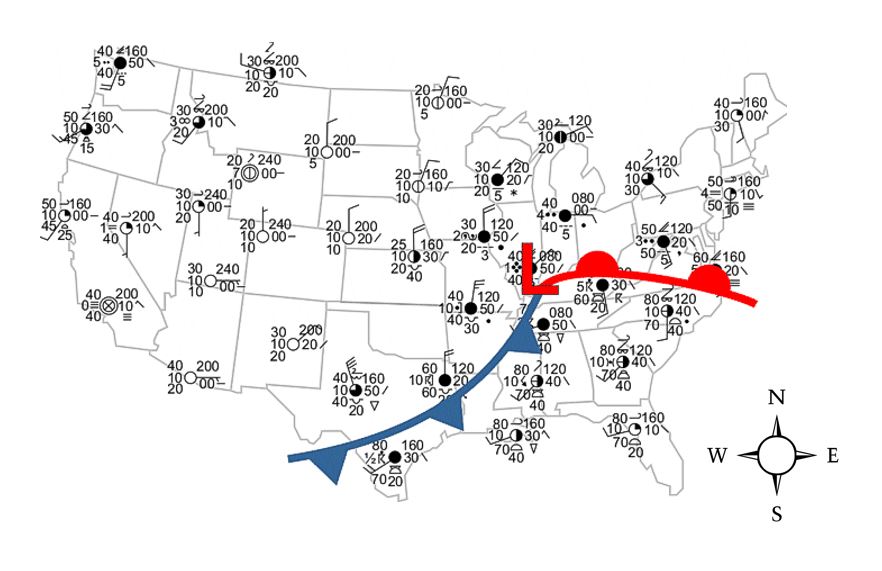
What type of front involves a moist, warm air mass sliding up and over a cold air mass resulting in steady precipitation?
a)
warm front
b)
cold front
c)
stationary front
d)
occluded front
49.
What direction is the cold front moving on the map? 
a)
Southwest
b)
Northwest
c)
Southeast
d)
Northeast
50.
Where would you find a tropical maritime air mass?
a)
over the ocean, near the equator
b)
over the ocean, near the poles
c)
over a continent, near the equator
d)
over a continent, near the poles
51.
 The more inland (away from the ocean and coast) climates are subject to more extreme or _______ temperatures.
a)
mild
b)
harsh
52.

Coastal climates, which are insulated by nearby water, are generally _______.

a)
mild
b)
harsh
53.
The air temperatures in Town 1 tend to be warmer in the winter and cooler in the summer than the air temperatures in Town 2. Which statement best explains the differences in climate between the two towns?
a)

Town 1 receives more atmospheric moisture than Town 2 due to its proximity to the ocean.

b)

Town 2 receives more sunlight in the summer than Town 1 due to its latitude.

c)

Town 1 receives more sunlight in the winter than Town 2 due to its latitude.

d)

Town 2 receives more atmospheric moisture than Town 1 because it is further inland.

54.
Which best describes why cities near oceans are often warmer in the winter than cities far from the ocean at the same latitude?
a)
Oceans cool more slowly than land.
b)
Ocean waves move more quickly in the winter.
c)
The moon heats the air over the ocean.
55.

How does the ocean affect the weather along the coast of Georgia?

a)
It causes less wind along the coastal areas than farther inland
b)
It causes less severe weather along the coastal areas than farther inland
c)

It causes smaller changes in temperature along the coastal area than farther inland

56.

Why do coastal areas have cooler summers than inland areas at the same latitude?

a)

because bodies of water heat up and cool off more slowly than land

b)

because bodies of water heat up more slowly than land, but cool off more rapidly than land

c)

because bodies of water heat up and cool off more rapidly than land

d)

because bodies of water heat up more rapidly than land, but cool off more slowly than land

57.

Three towns are located at similar latitudes. Which town will have the smallest difference between the average high temperature and the average low temperature?

a)

a town in a desert

b)

a town near the ocean

c)

a town high in the mountains

58.

In which direction does the jet stream flow over the United States?

a)

North to South

b)

East to West

c)

South to North

d)

West to East