
NEW
Font size
 Worksheets
Evaluating single project
Total questions: 32
Worksheet time: 16mins
The external rate of return must be used when:
It is impossible to calculate the minimum acceptable rate of return
A project starts with cash outflow.
There are multiple internal rates of return.
A project requires multiple investments and generates multiple benefits.
In which method, the excess revenue gets reinvested outside of the project and shortfalls are covered by borrowing from outside of the project?
Internal rate of return
External rate of return
Minimum attractive rate of return
The payback period
The project is not economically justified if:
ERR = MARR
ERR < MARR
ERR > MARR
None of the above
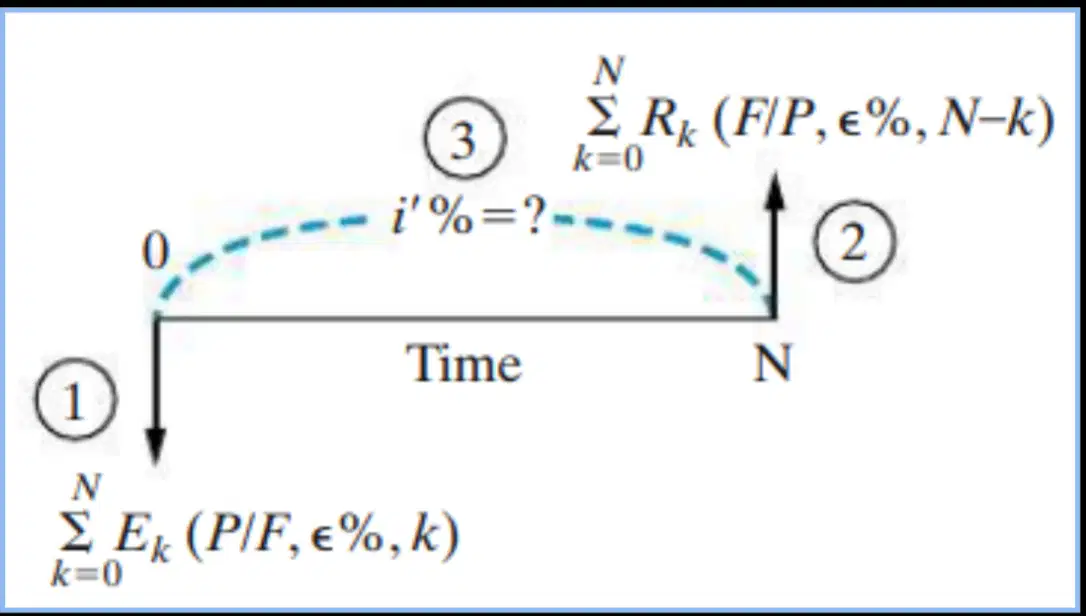
What is the second step of calculating the ERR?
All net cash inflows are compounded to period N at ∈%.
All net cash outflows are compounded to time zero (the present) at ∈% per compounding period.
The external rate of return, which is the interest rate that establishes between the two quantities, is determined.
All net cash outflows are discounted to time zero (the present) at ∈% per compounding period.
A company's minimum attractive rate of return is generally equal to the rate of return that the company would receive if it invested its money someplace else with similar risk.
True
False
Cash prevails over all other forms of equity and is not considered as one of the Fundamental Principles of Engineering Economics.
True
False
The two primary factors in Engineering Economics are not "time" and "money".
True
False
The minimum acceptable rate of return (MARR) is
an interest rate, which is equal to a current bank interest rate.
an interest rate that must be earned for a project to be accepted.
a highest interest rate among all alternative projects.
an interest rate that allows an investor to recoup the investment.
the least interest rate among all alternative projects.
The external reinvestment rate (∈) is 12% per year, and the MARR equals 15%
Year Cash Flows
0 5,000
1 −7,000
2 2,000
3 2,000
Calculate the net cash outflows
$7,000(P/F, 12%, 1) = 6,250
$5,000(P/F, 12%, 2) = 3,985
$7,000(P/F, 12%, 1) = 5,580
$5,000(P/F, 12%, 1) = 4,460
The external reinvestment rate (∈) is 12% per year, and the MARR equals 15%
Year Cash Flows
0 5,000
1 −7,000
2 2,000
3 2,000
Calculate the net cash inflows
$5,000(F/P, 12%, 3)+$2,000(F/P, 12%, 1) + $2,000 = 11,264
$5,000(F/P, 12%, 3)+$2,000(F/A, 12%, 2) = 10.264
$5,000(F/P, 12%, 3)+$2,000(F/P, 12%, 3) + $2,000 = 11,834
$5,000(F/P, 12%, 3)+$2,000(F/A, 12%, 3) = 13,773
The external reinvestment rate (∈) is 12% per year, and the MARR equals 15%
Year Cash Flows
0 5,000
1 −7,000
2 2,000
3 2,000
Calculate the ERR and does the answer satisfy the ERR decision rule?
6,250 (F/P, i'%, 5) = 11,264
i'=21.69% and not satisfied
6,250 (F/P, i'%, 5) = 11,264
i'=21.69% and satisfied
6,250 (F/P, i'%, 4) = 11,264
i'=21.69% and not satisfied
6,250 (F/P, i'%, 4) = 11,264
i'=21.69% and satisfied
PW Decision rule: The project is acceptable if:
PW(i=MARR) ≥ 0
PW(i=MARR) ≤ 0
PW(i=MARR) = 0
PW(i=MARR) ≠ 0
Consider a project that has an initial investment of $60,000 and that returns $12,000 per year for the next four years. If the MARR is 10%, is this a good investment?
Yes
No
Cannot conclude
What is the value of a 6%, 10-year bond with a par (and redemption) value of $20,000 that pays dividends semi-annually, if the purchaser wishes to earn an 8% return?
$16 282
$17 282
$18 282
$17 822
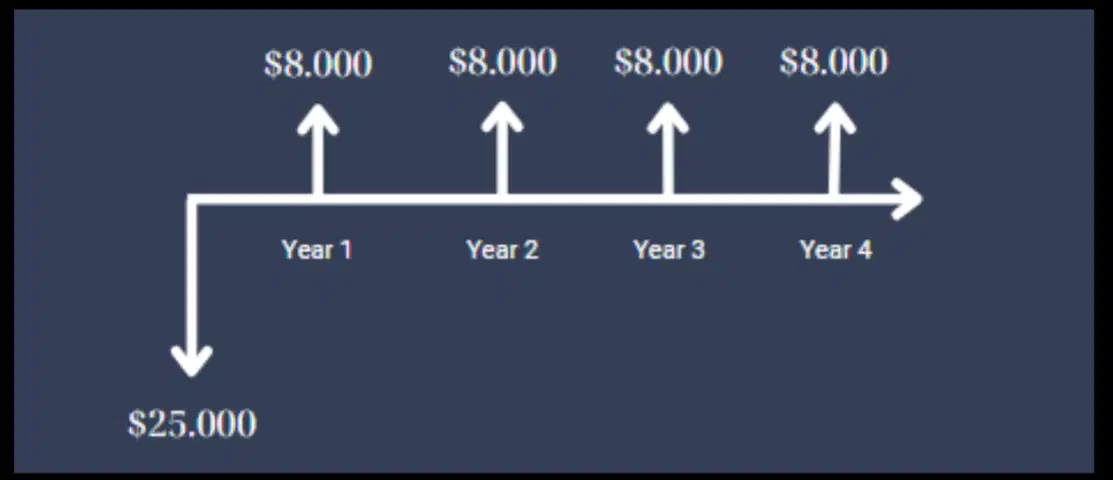
Solve for the internal rate of return of the following cash flow.
11%
12%
11.5%
10.5%
Assume that you are a millionaire and you want to purchase a building for $375000.The investment will generate $25000 in cash flows (i.e. rent) during the first three years. At the end of three years, you will sell the building for $450000. What is the IRR on this investment.
21.56%
21.65%
12.56%
12.65%
The IRR is sometimes referred to as
The break-even analysis
The break-up analysis
The break-odd analysis
The break-a-leg analysis
The payback method is a measure of profitability rather than a measure of liquidity.
True
False
The payback method, which is often called the simple payout method.
True
Fals
Mr. Dang invest 385 million VND to build 6 football fields. The annual value of 1 football field is estimated to be 17 million VND. What is the simple payback period of this investment?
3.77
4
3.3
22.65

Fill in the blank to complete the payback period formula:
Average annual cash inflow
Average annual cash outflow
Discounted annual cash flow
The simple payback period is _______ value of θ(θ ≤ N).
the biggest
the smallest
bigger than
smaller than
The simple payback period, θ, ignores the time value of money and all cash flows that occur after θ
True
False
A low valued payback period is NOT considered desirable
True
False
What is the definition of salvage value?
The cost of repairing a damaged asset.
The original purchase price of an asset.
The residual value at the end of its useful life.
The equivalent worth of all cash inflows and outflows.
Which of the following does the CR (Capital Recovery) method distribute across the life of the asset?
The initial cost and the principal payment
The book cost and the capital cost
The maintenance cost over the asset’s lifespan and the market value
The initial cost and the salvage value
According to the annual worth decision rule, when is a project considered acceptable?
When the annual worth (AW) is greater than zero.
When the annual worth (AW) is less than zero.
When the annual worth (AW) is equal to zero.
The annual worth (AW) is not applicable for project evaluation.
A project requires an initial investment of $50,000, has a salvage value of $11,000 after five years, incurs annual expenses of $5,000, and provides an annual revenue of $20,000. Using MARR of 10%, determine the AW of this project and whether it is acceptable or not?
AW= - $2611. The project is not acceptable.
AW= - $1704. The project is not acceptable.
AW= $2301. The project is acceptable.
AW= $3612. The project is acceptable.
What is the IRR ?
is the interest rate that equates the equivalent worth of an alternative’s cash inflows (revenue, R) to the equivalent worth of cash outflows (expenses, E).
is the interest rate that equates the equivalent worth of an alternative’s cash outflows (revenue, R) to the equivalent worth of cash inflows (expenses, E).
is the interest rate that equates the equivalent worth of an alternative’s cash inflows (expenses,E) to the equivalent worth of cash outflows (revenue, R).
Another answer
What is the challenges of IRR ?
It is computationally difficult without proper tools.
The IRR method must be carefully applied and interpreted when comparing two more mutually exclusive alternatives (e.g., do not directly compare internal rates of return).
In rare instances multiple rates of return can be found.
All options are correct

What is the Rk ?
net revenues or savings for the kth year
net expenditures, including any investment costs for the kth year
project life (or study period) interest i'% at which
Another answer
In this example, we can easily see that the sum of positive cash flows ($835,000) exceeds the sum of negative cash flows ($455,000). Thus, it's likely that a positive valued IRR can be determined.
True
False

