wayground logo

Free Printable Worksheets

Font size

S
M
L
XL
Worksheets

Ecology Test Review

Total questions: 35

Worksheet time: 3570secs

Name
Class
Date
1.
Which one is NOT an example of a decomposer?
a)
mushroom
b)
leaves
c)
mold
d)
worm
2.
Examples of a producer
a)
frog
b)
algae
c)
worm
d)
mouse
3.
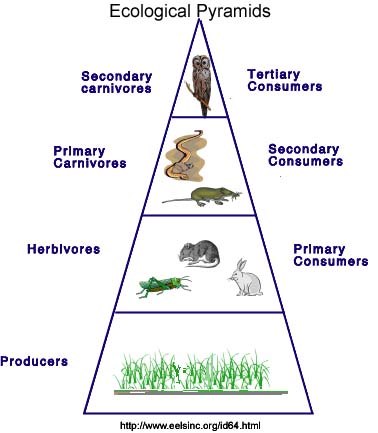
In the energy pyramid here, which organisms have the most energy available?
a)
Producers
b)
Carnivores
c)
Herbivores
d)
Top Predator
4.
In the energy pyramid below, which organism has the least amount of energy available?
a)
Producers
b)
Herbivores
c)
Carnivores
d)
Top Predator
5.
The largest group of organisms found in a food web would be:
a)
Primary Consumers
b)
Producers
c)
Decomposers
d)
Tertiary Consumers
6.
A food pyramid represent the relative amount of energy in trophic levels. Which of the following correctly shows a food pyramid?
a)
A
b)
B
c)
C
d)
D
7.
A third-level consumer has to be which type?
a)
Carnivore.
b)
Decomposer.
c)
Producer.
d)
Herbivore.
8.
A secondary consumer 
a)
eats primary consumers
b)
eats producers
c)
eats plants
9.

What amount of percentage does the energy decrease as it goes up the pyramid?

a)

100%

b)

1000%

c)

10%

d)

1%

10.

How does the energy flow in an energy pyramids?

a)

up the pyramid

b)

down the pyramid

11.
Which is the smallest level of an ecosystem?
a)
organsism
b)
population
c)
community
d)
ecosystem
12.
a system of food chains that shows the transfer of energy  is termed
a)
food web
b)
food chain
c)
prey
d)
predator
13.
Biodiversity is 
a)
the variety of species within an ecosystem
b)
a large number of the same species in an ecosystem
c)
an abundant amount of the same primary consumers 
d)
the ability to have an abundant source from the same species
14.

1. What is Ecology?

a)

The study of Earth's Mantle

b)

The study of relationships between living things and their environment

c)

The study of plants

d)

The study of humans and their impact on Earth

15.

2. Organisms of the same species living in the same environment together

a)

Population

b)

Community

c)

Ecosystem

d)

Environment

16.

3. Populations of organisms living in the same environment at the same time

a)

Population

b)

Community

c)

Biotic Factors

d)

Habitat

17.
After a forest fire, an ecosystem would start regrowth through -
a)
primary succession
b)
secondary succession
c)
climax community
d)
limiting factors
18.

What type of consumer eats only other animals?

a)

Decomposer

b)

Herbivore

c)

Carnivore

d)

Omnivore

19.

Consumers that only eat meat are called _____________.

a)

Herbivores

b)

Omnivores

c)

Carnivores

d)

Producers

20.
What does a food web represent?
a)
All connections of energy flow throughout all organisms in a habitat.
b)
The specific ways that mutualism is carried out.
c)
A single pathway or energy flow between organisms. 
d)
How carnivores get their food. 
21.
Barnacles create home sites by attaching themselves to whales. This relationship neither harms nor benefits the whales. 
a)
parasitism
b)
commensalism
c)
mutualism
22.
Yucca flowers are pollinated by yucca moths. The moths lay their eggs in the flowers where the larvae hatch and eat some of the developing seeds. Both species benefit. 
a)
parasitism
b)
commensalism
c)
mutualism
23.
Mistletoe extracts water and nutrients from a spruce tree. The spruce tree is harmed. 
a)
parasitism
b)
commensalism
c)
mutualism
24.

Hermit Crabs live in shells made and then abandoned by snails.

a)

Commensalism

b)

Parasitism

c)

Competition

25.
Two male Giraffes are fighting over the last green leaf of a tree that is dying.  
a)
Competition
b)
Mutualsim
c)
Predation
d)
Commensalism
26.
a relationship that occurs when two or more organims of the same species need the same resource at the same time
a)
competition
b)
symbiosis
c)
predation
27.
In a parasitic relationship, one organism is ___________ and one organism is benefiting. 
a)
helped
b)
harmed
c)
not effected
d)
happy
28.
Commensalism is where one organism is benefiting and the other organism is _____________________. 
a)
not effected
b)
helped
c)
harmed
d)
hurt
29.
In a mutual relationship, both organisms are ________________. 
a)
hurt
b)
not effected
c)
harmed
d)
benefiting 
30.
1.  A bee and a flower work together to benefit each other. This is an example of _________________. The bee helps the flower by pollinating it and the flower helps the bee by providing it with nectar. 
a)
commensal relationship 
b)
parasitic relationship 
c)
mutual relationship 
31.
 Mrs. Bush’s cat has fleas. A flea is a parasite that gets its energy from Dante’s blood. How are the flea and the cat affected in this relationship? 
a)
Both organisms are helped.
b)
Both organisms are not affected.
c)
One organism is helped and one organism is not effected.
d)
One organism is helped and another organism is harmed. 
32.
A coyote captures, kills, and eats a rabbit. What type of symbiotic relationship is this?
a)
mutualism
b)
commensalism
c)
parasitism
d)
predation
33.
Exponential population growth leads to this kind of graph
a)
S curve
b)
J curve
c)
M curve
d)
W curve
34.
What is the carrying capacity of this population?
a)
100
b)
200
c)
300
d)
400
35.

What is the arrow representing in a food chain/web?

a)

Traveling

b)

Flow of Nitrogen

c)

Flow of Energy

d)

Oxygen