
 Worksheets
Phy Sci Unit 10 Study Slides
Total questions: 73
Worksheet time: 1hrs 8mins

A group of students performed an investigation with toy cars. They applied a force on the toy cars and measured the time it took the cars to move through a 10-meter distance. The data from their investigation in shown.
What question were they most likely trying to answer?
Does the mass of a car affect the distance the car travels?
Does the distance the car travels affect the time?
Does the force on a car affect the change in motion?
Does the mass of a car affect the distance the car travels?

The model shows forces acting on a box when it is sliding down the ramp.
What would most likely happen to the motion of the box if you poured oil on the ramp?
It will slow the box because the force of friction will be increased.
It will speed up the box because the force of friction will be increased.
It will slow the box because the force of friction will be reduced.
It will speed up the box because the force of friction will be reduced.

A student did an investigation to see how changing the mass of an object would affect the distance it would take to stop. Shown is the data from his investigation.
How should he make the graph of his data?
He should make a line graph with mass on the "X" axis and distance on the "Y" axis.
He should make a line graph with mass on the "Y" axis and distance on the "X" axis.
He should make a bar graph with mass on the "X" axis and distance on the "Y" axis.
He should make a bar graph with mass on the "Y" axis and distance on the "X" axis.

A group of students want to test the effect of balanced forces on the motion of objects with different masses. They conducted trails with 10-gram, 20-gram, and 30-gram blocks. They applied 100 Newtons of force to each side of the blocks as shown in each trial.
Which hypothesis will most likely be supported by the results of the investigation?
When a balanced force is applied the block with the greatest mass will move fastest.
When an unbalanced force is applied the block with the least mass will move fastest.
When a balanced force is applied the speed of an object will not change.
When an unbalanced force is applied the speed of an object will not change.

A student recorded the distance than an object moved at 5 second intervals. The graph below shows the motion of an object.
Which of the following best describes the data in the graph?
Time is the dependent variable which is graphed on the "Y" axis.
Time the is dependent variable which is graphed on the "X" axis.
Distance is the dependent variable which is graphed on the "Y" axis.
Distance is the dependent variable which is graphed on the "X" axis.
Galileo
Newton
Aristotle


An Orange falls off a tree and lands on the ground. What force caused the orange to fall?
friction
heat
gravity
wind
Friction is a force that acts ...
in the same direction as the motion
opposite to the direction of the motion
opposite to the applied forces
the same direction as the applied force


The tendency of an object to resist a change in its motion...
acceleration
inertia
mass
frame of reference
A student wished to design an investigation to determine the effect of changing the mass of an object when an unbalanced force is applied the object.
What should she use as the independent variable in her investigation?
Time
Force
Mass
Speed
An object is in motion if it changes position relative to
a reference point
speed
the distance traveled
constant speed
Relative motion
the motion of an object in comparison to other objects in a specific frame of reference
the point of view used to measure the position and movement of objects
how fast something moves
the distance
What is force?
the PUSH or PULL on an object
the motion an object creates
going fast
Yoda

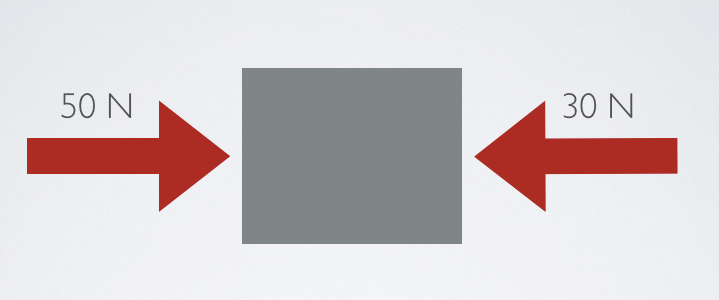


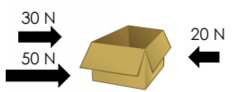
If forces are going in the same direction, you should
add the forces
subtract the forces
multiply the forces
divide the net force
Unbalanced forces
movement of electrons in motion
no change in motion
causes a change in motion
push or pull on an object
A contact force is from
objects physically touching
far apart objects
not touching object
always a pull
A non-contact force is between
two objects that aren't touching
two objects that are touching
the ground and wheels
you and me

The three examples pictured are of
Non-contact Forces
Contact Forces

The force between the phone and the mount is a
contact force
non-contact force

The force between the two people through the rope is
Contact Pull
Non-contact Pull
Contact Push
Non-contact Push

Find the velocity of a plane that traveled 3000 miles west in 5 hours.
65 mph
600 mph
600 mph west
600 mph

A stopped car begins moving and reaches a speed of 25m/s in 5 seconds. What is its acceleration?
+25m/s2
-0m/s2
+5m/s2
5m/s

A helicopter flies west 200 miles in 2 hours. What is its velocity?
99 mph
100 mph south
400 mph south
297 mph south
What two things must you know to determine speed?
distance and direction
direction and time
speed and direction
time and distance
What is your acceleration if you are riding your bike at 9 km/hr, and 10 minutes later your speed is 6 km/hr.
0.3 km/hr
30 km/hr
0.3 km/hr/hr
300 km/hr
Which of the following is an example of potential energy?
A glass jar sitting on a shelf
A flag waving in the wind
A ball rolling along the sidewalk
A battery powering a radio
At what speed would a car have to move in order to travel 20 kilometers in 2 hours.
5 km/hr
10 km/hr
20 km/hr
40 km/hr

The location on the track where the train has the greatest potential energy is....
1
2
3
4
Which of the following is an example of kinetic energy?
A baseball moving from the pitcher to the catcher
A rock sitting on top of a large hill
A pendulum at the top of it's swing
A new flashlight battery
If an unbalanced force acts on an object at rest, the object will move in the direction of the force. Which of the following best models an object with unbalanced forces acting on it?


A group of students want to test the effect of balanced forces on the motion of objects with different masses. They conducted trails with 10-gram, 20-gram, and 30-gram blocks. They applied 100 Newtons of force to each side of the blocks as shown in each trial.
Which hypothesis will most likely be supported by the results of the investigation?
When a balanced force is applied the block with the greatest mass will move fastest.
When an unbalanced force is applied the block with the least mass will move fastest.
When a balanced force is applied the speed of an object will not change.
When an unbalanced force is applied the speed of an object will not change.
Galileo
Newton
Aristotle
net force
unbalanced force
balanced force
balanced force
unbalanced force
50N to the left.
350N to the left.
350N to the right.
50N to the right.
The tendency of an object to resist a change in its motion...
acceleration
inertia
mass
frame of reference

