
 Worksheets
Civics Pre/Post Test
Total questions: 39
Worksheet time: 59mins

The image is from a historical document.
How does the constitutional republic of the United States reflect the ideas expressed in this document? (1.1)
by establishing a tradition of civic participation
by allowing states to challenge federal laws in court
by maintaining rule of law and holding all citizens accountable
by creating a separation of powers between branches of government

Based on this passage, which foundational principle is being described? "We the People of the United States, ... do ordain and establish this Constitution for the United States of America." (1.2)
rule of law
limited government
due process of law
equality of mankind

The diagram shows the connections between colonists' views on government and historical documents. Which phrase completes this diagram? (1.3)
habeas corpus
natural rights
due process of law
representative self-government
Which foundational principle is reflected in the creation of three branches of government? (1.4)
natural rights
social contract
separation of powers
consent of the governed

The diagram describes the causes that led to the writing of the Declaration of Independence.
Which action completes the diagram? (1.5)
Colonial agricultural trade increases.
Colonial religious rights are restricted.
The British enact a series of taxes in the colonies.
The British grant the colonists representation in Parliament.
The passage comes from the Declaration of Independence.
“We hold these truths to be self-evident, that all men are
created equal, that they are endowed by their Creator with
certain unalienable Rights, that among these are Life, Liberty
and the pursuit of Happiness. That to secure these rights,
Governments are instituted among Men, deriving their just
powers from the consent of the governed.”
Based on the passage, where should governments get their power? (1.6)
from God
from the public
from the legislative branch
from the executive branch
Which weakness of the Articles of Confederation was highlighted by the events of Shays's Rebellion? (1.7)
no power to tax
no national armed forces
lack of a legislative branch
lack of a national court system
In the Preamble to the U.S. Constitution, what is the meaning of the phrase "We the People"? (1.8)
Citizens express their will through political parties.
Citizens express their will by directly creating laws.
Government receives taxes from citizens and exists to support them.
Government receives its power from citizens and exists to serve them.

The newspaper details an important step in filling a vacancy on the U.S. Supreme Court. Which constitutional principle does the headline illustrate? (1.9)
rule of law
judicial review
checks and balances
separation of powers
The passage is from Anti-Federalist Paper #84, written by John DeWitt in 1787.
“The Constitution proposed to your acceptance is designed, not for yourselves
alone, but for generations yet unborn. The principles, therefore, upon which the
social compact is founded, ought to have been clearly and precisely stated, and
the most express and full declaration of rights to have been made. But on this
subject there is almost an entire silence.”
Based on this passage, with which statement regarding ratification of the U.S. Constitution would DeWitt agree? (1.10)
The Constitution should limit local government.
The Constitution should protect individual rights.
The Constitution should create a strong national government.
The Constitution should protect the rights of the individual states.
Which option best describes the importance of the rule of law? (1.11)
allows police to keep evidence a secret during a criminal trial
exempts government leaders from having to follow procedures
protects citizens from arbitrary and abusive use of government power
ensures different laws can be applied to people of different social classes
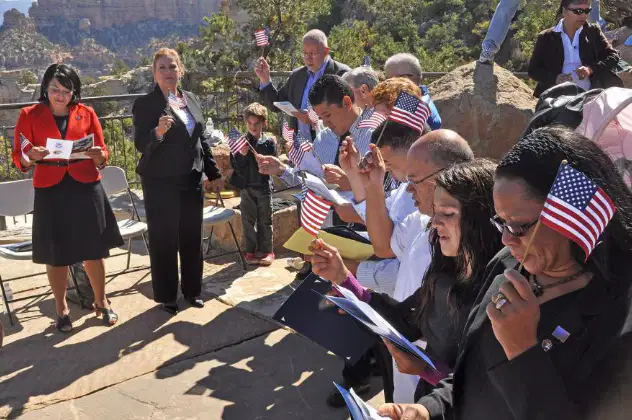
The photograph shows individuals becoming U.S. citizens through the naturalization process. Which option describes the eligibility requirements they had to meet? (2.1)
reside in the U.S. for five years, be of good moral character, and be able to speak and read basic English
be of good moral character, achieve permanent residency, and pledge to serve in the armed forces
reside in the U.S. for five years, pass a reading and math test, and be at least 25 years old
be of good moral character, pass a U.S. history and government test, and pay $15,000
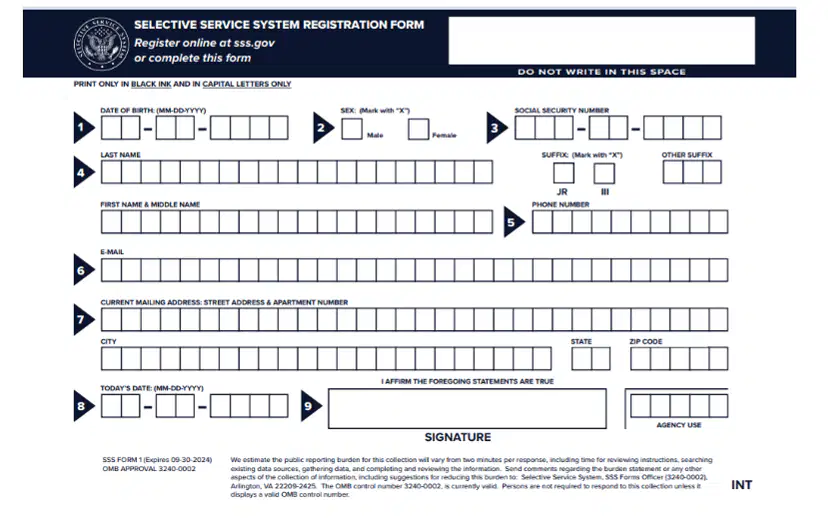
The image shows a legal document. Why are certain citizens obligated to respond to this document? (2.2)
to defend the safety and security of the nation
to ensure they stay informed about political issues
to guarantee their right to vote in national elections
to protect the constitutional right to be tried by one’s peers
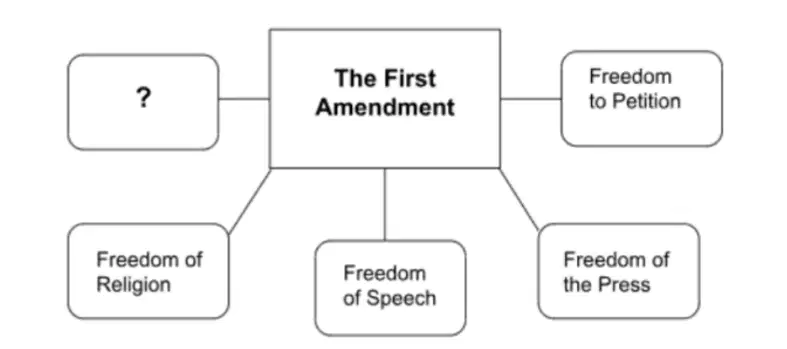
The diagram shows freedoms protected in the Bill of Rights. Which statement best completes the diagram? (2.3)
Freedom to Vote
Freedom of Assembly
Freedom to a Trial by Jury
Freedom from Habeas Corpus
The passage about government is from Federalist No. 78. "A constitution is, in fact, and must be regarded by the judges, as a fundamental law. It therefore belongs to them to ascertain its meaning, as well as the meaning of any particular act proceeding from the legislative body." What conclusion may be drawn from the author's views in this passage? (2.4)
The U.S. Constitution requires a bill of rights.
The U.S. Supreme Court ensures individual rights are protected.
The U.S. Constitution requires state laws to align with national laws.
The U.S. Congress has the sole responsibility of passing legislation.

The diagram shows the steps in selecting a juror.
Which statement best completes the diagram? (2.5)
The jurors listen to arguments and delivers a verdict.
Attorneys select a foreperson to serve as the jury spokesperson.
The jurors meet with court clerks to determine any biases they may have toward the trial in question.
Attorneys determine which potential jurors will serve on the jury through a process called 'voir dire.'

The diagram shows steps in the national election process. (2.6)
Political parties hold midterm elections.
The winner of the national political debates takes the oath of office.
Primary elections are held to narrow down the candidates.
State legislatures cast votes to determine who will appear on the ballot.

According to the biographical information, for which reason is Candidate A NOT qualified to run for governor of Florida? (2.7)
Candidate A is not old enough.
Candidate A was not born in Florida.
Candidate A does not have a law degree.
Candidate A has not lived in Florida long enough.
Which option is an example of how an individual may influence the government? (2.8)
signing a petition
walking by a protest
writing a lifestyle blog
watching presidential debates

The image is a propaganda poster created by the U.S. government in 1944. What was the desired impact of propaganda like this poster? (2.9)
Boost the economy during wartime.
Get more of the public to enlist in the armed forces.
Reduce the cost of goods to support the armed forces.
Encourage the public to support the war effort at home.
Luis and Isabelle are frustrated there isn’t a crosswalk near their neighborhood for all the students who walk home from school. Which of the following is an example of an appropriate course of action these students could take to address their concerns? (2.10)
Send an email to their U.S. senator.
Propose a plan at a city council meeting.
Hold a fundraiser to raise funds to make their own crosswalk.
Ask the local police chief to ban vehicles from this road during school hours.

The table describes the characteristics of a form of government. - Limited personal freedoms - Rulers are chosen by a higher power - Laws and decisions are based on religious beliefs - Religious authorities rule in the name of a god or deity Which form of government is being described in the table? (3.1)
republic
theocracy
monarchy
oligarchy
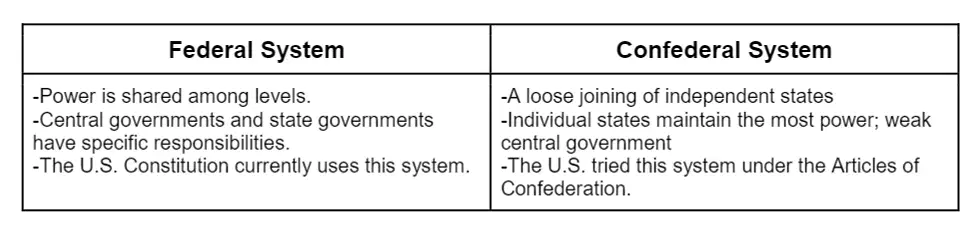
The diagram shows a comparison of two different systems of government. Which would be considered an advantage of a federal system of government? (3.2)
There are fewer laws that governments have to follow.
It is easier for states to enter treaties with foreign nations.
There is a stronger national government to protect the nation.
It is able to make quicker decisions with power concentrated in one individual.

The newspaper headline describes an event in U.S. history. Which part of the national government initiated the process described in the newspaper headline? (3.3)
Senate
Vice President
Supreme Court
House of Representatives
Which option is an example of an enumerated power? (3.4)
the power to tax
the power to establish local governments
the power to regulate interstate commerce
the power to set requirements for teaching license
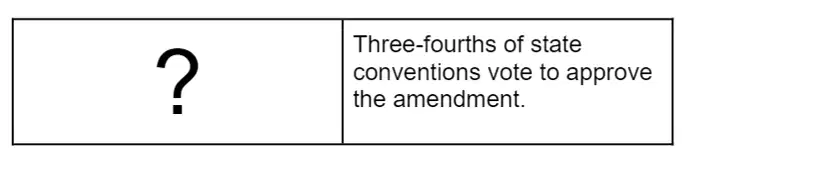
The diagram shows the second part of the process that may be used to ratify amendments to the U.S. Constitution.
Which statement completes the diagram? (3.5)
Three-fourths of the state legislatures vote to approve the amendment.
The president issues an executive order and approves the amendment.
Two-thirds of both houses of Congress vote to approve the amendment.
The Supreme Court rules the amendment is constitutional and approves it.

The newspaper details a significant amendment to the U.S. Constitution. What was the impact of this amendment on the political process? (3.6)
Women were allowed the right to vote.
African Americans were allowed to vote.
The need to pay poll taxes was eliminated.
The minimum age to vote was moved to eighteen.

The diagram shows some of the steps involved in creating a law at the national level. What is the first step in this lawmaking process? (3.7)
A senator or representative introduces a bill.
The judicial branch rules if a bill is constitutional.
The governor submits a bill for review at the national level.
A senator or representative reaches out to voters to submit drafted bills for review.

The diagram provides details about processes carried out by the executive branch at the national level of government. Which option best completes the diagram? (3.8)
Fund the armed forces
Draft bills to become laws
Make Cabinet appointments
Advise Supreme Court justices

The diagram provides details about the Florida court system. Which court completes the diagram? (3.9)
Florida Supreme Court
Florida Military Court
Florida Traffic Court
Florida Trial Court
Which option refers to laws created by judicial decisions and precedents? (3.10)
civil law
natural law
common law
constitutional law
Which statement identifies the impact of United States v. Nixon (1974)? (3.11)
Rule of law applies to the president.
“Executive privilege” protects the president from judicial review.
The U.S. Supreme Court does not have the power to intervene in presidential matters.
The president is able to record secret conversations with foreign governments and cabinet members.
Which statement identifies a similarity between the U.S. and Florida constitutions? (3.12)
Both guarantee individual freedoms.
Both have the same amendment process.
Both outline the process for obtaining citizenship.
Both outline the framework for state and local governments.

The table identifies powers of the different levels of government. Which phrase completes the diagram? (3.13)
Coin money
Sign treaties
Establish post offices
Establish school districts and school boards
How did the 12th Amendment change the process of presidential elections in the United States? (3.14)
It ensured presidents and vice presidents were elected as a team.
It created a system that allowed voters to more directly elect the president.
It ensured that candidates running for the office of president were more qualified.
It created the opportunity for the Supreme Court to overturn presidential election results.

The table describes economic systems. Which statement completes the chart? (3.15)
The economy is free of government regulation.
Individuals and companies control major industries.
Supply and demand are left to the free market, but the government manages wages.
The government heavily regulates the economy and controls all aspects of daily life.
Which action is an example of a foreign policy decision? (4.1)
Congress enacts new tax laws.
The Supreme Court takes a case involving a foreign-born citizen.
Soldiers are sent to another country to promote peacekeeping efforts.
The National Guard helps citizens in Florida during a natural disaster.
Which action illustrates citizen participation in an international organization? (4.2)
Steve teaches others about the World Trade Organization.
Chris writes a report on the history of the United Nations.
Liz reads the latest decisions made by the International Court of Justice.
Kimberly volunteers to raise funds for the United Nations International Children’s Emergency Fund (UNICEF).
The statement explains why the United States engaged in military action in the Middle East: "Great harm has been done to us. We have suffered great loss. And in our grief and anger we have found our mission and our moment. Freedom and fear are at war. The advance of human freedom – the great achievement of our time, and the great hope of every time – now depends on us. Our nation – this generation – will lift a dark threat of violence from our people and our future. We will rally the world to this cause by our efforts, by our courage. We will not tire, we will not falter, and we will not fail." -George W. Bush, September 20, 2001 Based on this passage, what was the reason for the United States' involvement in this international conflict? (4.3)
A. A partnering country committed acts of espionage.
B. The United States was facing a humanitarian crisis.
C. The United States was the target of a terrorist attack.
D. A partnering country broke promises outlined in a treaty.

