
 Worksheets
Practice Assessment for EOC SSUSH1-SSUSH15
Total questions: 150
Worksheet time: 4hrs 40mins
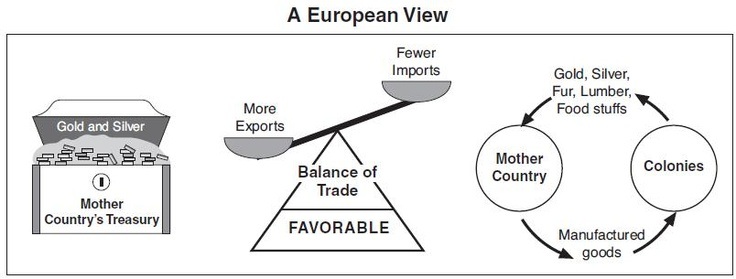
What is mercantilism?
A system where a mother countries gains money and power from natural resources that come from its colonies.
where colonies trade gold and silver with each other.
Wars that start over money.
Plantation colonies trading slaves for money.
True or False:
New England was settled by Puritans seeking freedom from religious persecution in Europe
True
False
The Virginia House of Burgesses, now known as the General Assembly of Virginia was:
the first government building in the nation
the last capital of the confederacy
the first elected assembly in the New World
The Virginia House of Burgesses, now known as the General Assembly of Virginia was:
the first government building in the nation
the last capital of the confederacy
the first elected assembly in the New World
What were the two main jobs in the New England region?
Farming and hunting
Trading and clothes making
rug weaving and basket weaving
Fishing and Ship Building
The Middle Colonies were ethnically and religiously diverse
True
False
The religion that was founded by William Penn was knows as __________.
Protestant
Baptist
Catholic
Quaker

What colony did William Penn help found?
New Jersey
New York
Delaware
Pennsylvania
Relaxed enforcement on trade laws imposed on colonies
Burgesses
Joint Stock Company
Charter
Salutary Neglect
What was salutary neglect?
Britain was strictly controlling the colonies
Britain left the colonies to govern themselves
Britain sent an army to the colonies
Britain sold the colonies to France
The trade pattern between the colonies, Africa, and Europe was called what?
Middle Passage
Navigation Acts
Triangular Trade
Columbian Exchange
Ministers of The Great Awakening preached ___________
God was kind and forgiving
people were not equal
colonists should not be independent
colonists could save themselves
How did the Great Awakening change America?
It brought people from all over the colonies together for the first time
It led to people denying God and leading secular lives
It spread abolitionism throughout the land and led to the end of slavery
It brought French rule to America
The Great Awakening was a __________ movement.
political
scientific
religious
artistic
When slaves were loaded onto boats to be taken and sold, this part of the triangular trade route was called what?
the American Passage
the Middle Passage
the Lower Passage
the African Passage

How were the conditions of the slave boats during the Middle Passage?
The lodgings were clean and sanitary for the slaves
The slaves were well fed and clothed
The conditions were dirty and unsanitary for the slaves
All of the above
In 1619, only __________ were considered citizens and could elect burgesses.
men and women
adult white men
male slaves
First Americans
Which statement describes the Gullah language?
It was the language spoken by the slaves when they lived in Africa.
It was the language spoken by Native American tribes in SC.
It was a mixture of many different languages brought to America by African slaves.
It was a combination of English and Spanish and was spoken by plantation owners.
The 1763 Treaty of Paris concluded a conflict between which two colonial powers?
England and Spain
France and England
Spain and Portugal
Portugal and France
What was one cause of the French and Indian War?
British attacks on French merchant ships
British expansion into the Ohio River Valley
American Indian attacks on French colonies
a French naval blockade of the port of Savannah
The end of the French and Indian War contributed to the beginning of the American Revolution in several ways. Which of the following was NOT one of those ways?
Colonial soldiers resented being treated differently from and paid less than British soldiers.
The end of the French threat in North America caused the colonies to rely less on Britain.
Fighting against a common enemy gave the colonists a sense of unity and a distinct identity.
The fur trade between the French and the colonies ended and caused economic hardships.

What event accounts for the decrease in French territory illustrated by these maps?
the American Revolution
the French and Indian War
the French Revolution
the Napoleonic Wars
What was a result of the French and Indian War that eventually led to the American Revolution?
Britain placed its colonies under strict control and began taxing them to help pay for the war.
Colonists were not offered aid during the war but were still expected to serve British interests.
The loss of colonial territory to the French made colonists lose faith in the British government.
Britain expected colonists to fight the war at their own expense and offered no reimbursement.
After the French and Indian War, the British issued the Proclamation of 1763 and the Stamp Act. These two measures were similar in that each contributed to which of the following?
political stability and economic growth in the colonies
increased reliance on slave labor in the British colonies
discontent in the colonies and growing support for revolution
improved relations between colonists and native populations
Why did many colonists object to the Proclamation of 1763?
It overturned many laws passed by colonial governments and severely limited their power.
It outlawed settlement in the western regions of many colonies, which limited their ability to expand.
It required colonists to provide housing and food for British soldiers stationed in the colonies.
It imposed taxes on everyday items such as tea and paper, which hurt the colonial economy.
The Daughters of Liberty were focused on
helping colonists boycott British goods.
defending the colonies from the French.
improving relations with American Indians.
making weapons in preparation for revolution.
Which of the following BEST explains who the Daughters of Liberty were and the role they played in the American Revolution?
They were wives of American soldiers who followed their husbands onto the battlefield.
They were women who remained loyal to the British throughout the American Revolution.
They were women who boycotted British goods, instead producing the goods they needed at home.
They were wives of American soldiers who took on the jobs of their husbands while they were serving in the Colonial Army.

Which of the following would make the BEST title for the outline above?
Colonial Reactions to British Policies
British Response to Colonial Resistance
American Response to the French Revolution
State-by-State Reactions to the Proposed Constitution
Why did American colonists resent British taxes?
American colonists were unhappy that the high taxes were keeping the nobility in luxury.
Unlike American colonists, people who lived in Great Britain did not have to pay any duties .
Americans did not elect representatives to Parliament as people who lived in Great Britain did.
Great Britain did not offer the American colonists any protection from the French and the Indians.
Which of the following statements about the Intolerable Acts is correct?
They were acts passed by British Parliament forcing colonists to give the government a portion of their salary.
They were what the colonists called the laws passed by the House of Burgesses forcing them to pay a tax on most paper products.
They were what the colonists called the strict laws passed by British Parliament in response to the Boston Tea Party.
D
They were the first acts passed by the House of Burgesses that forced the colonists to enlist in military service.
Why was Thomas Paine's Common Sense so influential in the colonies?
He presented his arguments in language most colonists could understand.
He was a well respected military leader with extensive political experience.
He was a member of the British aristocracy who chose to live in the colonies.
He resigned his seat in the House of Lords to protest British colonial policies.
What was the goal of Thomas Paine's Common Sense?
to convince colonists to remain loyal to Great Britain
to persuade colonists to approve the US Constitution
to convince the poor that a market economy would benefit them
to persuade colonists to support revolution against Great Britain
Authored the Declaration of Independence
Thomas Anderson
Thomas Paine
Thomas Jefferson
Benjamin Franklin
Ideas on Natural Rights were used in the Declaration of Independence
Thomas Jefferson
John Locke
Montesquieu
Thomas Hobbes
Ideas on Government were used in the Declaration of Independence
Montesquieu
John Locke
Thomas Paine
Thomas Hobbes
How many parts does the Declaration of Independence have
6
7
5
4
The continental Army faced a harsh, deadly winter while stationed at
Death Valley
Valley Forge
Trenton
Yorktown
Marquise de Lafeyette and Baron von Streubon served the United States (as French officers) in what capacity
Offered advice
Trained American soldiers
Brought food and drinks
Brought medicine
The battle of Trenton was a surprise attack on Hessians on which holiday
Christmas
Thanksgiving
Labor Day
Hanukkah
Who was the British general that led 7500 troops into the tiny town of Yorktown
Cornwallis
Washington
Franklin
Lafeyette
Which battle is seen as the turning point of the American Revolution
Yorktown
Trenton
Saratoga
Lexington
Without the help of _________________, the Americans would have lost the war
British
Spanish
French
Italians
The Diplomacy of these two Americans helped persuade the French to become our allies
Benjamin Franklin and John Adams
George Washington and John Locke
Benjamin Franklin and Thomas Hobbes
John Locke and Thomas Paine
Which strong feature of the Articles of Confederation created a method for territories to become states?
SSUSH5a
The ability to sign peace treaties
Shays' Rebellion
Northwest Ordinance
60,000 Ordinance
In the Articles of Confederation, where was most of the government power placed?
SSUSH5b
The States
The National Government
The Continental Congress
The Legislative Branch
The Articles of Confederation was successful in managing new lands with laws such as (there are multiple correct answers)
SSUSH5a
Northwest Ordinance of 1787
Land Ordinance of 1785
Proclamation Line of 1763
Western lands Ordinance
What was the significance of the Land Ordinance of 1785?
It set up a system where settlers could
purchase farmland in the undeveloped
Northwest
It set up a system where settlers could
purchase farmland in the undeveloped
South
It set up a system where settlers could
purchase farmland in the undeveloped
West
It set up a system where settlers could
purchase farmland in the undeveloped
West
Which statement best describes governmental power under the Articles of Confederation?
The power of the states greatly exceeded
the power of the central government
Power was shared equally by the central
government and the states
A strong chief executive headed a unified
central government
A balance of power existed among the
three branches of the central government
The governing body of a nation, state, or community.
Government
President
Executive
Legislative
1st Constitution of the U.S. 1781-1788 (weaknesses-no executive, no judicial, no power to tax, no power to regulate trade).
U.S. Constitution
Bill of Rights
Articles of Confederation
Declaration of Independence

Which is a weakness of the Articles of Confederation?
SSUSH5b
Congress couldn't collect taxes
Weak central government
Provided for no common currency
All of the these
The uprising of Massachusetts farmers who did not want to lose their farms to pay for heavy state taxes after the American Revolution was known as
SSUSH5b
Shays Rebellion
The Boston Tea Party
The Civil Rights Movement
The Constitutional Convention
Ultimately, the weaknesses of the Articles of Confederation lead to the adoption of:
SSUSH5c
The Treaty of Paris
The Affordable Care Act
The U.S. Constitution
The Declaration of Independence
Which factor caused people to reexamine the Article of Confederation after Shays´ Rebellion?
The Articles prohibited approval of the Northwest Ordinance of 1787.
The Articles restrained decision making during the American Revolution.
The Articles caused most people to distrust a strong central government.
The Articles limited the ability of the central government to respond to that crisis.
Which three rights are guaranteed by the Bill of Rights?
SSUSH5e
freedom of speech, right to work, right to petition the government.
right to bear arms, right to a speedy trial, right to an education
freedom of speech, right to bear arms, right to a speedy trial
right to vote, right to work, right to a speedy trial
The Three-Fifths Compromise help settle the debate over whether to count slaves in the population or not.
SSUSH5c
True
False
The Virginia Plan proposed
a bicameral legislature; representation based on population
a unicameral legislature; equal representation
a bicameral legislature; equal representation
a unicameral legislature; representation based on population
How was the divisive and controversial issue of slavery settled at the Constitutional Convention?
Great Compromise
Bill of Rights
3/5 Compromise
13th Amendment
Which statement best reflects the views of an Anti-Federalist?
SSUSH5d
“I demand a new constitution”
“I support ratification”
“I fear a strong government”
a. “I oppose a bill of rights”
Anti-federalists wanted a Bill of Rights added to the constitution to help protect...
SSUSH5d and SSUSH5e
Individual Rights
State Rights
Slavery
The Articles of Confederation
The Federalists papers were written to persuade people to support the new constitution.
SSUSH5d
True
False
Patrick Henry opposed the Constitution because...?
SSUSH5d
The states would give too much power to the Federal government
The Federal government would give too much power to the states
He was the main author of the Articles of Confederation
He wanted the U.S. to be part of England again
A major principle of US foreign policy know as _______ first espoused in the famous farewell address by George Washington
Emancipation
Belligerence
Interposition
Neutrality
The Louisiana Purchase of 1803
was a major cause of the Spanish-American War
resulted in increase conflict between the US and France
resulted in the removal of all British military forces from North America
Almost doubled the area of the US and gave it control of the Mississippi River
Which of these was a precedent set by the first President of the United States, George Washington
the popular election of the President
the tradition of only serving two terms
naming the nine Justices to the Supreme Court
addressing the Chief Executive as a "Your Highness"

The cartoon refers to the Monroe Doctrine issued in 1823. The Monroe Doctrine was intended to prevent European expansion in
China
North Africa
South America
Southeast Asia
During George Washington's presidency, which was the major reason for conflict between Thomas Jefferson and Alexander Hamilton?
Washington's decision not to get involved in the revolution in France
the distribution of power between the judicial branch and the legislative branch
Hamilton's objection to Jefferson's strict interpretation of the Constitution
the US government's decision to remain neutral in the war between France and Britain
The War of 1812 resulted in
Great Britain gaining control of Canada
the United States gaining control of Spain
the United States maintaining its previous strength
Great Britain agreeing to end the practice of impressment
The main idea behind the settling of western lands by Americans in the early-1800s was known as
Women Suffrage
Manifest Destiny
the Industrial Age
the Abolition Movement
"It is emphatically the duty if the Judicial Department to say what the law is. Those who apply the rule to particular cases must, of necessity expound and interpret the rule. If two laws conflict with each other, the Court must decide on the operation if each
-John Marshall, Chief Justice of the Supreme Court
making laws
judicial review
veto any laws of Congress
issuing writs of mandamus in all cases
The Election of 1800 was significant because it
played a major role in America's acquisition of the Louisiana Territory
was the first peaceful transition of political power between opposing parties in US history
gave the Federalist control of the executive and legislative branches
marked the beginning of the era known as "Jacksonian Democracy"
Why was Monroe's presidency known as the "Era of Good Feelings"?
Slavery had begun to decrease which led to more national unity
There was more national unity due to the end of the War of 1812
The Federalist party came to a compromise with the Democratic-Republican party
The Homestead Act was passed which led to widespread expansion and land ownership
When studying the Constitution and early United States History, the Alien and Sedition Acts of 1798 can be viewed as a violation of which of these
Checks and Balances
Popular Sovereignty
Fifth Amendment
First Amendment
Which aspect of governance is at the heart of the Monroe Doctrine ?
Federalism
Foreign Policy
Domestic Policy
Monetary Policy
THe Nullification Crisis concerned...
Whether the President had the power to assasinate people
Whether States could cancel out federal laws they didnt like
Alliances with foreign powers
Slavery
Which if these were not a part of Henry Clay's "American System"
Ending slavery
Government investment in infrastructure
National bank and national currency
Tariffs to protect American products
Nat Turner led a...
Movement for public schools
Political party
Slave rebellion that killed 60 people
Movement to allow Native Americans to vote
How did Andrew Jackson appoint members to his administration?
Spoils system
professional knowledge of its members
members of the federalist party and the whigs
those who supported slavery only
The major social reform movement for the 1840's and 1850's was known as .......
1st Great Awakening
2nd Great Awakening
War of 1812
Manifest Destiny
Horace Mann is associated with which reform movement?
Education reform
Prison reform
Immigration reform
Abolition
During the age of Jackson the term "Jacksonian Democracy" emphasized
decreasing the power of the executive branch
preserving tribal land
increasing voting rights in the United States
states rights
The Seneca Falls Convention of 1848 drew national attention to
Women's rights
Abolition
prohibition
Immigration
Which of these was the largest and most constant issue facing the United States during the era of "Manifest Destiny?"
whether labor unions would be allowed to form
whether states would allow women the right to vote
whether Indians would be relocated to North Carolina
whether slavery would spread across the United States
Sectionalism can be defined as
Differences that arise between different regions of a country economically, culturally, or politically, for example
Migration patterns that occur as people leave one part of a country for another part
One part of a country choosing to break ties with the rest of the nation in order to be independent
A regions decision to be economically self-sufficient
According to the idea of popular sovereignty, which of the following would decide whether slavery would be allowed in a territory?
the Senate
the President
the residents of the territory
the House of Representative
"54-40 or fight!" was a campaign slogan of James K Polk and meant that
The US would go to war with Mexico for California if necessary.
The US would go to war with Britain over Oregon if necessary.
The US would go to war with Russia over Alaska if necessary.
The US would take Hawaii by force.
What was a result of passage of the Kansas-Nebraska Act?
several years of peace on the issue of slavery
the end of the political career of Stephen Douglas
popular sovereignty for Kansas and Nebraska
a reaffirmation of the Missouri Compromise
When the admission of new states threatened the balance of free and slave states in the Union, which Kentucky Senator drew up the "Missouri Compromise" in 1820?
Henry Clay
Andrew Jackson
John C. Calhoun
William H. Harrison
Which statement is TRUE regarding the consequences of the Treaty of Guadalupe Hidalgo?
It ended the Mexican War of Independence.
It created a transcontinental railroad through Texas.
It established US control over New Mexico, Nevada, and California. (Mexican Cession)
It solidified Mexican authority over Texas and the surrounding region.
What was the main issue involving John Brown's 1859 raid in Harper's Ferry, Virginia?
Suffrage
Slavery
Money
Secession
Abolitionists often opposed annexation of western territories because they
feared the addition of antislavery states.
thought the land was too far away.
feared the extension of slavery
wanted to protect the Indians.
Which BEST describes a result of the Supreme Court's decision in the Dred Scott case?
A slave had the right to sue for freedom in a federal court.
A slave was only a citizen after he or she purchased freedom.
A slave was not a citizen but rather the property of an owner.
A slave who lived on free soil for any length of time was free.
What did the Missouri Compromise, the Compromise of 1850, and "Bleeding Kansas" have in common?
They were all vetoed by President Abraham Lincoln.
They helped Abraham Lincoln win the Election of 1860.
They all dealt with the expansion of slavery into the western territories.
They were permanent solutions to the conflict between the North and South.
Which BEST describes a result of the Supreme Court's decision in the Dred Scott case?
A slave had the right to sue for freedom in a federal court.
A slave was only a citizen after he or she purchased freedom.
A slave was not a citizen but rather the property of an owner.
A slave who lived on free soil for any length of time was free.
What was a major reason the North defeated the South in the Civil War?
The North was more industrialized and had better use of railroads and telegraph
The South actually won the war because of its ability to fight and superior infrastructure
The North had better generals and soldiers but lacked technological advancements
The South actually had more people for the war and technologically advanced weapons
Which of the following was NOT an action taken by President Abraham Lincoln during the Civil War?
He signed a law freeing slaves in the Confederate states.
He authorized the suspension of habeas corpus during the conflict.
He ordered that any escaped slaves captured in the North be conscripted into the Union Army.
He instituted a draft to supply the Union with enough soldiers to win the war against Confederacy.
Which statement BEST illustrates President Abraham Lincoln's hopes and expectations following the issuing of the Emancipation Proclamation?
Lincoln was hopeful that Southern states would renounce their loyalty to the Confederacy and believed that they would quickly rejoin the Union.
Lincoln was hopeful that slaves in the South would be freed and believed that many freed slaves would attempt to escape captivity and flee to the North
Lincoln was hopeful that Southern states would renounce their loyalty to the Confederacy and believed that many Southerners would rebel against Confederate leaders.
Lincoln was hopeful that slaves in the South would be freed and believed that freed slaves in the North would join the Union Army
After the Civil War, what was the purpose of the 13th ammendment?
To make it illegal to leave or secede from the union ever again
To make slavery illegal, except for forms of Criminal punishemen
To allow Abraham Lincoln to serve a third and fourth term as president during reconstruction
To promote Women's Suffrage, Temperance, Public schools, and Manifest Destiny
Why was the Battle of Appomattox Court House an important event in the Civil War?
General Lee’s surrender showed that the Southern states had lost the Civil War.
General Lee’s defeat by General Meade ended the South’s invasion of Northern territory
General Grant achieved control of the Mississippi River by capturing a major fortress.
General Grant defeated the Southern army that was defending the Confederate capital.
Which BEST explains why Vicksburg was important in the Civil War?
It was located on the Mississippi River, a crucial supply route
It was on the border between the North and the South.
It was the site of the war's deadliest battle
. It was burned to the ground by General Sherman.
The agency with the GREATEST impact on helping former slaves adjust to their new lives after the Civil War was: (SSUSH10b)
The State Department
The Emancipation Proclamation
The Bureau of Family and Human Services
The Freedman’s Bureau
Which of the following BEST explains the growing popularity of the Ku Klux Klan throughout the South in the 1860s and 1870s?
The organization capitalized on Southerners' fear of the changes that occurred after the Civil Wa
The organization established the first public high schools and universities in many Southern states.
. The organization built many large factories and helped the South became a major manufacturing center.
The organization was the dominant political party in the South and helped influence federal policy
Which of the following statements about the Compromise of 1877 is NOT correct?
It brought an end to the Reconstruction Era.
It removed federal troops from the former Confederate states.
It provided the legal basis for racial segregation.
It introduced laws that helped the South rebuild economically.
How was the disputed presidential election of 1876 resolved?
through the Compromise of 1877, which awarded Rutherford B. Hayes the presidency with the agreement that Hayes would end military occupation of the South
through the Compromise of 1877, which awarded Samuel Tilden the presidency with the agreement that Tilden would end military occupation of the South
through the Compromise of 1877, which awarded Rutherford B. Hayes the presidency with the understanding that he would support the Democratic state governments in the South
through the Compromise of 1877, which awarded Samuel Tilden the presidency with the understanding that he would support the Democratic state governments in the South
How did the growth of the railroad industry lead to the growth of stock markets in the United States?
A. The railroad industry led to the expansion of other industries such as steel and coal. These industries required large capital investments that could best be obtained through the stock market.
B. The railroad industry led to the rapid growth of cities on the nation's coasts. These coastal cities developed independent stock markets to raise capital in order to expand their infrastructure.
C. The railroad industry was decentralized and controlled by many small investors. These investors were not independently wealthy and needed to raise capital through the sale of stock in order to further expand.
D. The railroad industry was decimated by the Civil War and was on the verge of collapse. The federal government organized stock markets in order to help railroads raise capital so that the nation could start to rebuild.
What led to the rapid growth of the railroad industry in the United States in the second half of the nineteenth century?
A. the development of the Bessemer steel-making process
B. the discovery of coal deposits in West Virginia
C. the development of the creosote wood-treatment process
D. the discovery of oil in the American Southwest
Which of the following BEST describes the contribution of railroads to the economic development of the United States?
A. lowered costs of shipping in the United States
B. allowed more immigrants to enter the country
C. enabled trade to most parts of the country
D. provided good investment opportunities
Which of the following BEST describes what occurred during the Industrial Revolution that helped people migrating west open and operate successful businesses?
A. the development of large cities in the region, which allowed businesses to pay workers very low wages because of the high level of competition for jobs at their factories
B. the establishment of a trade agreement between the government and Mexico, which allowed Mexico to purchase products from these new businesses for low prices
C. the establishment of peace treaties between the government and American Indian tribes, which prevented any conflict that could harm the new businesses
D. the development of railroads and canals, which could be used to ship products to Northern and Southern states, and to ship important farm
John D. Rockefeller and the Standard Oil Company achieved financial success by
A. promoting a diverse working environment by hiring large numbers of African Americans and women.
B. building factories outside of the United States to take advantage of less restrictive labor laws.
C. controlling all aspects of production, from the acquisition of raw materials to the sale of finished products.
D. attracting government investment by producing a good that was essential to the economy of the United States.
Which Scottish immigrant became a billionaire during the Second Industrial Revolution by introducing the Bessemer process to massproduce steel and vertically integrating the steel industry?
A. Andrew Carnegie
B. Cornelius Vanderbilt
C. Henry Clay Frick
D. John Jacob Astor
In the late nineteenth century, corporate mergers and the creation of holding trusts and companies led to which of the following?
A. increasingly diversified markets
B. the development of monopolies
C. more small businesses
D. less international trade
Thomas Edison created a commercially viable incandescent light bulb in 1879. How did this invention change the American workplace?
A. It forced workers to specialize in certain tasks.
B. It reduced efficiency in the workplace.
C. It allowed workers to work longer hours.
D. It led to the end of child labor laws.
Which is one difference between Angel Island and Ellis Island?
A. Immigrants from Europe generally passed through Angel Island while immigrants from Asia generally passed through Ellis Island.
B. Immigrants who had were unemployed passed through Ellis Island to gain entry to the United States, while immigrants who had secured jobs passed through Angel Island.
C. Immigrants from Europe generally passed through Ellis Island while immigrants from Asia generally passed through Angel Island.
D. Immigrants who had were unemployed passed through Angel Island to gain entry to the United States, while immigrants who had secured jobs passed through Ellis Island.
As the United States became increasingly industrialized in the early twentieth century, immigration to the country increased. Which of the following BEST explains why workers living in large urban cities resented these new immigrants?
A. The new immigrants lacked the skills necessary to work at the factories and instead resorted to crime in order to survive.
B. The new immigrants often started small businesses and charged high prices for goods that the urban workers needed.
C. The new immigrants tended to be much richer than those living in the cities and rarely needed to work to provide for their families.
D. The new immigrants were willing to work for lower wages so they were often given jobs instead of the other urban workers.
The purpose of the labor unions formed by workers in the United States in the late 1800s was to
A. convince consumers to buy manufactured goods
B. gain investors in order to start their own factories
C. improve working conditions and obtain higher wages
D. create more job opportunities for women and children

-
Number of Immigrants to the United States
1901- 500,000
1903- 800,000
1905- 1,000,000
1907- 1,200,000

-
In addition to the problems stated here, what other issue contributed to the problems faced by Native Americans on the Great Plains at the end of the 19th century?
The printing of sensational pictures and stories to rally support against Spain.
yellow journalism
social darwinism
anti-imperialism
annexation
U.S. helped this country gain its independence in order to build a canal
Panama
Guatemala
Colombia
Mexico
Which foreign policy stated America now had the right to "intervene in Latin American nations whenever those nations seemed unstable"?
Monroe Doctrine
Roosevelt Corollary
Dollar Diplomacy
None of the above

Extension of the Monroe Doctrine in 1904 in which the U.S. claimed the right to protect its economic interests by means of military intervention in the affairs of Western Hemisphere nations
Dollar Diplomacy
Open Door Policy
Roosevelt Corollary
Moral Diplomacy

An artificial waterway built to provide a shortcut between the Atlantic and Pacific Oceans, opened in in 1914
Roosevelt Corollary
Panama Canal
Yellow Journalism
Open Door Policy
The major objective of United States foreign policy toward Latin America during the period from 1900 to 1920 was
improve the standard of living
of the people in Latin America
support land reform throughout
the Western Hemisphere
protect the human rights of
native peoples in Latin America
serve as protector and police
officer in the Western Hemisphere
At the onset of WWI the US practiced a policy of
divide and conquer
neutrality
isolation
colonialism
What event prompted the US entry into WWI?
The sinking of the US Maine
The sinking of RMS Lusitania and loss of American lives
The blitzkrieg of Britain
the Treaty of Tordesille
What war tactic was Germany using which threatened the safe passage of ships in the Atlantic ?
barracades
embargos
unrestricted submarine warfare
the use of hydrogen bombs
Once at war, how did society change in the US?
Factories converted to making war equipment and supplies.
Workers were needed to fill the factories.
There was a great movement of people to the North.
all of the above
Worried about attempts stop the US involvement in WWI by immigrants living in America, the US passed which law?
The Espionage and Sedition Acts
the Chinese Exclusion Act
The Zimmerman Act
The Fourteen Points
What solution did Woodrow Wilson propose following WWI to unite the world?
The United Nations
NATO
The League of Nations
Tin Pan Alley
What was Wilson’s 14th Point?
Restrictions on Russia’s boundaries
Unifying independent Poland
Readdressing colonization
creating a world peace keeping body
While the US did not pass Wilson’s 14 Points, what organization was eventually created to keep world peace?
NATO
The Warsaw Pact
The European Union
The United Nations
Langston Hughes wrote I, too. It is a poem about being forgotten as an African American. He was part of a cultural movement known as
The Jazz Revival
The rise of Broadway
the Harlem Renaissance
The golden Age of Movies

