
Font size
 Worksheets
CHAPTER 9
Total questions: 40
Worksheet time: 21mins


Which of the following describes the QRS wave?
Ventricular depolarization
ventricular contraction
ventricular repolarization
none of these
Which of the following describes the T wave?
atrial contraction
ventricular contraction
ventricular repolarization
none of these
Which of the following describes the P wave?
atrial contraction
ventricular contraction
ventricular repolarization
none of these
Which of these physical factors impacts the heart rate?
Age
Body Temperature
Gender
Exercise
Factor that modifies heart rate: Epinephrine and thyroxine speed the HR.
(Excess/lack of Ca, Na, and K ions also modify heart activity)
Neural (ANS) controls
Hormones and ions
Physical Factors
Factor that modifies heart rate: Sympathetic nervous system speeds up HR & parasympathetic nervous system slows HR
Neural (ANS) controls
Hormones and ions
Physical Factors
Which order of events is correct for the cardiac cycle?
1. Atrial systole
2. Atrial diastole (filling)
3. Isovolumetric relaxation
4. Ventricular Systole (ejection)
5. Isovolumetric contraction
1. Atrial diastole (filling)
2. Atrial systole
3. Isovolumetric relaxation
4. Ventricular Systole (ejection)
5. Isovolumetric contraction
1. Atrial diastole (filling)
2. Atrial systole
3. Isovolumetric contraction
4. Ventricular Systole (ejection)
5. Isovolumetric relaxation
Systole = __________
Diastole = ___________
contraction;
relaxation
relaxation;
contraction
Slow heart rate (under 60 bpm)
Tachycardia
Bradycardia
Rapid heart rate (over 100 bpm)
Tachycardia
Bradycardia
________ spread the impulse through the ventricle wall muscles of the heart after the signal is sent through the AV bundle.
Sinoatrial (SA) node
Atrioventricular (AV) node
Purkinje fibers
The nodal system is
the controlling system for voluntary cardiac muscle constriction.
The unifying control system for the heart beats
The control system for vasodilation of blood vessels
Which of the following affect blood flow?
blood type, blood pressure, body size
blood pressure, resistance of vessel walls, velocity due to constriction and dilation
resistance, lumen size, blood type, tunica media thickness
Which of the following correlate with the sounds of the cardiac cycle heard with a stethoscope?
atrial contraction
the opening of valves
the closing of valves
electrical impulse conduction
When blood pressure is taken, the number on the top is the pressure during systole. This correlates with which of the following?
ventricular contraction
ventricular relaxation
atrial contraction
atrial relaxation
Which of the following can INCREASE your heart rate?
Yoga
Sleep
Anxiety
Meditation
What does an ECG or EKG record?
the electrical changes in the myocardium
the chemical changes in the medulla oblongata
the amount of blood filling the ventricles
the amount of blood filling the atria
Which of the following is referred to the pacemaker of the heart?
Sinoatrial (SA) node
Atrioventricular (AV) node
Atrioventricular (AV) bundle
Purkinje fibers
Why do cardiac muscles have a longer, slower sustained contraction compared to skeletal muscles?
To prevent the heart from beating too slowly
To prevent the heart from beating too quickly
To prevent the heart from fatiguing quickly
Which part of the intrinsic conduction system connects the atria to the ventricles, and when damaged can cause various degrees of heart block?
atrioventricular (AV) node
bundles of His
Purkinje fibers
sinoatrial (SA) node
What is the function of valves in the heart?
promote contraction of ventricles
prevent backflow of blood through the heart
eliminate pressure variances within the heart
allow oxygen to diffuse into the heart
When blood is traveling toward the heart, in which of the following would you find it?
arteries
capillaries
arterioles
veins
When blood is traveling away from the heart, in which of the following would you find it?
arteries
capillaries
venules
veins
What ion is responsible for pacemaker potential?
Sodium
Lithium
Magnesium
Potassium

Which of the following shows the correct order of the cardiac conduction system (as seen in graph)?
1. Repolarization, 2. pacemaker potential, 3. depolarization
1. Pacemaker potential, 2. depolarization, 3. repolarization
1. Pacemaker potential, 2. repolarization, 3. depolarization
1. Depolarization, 2. repolarization, 3. pacemaker potential

EKG interpretation:
Normal Sinus Rhythm
Sinus Bradycardia
Sinus Tachycardia
Sinus Arrhythmia

EKG interpretation:
Normal Sinus Rhythm
Sinus Bradycardia
Sinus Tachycardia
Sinus Arrhythmia

Which figure(s) is known as a Mobitz type II (2nd Degree type 2) heart block?
Figure 4
Figure 3
Figure 2
Figure 1 & 2

Figure 4 is known as what type of rhythm?
2nd Degree Type 2 (Mobitz II)
1st Degree AV Block
Wenckeback
3rd Degree Heart Block
ECG stand for
Electrocardiograph
Electrocardiogram
Electrocardiopraphy
Electronicardiogram

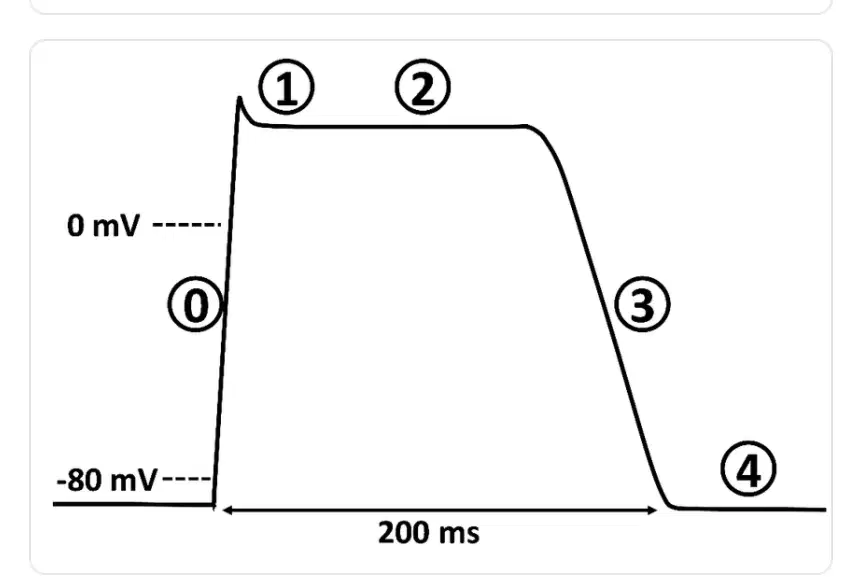
What’s the average resting potential for Cardiac Action Potential?
(a)
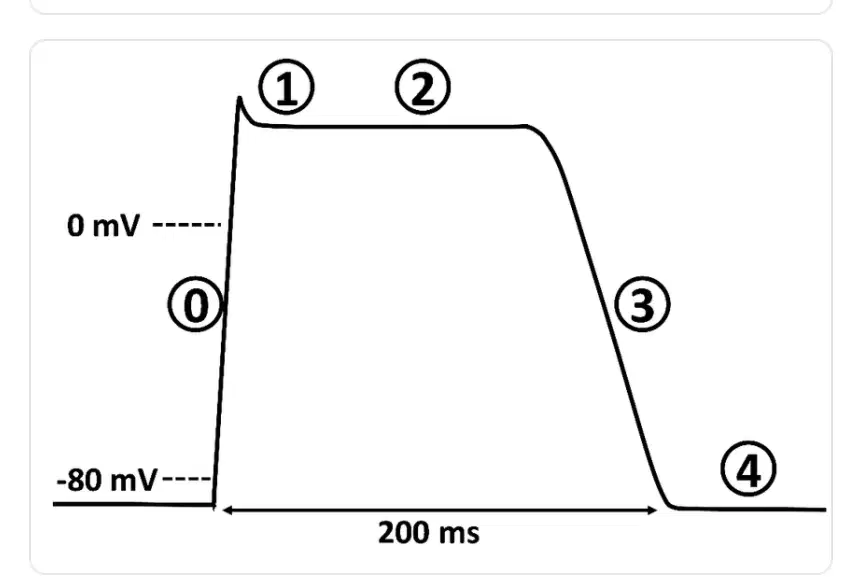
What’s the threshold for sodium in a cardiac action potential ?
-50 mb
-40mv
-60mv
-70mv
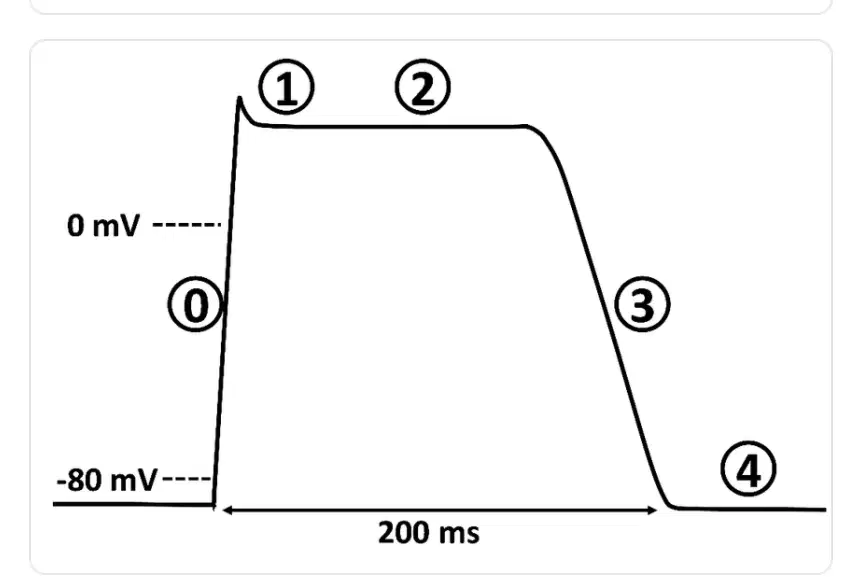
What number is 0 in this image ?
Sodium
Potassium
Calcium

