
 Worksheets
Mode of Action of Vamana Karma
Total questions: 41
Worksheet time: 21mins
What are the properties of Vāmaka Dravya in Vamana Karma?
Ushna, Tikshna, Sūkshma, Vyavāyi, Vikāsi
Sheeta, Manda, Sthula, Sthira, Guru
Snigdha, Mridu, Sara, Sthira, Laghu
Ruksha, Tikta, Sthira, Guru, Sthula
Which sites are affected by Vāmaka Dravya in Vamana Karma?
Hridaya, Āmāśaya
Yakrit, Pleeha
Rakta, Twak
Shira, Vasti
Through which channels do Vāmaka Dravya move in Vamana Karma?
Dhamani
Sira
Nadi
Rakta
What is the stimulant for the movement of Vāmaka Dravya in Vamana Karma?
Udāna Vāyu
Prāna Vāyu
Samāna Vāyu
Apāna Vāyu
What is the constitution involved in the action of Vāmaka Dravya in Vamana Karma?
Agni + Vāyu
Jala + Prithvi
Vāyu + Akasha
Agni + Jala
What is the Prabhāva (effect) of Vāmaka Dravya in Vamana Karma?
Ūrdhva bhāgahara
Adho bhāgahara
Sāmānya bhāgahara
Virechana bhāgahara
According to the passage, what property of Vāmaka Dravya helps to liquefy the complexes of vitiated Dosha?
Ushna property
Snigdha property
Ruksha property
Sheeta property
Which property of Vāmaka Dravya helps to fragment complexes into smaller molecules in Vamana Karma?
Tikshna property
Snigdha property
Guru property
Manda property

In the mechanism of Vamana Karma, which yoga initiates the process?
Vamana Kashiya Yoga
Virechana Kashiya Yoga
Basti Kashiya Yoga
Nasya Kashiya Yoga

Which qualities are associated with Vyavayi, Vikashi, Ushna, Tikshna & Sukshma Virya in the mechanism of Vamana Karma?
Vyavayi, Vikashi, Ushna, Tikshna & Sukshma Virya are qualities that facilitate the process in Vamana Karma.
Vyavayi, Vikashi, Ushna, Tikshna & Sukshma Virya are qualities that hinder the process in Vamana Karma.
Vyavayi, Vikashi, Ushna, Tikshna & Sukshma Virya are unrelated to the mechanism of Vamana Karma.
Vyavayi, Vikashi, Ushna, Tikshna & Sukshma Virya are only associated with Virechana Karma.

In the mechanism of Vamana Karma, after entering the Hridaya, what is the next step?
Through Dhamani, circulates all over the body
Exits through the mouth immediately
Absorbed by the liver
Stored in the stomach
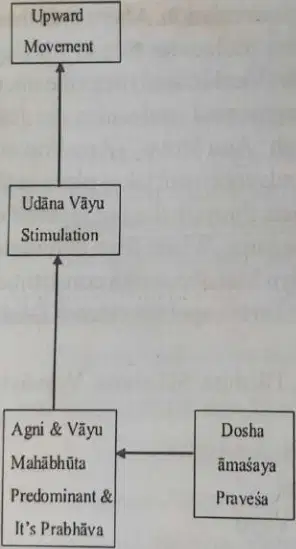
What is the role of Udana Vayu in the mechanism of Vamana Karma?
Stimulation
Absorption
Digestion
Elimination
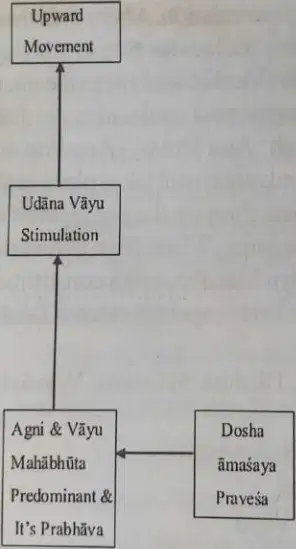
Which factor is predominant in the stimulation of Udana Vayu in Vamana Karma?
Agni & Vayu Mahabhuta Predominant & It's Prabhava
Jala Mahabhuta Predominant & It's Prabhava
Prithvi Mahabhuta Predominant & It's Prabhava
Akasha Mahabhuta Predominant & It's Prabhava
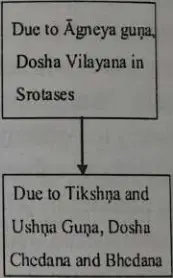
What happens due to Tikshna and Ushna Guna in the mechanism of Vamana Karma?
Dosha Chedana and Bhedana
Dosha Sthana Samshraya
Dosha Sthana Parivartana
Dosha Sthana Sthapana
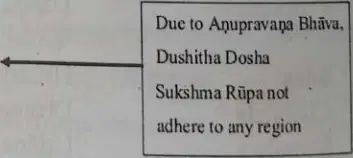
In the mechanism of Vamana Karma, what is the result of Aupurvapa Bhava?
Dushitha Dosha Sukshma Rupa not adhere to any region
Dosha gets completely eliminated from the body
Agni becomes extremely weak
Patient experiences severe dehydration
According to the modern view described in the passage, what is the main purpose of Vamana Karma?
To empty the content of the stomach only
To manage systemic diseases caused by Kapha
To treat diseases caused by Pitta
To increase stomach acidity
Fill in the blank: The active principle of Vamana drug taken orally is absorbed from the stomach into the ______ system, wherefrom it is circulated to all over the body.
circulatory
digestive
respiratory
nervous
The role of mild inflammation in the process of Vamana Karma as described in the passage is:
To facilitate the expulsion of toxins from the body
To reduce the effectiveness of the therapy
To cause severe discomfort to the patient
To prevent the absorption of nutrients
The softening (Vishyanadana) action of the drugs may be understood from the example of fatty degeneration.
True
False
Fill in the blank: The Vamana drugs are given in ______ stomach when the pyloric end of stomach remains closed and all the local activities of the Vamana drugs are confined.
full
empty
distended
contracted
What is the main purpose of Vamana Karma (Emesis Therapy) as described in the text?
To increase absorption of nutrients
To facilitate the excretion of toxins and metabolites from the stomach
To reduce inflammation in the stomach
To treat diarrhea
According to the text, what causes the absorption of active principles of the drug during Vamana Karma?
Increased permeability of the capillaries of the stomach
Decreased inflammation
Reduced excretion of toxins
Lowered stomach acidity
Fill in the blank: Vomiting is the oral expulsion of upper gastrointestinal contents resulting from contractions of ______ and thoraco-abdominal wall musculature.
gut
lungs
heart
kidneys
What provides an especially strong stimulus for vomiting according to the modern view?
Excessive distention or irritation of the duodenum
Increased stomach acidity
Decreased cortisol secretion
Reduced absorption of nutrients
Secretions of cortisol are related to vomiting and minor stress because:
Cortisol is released in response to stress and can trigger vomiting.
Cortisol prevents vomiting during stress.
Cortisol has no effect on vomiting or stress.
Cortisol is only secreted during major stress, not minor stress.
During vomiting when one administers a large amount of decoction of Vamanapaga medicine and afterwards Vamanaka Yoga to cause irritation in the gastric mucosa again and again to produce vomiting, it stimulates a series of steps by the defense mechanism of the body to protect, further damage, through the means of inflammation as follows: (i) Release from the damaged tissues cells of chemical substances that activate the inflammatory process - chemicals such as ________, bradykinin, prostaglandins, proteolytic enzymes and leukotrines.
histamine
serotonin
dopamine
acetylcholine
During vomiting when one administers a large amount of decoction of Vamanapaga medicine and afterwards Vamanaka Yoga to cause irritation in the gastric mucosa again and again to produce vomiting, it stimulates a series of steps by the defense mechanism of the body to protect, further damage, through the means of inflammation as follows: (ii) There will be an ________ blood flow in that area.
increased
decreased
unchanged
restricted
During vomiting when one administers a large amount of decoction of Vamanapaga medicine and afterwards Vamanaka Yoga to cause irritation in the gastric mucosa again and again to produce vomiting, it stimulates a series of steps by the defense mechanism of the body to protect, further damage, through the means of inflammation as follows: (iii) Leakage of large quantities of pure plasma out of the capillaries into the ________ areas.
damaged
healthy
muscular
neural
During vomiting when one administers a large amount of decoction of Vamanapaga medicine and afterwards Vamanaka Yoga to cause irritation in the gastric mucosa again and again to produce vomiting, it stimulates a series of steps by the defense mechanism of the body to protect, further damage, through the means of inflammation as follows: (iv) Infiltration of the area by ________.
leukocytes
erythrocytes
platelets
lymph
What is the immediate effect of cortisol secretion during inflammation?
Enhances the rate of healing
Blocks most of the factors that are promoting the inflammation
Mobilizes amino acids
Increases blood flow
What is the efferent nerve for the secretion of saliva during vomiting?
Vagus nerve
Corda tympani
Phrenic nerve
Glossopharyngeal nerve
Vomiting is generally preceded by a feeling of ________, and usually there is a rush of saliva to the mouth.
nausea
hunger
thirst
fatigue
The afferent impulses in vomiting may be discharged from the mucous membrane of the ________, pharynx, and root of the tongue.
soft palate
hard palate
nasal cavity
epiglottis
Vomiting can be produced by direct stimulation of the vomiting centers.
True
False
Which nerve carries impulses to the diaphragm during vomiting?
Vagus nerve
Phrenic nerve
Glossopharyngeal nerve
Intercostal nerve
Vomiting produced by the thought of something disagreeable is caused by the conduction of the excitement from the ________ to the vomiting center.
cerebrum
medulla oblongata
spinal cord
cerebellum
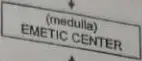
Which center in the brain is primarily responsible for coordinating the act of vomiting?
Cerebellum
Emetic Center
Solitary Tract Nucleus
Inner Ear
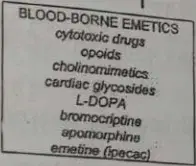
Refer to the diagram titled 'Mechanism of Vomiting'. Which of the following is NOT a blood-borne emetic listed in the diagram?
Cytotoxic drugs
Opioids
Bromocriptine
Bacteria
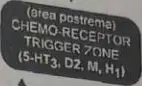
Refer to the diagram titled 'Mechanism of Vomiting'. The chemo-receptor trigger zone (CTZ) is located in which area?
Cerebellum
Area postrema
Inner ear
Stomach
During vomiting, the ________ relaxes to allow the expulsion of stomach contents.
LES (Lower Esophageal Sphincter)
Pyloric sphincter
Cardiac sphincter
Ileocecal valve
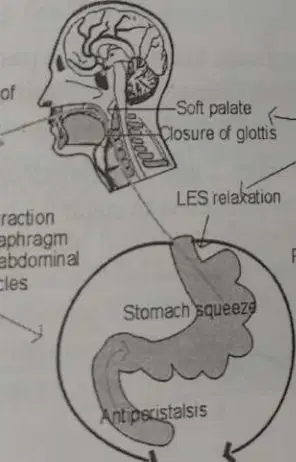
Refer to the diagram titled 'The Act of Vomiting'. Which of the following is a step in the cascade of vomiting?
Respiration increases
Closure of glottis
LES contraction
Stomach relaxation

