
 Worksheets
Honors Bio Protein Synthesis Assessment
Total questions: 10
Worksheet time: 15mins
Name
Class
Date
1.
A scientist wants to prevent a culture of live cells from producing a particular protein. Which of the following will the scientist most likely modify to prevent the production of the protein?
a)
The DNA in the nucleus
b)
The enzymes in the lysosomes
c)
The polysaccharide in the cytoplasm
d)
The phospholipids in the plasma membrane
2.

The diagram below shows a process that occurs in cells. This process is called...
a)
DNA replication
b)
Transcription
c)
Translation
d)
Mutation
3.
Specific DNA sequences called "promoters" provide binding site for the enzyme that synthesizes mRNA. These are involved directly in which process?
a)
DNA replication
b)
Transcription
c)
Translation
d)
None of the above
4.
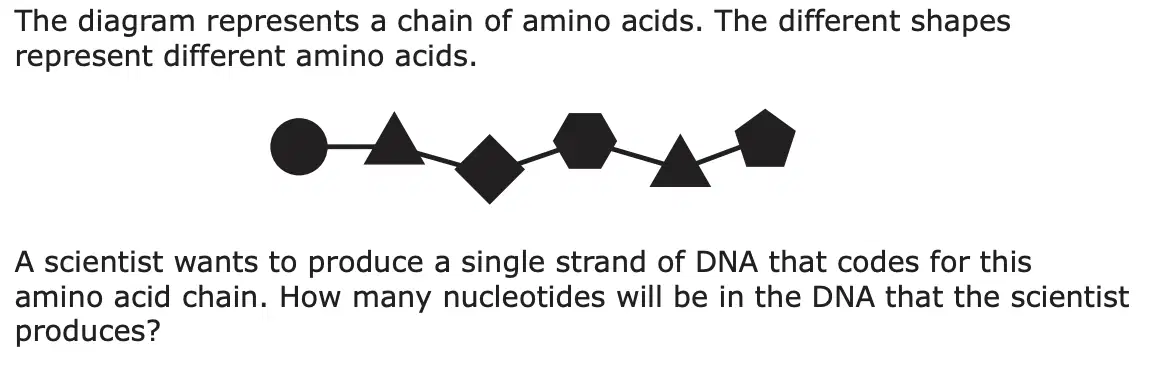
The diagram represents a chain of amino acids. The different shapes represent different amino acids. A scientist wants to produce a single strand of DNA that codes for this amino acid chain. How many nucleotides will be in the DNA that the scientist produces?
a)
5 nucleotides
b)
6 nucleotides
c)
12 nucleotides
d)
18 nucleotides
5.
Which of the following statements best describes how an mRNA sequence specifies the production of an amino acid chain?
a)
Each individual mRNA base codes for a single amino acid
b)
Each group of three mRNA bases codes for an enzyme that helps join amino acids together.
c)
Each group of three mRNA bases codes for a single amino acid.
d)
Each individual mRNA base codes for three amino acids.
6.
A scientist inserts the luciferase (means: light enzyme) gene into the DNA of the cells from another organism. If these cells produce light, the scientist knows that which of the following occurred?
a)
The luciferase gene mutated inside the cells.
b)
The luciferase gene was transcribed and translated accurately.
c)
The luciferase gene destroyed the original genes of the cells.
d)
The luciferase gene moved form the nucleus to the ER.
7.
Ribosomes are made of …
a)
mRNA
b)
protein
c)
rRNA
d)
tRNA
8.
Identify which applies to DNA ONLY. (3 options)
a)
Single Strand
b)
Double Strand
c)
Deoxyribose
d)
Ribose
e)
Thymine
9.
Identify which applies to RNA ONLY. (2 options)
a)
Single Strand
b)
Double Strand
c)
Deoxyribose
d)
Ribose
e)
Thymine
10.

Part A: Determine the DNA sequences from which this mRNA sequence was transcribed.
mRNA: AUG UCU GAU UGG UAC
a)
DNA: AUG UCU GAU UGG UAC
b)
DNA: TAC AGA CTA ACC ATG
c)
DNA: CAT AGA ATC CCA GTA
d)
DNA: UAC AGA CUA ACC AUG
100 %

